 👻 Mediumship and Spiritualism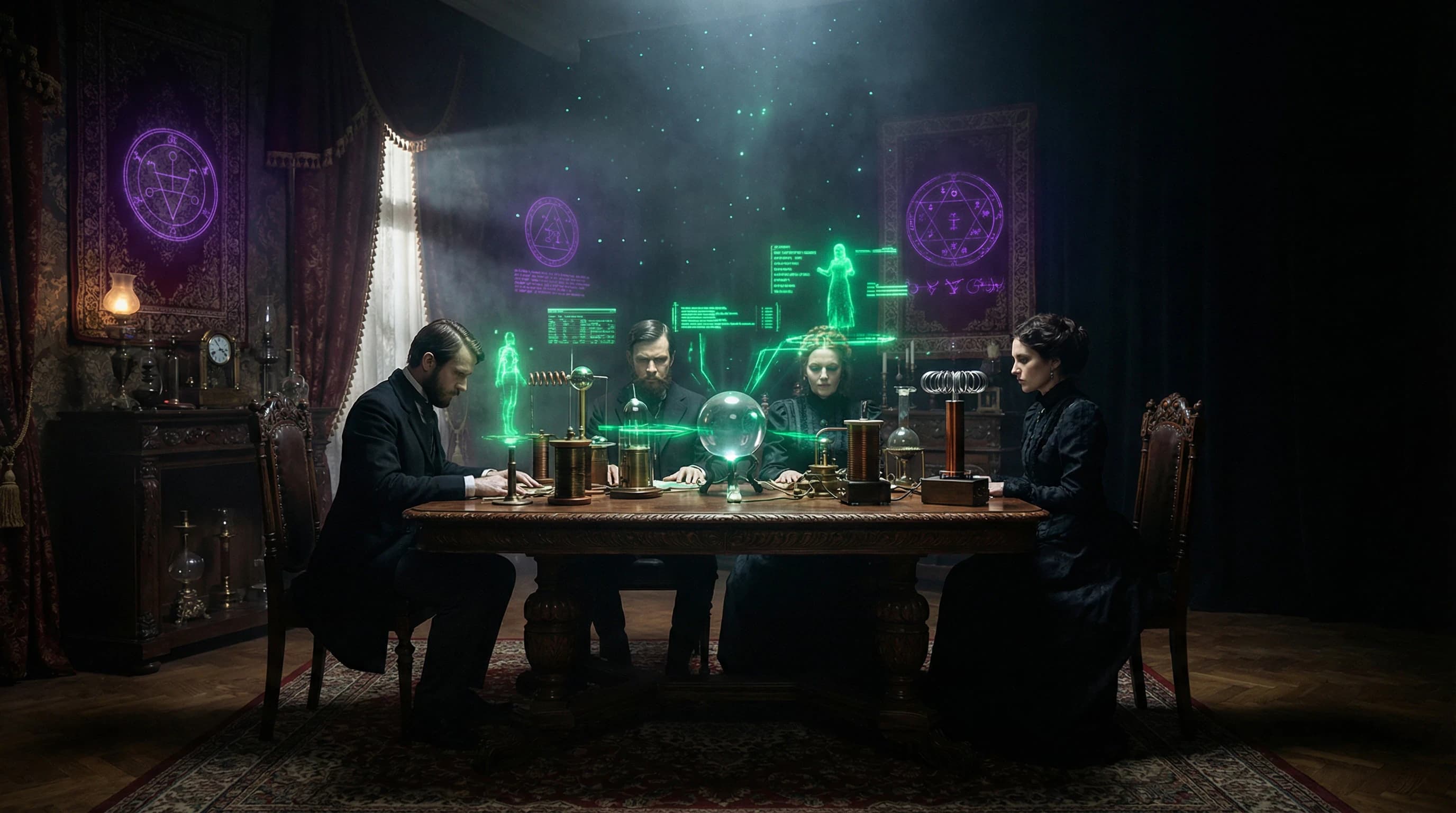
Mediumship and Spiritualism: Between Faith and Scienceλ
A study of spirit communication phenomena that emerged in the 19th century and continue to influence contemporary parapsychological and religious discourse
Overview
Mediumship — the practice of "communicating with spirits" through trance states, emerged in the mid-19th century and sparked large-scale scientific debates. In America, it was investigated by researchers like William James 🧩 journals such as the Journal of the Society for Psychical Research (1882–present) documented séances and experiments. Modern science classifies mediumship as pseudoscience: reproducible evidence is absent, methodology fails verification, but the social and psychological mechanisms of the phenomenon remain subjects of study.
🛡️
Laplace Protocol: Academic sources consistently characterize mediumship and spiritualism as scientifically problematic phenomena, carrying "distorted representations of spiritual life" and leading to false worldviews. Religious traditions, including Christianity and theosophy, warn of the spiritual dangers of these practices.
Reference Protocol
Scientific Foundation
Evidence-based framework for critical analysis
Protocol: Evaluation
Test Yourself
Quizzes on this topic coming soon
Sector L1
Articles
Research materials, essays, and deep dives into critical thinking mechanisms.
👻 Mediumship and Spiritualism 👻 Mediumship and Spiritualism
⚡
Deep Dive
Historical Roots and Development of Spiritism in the 19th Century
Mediumship and spiritism as organized movements gained widespread popularity in the mid-19th century, though their roots trace back to ancient practices of necromancy and ancestor communication. This period was marked by unprecedented interest among the educated public in the possibility of scientific investigation of the "otherworldly."
Spiritism represented not merely a set of occult practices, but a philosophical and religious movement asserting the existence of spirits and the possibility of systematic communication with them through mediums—individuals purportedly capable of entering trance states to mediate between the physical and spiritual worlds.
The spiritualist debate engaged scientists with decades of research experience, not just marginal circles. This created an illusion of scientific legitimacy that was later debunked by the absence of reproducible results under controlled conditions.
Alexander Aksakow and the Russian School of Research
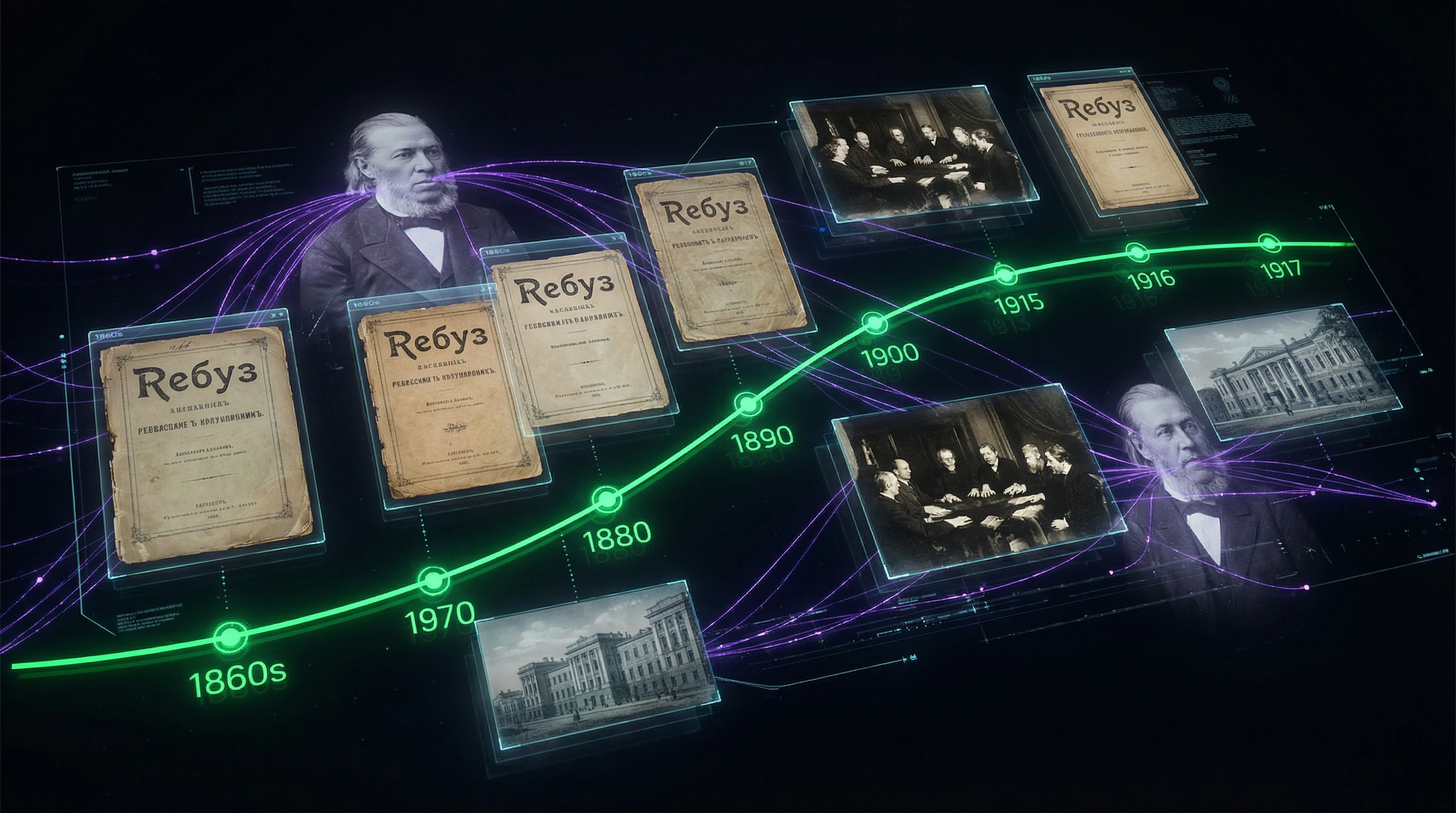
Alexander Nikolayevich Aksakow became a pioneer in occult phenomena research in Russia and Germany, beginning his work in the 1860s. He published extensive works in German and Russian on animal magnetism and spiritism.
The Russian school under Aksakow's influence sought to apply scientific methodology to the study of mediumistic phenomena. However, academic consensus subsequently classified these attempts as pseudoscience—not due to researcher misconduct, but because of the fundamental lack of reproducibility under controlled conditions.
- Animal Magnetism
- The concept of an invisible force purportedly transmitted from medium to subject. Served as an explanatory model for trance states and physical effects during séances.
- Trance States
- Altered states of consciousness into which mediums allegedly entered to communicate with "disembodied souls." The mechanism remains unclear from a neurophysiological perspective.
The Journal "Rebus" and the Spread of Ideas (1881–1917)
The journal "Rebus," published from 1881 to 1917, became the central publication devoted to questions of psychism, mediumship, and spiritism in Russia. This publication played a key role in popularizing spiritualist ideas among the educated public.
Publications in "Rebus" covered a wide range of topics—from descriptions of physical mediumship séances to theoretical discussions about the structure of spiritual worlds and hierarchies of "subtle planes." The journal served as a platform for experience exchange between researchers and practitioners, creating an impression of consensus where none existed.
| Period | Key Figures | Dissemination Mechanism |
|---|---|---|
| 1860–1880 | A. N. Aksakow | Scientific works, correspondence with European researchers |
| 1881–1917 | Editors and authors of "Rebus" | Periodical publication, séances, lectures |
Phenomenology of Mediumship: Practices and Claims
Mediumship postulates that certain individuals serve as intermediaries between the physical and spiritual worlds, facilitating dialogue with "disembodied souls." Spiritualism differs from mysticism of dissolution in that it maintains dialogue with separate spiritual entities, preserving their individuality and hierarchical structure.
The spiritualist movement developed systematic approaches to understanding the "otherworldly": technical methods of transcommunication and structured representations of consciousness survival after death.
Trance States and Communication with "Disembodied Souls"
The central element of mediumistic practice is the medium's entry into an altered state of consciousness (trance), during which contact with spiritual entities allegedly occurs. Mediums claim that their consciousness temporarily yields to the spirits of the deceased or other immaterial beings, who use the medium's body to communicate with the living.
- Automatic writing — the medium records messages allegedly from spiritual sources
- Voice mediumship — the medium speaks words allegedly originating from spirits
- Telepathic transmission — the medium receives and transmits information from immaterial beings
Critical sources indicate that such practices carry distorted representations of spiritual life and may form false worldviews instead of genuine spiritual development.
Physical Mediumship and Poltergeist Phenomena
Since the 19th century, mediumship has been associated with physical mediumship and poltergeist phenomena — allegedly material effects of spiritual presence. The spectrum of claimed phenomena includes levitation of objects, materialization of "ectoplasm," unexplained sounds, movement of furniture, and appearance of luminous forms during séances.
Historical records document numerous attempts by researchers to capture these phenomena under controlled conditions, however academic consensus points to methodological problems and lack of reproducibility of results.
Scientific Controversy and Epistemological Critique
The scientific community's attitude toward mediumship and spiritualism is built on fundamental epistemological disagreements that have persisted from the 19th century to the present. Academic consensus classifies these practices as pseudoscience, pointing to three critical deficiencies: absence of reproducible experiments, theoretical contradictions, and methodological barriers to verification.
Participation of Scientists in Debates on Both Sides
The 19th-century scientific controversy surrounding spiritualism was a serious intellectual discussion, not a marginal phenomenon. Alexander Aksakov and his colleagues published extensive works applying scientific methodology to the study of mediumistic phenomena — this testifies to genuine intellectual engagement, even if the conclusions did not receive scientific confirmation.
The participation of individual scientists in research does not validate supernatural claims. Contemporary academic consensus views these phenomena as historical and sociological phenomena, not as proven scientific facts.
Methodological Problems and Lack of Reproducibility
The fundamental problem of spiritualist research is the impossibility of obtaining reproducible results under controlled conditions. This is the cornerstone of the scientific method, and no study has been able to demonstrate consistent, independently verifiable effects.
Criticism comes not only from science. Religious authorities, including Orthodox Christianity, consistently condemn these practices as spiritually dangerous. Helena Blavatsky and the theosophical tradition also warned against spiritualist practices, establishing the rule: "no spirit, no medium" should be trusted unconditionally.
- Reproducibility
- The ability of an independent researcher to repeat results under identical conditions. Its absence is the primary marker of unscientific practice.
- Verification
- Testing claims through objective, measurable criteria. Mediumistic phenomena do not lend themselves to such testing.
- Epistemological Gap
- The incompatibility of spiritualist methods (subjective experience, testimonies) with the requirements of science (objectivity, reproducibility).
Religious and Spiritual Perspectives on Mediumship and Spiritism
Orthodox Critique of Spiritist Practices
Orthodox Christianity condemns mediumship and spiritism as spiritually dangerous practices incompatible with doctrine. Church authorities view attempts to communicate with the deceased as violations of divine order and potential contact with demonic forces rather than the souls of the departed.
This position is based on biblical prohibitions against necromancy and the teaching that the fate of the soul after death rests exclusively in God's hands. True spiritual development, according to this logic, is achieved through prayer, sacraments, and ascetic practice, not through mediumistic séances.
Spiritist practices violate the boundary between the world of the living and the world of the dead, established by Divine order. This is not communication with the departed, but opening a door to lower forces.
Theosophical Critique: Blavatsky Against Mediumship
Helena Blavatsky and the theosophical tradition warned against spiritualist practices, despite their own esoteric orientation. Blavatsky established a categorical rule: no spiritist, no medium should be trusted unconditionally.
The theosophical critique focused on the mechanism: mediums become passive channels for lower astral entities, losing control over consciousness and subjecting themselves to spiritual exhaustion. This reflects the distinction between active occult knowledge and passive mediumistic receptivity, which theosophy considered regressive.
| Approach | Position on Mediumship | Mechanism of Danger |
|---|---|---|
| Orthodox Christianity | Demonic contact, violation of order | Opening channel to lower forces |
| Theosophy | Passive receptivity, regression | Loss of control, consciousness depletion |

Distinctions Between Mediumship and Related Practices and Mysticism
Spiritism versus Dissolution Mysticism
Spiritism differs fundamentally from dissolution mysticism: it does not seek union with the primordial source, but maintains dialogue with separate spiritual entities.
Classical mysticism (Sufism, Advaita Vedanta) aims at transcending individuality and merging with the absolute. Spiritualist practice preserves the dualistic structure of "medium-spirit."
Spiritism affirms the existence of structured hierarchies of spiritual worlds with multiple levels of "subtle planes," where individual personalities of the deceased are preserved. This ontological difference determines different techniques: mystics practice meditation for ego dissolution, while mediums cultivate trance states to establish a communication channel.
Connection to Mentalism as Performative Art
Mentalism as a form of performative art developed in the 19th century parallel to public interest in mediumship, often imitating spiritualist phenomena.
Professional mentalists used psychological techniques, cold reading, and illusionist methods to create effects that audiences accepted as paranormal abilities.
- Many supposedly genuine mediums have been exposed as using the same tricks as stage performers.
- The historical intertwining of mentalism and spiritism demonstrates how cultural expectations and theatrical techniques create convincing but false evidence.
- This connection has complicated scientific investigation of mediumship and verification criteria for paranormal phenomena.
Contemporary State and Para-Religious Consciousness
Academic Study as Historical Phenomenon
Contemporary academic science studies mediumship and spiritualism as historical and sociological phenomena, not as valid paranormal practices. Researchers analyze the spiritualist movement in the context of religious studies, history of science, and cultural anthropology.
The journal "Rebus" (1881–1917), dedicated to questions of psychism, mediumship, and spiritualism in Russia, now serves as a valuable historical source for understanding the intellectual debates of that period. The academic approach focuses on the social functions of spiritualism, its role in forming alternative religious movements, and its interaction with the scientific discourse of the era.
Nineteenth-century spiritualism is not an object of paranormal verification, but a mirror of the intellectual anxieties and social transformations of its time.
Influence on Contemporary New Age Movements
Spiritualist ideas of the nineteenth century exerted significant influence on the formation of contemporary New Age movements, which adapted concepts of mediumship to the modern context. Channeling practices, popular since the 1970s, represent a direct continuation of traditional mediumship, replacing Victorian terminology with modern esoteric vocabulary.
Contemporary spiritualist practices often integrate elements of Eastern philosophy, psychology, and quantum physics (in popularized form), creating syncretic belief systems. Despite changes in cultural packaging, the basic claims about communication with non-physical entities and the existence of multi-level spiritual realities remain conceptually identical to classical nineteenth-century spiritualism.
- Repackaging of terminology (Victorian spiritualism → contemporary channeling)
- Synthesis with scientific rhetoric (quantum physics, psychology, Eastern philosophy)
- Preservation of core: communication with non-physical entities and multi-level realities

Knowledge Access Protocol
FAQ
Frequently Asked Questions
Mediumship is the practice of communicating with spirits through mediums in trance states, while spiritualism is a philosophical movement asserting the existence of spirits and the possibility of contact with them. These phenomena gained widespread popularity in the 19th century, when mediums claimed the ability to serve as intermediaries between the physical and spiritual worlds. In the English-speaking world, systematic investigations began in the 1840s with the Fox sisters in New York.
Spiritualism gained mass popularity in the mid-19th century, though it has ancient roots. In America and Britain, systematic investigations began in the 1840s-1850s, and publications like "The Spiritualist" (1869-1882) became centers for disseminating ideas about psychic phenomena and mediumship. The movement attracted attention from both scientists and the general public throughout Europe and North America.
The academic community classifies mediumship as pseudoscience due to the absence of reproducible experimental confirmation. Despite the participation of serious scientists in 19th-century debates, methodological problems and theoretical inconsistencies prevented scientific recognition. Modern science studies these phenomena as historical and sociological occurrences rather than genuine abilities.
Spiritualist practices are not recommended for independent study due to potential psychological risks. Helena Blavatsky and the theosophical tradition warned about the dangers of mediumship, establishing the rule not to trust mediums unconditionally. Christian churches categorically condemn such practices as spiritually dangerous.
Spiritualism maintains dialogue with individual spiritual entities, whereas dissolution mysticism seeks union with the primordial source. Spiritualist practices presuppose structured hierarchies of spiritual worlds and technical transcommunication. Mysticism, however, focuses on personal spiritual experience and consciousness transformation without intermediaries.
Alexander Nikolayevich Aksakov was a pioneer in investigating occult phenomena in Russia and Germany from the 1860s. He published extensive works on animal magnetism and spiritualism in German and Russian. Aksakov represented the serious scientific side in intellectual debates about the nature of mediumistic phenomena.
No scientific evidence exists for mediums' ability to communicate with the deceased. Academic research demonstrates methodological problems and absence of reproducible results under controlled conditions. Many claimed phenomena are explained by psychological mechanisms, cold reading, and cognitive perceptual biases.
Physical mediumship is a practice in which mediums claim to materialize spirits and produce physical phenomena (rapping, levitation, ectoplasm). Since the 19th century, these phenomena have been associated with poltergeist activity and attracted researchers' attention. Most documented cases were exposed as fraud or explained by natural causes.
Christian churches categorically condemn spiritualist practices as spiritually dangerous and contradictory to Christian teaching. The church regards attempts to communicate with spirits as a form of occultism leading to distorted understandings of spiritual life. Believers are strongly discouraged from participating in spiritualist séances.
"The Spiritualist" (1869-1882) was a British journal devoted to questions of psychic phenomena, mediumship, and spiritualism. The publication became a major platform for disseminating spiritualist ideas in the English-speaking world and publishing investigations. The journal reflected the era's serious intellectual interest in paranormal phenomena and their scientific study.
Mentalism as a performance art developed in the 19th century alongside public interest in mediumship. Mentalist performers use psychological techniques and illusions to create the effect of mind reading, without claiming actual supernatural abilities. This is an entertainment form, unlike spiritualism, which claims genuine communication with spirits.
Helena Blavatsky repeatedly cautioned against spiritualist practices, establishing a theosophical rule not to trust mediums unconditionally. She emphasized the dangers of mediumistic phenomena and their potential harm to spiritual development. Theosophy viewed spiritualism as a superficial and risky approach to spiritual realities.
Contemporary academia studies spiritualism as a historical, sociological, and cultural phenomenon, not as a valid practice. Research is conducted within the frameworks of religious history, parapsychology, and cultural studies. Spiritualism is examined as an example of "para-religious consciousness" and its influence on public consciousness in the 19th-20th centuries.
Participation in spiritualist practices can carry psychological risks, especially for suggestible individuals. Trance states, emotional tension, and belief in contact with the deceased can trigger anxiety, dissociative disorders, and other issues. Mental health professionals do not recommend such practices without professional supervision.
19th-century spiritualism laid the foundation for many ideas in the modern New Age movement, including channeling and communication with spiritual entities. Concepts of hierarchies of spiritual worlds and transcendent communication were adapted into new forms. Contemporary esoteric practices often use reinterpreted spiritualist terminology and methodology.
Most spiritualist phenomena are explained by psychological mechanisms: suggestion, pareidolia, the Barnum effect, and cognitive biases. Physical manifestations often proved to be the result of fraud or misinterpretation of natural phenomena. Modern neuroscience and psychology offer rational explanations for trance states and hallucinatory experiences without invoking the supernatural.