The Twin Flames concept ("twin souls") is one of the most persistent romantic illusions of our time, promising an encounter with "the one and only soulmate." But what lies behind this myth from the perspective of cognitive science, attachment psychology, and social dynamics? We examine the mechanisms that transform a beautiful metaphor into a toxic thought pattern, analyze the absence of scientific evidence, and show how to check yourself for cognitive dependence on this idea.
What exactly the Twin Flames concept claims and why it cannot be falsified
The Twin Flames concept asserts that each soul was "split" into two parts upon incarnation, and these two halves are destined to seek each other across multiple lifetimes. Meeting your Twin Flame is described as instant, irresistible recognition, accompanied by intense emotions, synchronicities, and a feeling of "coming home." More details in the section Karma and Reincarnation.
Unlike the concept of soulmates, of which there can be several, there is always only one Twin Flame, and the relationship with them supposedly serves a higher spiritual purpose: transformation, karmic healing, and achieving enlightenment through suffering and reunion.
⚠️ Structure of unfalsifiability
The Twin Flames myth is constructed so that any contradiction is integrated into the system itself as "proof." If the relationship is harmonious—it's a sign of true connection. If toxic—"a necessary stage of purification." If the partner leaves—"a period of separation for spiritual growth." If they return—confirmation of destiny. If they don't return—"the lesson hasn't been learned yet."
Any outcome is interpreted as confirmation. The concept cannot be empirically tested because contradiction is built into the logic of the myth itself (S009).
🧩 Metaphor versus dogma
Using Twin Flames as a poetic description of a deep connection is harmless and can enrich emotional experience. The problem begins when this becomes a rigid belief system dictating behavior.
- Metaphor (safe)
- Figurative description of an intense connection that doesn't influence decisions
- Dogma (dangerous)
- Belief in the predestination of a specific partner, justifying destructive relationships and ignoring red flags
🔎 From Plato to commerce
The idea of divided halves traces back to the myth from Plato's "Symposium." The modern Twin Flames concept is a product of the 1970s-80s New Age movement, which blended theosophy, Eastern philosophy, and Western romanticism.
Commercialization began in the 2000s with the emergence of "spiritual coaches" offering paid courses on "reuniting with your Twin Flame." The lack of historical continuity with ancient traditions makes the modern version a synthetic construct rather than an authentic teaching (S008).
| Period | Source of idea | Character |
|---|---|---|
| Ancient times | Plato, mythology | Philosophical metaphor |
| 1970s–1980s | New Age movement | Synthesis of traditions |
| 2000s – present | Spiritual coaches | Commercial product |
Steel Version of the Argument: Seven Most Compelling Cases for Twin Flames
Before dismantling a myth, it's necessary to present it in its strongest form — the steelman argument. This is an intellectually honest approach that requires examining the best, not the worst, versions of the opposing position. More details in the Witchcraft section.
Below are the seven most convincing arguments made by proponents of the Twin Flames concept, formulated in their most rational form.
💎 The Argument from Intensity of Experience: "Such Feelings Cannot Be Random"
Proponents point to the unprecedented intensity of emotions when meeting a supposed Twin Flame — a sense of recognition, of "coming home," accompanied by physiological reactions: accelerated heartbeat, altered time perception, a feeling of energetic resonance.
If this were merely projection or brain chemistry, why is it so specific and different from all previous experiences?
🔁 The Argument from Synchronicities: "Coincidences Are Too Precise to Be Random"
Meeting a Twin Flame is often accompanied by a chain of "meaningful coincidences": repeating numbers (11:11, 22:22), unexpected encounters in improbable places, simultaneous thoughts or actions, shared dreams.
Proponents interpret this as evidence of a non-local connection between souls that transcends materialistic explanation. The probability of so many coincidences is statistically negligible; therefore, an organizing principle must exist.
🧬 The Argument from Transformation: "This Relationship Changed Me Fundamentally"
Many describe the Twin Flame experience as a catalyst for profound personal changes: reassessment of values, breaking free from destructive patterns, spiritual awakening, development of empathy and self-awareness.
If the concept is merely an illusion, why does it lead to real, measurable changes in a person's life?
🧠 The Argument from Cross-Cultural Universality: "This Idea Exists in All Traditions"
The concept of "two halves of one soul" appears across different cultures and eras: from Plato to the Hindu concept of Ardhanarishvara (the androgynous deity), from the Kabbalistic idea of bashert to the Chinese legend of the red thread of fate.
If an idea arises independently in different cultures, this may point to a universal truth about the nature of human connections, rather than a cultural construct.
⚙️ The Argument from Predictive Power: "The Concept Explains Patterns That Are Otherwise Inexplicable"
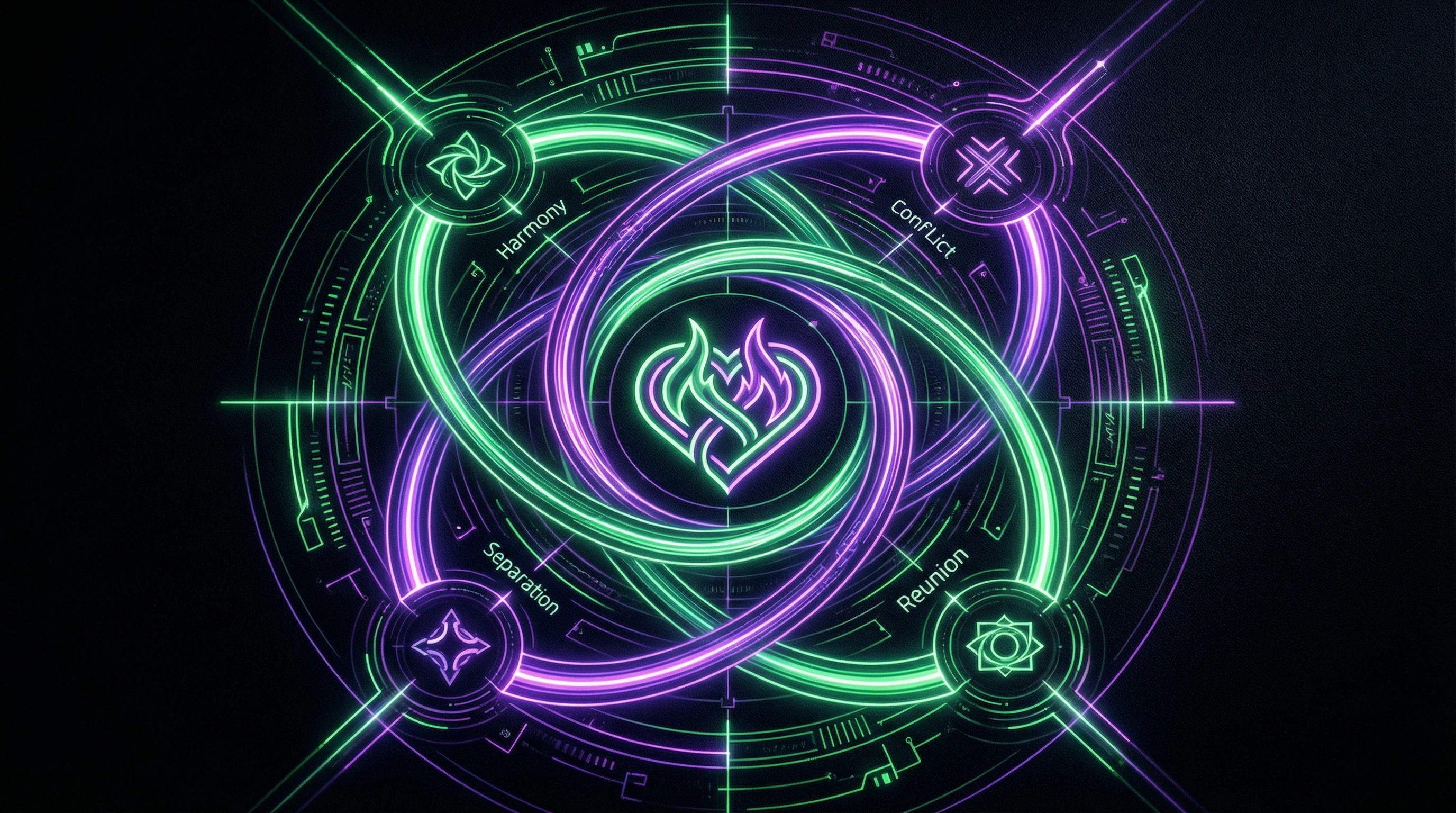
The Twin Flames model has predictive power: it explains why certain relationships go through specific stages (meeting, crisis, separation, reunion), why attempts to "forget" the person don't work, why the connection persists even after a breakup.
- Meeting — intense recognition and synchronicity
- Crisis — escalation of conflicts and trials
- Separation — physical or emotional distance
- Reunion — return and integration
🔬 The Argument from Quantum Entanglement: "Science Is Discovering Non-Local Connections"
More sophisticated defenders of the concept appeal to quantum physics, pointing to the phenomenon of entanglement, where particles remain connected regardless of distance.
If non-local connections exist at the level of elementary particles, why can't they exist at the level of consciousness?
🛡️ The Argument from Therapeutic Value: "Belief Helps People Cope with Pain"
Even if the concept doesn't correspond to objective reality, it may have therapeutic value: it helps give meaning to suffering, sustains hope during difficult periods, motivates personal growth.
If belief in Twin Flames improves psychological well-being and causes no harm, does it matter whether it's objectively true? Pragmatic value may be more important than metaphysical truth.
Evidence Base: What Science Says About "Soulmates," Attachment, and the Illusion of Predestination
Let's turn to empirical data. More details in the Esoterica and Occultism section.
📊 Absence of Empirical Evidence for Predetermined Connections
Systematic review of scientific literature reveals not a single study confirming the existence of predetermined romantic connections or "soul halves." Research on partner compatibility shows: successful relationships depend on shared values, communication styles, conflict resolution skills, socioeconomic compatibility—but not on mystical predestination.
Longitudinal studies demonstrate that people form deep, satisfying connections with different partners throughout their lives (S009). This contradicts the idea of a single Twin Flame.
- Successful relationships are the result of joint effort, not cosmic coincidence
- One person can experience deep attachment with multiple partners during different life periods
- Absence of scientific data on "soul halves" in PubMed, PsycINFO, Web of Science databases
🧪 Neurobiology of Intense Infatuation: Dopamine, Oxytocin, and the Illusion of Uniqueness
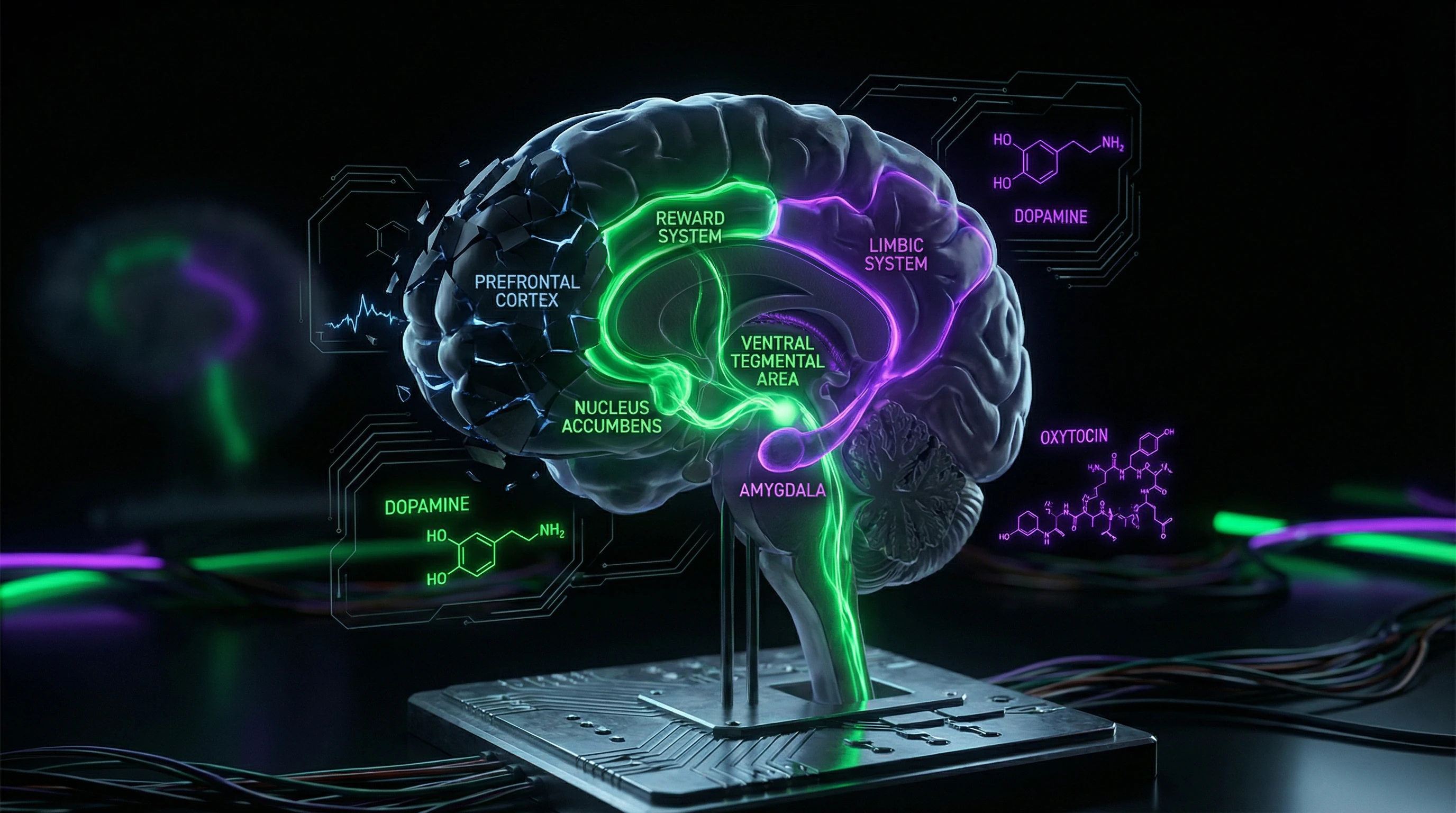
The feeling of "this is fate" when meeting a potential partner has a clear neurobiological basis. Activation of the brain's reward system (ventral tegmental area, nucleus accumbens) when seeing the object of infatuation creates a state similar to drug addiction.
Dopamine release intensifies attention to the object, oxytocin forms attachment, decreased activity in the prefrontal cortex (responsible for critical thinking) leads to partner idealization and ignoring incompatibilities. The brain is literally wired to perceive the connection as "special" and "predetermined," regardless of the partner's objective characteristics.
The neurochemistry of infatuation creates a subjective sensation of uniqueness that is easily interpreted as cosmic destiny. This is not proof of Twin Flames, but a demonstration of how the brain constructs meaning from biochemistry.
🧾 Synchronicities and Apophenia: When the Brain Finds Patterns in Noise
The phenomenon of "meaningful coincidences" is well-studied in cognitive psychology under the term apophenia—the tendency to perceive connections between unrelated phenomena. When a person is emotionally involved (in love, experiencing crisis), their attention becomes hyperfocused on information related to the object of attachment.
This creates the frequency illusion effect (Baader-Meinhof phenomenon): a person begins noticing coincidences that always existed but were previously ignored. Repeating numbers, chance encounters, common interests—everything becomes "meaningful" post hoc, when the brain seeks confirmation of an already-formed hypothesis about the fateful nature of the connection (S009).
- Apophenia
- Seeing patterns in random data. Mechanism: the brain searches for patterns for survival, but under conditions of emotional activation begins finding them everywhere.
- Frequency Illusion
- When you learn about something, you start noticing it everywhere. Not because it became more frequent, but because your attention shifted.
- Confirmation Bias
- The brain seeks and remembers information confirming an already-accepted hypothesis, ignoring contradictory data.
🔁 Transformation Through Relationships: Real Effect, False Attribution
Intense relationships lead to personality changes—this is fact. However, attributing these changes to the "special nature" of the connection is a logical error. Any significant relationships (romantic, friendship, therapeutic) can catalyze growth, especially if they provoke cognitive dissonance or push one out of the comfort zone.
The transformational effect depends not on the mystical predestination of the partner, but on a person's readiness for change and the intensity of emotional challenge. Post-traumatic growth research shows: even toxic relationships can lead to positive changes. This doesn't make them "fateful," but merely demonstrates the adaptability of the psyche.
🧬 Quantum Entanglement and Consciousness: Category Error
Appeals to quantum physics to justify Twin Flames are a classic example of category error and abuse of scientific terminology. Quantum entanglement is a phenomenon at the level of elementary particles under strictly controlled conditions, does not scale to macroscopic objects, much less to consciousness.
Attempts to extrapolate quantum effects to human relationships have no theoretical basis and are not supported by any experiment. This is an example of "quantum mysticism"—a rhetorical strategy using scientific terminology to lend legitimacy to unscientific claims (S004).
| Level of Reality | Quantum Effects | Applicable to Consciousness? |
|---|---|---|
| Elementary Particles | Entanglement, superposition, tunneling | No—requires isolation from environment |
| Molecules, Cells | Quantum effects suppressed by thermal noise | No—classical physics dominates |
| Brain (37 billion cells, 98.6°F) | Decoherence within nanoseconds | No—environment too "noisy" |
📌 Cross-Cultural Myths About Paired Souls: Convergent Evolution of Narratives
The presence of similar myths in different cultures does not prove their truth—it demonstrates convergent evolution of narratives responding to universal psychological needs. People in all cultures experience the need for belonging, fear of loneliness, and desire to give meaning to random events.
Myths about predetermined partners serve a psychological function: they reduce choice anxiety, justify intensity of feelings, explain suffering. This is not evidence of metaphysical reality, but an example of how cultures independently create similar narratives to solve the same existential problems (S008).
The connection between the twin flame myth and other esoteric concepts (like the law of attraction) shows how psychological needs translate into metaphysical systems. Each system offers an illusion of control over randomness.
Cognitive Anatomy of the Myth: What Mental Mechanisms Make the Twin Flames Concept So Convincing
Why is the Twin Flames myth so persistent despite the lack of evidence? The answer lies in how it exploits fundamental features of human cognition — cognitive biases, emotional needs, and social dynamics. Learn more in the Statistics and Probability Theory section.
⚠️ Confirmation bias: the brain as a hypothesis-confirming machine
Once a person accepts the idea of a Twin Flame, their brain actively begins seeking confirmation while ignoring contradictory data. This is called confirmation bias — the tendency to interpret information in ways that support existing beliefs.
If a partner shows care — it's a "sign of true connection." If they're toxic — it's a "test for spiritual growth." If the relationship ends — it's a "temporary separation." The brain becomes a machine for generating explanations that protect the original hypothesis from falsification (S009).
🕳️ Sunk cost fallacy: "I've invested too much to leave"
The Twin Flames concept amplifies the sunk cost fallacy: the more time, emotions, and resources a person has invested in a relationship, the harder it becomes to admit it isn't "destined." Belief in the predestined nature of the connection compels continued investment even in destructive relationships, since abandoning them would mean acknowledging that all previous sacrifices were in vain.
The greater the suffering, the stronger the need to justify it with "higher meaning." This creates a vicious cycle that's cognitively difficult to escape.
🧩 Narrative fallacy: turning chaos into story
Humans are narrative-creating beings. The brain automatically transforms random events into coherent stories with a beginning, middle, and end. The Twin Flames concept provides a ready-made plot: meeting (recognition), conflict (trial), separation (dark night of the soul), reunion (triumph of love).
This archetypal narrative is so powerful that people unconsciously fit real events into its structure, ignoring details that don't fit the plot. This is called the narrative fallacy — the illusion of understanding created by post-hoc construction of causal relationships (S001).
- Meeting → interpreted as "recognition" (déjà vu, synchronicity)
- Conflict → reframed as "trial" (test of devotion)
- Separation → experienced as "dark night of the soul" (necessary stage)
- Reunion (if it happens) → triumph of destiny
- Absence of reunion → "not yet time" or "wrong Twin Flame"
🔁 Intermittent reinforcement: why toxic relationships create the strongest addiction
Paradoxically, the Twin Flames concept is often associated with unstable, toxic relationships — and this is no accident. Intermittent reinforcement — when rewards (attention, intimacy, validation) are provided unpredictably — creates the strongest form of addiction.
This is the same mechanism used in slot machines. If a partner is sometimes warm, sometimes cold, sometimes available, sometimes distant, the brain interprets this not as instability but as "complexity of spiritual connection." Unpredictability strengthens attachment, and the Twin Flames concept provides rationalization for staying in such relationships.
🧷 Attachment trauma bonding: when suffering becomes proof of love
For people with attachment trauma (especially anxious and disorganized types), the Twin Flames concept can be particularly dangerous. It transforms patterns of traumatic attachment (pursuit-distancing, idealization-devaluation) into a "spiritual path."
Someone who grew up in an environment where love was unpredictable and conditional may perceive toxic relationships as "real" because they activate familiar neural patterns. The Twin Flames concept legitimizes trauma bonding, disguising it as a higher form of love. Learn more about the mechanisms of illusion in the article on synchronicity and the illusion of meaning.
Causation vs. Correlation: Why "Working" Predictions Don't Prove a Model's Truth
One argument in favor of the Twin Flames concept is its supposed predictive power. However, a model's ability to "predict" events doesn't prove its truth if those predictions are sufficiently vague and the interpretation sufficiently flexible. For more details, see the Logic and Probability section.
🔎 The Barnum Effect: Why General Statements Seem Personally Accurate
Descriptions of Twin Flame stages (meeting, crisis, separation, reunion) are so general that they apply to virtually any intense relationship. This is an example of the Barnum effect—the tendency to perceive vague, general statements as personally accurate.
Any relationship goes through phases of closeness and distance, conflict and reconciliation. Attributing these universal patterns to the "special nature" of Twin Flames is retrospective data fitting to a model, not prediction.
- The meeting is described as "magical"—but intense attraction occurs at the beginning of any relationship.
- Crisis is interpreted as a "test of fate"—but conflicts are inevitable in close connections.
- Separation is framed as a "necessary stage of growth"—but people part ways without mystical reasons.
- Reunion is seen as "cosmic destiny"—but people return to each other for psychological and social reasons.
📊 The Multiple Comparisons Problem: With Enough Attempts, Any Model Will "Work"
If a person interprets every event in a relationship through the lens of the Twin Flames concept, sooner or later some event will "confirm" the model simply by the law of large numbers.
A coincidence that occurs with sufficient attempts is not proof of causal connection. It's an artifact of pattern-seeking in noise.
A person notices synchronized call timing, matching birth dates, identical dreams. But they don't count the thousands of moments when synchronization didn't occur. This is selective attention, not statistical proof.
The Twin Flames concept works like synchronicity—any coincidence becomes a "sign," any discrepancy is ignored. A model that explains everything explains nothing. The scientific method requires not only explaining facts but predicting what should happen if the model is false.
Twin Flames predicts nothing testable. It only reinterprets what has already occurred.