Synchronicity — Carl Jung's concept of "meaningful coincidences" supposedly connected not causally, but through meaning. Millions of people see random events as signs of fate, confirmation of correct choices, or mystical messages. But what if this is a cognitive illusion — the result of a brain that searches for patterns even where none exist? We examine the mechanism of this delusion, show the level of evidence, and provide a self-check protocol.
🖤 You think about an old friend — and a minute later they call. You see the same number on clocks, license plates, receipts. You make a decision — and suddenly "signs" confirm its correctness. Millions of people interpret such coincidences as messages from the Universe, proof of destiny, or the work of the collective unconscious. But modern cognitive science offers a more prosaic explanation: your brain is a pattern-seeking machine that doesn't know how to turn off even where no patterns exist. 👁️ This article is not an attack on the romance of chance, but an analysis of how the illusion of meaning works and why it's so convincing.
What is Jungian synchronicity and why this concept became a cultural meme
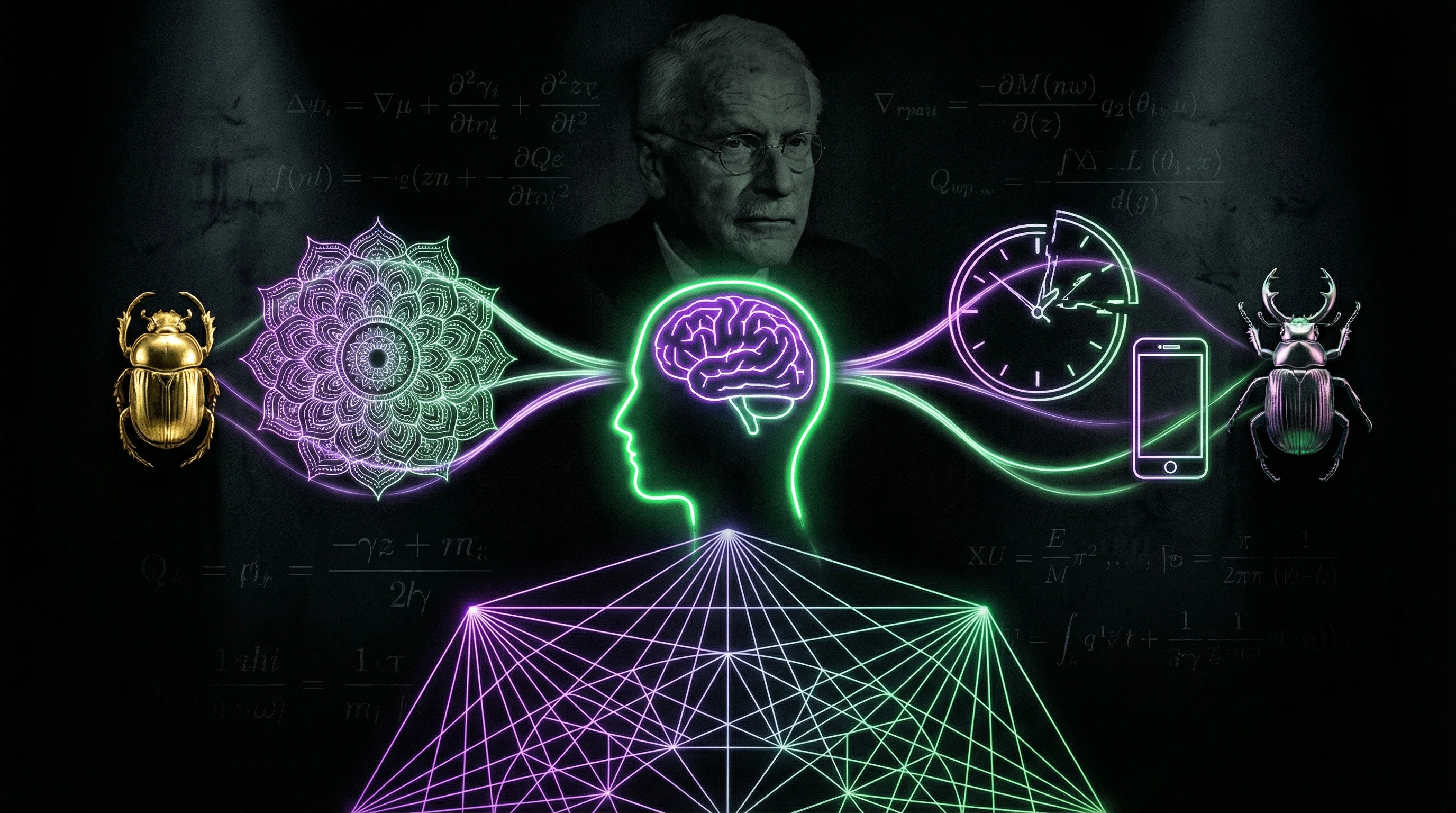
Carl Gustav Jung introduced the term "synchronicity" (Synchronizität) in the 1920s, finalizing it in his work "Synchronicity: An Acausal Connecting Principle" (S005). Jung defined it as a "meaningful coincidence" of two or more events, where the connection between them is not causal but semantic—through archetypes of the collective unconscious.
Classic example: a patient tells Jung about a dream featuring a golden scarab beetle, and at that moment a real scarab beetle strikes the window of his office. For Jung, this was not chance but a manifestation of a deep connection between psyche and material world. More details in the Energy Practices section.
Synchronicity is not magic and not proof of the supernatural. Jung sought a scientific explanation for the phenomenon, collaborating with physicist Wolfgang Pauli and exploring connections with quantum mechanics. However, his followers often ignore these caveats, turning synchronicity into a universal explanation for any coincidence.
🧩 Three components of Jungian synchronicity
Jung identified three essential elements: (1) an internal psychic state (thought, emotion, dream), (2) an external event coinciding with it in meaning, (3) absence of a causal connection between them.
- Key criterion—meaning
- The coincidence must be subjectively significant to the observer. Jung believed that synchronicity points to the existence of an "acausal order" in the Universe, where events are connected through a common archetypal pattern rather than through cause and effect.
⚠️ Why the concept became popular in mass culture
Synchronicity quickly moved beyond analytical psychology and became part of the New Age movement, pop psychology, and spiritual practices. Four reasons for its popularity surge:
- Provides a simple explanation for complex coincidences without needing to understand statistics
- Flatters the ego—"The Universe is sending me signs"
- Creates an illusion of control and predictability in a chaotic world
- Requires no empirical verification—any coincidence can be interpreted as confirmation
Today the term is used in coaching, astrology, tarot, motivational books, and marketing ("signs that you need this product"). This creates an ecosystem where synchronicity becomes the default explanation for any coincidence that seems too good to be random.
| What Jung claimed | What popular culture does with it |
|---|---|
| Synchronicity is a phenomenon requiring scientific explanation | Synchronicity is proof of magic and the supernatural |
| Many coincidences are explained by chance and selective attention | All coincidences are signs from the Universe |
| Connection with quantum mechanics is a hypothesis requiring verification | Quantum mechanics proves synchronicity |
The difference between the Jungian approach and its mass interpretation is the difference between a scientific question and spiritual consolation. Jung left room for skepticism; his heirs often close it.
Steel Version of the Argument: Seven Most Compelling Cases for the Reality of Synchronicity
Before dissecting the concept, it's necessary to present it in its strongest form — a steelman argument. This isn't a straw man, but the best arguments from synchronicity proponents that genuinely give pause. More details in the Occultism and Hermeticism section.
🔬 Argument 1: Quantum Nonlocality and Correlations Without Causality
Synchronicity proponents cite quantum mechanics, especially the phenomenon of quantum entanglement, where measuring the state of one particle instantaneously affects the state of another, regardless of distance. This violates classical notions of local causality.
Jung and Pauli hypothesized that synchronicity might be a macroscopic manifestation of similar nonlocal correlations. Contemporary research in quantum biology (quantum effects in photosynthesis and bird navigation) shows that quantum phenomena can influence biological systems.
📊 Argument 2: Statistical Anomalies in Precognition Experiments
Meta-analyses of presentiment and precognition experiments show small but statistically significant deviations from randomness — the effect replicates across independent laboratories, though the magnitude is weak (d ≈ 0.1-0.2).
In experiments, participants demonstrated physiological responses (changes in skin conductance, pupil dilation) several seconds BEFORE presentation of emotionally significant stimuli. Synchronicity proponents interpret this as evidence of acausal connections between future and present.
🧠 Argument 3: Jung's Clinical Observations and Therapeutic Value
Jung documented hundreds of synchronicity cases in his clinical practice, where coincidences played key roles in therapeutic breakthroughs. Patients who interpreted coincidences as meaningful often demonstrated improved conditions and resolution of internal conflicts.
Even if synchronicity is an illusion, its therapeutic effect is real. The meaning a person assigns to events affects their psychological and even physical state — this aligns with research on placebo and narrative therapy.
🔁 Argument 4: Cross-Cultural Universality of the Phenomenon
- Chinese concept
- "gan-ying" (mutual resonance) — belief in synchronization of events through invisible connections
- Indian tradition
- karma — causality stretched across time and lifetimes
- Islamic tradition
- "tawakkul" (trust in Allah's signs) — interpretation of coincidences as divine guidance
- Christian providence
- belief that events are coordinated by higher will
Anthropological research shows that people in isolated societies with no contact with Western psychology independently developed similar concepts. Evolutionary psychologists suggest that the tendency to see patterns and meaning in coincidences may have been adaptive: better to overestimate connections between events than miss a real threat or opportunity.
🧬 Argument 5: Neurobiological Correlates of "Insight" Coincidences
fMRI studies show that experiencing a "meaningful coincidence" activates specific brain regions: medial prefrontal cortex (associated with self-reference and meaning), posterior cingulate cortex (autobiographical memory), and insula (interoception and emotional salience).
These activation patterns differ from responses to ordinary random events. Synchronicity proponents argue that the brain may "detect" real acausal connections not captured by conscious analysis.
⚙️ Argument 6: Information Theory and "Meaning Fields"
Some theorists propose models based on information theory, where "meaning" is treated as a physical quantity capable of organizing events. Rupert Sheldrake's concept of "morphogenetic fields" or David Bohm's "implicate order" suggest the existence of invisible structures that coordinate events at a distance.
While these theories are speculative and lack empirical confirmation, they offer conceptual frameworks for understanding synchronicity without resorting to mysticism.
💎 Argument 7: Personal Experience as Irrefutable Evidence
For many people, the most convincing argument is their own experience. Coincidences are so specific, improbable, and emotionally resonant that the explanation "it's random chance" seems inadequate.
Philosophers of science acknowledge that subjective experience (qualia) cannot be fully reduced to objective measurements. If a person experiences synchronicity as real, that experience has ontological status, regardless of its physical nature. The phenomenological approach proposes studying synchronicity as a phenomenon of consciousness, without reducing it to illusion or error.
The connection between belief in coincidences and the search for meaning is traced in other areas as well — from the law of attraction to myths about twin flames. All these systems operate on one principle: people seek patterns that confirm their expectations.
Evidence Base: What Systematic Reviews and Meta-Analyses Say About the Reality of Synchronicity
Scientific consensus leans toward synchronicity being a cognitive illusion rather than a real physical phenomenon. Let's look at what the data says. More details in the Feng Shui and Vastu section.
📊 Meta-Analyses of Parapsychological Experiments: The Effect Exists, But It Disappears
Systematic reviews of precognition and telepathy experiments do show a small statistically significant effect. But critical analysis reveals serious problems.
- The effect disappears in preregistered studies (protocol fixed before data collection)
- Strong publication bias — negative results aren't published
- Effect correlates with methodological quality: the stricter the control, the weaker the result
- Independent replications often fail to confirm original findings
This is a classic pattern of artifact, not discovery of a real phenomenon.
🧪 Quantum Mechanics Doesn't Support Macroscopic Synchronicity
Quantum entanglement is real, but extrapolating it to everyday coincidences has no physical basis. Quantum effects manifest at the level of elementary particles and rapidly break down (decoherence) when interacting with the environment.
Human body and brain temperature is too high to maintain quantum coherence at scales necessary to explain synchronicity. Physicists, including Pauli himself, later acknowledged that the connection between quantum mechanics and Jungian synchronicity is metaphor, not literal explanation.
Quantum mystification remains a popular way to give scientific appearance to esoteric ideas. More on the mechanisms of this process in the "Quantum Mystification" section.
🧾 Neurobiology Explains the Experience, But Doesn't Confirm the Phenomenon
Activation of specific brain regions during synchronicity experiences doesn't prove the reality of acausal connections — it only shows that the brain processes these events as meaningful. The brain also activates when perceiving optical illusions, but that doesn't make illusions real.
- Default Mode Network (DMN)
- Responsible for self-reference, daydreaming, and meaning-making. People with heightened DMN activity more frequently report synchronistic experiences, but are also more prone to apophenia (seeing patterns in random data) and magical thinking.
- Conclusion
- Neurobiology explains why people experience synchronicity, but doesn't explain why it would be real.
🔎 Statistics of Coincidences: Why the "Incredible" Is Inevitable
Mathematical analysis shows that seemingly incredible coincidences are statistically inevitable in large samples. The law of large numbers guarantees that with sufficient events, any combination will eventually occur.
| Phenomenon | Perceived Probability | Actual Probability (accounting for sample size) |
|---|---|---|
| Two people in a group of 23 share the same birthday | ~1% | 50%+ |
| Seeing the same number three times in a day | Very low | High (you see hundreds of numbers, only notice matches) |
| Thinking of a friend, and they call | Mystical coincidence | Statistically expected (you often think of close ones, they often call) |
People systematically underestimate the frequency of random coincidences and overestimate their significance. This isn't a perceptual error — it's an error of statistical intuitive calculation.
⚠️ Publication Bias and the Replication Crisis
Most "evidence" for synchronicity comes from studies with low methodological quality: small samples, lack of preregistration, multiple hypothesis testing (p-hacking), selective publication of results.
The replication crisis in psychology has shown that many "established" effects don't reproduce in independent laboratories. Parapsychological research is especially vulnerable: effects disappear under strict control, and positive results are often explained by methodological artifacts rather than real phenomena.
To understand how reality testing works in science, see "Reality Testing". It breaks down the criteria that separate reliable data from noise.
The Mechanism of Illusion: How the Brain Creates the Sensation of Synchronicity from Random Noise
Understanding the cognitive mechanisms underlying the experience of synchronicity is critical for evaluating the phenomenon. The brain is not a passive recorder of reality, but an active interpreter that constantly seeks patterns, meaning, and predictability. More details in the section Thinking Tools.
🧬 Apophenia: The Evolutionary Legacy of a Hyperactive Pattern Detector
Apophenia—the tendency to see patterns and connections in random or unrelated data—is not a bug, but an evolutionary feature. Our ancestors who saw a predator in rustling leaves (even if it was just wind) survived more often than those who ignored potential threats.
The cost of a false positive error (seeing a pattern that isn't there) was lower than the cost of a false negative (missing real danger). Result: the brain is tuned for hypersensitivity to patterns. This explains why people see faces in clouds (pareidolia), hear voices in white noise, and find meaning in random coincidences.
The hyperactive pattern detector is an adaptation that saved lives in conditions of information scarcity. In today's world of data abundance, this same system creates illusions.
🔁 Selective Attention and the Baader-Meinhof Effect
When you start thinking about something (for example, buying a red car), you suddenly start noticing red cars everywhere. This doesn't mean there are more of them—your attention has changed.
The Baader-Meinhof effect (frequency illusion) explains many cases of synchronicity: you thought about dozens of people, but only one called, and you didn't remember the other cases. Selective attention is amplified by emotional significance: the more important an event is to you, the more you notice coincidences related to it.
| Cognitive Mechanism | How It Works | Result in the Context of Synchronicity |
|---|---|---|
| Apophenia | Brain automatically searches for patterns in noise | You see connections where none exist |
| Selective Attention | You notice only events relevant to you | Coincidences seem frequent, non-coincidences invisible |
| Memory Confabulation | Memory is reconstructed, adding details | Premonition seems more accurate than it actually was |
| Confirmation Bias | You notice facts that confirm your belief | Belief in synchronicity reinforces itself |
🧷 Retrospective Revaluation and Memory Confabulation
Memory doesn't work like a video recording—it's reconstructed each time anew, and in the process, details that weren't there are added. When a coincidence occurs, the brain retrospectively "improves" the memory of the preceding thought or event, making the connection more explicit and specific.
You thought about a friend "in general," but after their call you remember thinking about them "at that exact moment." People systematically overestimate the accuracy of their premonitions and predictions, especially when the outcome is emotionally significant.
🧩 Confirmation Bias and Base Rate Neglect
Confirmation bias causes us to notice and remember events that confirm our beliefs, and ignore contradictory ones. If you believe in synchronicity, you record coincidences and interpret them as meaningful, but don't count cases when coincidences didn't occur.
Base rate neglect is another error: people don't account for how often an event occurs in general. You're surprised to meet an acquaintance at the airport, but don't consider that millions of people pass through airports, and the probability of meeting isn't as small as it seems.
- Notice coincidence → emotional spike
- Brain seeks explanation → finds pattern
- Memory is reconstructed → premonition seems more accurate
- Attention focuses → you notice similar coincidences
- Belief strengthens → you seek new confirmations
🕳️ Illusion of Control and the Need for Meaning
People experience a strong need for a sense of control and predictability. Synchronicity provides the illusion that the Universe is "communicating" with you, that events are not random but have meaning and direction.
This is especially attractive in situations of uncertainty, stress, or important life decisions. Belief in synchronicity reduces anxiety and gives the feeling that "everything is going as it should." The tendency to see synchronicity increases during periods of crisis, loss, or existential uncertainty.
The need for meaning is not a weakness, but a fundamental feature of human thinking. Synchronicity satisfies this need, even if the explanation is illusory.
The connection between these mechanisms and belief in the law of attraction or Twin Flames is obvious: the same cognitive errors reinforce belief in magical thinking. Understanding reality-testing mechanisms helps distinguish coincidence from causality.
Conflicts and Uncertainties: Where Data Contradict Each Other and What Remains Unclear
Scientific integrity requires acknowledging areas where data are incomplete, contradictory, or open to interpretation. For more details, see the section Statistics and Probability Theory.
🔬 The "Hard Case" Problem: Extremely Specific Coincidences
Some cases of synchronicity are so specific and improbable that the explanation "randomness + cognitive biases" seems insufficient. For example, Jung's scarab case: a beetle struck the window precisely at the moment of recounting a dream, and it was a rare species, atypical for the region.
Skeptics point to the possibility of retrospective revaluation (details are rewritten in memory, improbable elements are forgotten). But critics of skepticism counter: even if the probability of one such event is low, we don't know exactly how many similar cases occur in the lives of billions of people daily.
Paradox: the rarer the event, the more impressive it is, but the harder it becomes to distinguish a true signal from an artifact of memory and selective attention.
📊 Contradictions in Meta-Analyses: Why Results Don't Converge
Systematic reviews (S005) show that synchronicity effects either fail to replicate or disappear when methodology is tightened. However, some researchers argue that the very methodology of classical science may be unsuitable for studying phenomena that allegedly depend on observer intention.
This creates a logical impasse: if an effect is not detected by standard methods, does this prove its absence or the inadequacy of the method?
| Position | Argument | Weakness |
|---|---|---|
| Skeptic | Lack of reproducibility = no effect | Doesn't account for possible methodological limitations |
| Proponent | Effect exists but cannot be measured by standard means | Becomes unfalsifiable — any result is interpreted in favor of the hypothesis |
🧩 Quantum Entanglement as Analogy: Temptation and Danger
Some proponents of synchronicity cite quantum entanglement as a possible mechanism. However, quantum effects do not transmit information and do not operate at the macroscopic scales of consciousness (S002).
This is a classic example of quantum mystification: a scientific term is used as a metaphor but then mistakenly interpreted as a literal explanation.
- Quantum entanglement is real but localized at the subatomic level
- The brain is a classical system; quantum effects do not dominate there
- The analogy between entanglement and synchronicity is a rhetorical device, not a mechanism
💭 What Remains Open
It remains unclear why people with high media literacy and knowledge of cognitive biases still report experiences of synchronicity. This may indicate: (1) deep features of human perception that we have not yet fully understood; (2) social and cultural factors that survive even critical thinking; (3) a real effect that simply is not detected by current methods.
Honest conclusion: synchronicity as a causal mechanism is not confirmed, but the psychological and social mechanisms of its perception require further study. This does not mean the effect is real — it means our understanding of human cognition remains incomplete.
For practice: if you experience synchronicity, it's most useful to ask yourself what reality-checking mechanisms you're using, and whether you're prepared for the answer to be more mundane than it seemed.
Counter-Position Analysis
⚖️ Critical Counterpoint
Synchronicity is often dismissed as an illusion, but intellectual honesty requires acknowledging the boundaries of our knowledge. Here's what should be considered when evaluating the phenomenon.
Unknown mechanisms do not equal their absence
The history of science is full of examples where the "impossible" became explainable: magnetism, quantum entanglement, the wave nature of light. We categorically deny synchronicity as a mystical phenomenon, but cannot completely exclude the possibility of mechanisms connecting events that are currently unknown to science.
Psychological reality has its own value
The focus on cognitive biases can be reductionist. The subjective experience of meaningful coincidence has psychological reality and value for a person, even if there is no objective connection—perhaps more attention should have been paid to the phenomenology of the experience, rather than just debunking.
Absence of experimental data does not prove non-existence
The absence of reproducible results in controlled experiments does not prove the non-existence of synchronicity. Perhaps the phenomenon is inherently not reproducible under laboratory conditions, like many aspects of consciousness.
Intuition and subconscious processing are underestimated
Some "coincidences" may be the result of subconscious pattern recognition, which consciousness interprets as mystical. The article may underestimate the role of intuition and unconscious information processing in forming the sense of synchronicity.
Scientific development may rewrite explanations
In 10–20 years, advances in neuroscience and quantum biology may offer new explanations for phenomena that now seem purely random. Our confidence in the absence of a mechanism may prove premature.
FAQ
Frequently Asked Questions

Author of the Cognitive Immunology Hub project. Researches mechanisms of disinformation, pseudoscience, and cognitive biases. All materials are based on peer-reviewed sources.