What exactly the "Law of Attraction" claims—and why it's not just positive thinking
The Law of Attraction (LoA) is not a single theory but a family of claims united by a central idea: like attracts like at the level of thoughts and energies. The classic formulation states that a person's thoughts emit a certain "vibration" or "frequency" that resonates with corresponding events, people, and circumstances in the Universe. More details in the section Tarot and Cartomancy.
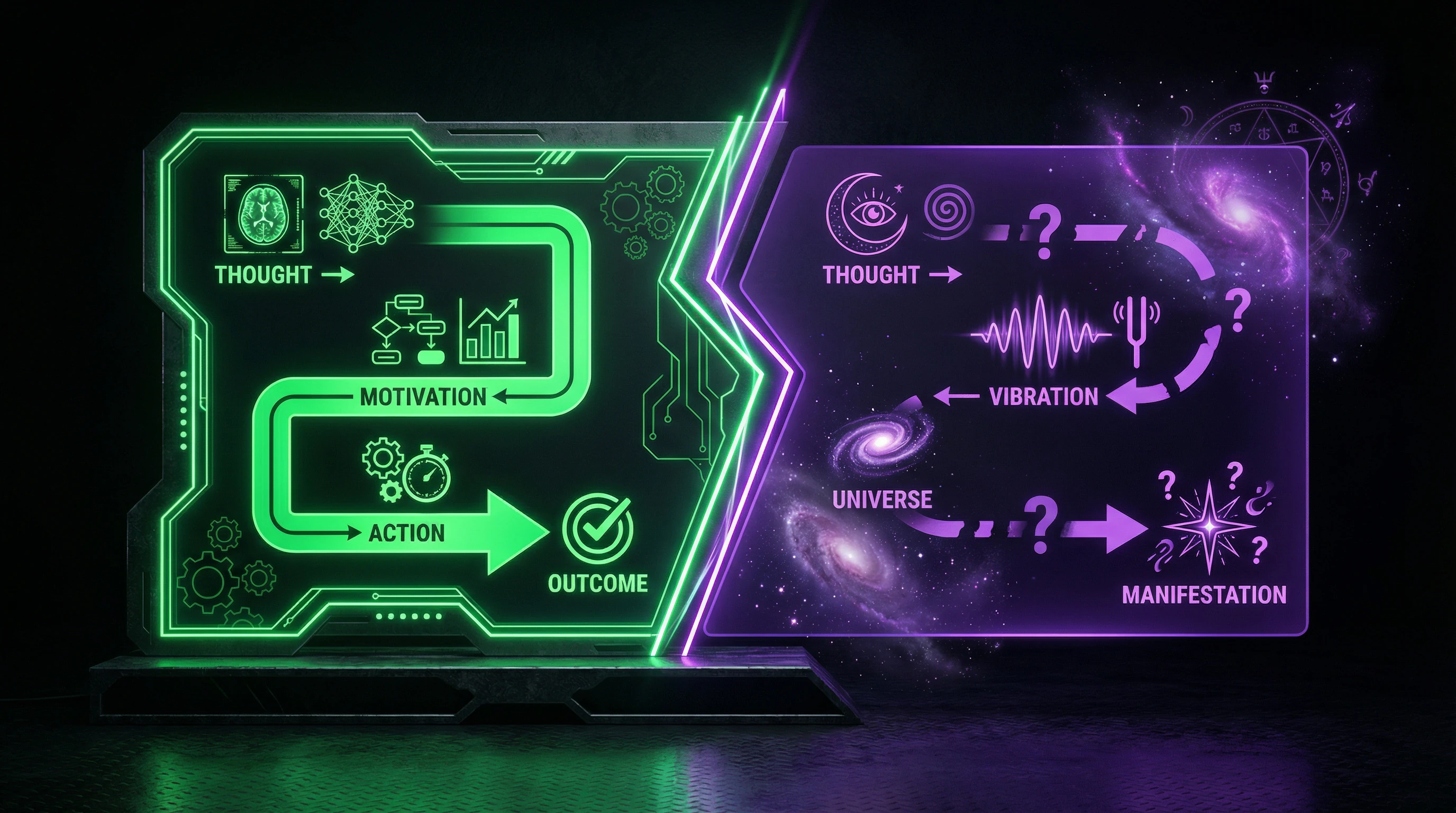
Key point: this is not a motivational metaphor but a literal causal mechanism—thought as cause, material event as effect, without the need for intermediate physical actions.
🧩 Core components of the doctrine
- Visualization
- Detailed mental representation of the desired outcome with emotional involvement, supposedly "programs" reality.
- Affirmations
- Repetition of statements in present tense ("I am wealthy," "I am healthy") to change one's "energetic signature."
- Releasing resistance
- Eliminating doubts, fears, and negative thoughts that supposedly block attraction.
- Gratitude
- Expressing appreciation for what has not yet been received, as if it already exists, to amplify "vibrational alignment."
⚠️ The boundary between psychology and magic
Goal-setting and positive mindset can improve motivation and attentional focus, increasing the likelihood of achieving goals through real actions. But this is not the same as claiming that thoughts themselves, without physical mediation, alter the probability of external events.
Psychological level: visualization of success and goal-setting are supported by research in motivational psychology and cognitive-behavioral therapy. This works through attention, memory, and behavior.
Magical level: the claim that thoughts about a parking space "cause" it to open up, or that thoughts about money attract an unexpected inheritance. This is precisely what lacks scientific confirmation and is the subject of criticism.
🔎 From New Thought to "The Secret"
The idea of attraction through thoughts traces back to the New Thought movement of the late 19th century in the United States, combining elements of transcendentalism, mesmerism, and positive thinking. Phineas Quimby, Wallace Wattles ("The Science of Getting Rich," 1910), and Napoleon Hill ("Think and Grow Rich," 1937) formulated ideas about "mental chemistry" and "thought vibrations."
The modern boom began with Rhonda Byrne's book "The Secret" (2006), which popularized the term "Law of Attraction" as a universal physical law comparable to gravity. The book sold over 30 million copies, spawning a wave of imitations and commercial programs. More on the contradictions between the Law of Attraction and modern science.
Steel Version of Arguments: Seven Strongest Cases for the Law of Attraction
Before moving to criticism, it's necessary to present the most convincing arguments of law of attraction proponents in their strongest form — the so-called "steelman" instead of "straw man." This allows honest assessment of where exactly the boundary lies between justified observations and unjustified conclusions. More details in the Numerology section.
💎 First Argument: Phenomenology of Coincidences and Subjective Experience of Synchronicity
Proponents point to personal testimonies: a person thinks intensely about an old friend, and they call an hour later; visualizes a specific sum of money, and receives an unexpected bonus; imagines an ideal partner, and meets someone with similar qualities. These coincidences are experienced as meaningful and causally connected to preceding thoughts.
The Jungian concept of synchronicity — meaningful coincidences without causal connection — is often invoked for explanation, though Jung himself didn't claim that thoughts create events, only that they may correlate through an "acausal connecting principle."
💎 Second Argument: Reticular Activating System Effect and Selective Attention
More scientifically oriented proponents reference the reticular activating system (RAS) of the brain — a network of neurons that filters sensory information and directs attention to relevant stimuli. When a person forms a clear intention or goal, the RAS tunes in to search for corresponding opportunities in the environment.
For example, deciding to buy a red car, a person suddenly "notices" red cars everywhere — not because there are more of them, but because attention now highlights them. This mechanism is real and confirmed by neuroscience, but LoA proponents sometimes extrapolate it beyond attention, claiming that mental focus doesn't just notice but creates opportunities.
| What RAS Claims | What LoA Adds | Where the Boundary Is |
|---|---|---|
| Brain filters information according to goals | Thought creates or attracts events | Attention highlights existing opportunities, doesn't generate new ones |
| Intention influences perception | Intention influences physical reality | Perception is a subjective process; reality remains independent |
💎 Third Argument: Self-Fulfilling Prophecies and Behavior Change
Social psychology documents the self-fulfilling prophecy effect: a person's expectations influence their behavior, which in turn influences other people's reactions, confirming the original expectation. If a person believes they are attractive and successful, they behave confidently, which increases the likelihood of positive social responses.
If they visualize success in negotiations, they may subconsciously prepare better and show more persistence. LoA proponents claim this is "attraction" in action, though the mechanism here is entirely psychological and behavioral, without a mystical component.
💎 Fourth Argument: Quantum Mechanics and the Role of the Observer
A popular appeal to quantum physics: the observer effect in quantum mechanics (wave function collapse upon measurement) is interpreted as proof that consciousness influences physical reality. LoA proponents extrapolate this to the macroscopic level, claiming that observation (thought, intention) collapses probabilities into the desired outcome.
Physicists emphasize: the "observer" in quantum mechanics isn't necessarily a conscious subject — it's any interaction causing decoherence. The effect doesn't scale to everyday objects due to decoherence in warm, wet, macroscopic systems. Quantum mysticism often confuses microscopic phenomena with macroscopic reality.
💎 Fifth Argument: Placebo Effect and Psychosomatic Influence
The placebo effect demonstrates that expectations and beliefs can cause real physiological changes: pain reduction, changes in neurotransmitter levels, even structural changes in the brain. LoA proponents ask: if thoughts can heal the body, why can't they influence external events?
However, placebo works through known biological pathways (endogenous opioids, immune modulation) within the organism, not through changing external physical reality independent of the body.
💎 Sixth Argument: Statistical Clustering and the Law of Small Numbers
Some defenders acknowledge that many "manifestations" may be random coincidences, but claim that the frequency of coincidences among LoA practitioners is higher than in control groups. They cite personal journals and anecdotal data showing clusters of successes after beginning visualization practice.
The problem: without controlled research, it's impossible to separate the effect from regression to the mean, confirmation bias (remembering hits, forgetting misses), and behavior change (more actions = more results).
💎 Seventh Argument: Pragmatic — "It Works for Me, and That's What Matters"
Regardless of mechanism, if the practice of visualization and affirmations improves a person's life — increases motivation, reduces anxiety, enhances persistence — then the question of the truth of metaphysical claims is secondary. This is the position of instrumentalism: a theory is valuable if it's useful, not necessarily if it's true.
- Short-term utility: increased motivation, reduced anxiety, improved self-efficacy
- Long-term risk: passivity ("The Universe will arrange everything"), self-blame upon failure ("I didn't believe enough"), refusal of medical help
- Critical question: can a false belief be useful if it leads to harm in other contexts?
Law of attraction proponents often combine these arguments, creating an impression of scientific validity. However, each contains a logical leap: from a real psychological mechanism to a claim about magical influence on external reality.
Evidence Base: What Controlled Studies Show About the Influence of Thoughts on External Events
Moving from arguments to empirical data, the key question is: do controlled studies exist demonstrating that thoughts or intentions influence physical systems or events outside the human body, independent of their actions?
The answer, based on systematic reviews and meta-analyses: there is no convincing evidence of such an effect.
🧪 Psychokinesis and Remote Influence Research: Null Results Under Rigorous Control
Parapsychological research since the 1970s has attempted to detect psychokinesis—the influence of thought on physical systems: random number generators, dice rolls, radioactive decay. Early studies at Princeton University laboratories reported small but statistically significant effects. More details in the section Crystals and Talismans.
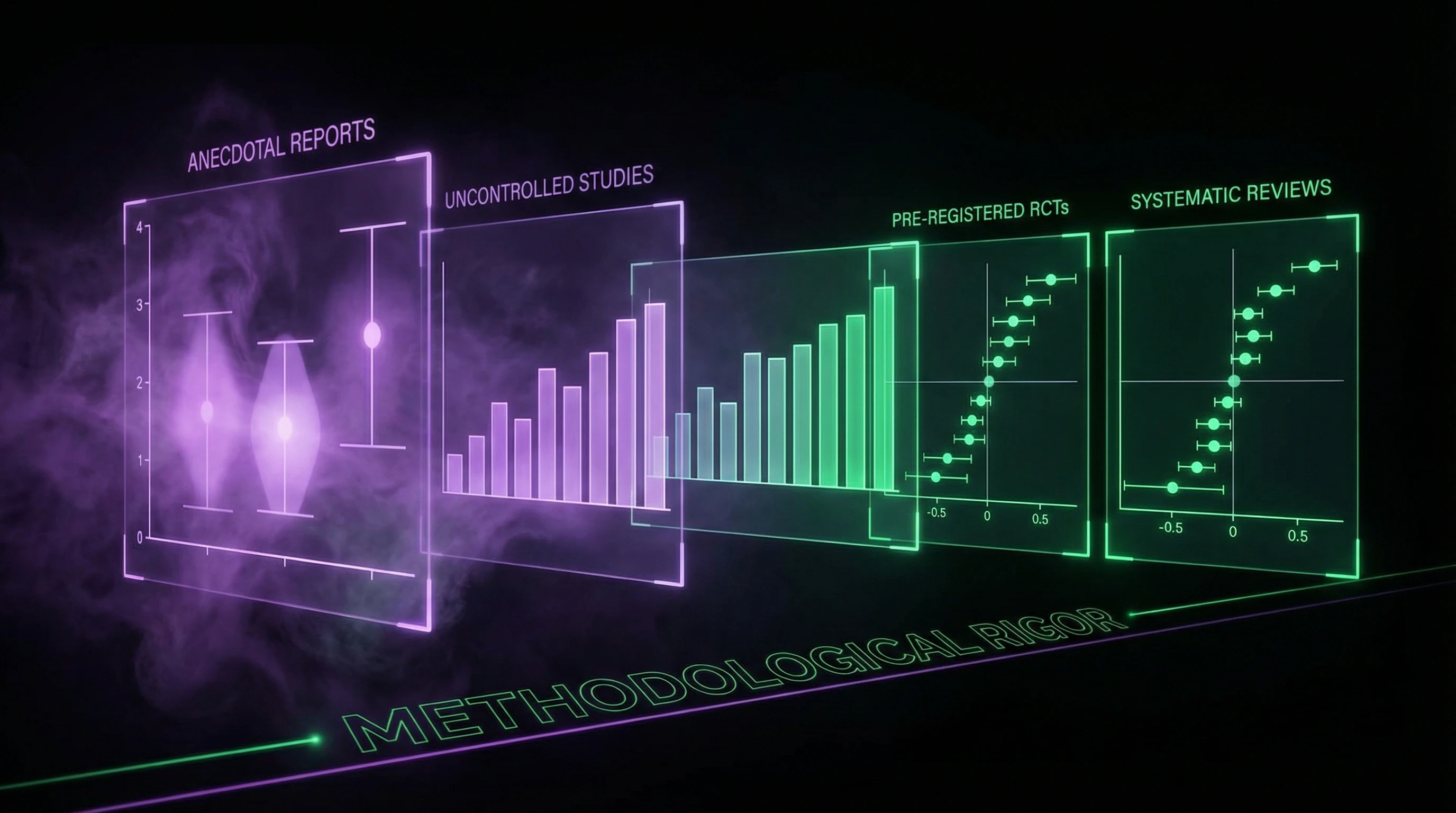
However, systematic reviews and meta-analyses accounting for publication bias and methodological flaws showed: the effect disappears under rigorous control and pre-registration of hypotheses. Studies with independent replication have not confirmed the existence of psychokinesis above chance level.
🧪 Visualization and Goal Achievement: Effect Exists, But Mechanism Is Behavioral
Psychological research on visualization shows mixed results. Meta-analyses in sports psychology confirm: mental training improves athletic performance, but the effect is mediated by improved motor planning, confidence, and reduced anxiety—all of which influence actual physical execution.
Research by Gabriele Oettingen revealed a paradox: positive fantasy about the future without a concrete action plan can reduce motivation and effort, as the brain perceives imagined success as already achieved. More effective is the technique of "mental contrasting"—visualizing the goal plus realistic assessment of obstacles and action planning.
📊 Affirmations: When They Help and When They Harm
Research on self-affirmations shows that statements about one's own values can reduce defensive reactions to threatening information and improve academic outcomes in at-risk groups.
However, a study by Joanne Wood and colleagues found: positive self-statements ("I love myself") can worsen mood in people with low self-esteem, as they create cognitive dissonance between the statement and internal belief. The effect of affirmations depends on context, content, and the person's initial state—there is no evidence they directly influence external events.
| Method | Claimed Effect | What Research Shows | Mechanism (if any) |
|---|---|---|---|
| Psychokinesis (RNG, dice) | Thought influences random events | No effect under rigorous control | Absent |
| Mental visualization | Imagination realizes goals | Improves sports performance | Motor planning, confidence |
| Positive affirmations | Thoughts attract events | Help with high self-esteem; harm with low | Cognitive dissonance or reduced defensiveness |
| Remote intention | Thought influences people at distance | No effect in double-blind conditions | Absent |
🧾 Systematic Reviews: Absence of Mechanism in Physics and Biology
Systematic literature reviews on proposed mechanisms of "thought energy" find no physical carrier. The brain generates electromagnetic fields (EEG, MEG), but their intensity falls proportionally to the square of distance and is too weak to influence objects beyond the skull at distances greater than a few centimeters.
There is no known physical field or particle that could transmit "thought vibrations" over macroscopic distances and selectively influence events according to thought content.
Quantum entanglement does not allow transmission of information or causal influence faster than light and is not applicable to warm biological systems due to decoherence. Attempts to link the law of attraction with quantum mysticism remain speculation without experimental support.
In contrast: research on the law of attraction as pseudoscience shows that the persuasiveness of this teaching is rooted not in physics, but in psychological mechanisms—selective attention, confirmation bias, and memory rewriting about coincidences.
Mechanisms and Causality: Why Correlation Between Thoughts and Events Doesn't Prove a Magical Connection
Even if a person observes correlation between their thoughts and subsequent events, this doesn't prove a causal relationship of the type "thought creates event." There are numerous alternative explanations that don't require postulating new physical laws and better align with known data. More details in the Logic and Probability section.
🧬 Confounders: Hidden Variables Explaining Correlation
A classic confounder is behavioral change. When a person begins practicing wealth visualization, they may simultaneously read more about finance, actively seek opportunities, work harder, and take risks. It's these actions, not the thoughts themselves, that increase the probability of financial success.
Another confounder is social environment: a person surrounded by successful people is more likely both to think about success and to have access to resources. A third is temporal trends: during periods of economic growth, many people become wealthier regardless of their thoughts, but those who practiced visualization attribute success to the practice.
| Confounder | Mechanism | Why It Looks Like Magic |
|---|---|---|
| Behavioral change | Thought → action → outcome | Person notices only thought and outcome, forgetting the action |
| Social environment | Environment → thoughts and resources simultaneously | Success attributed to thoughts rather than access to networks |
| Temporal trends | Economic cycle → success of everyone in group | Temporal coincidence with start of practice appears causal |
🔁 Reverse Causality: Events Influence Thoughts, Not Vice Versa
Often the direction of causality is opposite to what's claimed. A person begins thinking about an old friend not randomly, but because they subconsciously noticed indirect signals: a mutual acquaintance, a similar place, an anniversary of meeting.
The brain processes these signals before conscious awareness, creating the illusion of a spontaneous thought "magically" followed by a call. Similarly, a person may begin visualizing a promotion because they subconsciously picked up positive signals from management that actually predict the real promotion.
Thought is often not the cause of an event, but its premonition. The brain detects patterns faster than consciousness recognizes them.
🧷 Confirmation Bias and Selective Memory
People tend to remember hits and forget misses. If a person visualized a parking spot and found one, this is remembered as confirmation. If they visualized but didn't find one, this is rationalized ("didn't believe enough," "had blocks") or forgotten.
Research shows that in retrospective assessment, people overestimate the frequency of coincidences by 2–3 times compared to prospective diary records. Without a control group and blind protocol, it's impossible to separate real effect from systematic error.
- Person visualizes outcome
- Outcome occurs → remembered as confirmation
- Outcome doesn't occur → reinterpreted or forgotten
- Final memory: 80% hits instead of actual 50%
🧩 Illusion of Control and Causal Illusion
Psychologists document the "illusion of control"—the tendency to overestimate the degree of influence over random events. Ellen Langer's classic experiment: people are willing to pay more for a lottery ticket they chose themselves than for a randomly assigned one, even though the probability of winning is identical.
Visualization rituals create a sense of control over uncontrollable events, which reduces anxiety but doesn't change objective probabilities. "Causal illusion" arises when two events occur close in time: the brain automatically assumes a causal connection, even when none exists.
The sense of control is a powerful anxiolytic. But an anxiolytic doesn't change probabilities; it only changes perception.
Conflicts in Sources and Boundaries of Uncertainty: Where Data is Contradictory or Absent
Honest analysis requires acknowledging areas where the scientific community has not reached consensus or where data is insufficient for definitive conclusions. More details in the section Cognitive Biases.
🔎 Disputes Over Parapsychological Research Methodology
Within the parapsychological community, debates continue over whether meta-analyses demonstrate a small but real effect, or whether observed deviations from chance are explained by publication bias, p-hacking, and methodological artifacts.
Critics point out that the effect in meta-analyses correlates with methodological quality: the stricter the controls, the smaller the effect—a typical sign of an artifact. Proponents counter that some high-quality studies still show anomalies.
Mainstream scientific consensus: extraordinary claims require extraordinary evidence, and current data does not meet this threshold.
🔎 Uncertainty in Placebo and Nocebo Mechanisms
While the placebo effect is well documented, the precise mechanisms, especially for complex conditions (depression, chronic pain), remain subjects of research. Some studies show that placebo can influence objective biomarkers (immune indicators, neurotransmitters), others—that the effect is limited to subjective reports.
This creates space for speculation: if expectations influence biology, how far does this influence extend? However, even maximum estimates of the placebo effect do not extend beyond the organism and do not affect external physical systems.
- Placebo affects neurotransmitters and immune response within the body
- The effect does not extend to independent external events
- The boundary between psychosomatics and thought magic—is precisely here
🔎 Gaps in Research on Long-Term Effects of Visualization Practices
Most visualization studies are short-term (weeks or months) and focus on specific tasks (athletic performance, exams). There is little data on long-term effects (years) of regular visualization practice on life trajectories, well-being, and achievement of complex goals.
This makes it difficult to evaluate claims like "visualization changed my life over 5 years." Perhaps long-term practice has cumulative behavioral effects not captured by short-term studies, but this does not prove a magical mechanism.
| What is Known | What is Unknown | Why This Matters |
|---|---|---|
| Visualization improves short-term outcomes in specific tasks | Whether it affects life trajectories over 5+ years | Distinguishes behavioral effect from magic |
| Placebo affects subjective sensations and some biomarkers | Boundaries of this impact on complex systems | Defines where psychosomatics ends |
| Parapsychological meta-analyses show small effects | Whether these are artifacts or real phenomena | Determines whether new physics paradigms are needed |
Cognitive Anatomy of Belief: What Mental Traps Make the Law of Attraction So Convincing
The law of attraction doesn't rest on facts—it rests on the architecture of human thinking. The psychological mechanisms that support it operate independently of evidence—and that's precisely why it's so resilient. More details in the Abiogenesis section.
Belief in thought magic activates the same neural network patterns as religion, gambling, and romantic love. The brain seeks patterns, even where none exist.
Confirmation Bias and Selective Attention
People notice events that align with their expectations and forget those that contradict them. If you're waiting for a friend to call and they do—it's a "sign." If they don't—you simply don't remember the hundred days you waited and nothing happened.
Confirmation bias isn't a perceptual error. It's a survival filter. The brain conserves energy by noticing only what's relevant. The law of attraction simply rebranded this error as "magic."
Illusion of Control and Post-Hoc Narrative
When something good happens, people rewrite the story: "I attracted this with my thoughts." When something bad happens—they blame external circumstances or insufficient belief.
This isn't conscious deception. It's an automatic ego-protection mechanism. The brain constructs a narrative in which you're an agent, not a victim of chance.
Social Reinforcement and Network Effect
Millions believe in the law of attraction. This mass adoption itself becomes proof—not through logic, but through social consensus. Communities create closed ecosystems where doubt equals betrayal.
- You share success → community confirms your belief
- You stay silent about failures → they don't count
- Newcomers see only success stories → they join
- The cycle closes
Emotional Reward and Meaning
Belief in the law of attraction provides a sense of control over chaos. This is psychologically cheaper than accepting that much of life is randomness and luck. Meaning, even illusory, reduces anxiety.
Coincidences feel like signs because the brain is wired to find patterns. Quantum mechanics gets translated into mysticism because uncertainty sounds like possibility.
Why This Works Against Criticism
Any objection gets incorporated into the belief system. You're skeptical? Your vibration is low. You ask for evidence? You don't believe enough. The system is hermetic—criticism becomes confirmation.
The law of attraction isn't a theory that can be disproven. It's a psychological trap that flips any objection in its own favor.
Understanding these mechanisms doesn't mean contempt for believers. It means that escaping the trap requires not logic, but restructuring the emotional reward system.