Karma and Reincarnation: Eastern Philosophy, Scientific Research, and Criticismλ
An exploration of karma and reincarnation concepts through Eastern traditions, Christian theology, parapsychological experiments, and contemporary philosophical debates on soul rebirth.
Overview
Karma and reincarnation — mechanisms of cause-and-effect and soul rebirth that the Indian tradition has developed over millennia. Parapsychologists seek empirical evidence 🧩 of past-life memories, Christian theologians point to incompatibility with resurrection, philosophers debate the nature of personal identity. We examine the logic of these concepts, Ian Stevenson's research methods, and the boundaries of applying Eastern models in Western contexts.
🛡️
Laplace Protocol: Analysis based on academic sources, including peer-reviewed articles, theological studies, and parapsychological research. Multiple perspectives presented without privileging one tradition, distinguishing religious beliefs from empirical claims.
Reference Protocol
Scientific Foundation
Evidence-based framework for critical analysis
Protocol: Evaluation
Test Yourself
Quizzes on this topic coming soon
⚡
Deep Dive
Indian Roots of Karma and Reincarnation: From the Vedas to Modern Times
The concepts of karma and reincarnation originated in the Indian religious tradition and have no historical connection to early Christianity. These ideas developed over millennia within Vedic philosophy, gradually evolving from simple notions of postmortem existence to complex metaphysical systems.
The early Christian church consistently rejected these concepts, as documented in patristic texts.
Vedic Origins and Sanskrit Terms
The term "karma" (Sanskrit: कर्म) literally means "action" or "deed" and first appears in early Vedic texts as a designation for ritual actions. Over time, the concept expanded to encompass all physical, mental, and spiritual actions that create impressions (samskaras), which influence future incarnations.
- Punarjanma (पुनर्जन्म)
- Literally "new birth" — the mechanism of cyclical rebirth governed by accumulated karma.
- Samsara (संसार)
- Cyclical existence, the cycle of births and deaths from which liberation is sought.
These concepts became fundamental to Hindu, Buddhist, and Jain philosophies, though their interpretations differ substantially.
Karma as a Universal Law of Causality
Karma functions not as a system of simple moral retribution, but as a complex web of cause-and-effect relationships spanning multiple lifetimes. Each action generates consequences that may manifest immediately, in the current life, or in future incarnations.
| Common Understanding | Actual Mechanism in Traditions |
|---|---|
| Karma as fatalistic determinism | Karma as a network of causality with potential for transformation through conscious action |
| Inevitable punishment for sins | Natural consequences that can be redirected through free will |
Cycles of Rebirth and Liberation
Reincarnation represents not endless repetition, but a process with an ultimate goal — liberation (moksha, nirvana) from the cycle of births and deaths. The conditions of each new incarnation are determined by the accumulated karma of previous lives, creating a unique combination of circumstances for spiritual growth.
Modern Indian entrepreneurs study the philosophy of karma and reincarnation as part of their cultural heritage, which influences their business ethics and decision-making processes.
Three Incompatible Models: Hinduism, Buddhism, and Jainism
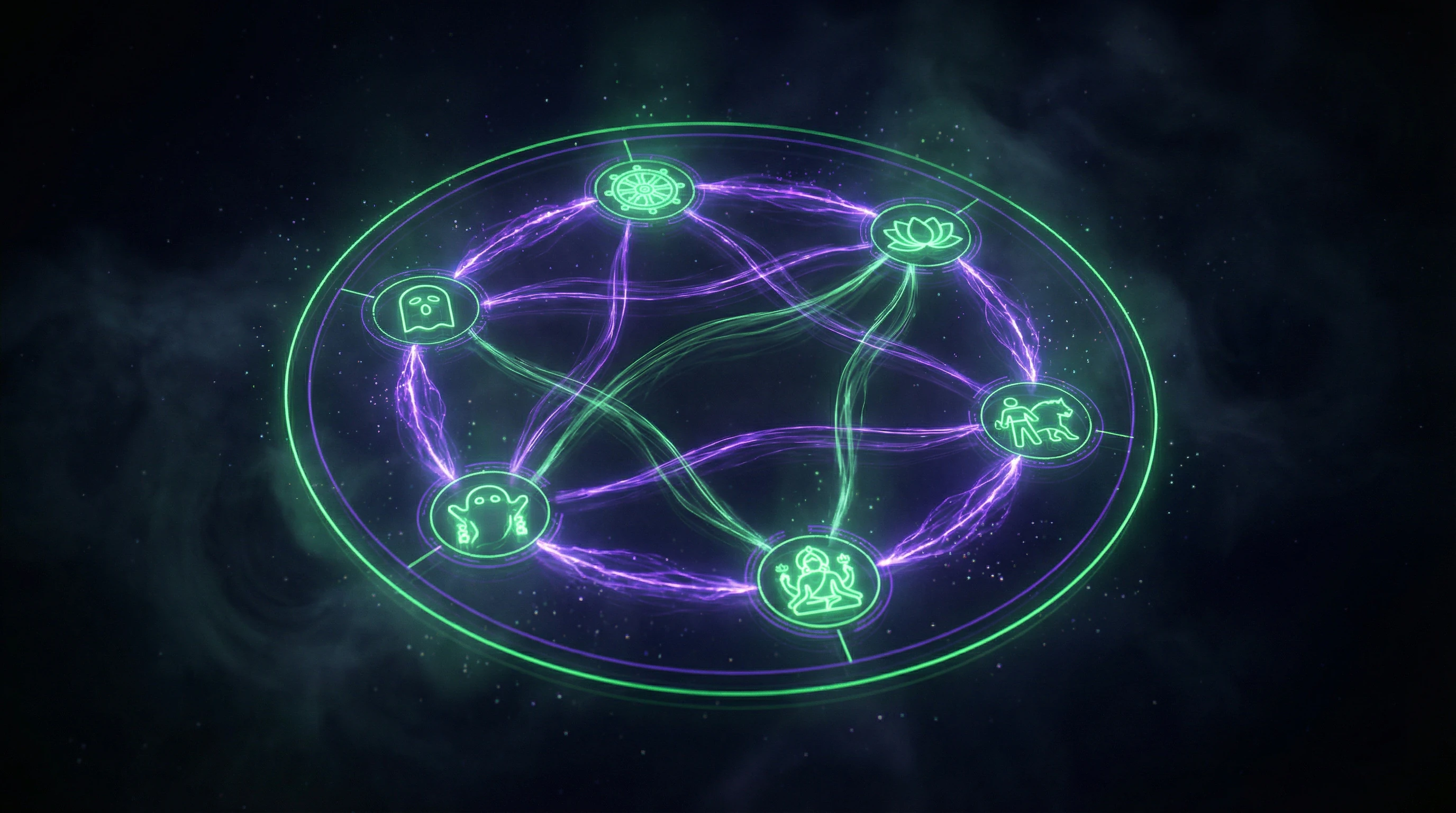
Eastern teachings on karma and reincarnation appear uniform only on the surface. In reality, they diverge on fundamental questions: what exactly reincarnates, how karma works, and where it leads.
Hindu Atman and the Path to Moksha
In Hinduism, what reincarnates is the eternal soul—atman, which is essentially identical to absolute reality (Brahman). Karma accumulates as a result of actions performed in ignorance of one's true nature and determines the next incarnation—from divine realms to animal forms.
Moksha (liberation) comes through realizing the identity of atman and Brahman, which breaks the cycle of rebirth. Different schools of Hinduism offer different routes to this knowledge.
- Jnana yoga: liberation through direct knowledge of atman's nature
- Bhakti yoga: devotion to deity as a path to union with Brahman
- Karma yoga: selfless action without attachment to results
Buddhist Anatta: Rebirth Without a Soul
Buddhism denies the existence of a permanent soul (anatta). This creates a paradox: what reincarnates if there is no unchanging essence?
The answer—a stream of consciousness (santana), where each moment is causally connected to the next, like one candle lighting another. Karma here is the intention (cetana) behind an action, not the action itself.
Buddhism solves the problem of rebirth without a soul through causality: consciousness of one moment generates consciousness of the next, without requiring a permanent carrier.
The emphasis shifts to psychology and ethics. The goal—nirvana, complete cessation of suffering through elimination of the thirst for existence.
Jainism and Material Karma
Jainism interprets karma as a subtle material substance that literally adheres to the soul (jiva) as a result of actions. This matter obscures the jiva's original omniscience and bliss.
Liberation requires strict asceticism and non-violence (ahimsa) to "burn off" accumulated karma. This is the most demanding of the three systems—Jain monks and nuns observe discipline that appears extreme even by the standards of other Eastern traditions.
| Tradition | What Reincarnates | Nature of Karma | Path to Liberation |
|---|---|---|---|
| Hinduism | Atman (eternal soul) | Result of actions in ignorance | Realization of unity with Brahman |
| Buddhism | Stream of consciousness (santana) | Intention (cetana) behind action | Nirvana through elimination of thirst |
| Jainism | Jiva (soul) | Material substance | Asceticism and non-violence |
Sikhism: Synthesis and Divine Grace
Sikhism synthesizes elements of Hinduism and Islam, acknowledging reincarnation but emphasizing the role of divine grace (guru) in liberation from the cycle of births. This brings it closer to theistic traditions, where salvation depends not only on one's own efforts.
Christian Theology versus Eastern Metaphysics
Orthodox and Catholic theologies reject karma and reincarnation as incompatible with fundamental Christian doctrines. This opposition is based on profound metaphysical and soteriological differences.
Claims that reincarnation was removed from the Bible at church councils lack historical foundation and are refuted by patristic scholarship.
Bodily Resurrection versus Transmigration of Souls
Christian doctrine of resurrection affirms a single earthly life, followed by bodily resurrection and eternal existence in a transformed body. This radically contradicts the idea of multiple incarnations in different bodies.
The Apostle Paul: "it is appointed for man to die once, and after that comes judgment" (Hebrews 9:27). This excludes cyclical rebirths.
Resurrection implies preservation of personal identity and continuity of consciousness, whereas reincarnation in most traditions assumes forgetting of previous lives.
Linear Time and Eschatological Perspective
Christianity is founded on a linear conception of time: creation → incarnation of Christ → Second Coming and Final Judgment. This teleological structure is incompatible with the cyclical time of samsara.
| Christian Model | Eastern Cyclical Model | ||
|---|---|---|---|
| Each life possesses unique value and irreversible consequences | Multiple opportunities to correct mistakes in future lives | Existential urgency of moral choice | Extended responsibility across cycles of birth |
Grace versus Karmic Justice
A fundamental difference in the mechanism of salvation: Christianity proclaims salvation through divine grace, not through one's own merits. Karma represents an impersonal law of cause and effect.
The concept of forgiveness of sins through repentance and faith contradicts the karmic principle of inevitable retribution for every action.
- Grace — a transcendent act of God's will, independent of human merit
- Karma — an immanent mechanism operating automatically without external intervention
- Repentance in Christianity can change spiritual status; in the karmic system it only mitigates future consequences
Early Church Fathers — Irenaeus of Lyons and Tertullian — explicitly criticized teachings on transmigration of souls as incompatible with the Gospel. Historical documents do not confirm the existence of reincarnation beliefs in orthodox Christianity of the first centuries.
Parapsychological Research and Empirical Verification Attempts
Hiroshi Motoyama's Work and Experimental Approach
Japanese parapsychologist Hiroshi Motoyama documents spontaneous past-life memories, measures psychophysiological parameters during meditation, and analyzes birthmarks as traces of trauma from previous incarnations.
Motoyama claims to have collected experimental data supporting reincarnation, but his methodology remains subject to criticism in the academic community.
Past-Life Memory Cases and Their Documentation
Research focuses on childhood cases: a child reports details about an alleged past life, which are then verified. Such cases occur more frequently in cultures where reincarnation is part of the religious worldview.
The cultural origin of memories is inseparable from their content: in societies without belief in reincarnation, children do not report past lives.
Critics point to cryptomnesia (hidden memories from heard stories), confabulation, and unintentional suggestion by researchers or relatives.
The absence of controlled conditions excludes alternative explanations and turns each case into an anecdote rather than evidence.
Methodological Problems of Verification
Empirical verification of reincarnation faces fundamental limitations:
- Continuity of consciousness between incarnations. It is impossible to establish that one person's consciousness transferred to another—there is no identity criterion for an immaterial subject.
- Criteria for memory authenticity. There is no objective way to distinguish genuine memory from fantasy or suggestion.
- Falsifiability. The hypothesis cannot be disproven—any result is interpreted in its favor.
- Reproducibility. Phenomena do not repeat under controlled conditions according to academic science standards.
These limitations make reincarnation a scientifically unverifiable hypothesis and explain why parapsychological research does not receive recognition in the scientific community.
Philosophical Problems and Paradoxes of the Karmic System
The Problem of Personal Identity Continuity
The central paradox of reincarnation: what exactly transfers between incarnations if memory, character, and psychology are not preserved? In what sense does the reincarnating entity remain the same person?
The Buddhist concept of anātman (absence of a permanent "self") sharpens the problem—if there is no unchanging soul, what is reborn?
| Tradition | Transfer Mechanism | Problem |
|---|---|---|
| Hinduism | Ātman as unchanging substance | Contradicts experience—we don't perceive a permanent "self" |
| Buddhism | Stream of consciousness (vijñāna) without subject | How does the stream remain identical without a substrate? |
| Jainism | Jīva (soul) through karma as matter | Karma as physical substance—metaphysical leap |
No solution satisfies Western analytic philosophy, which demands logical consistency.
Free Will versus Karmic Determinism
Karma creates a sharp contradiction: if current circumstances are determined by past actions, how free is choice in the present?
Most traditions offer a compromise: karma determines conditions, but not the response to them. However, this distinction remains philosophically vulnerable—especially for the first action, which was supposedly free but already determined the entire subsequent chain.
Strict determinism eliminates moral responsibility. If I couldn't have acted otherwise, why am I at fault?
Theodicy and the Justice of Suffering
Karma is often positioned as a solution to the problem of evil: suffering is the result of one's own past actions, the universe is just. But this creates moral traps.
- An infant suffers because of actions in a forgotten past life—is this justice or arbitrary punishment?
- The concept of karmic debt has historically justified social passivity and the caste system.
- Structures of inequality were conveniently explained as "deserved," blocking critical thinking.
Epistemological Limitations
The fundamental problem: it is impossible to verify karmic claims. The absence of reliable access to information about past lives makes it impossible to test causal connections between past actions and current circumstances.
Interpretation of life events as karmic consequences remains subjective and unverifiable—opening the door to arbitrary explanations and self-deception. Karma becomes a matter of faith, not knowledge in the strict sense.
Modern Applications and Cultural Influence of the Concepts
Karma in Business Ethics of Indian Entrepreneurs
Indian entrepreneurs integrate karma and reincarnation into education and business practice. The karmic principle shapes long-term strategic thinking, ethical decisions, and partnership relationships.
For international business, understanding these concepts becomes an element of cultural competency. Critics point out: business applications of karma often simplify complex philosophical teachings into a tool for reputation management and long-term benefit.
Psychotherapeutic Regression Practices
Past life therapy uses hypnotic regression to access supposed memories of past incarnations. Proponents claim effectiveness for phobias, relationship patterns, and psychosomatic symptoms.
Scientific psychology views these "memories" as confabulations created under hypnosis. They may have therapeutic value as metaphors, but are not genuine memories.
The risk is concrete: creating false memories and distracting from real problems requiring evidence-based treatment methods.
Popular Culture and Neo-Hinduism in the West
Western popular culture adapts karma and reincarnation, transforming their original meaning. Karma is simplified to "what goes around comes around" within a single lifetime, losing connection to the cycle of rebirth and spiritual liberation.
Reincarnation is romanticized as an opportunity for spiritual growth without emphasis on the suffering of samsara, from which Eastern traditions seek liberation. This adaptation creates hybrid forms of belief—"neo-Hinduism" or New Age spirituality, differing from traditional Indian teachings in both content and function.
- Western version: karma as justice within one lifetime, a mechanism of personal responsibility.
- Eastern tradition: karma as the law of causality through multiple incarnations, a system of spiritual debt.
- Western version: reincarnation as an opportunity for growth and self-improvement.
- Eastern tradition: reincarnation as a cycle of suffering (samsara), from which one must be liberated through enlightenment.
- Result: two incompatible systems under one name, each solving different psychological and cultural tasks.
Knowledge Access Protocol
FAQ
Frequently Asked Questions
Karma is the law of cause and effect in Eastern philosophy, according to which all human actions (physical, mental, spiritual) create consequences that affect future lives. It is not a system of punishments and rewards, but a complex network of cause-and-effect relationships. Karma serves as the driving force determining the conditions of subsequent incarnations.
In Hinduism, an eternal soul (atman) is reborn, striving for liberation (moksha), whereas Buddhism denies the existence of a permanent soul. The Buddhist concept describes rebirth as a continuous stream of consciousness without an unchanging essence. These differences are fundamental, despite the common cultural roots of both traditions.
Christian doctrine is based on a single life, followed by bodily resurrection and eternity, which is incompatible with cyclical rebirths. The early Church consistently rejected reincarnation, contrasting divine grace with karmic justice. Claims about reincarnation being removed from the Bible are historically unfounded.
No scientific consensus exists regarding evidence of reincarnation. Parapsychologists like Hiroshi Motoyama investigate cases of past-life memories, but methodological problems of verification remain unresolved. Most scientists remain skeptical of such claims due to the absence of reproducible experimental data.
Most Eastern traditions emphasize the presence of free will and the possibility of transforming karma through conscious actions. Karma is not rigid determinism, but represents tendencies and predispositions that can be changed. It is a common misconception that karma means inevitable fate.
Some traditions claim that through meditation and spiritual practices, one can access memories of past incarnations. Parapsychologists document cases of spontaneous memories, especially in children. However, epistemological limitations make objective verification of the authenticity of such memories impossible.
The concept of karma influences ethical decisions, business practices, and interpersonal relationships in cultures where it is prevalent. Indian entrepreneurs study karma philosophy for business decision-making. In Western contexts, the idea of karma is often adapted as a principle of personal responsibility for one's actions.
Different traditions describe intermediate states differently: Tibetan Buddhism speaks of bardo, Hinduism of various lokas (worlds). The duration and nature of this period depend on accumulated karma. Details vary greatly even within a single religious tradition.
No, this is a widespread myth without historical basis. The early Church never included reincarnation in Christian teaching, and there is no evidence of its removal from canonical texts. Christian doctrine was based on resurrection, not rebirth, from the very beginning.
In classical Hinduism and Buddhism, rebirth in animal forms is considered a possible result of negative karma. However, modern interpretations often view this metaphorically, as states of consciousness. Jainism particularly emphasizes the possibility of incarnation in all life forms.
Some traditions recognize collective karma that connects groups of people through shared actions and consequences. Families may share karmic bonds that explain recurring patterns or joint incarnations. This concept is less developed in classical texts and appears more prominently in modern interpretations.
The number of rebirths is not fixed and depends on spiritual progress and resolution of karmic debts. The cycle continues until liberation is achieved (moksha, nirvana), which may take countless lifetimes. Some traditions speak of millions of incarnations before final liberation.
Karma theory offers an explanation through actions in past lives, asserting that current suffering results from previous deeds. This solution to the problem of theodicy differs from the Christian approach through the fall and redemption. Critics point out that this can lead to justification of social injustice.
Most Eastern traditions assert that spiritual practices, including meditation, can transform karmic patterns. Mindfulness and intentional actions create new positive karma, weakening the influence of the past. However, complete liberation requires not only practice but also deep understanding of the nature of reality.
Moksha is liberation from the cycle of rebirth (samsara) in the Hindu tradition, the ultimate goal of spiritual development. Achieving moksha means cessation of karmic accumulations and merging with absolute reality (Brahman). This state transcends individual existence and the cycles of birth and death.
Methodological problems of verification include the impossibility of independently confirming subjective experience and the risk of false memories. Researchers attempt to verify specific details through historical records, but cultural contamination and cognitive biases remain serious obstacles. Epistemological limitations make definitive verification practically impossible.