
What is Reality Shifting: From TikTok Trend to Metaphysical Doctrine with Millions of Followers
Shifting (reality shifting, "reality shift") is a mental practice that, according to its proponents, allows one to "shift consciousness" from Current Reality (CR) to Desired Reality (DR) (S005). Practitioners claim this isn't merely vivid dreaming or visualization, but literal relocation to a parallel universe where they can interact with fictional characters, alter events, and live alternative lives (S003).
⚠️ Core Terminology of Shifting Communities: How Practitioners Describe Their Practice
The shifter community has developed an extensive conceptual framework that functions as both a language of belief and action coordination. More details in the section Chakras, Aura and Energy.
- Desired Reality (DR)
- The world or universe the practitioner aims to "shift into" (S005). Typically a fictional world from movies, books, games, or anime.
- Current Reality (CR)
- The reality where a person is physically located right now (S005).
- "Script"
- A detailed written description of the desired reality: characters, locations, storylines, physical sensations, world rules (whether characters can die, feel pain, age) and even a "safe word" for emergency return to CR (S004).
🧩 "Shifting" Methods: From Meditation to Hypnagogic States
Practitioners use dozens of methods, most based on meditation, visualization, and attempts to enter altered states of consciousness at the boundary between sleep and wakefulness.
- Raven Method: lying in starfish position, counting to 100 while visualizing the desired reality
- Pilot Method: imagining oneself as a pilot flying to DR
- Alice in Wonderland Method: visualizing chasing a character and falling down a rabbit hole (S006)
Achieving "hypnagogic symptoms" is considered key—rapid heartbeat, goosebumps, sensations of flying or falling, light flashes, limb numbness—which are interpreted as signs of successful "shifting" (S004).
📊 Scale of the Phenomenon: From Niche Practice to Viral Movement
Shifting as a mass phenomenon emerged in 2020, predominantly on English-language TikTok, and rapidly spread to Russian-language platforms (S005). Hashtags #shifting and #realityshifting have accumulated billions of views.
Specialized wikis, Reddit communities with hundreds of thousands of members, Telegram channels, and Discord servers have been created (S003, S004). The practice is especially popular among teenagers aged 13-19, predominantly girls, many seeking to "shift" into worlds of popular franchises—Harry Potter, anime universes, K-pop groups, Marvel (S004, S006).
This isn't a marginal phenomenon: shifting and dissociation have become topics of discussion in the context of adolescent mental health. Simultaneously, a content industry is growing—from guides and meditations to courses in esoteric practices that monetize belief in the possibility of consciousness shifting.
Steelman Argumentation: Seven Most Convincing Arguments from Shifting Proponents — and Why They Seem Plausible
Before analyzing the scientific invalidity of shifting, it's necessary to honestly examine the strongest arguments of its proponents. This is not a straw man, but real arguments that convince millions of people. More details in the section Crystals and Talismans.
🧠 Argument from Subjective Experience: "I Was There, It Was More Real Than Reality"
Thousands of practitioners report experiences of exceptional vividness and realism — more detailed than ordinary dreams, with a full range of sensory perceptions (smells, tastes, tactile sensations, temperature). They describe coherent narratives lasting subjectively days or weeks, the ability to make decisions and interact with "characters" who demonstrate autonomous behavior.
This argument is strong because subjective experience is indeed irrefutable for the person experiencing it — no one can prove that a person "didn't feel" what they felt.
🕳️ Argument from Quantum Mechanics and Multiverse Theory
Shifting proponents often cite the many-worlds interpretation in quantum mechanics and popular science fiction multiverse concepts, claiming that if parallel realities exist physically, then consciousness could theoretically "tune in" to another frequency or dimension. This argument exploits real scientific uncertainty and the complexity of quantum theory, making metaphysical claims more plausible to non-specialists.
| Argument | Psychological Strength | Logical Vulnerability |
|---|---|---|
| Mass testimony | Collective validation, consistency of descriptions | Argumentum ad populum; social contagion |
| Lucid dreaming as precedent | Based on scientifically recognized phenomenon | Unjustified leap from dream to parallel reality |
| Structured methodologies | Impression of systematic knowledge | Unfalsifiability (failure explained by practitioner error) |
| Therapeutic effect | Real psychological benefit | Doesn't prove truth of metaphysical claims |
📊 Argument from Mass Appeal: "Millions of People Can't Be Wrong"
The enormous quantity of "successful shift" testimonials, thousands of detailed reports, consistency in descriptions of methods and symptoms create an impression of collective validation. If so many people independently report similar experiences, doesn't that indicate the phenomenon is real?
This argument is psychologically strong, though logically it represents the classic argumentum ad populum fallacy. Mass belief doesn't correlate with truth — it's a matter of social contagion mechanisms and monetization of esoteric practices.
🧬 Argument from Lucid Dreaming: "Science Recognizes Dream Control"
Practitioners often point out that lucid dreaming is a scientifically confirmed phenomenon in which a person becomes aware they're dreaming and can control dream content. If lucid dreams are real, why should shifting, which uses similar techniques, be impossible?
This argument is strong because it genuinely relies on a scientifically recognized phenomenon, though it makes an unjustified leap from it. Neuroscience confirms lucid dreams, but not transitions to parallel realities.
⚙️ Argument from Methodology Reproducibility: "Techniques Work for Everyone Who Practices Correctly"
The community has developed detailed, step-by-step protocols that supposedly allow anyone to achieve a "shift" with sufficient practice. The existence of structured methodologies, terminology, and training materials creates an impression of systematic knowledge analogous to scientific or technical disciplines.
If the methodology doesn't work, it's explained by insufficient practice, incorrect execution, or psychological blocks — making the claim unfalsifiable and protected from criticism.
🧩 Argument from Therapeutic Effect: "It Helps People Cope with Reality"
Many practitioners report positive psychological effects: reduced anxiety, improved mood, enhanced creativity, sense of control over life. If the practice brings real benefits, doesn't that testify to its value, regardless of metaphysical claims?
This argument is pragmatically strong, though therapeutic effect doesn't prove the truth of underlying claims. Placebo also works, but that doesn't make its mechanism real.
👁️ Argument from Epistemological Skepticism: "You Can't Prove It Doesn't Work"
Some proponents take a radically skeptical position: if we can't definitively prove the nature of reality and consciousness, who can confidently claim shifting is impossible? This argument exploits real philosophical problems (the problem of solipsism, the hard problem of consciousness) and reverses the burden of proof, demanding skeptics prove a negative claim.
The strength of these arguments lies not in their logical correctness, but in the fact that each contains a kernel of real uncertainty — and this kernel becomes an entry point for persuasion. This is precisely why shifting convinces millions: it's not completely irrational, but strategically ambivalent.
Evidence Base: What Science Says About "Consciousness Shifting" and Why All Evidence Points to Illusion
Despite millions of subjective reports, there is not a single scientifically documented case of shifting that has withstood controlled verification. All available data indicate that shifters' experiences represent a combination of lucid dreaming, hypnagogic hallucinations, and intense visualization, rather than literal movement into parallel universes. For more details, see the section on Occultism and Hermeticism.
🧪 Absence of Objective Evidence: The Verification Problem
The key problem with all shifting claims is the complete absence of objective, verifiable evidence. All "testimony" is based exclusively on subjective reports that cannot be independently verified (S001).
No practitioner has been able to bring back from their "desired reality" information they could not have known beforehand—a new mathematical proof, unknown historical facts, predictions of future events. All descriptions of "other realities" fully correspond to content already known to the practitioner from books, films, and games (S004).
📊 Neurobiology of Lucid Dreaming: What Actually Happens in the Brain
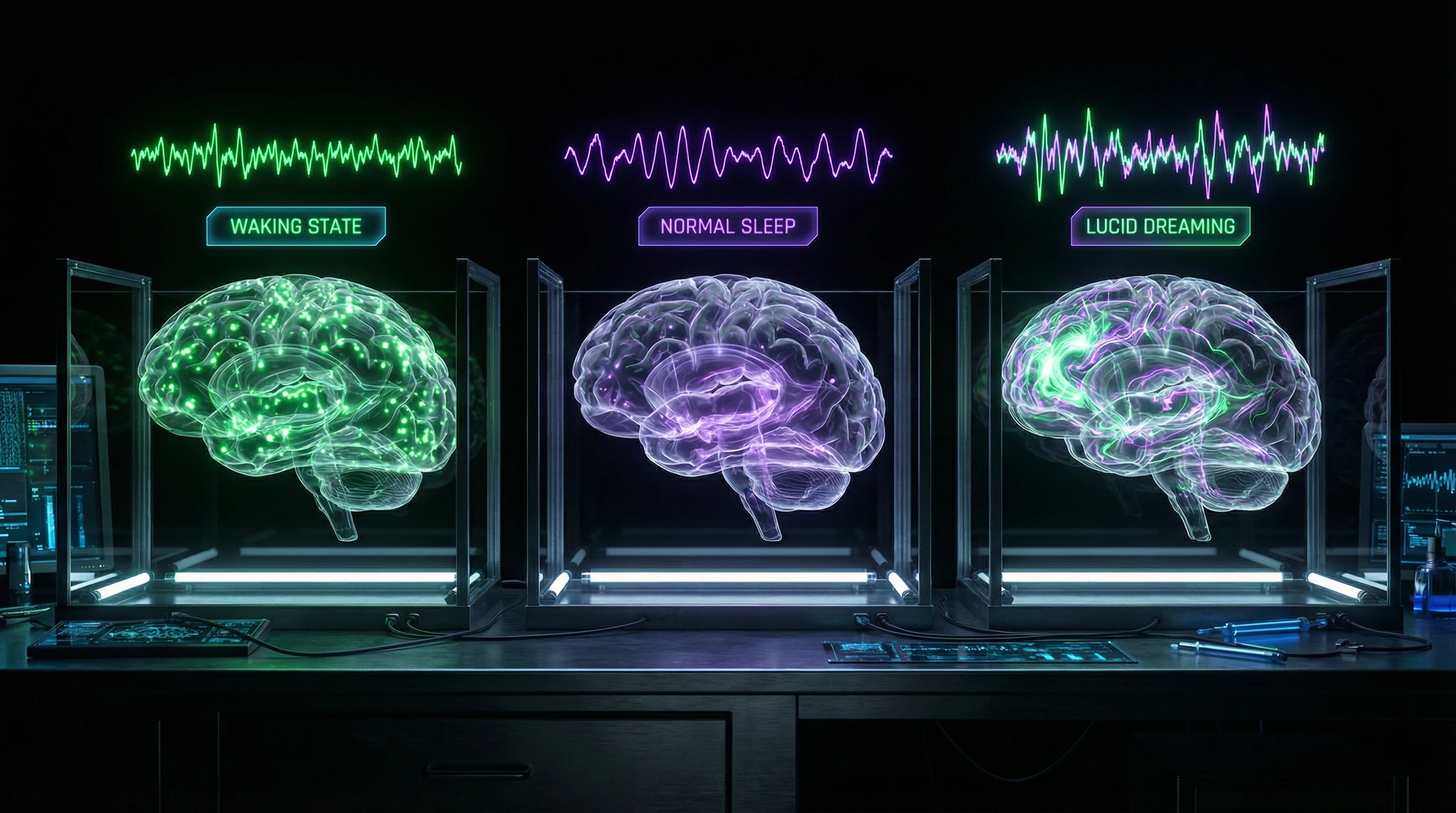
Lucid dreaming is a real and well-studied phenomenon in which specific brain regions are activated: the dorsolateral prefrontal cortex (associated with metacognition and self-awareness) demonstrates increased activity during lucid dreams compared to ordinary dreams (S007), (S008).
Studies using EEG and fMRI show that lucid dreaming occurs predominantly during REM sleep, is characterized by specific patterns of brain activity, and can be objectively recorded through pre-agreed eye signals (S008). All shifting techniques are aimed at inducing precisely this state, not some fundamentally different phenomenon.
Shifting techniques are lucid dreaming induction methods repackaged in metaphysical narrative. The neural mechanism remains unchanged.
🧬 Hypnagogic Hallucinations: The Physiology of "Transition Symptoms"
"Symptoms" that shifters interpret as signs of successful "transition"—rapid heartbeat, goosebumps, sensation of falling, flashes of light, sleep paralysis, limb numbness (S004)—represent well-known hypnagogic and hypnopompic phenomena that occur at the boundary between wakefulness and sleep.
These experiences are related to desynchronization of various brain systems during falling asleep or waking and do not indicate any "movement" of consciousness (S008). They are universal to human physiology and occur in people who have never heard of shifting.
| Shifter Interpretation | Physiological Mechanism | Prevalence |
|---|---|---|
| "Vibrations"—sign of energy channel activation | Hypnagogic jerks, muscle microcontractions during sleep transition | 60–70% of population |
| "Sleep paralysis"—physical body blockage | Muscle atonia in REM phase, dissociation between consciousness and motor control | 40–50% of population at least once in lifetime |
| "Flashes of light"—entry into another reality | Phosphenes, spontaneous visual cortex activation with closed eyes | Universal |
| "Sensation of falling"—beginning of flight | Hypnopompic reflex, evolutionary artifact | 70% of population |
⚠️ The Problem of Unfalsifiability: Why Shifting Is Not a Scientific Hypothesis
Shifting claims are formulated in such a way that they cannot be disproven. If a "transition" fails, this is explained by insufficient practice, incorrect technique, psychological blocks, or "wrong timing" (S002), (S005).
If someone claims to have "shifted" but cannot provide objective evidence, this is explained by "evidence being impossible by the nature of the phenomenon" or that "skeptics simply don't understand" (S001). This argumentative structure makes the claim unfalsifiable and therefore unscientific by Popper's criterion.
- Formulate a prediction: "If shifting is real, a practitioner should bring back information unavailable in their current reality."
- Conduct a controlled test: ask a shifter to provide verifiable data.
- Record the result: none of the known cases have passed this verification.
- Conclusion: the claim does not meet the criteria of a scientific hypothesis.
🧾 Metaphysical Claims Without Mechanism: The "How" Problem
Even if we accept the existence of parallel universes (which remains a speculative hypothesis in physics), shifting proponents offer no plausible mechanism by which consciousness could "move" between them.
Consciousness, as far as we know, is a product of physical brain activity—specific patterns of neural activity, neurotransmitters, electrochemical processes (S001). The claim that it can exist independently of the brain and "move" to other universes through meditation contradicts everything we know about neurobiology and is not supported by any empirical data.
🔎 Analysis of "Successful" Reports: Patterns Indicating Dreams
Detailed analysis of "successful transition" reports reveals characteristic signs of dreams rather than alternative realities: instability of details (environmental elements change inconsistently), violations of logic and physics (flight, teleportation, impossible events), memory gaps, "characters" acting according to the practitioner's expectations rather than demonstrating genuine autonomy (S004).
All these characteristics are typical of dreams and absent in the perception of objective reality. For more on the mechanisms that make this illusion convincing, see the analysis of dissociation and shifting.
The Mechanism of Illusion: Why the Brain Creates the Experience of "Another Reality" and How It Works at the Neural Level
Understanding why shifting feels real to practitioners requires diving into the neurobiology of consciousness, dreams, and the brain's mechanisms for constructing reality. More details in the section Epistemology Basics.
🧬 The Constructive Nature of Perception: The Brain as Reality Generator
A fundamental fact of neuroscience: the brain doesn't passively "record" reality, but actively constructs it from sensory data, memory, expectations, and predictions.
Perception is a controlled hallucination, constantly corrected by sensory input (S008). During sleep, sensory input is minimal, and the brain generates experiences almost entirely from internal sources—memory, emotions, expectations. Shifting techniques intentionally amplify this process through intense visualization and emotional engagement before sleep.
🔁 The Role of Expectation and Self-Suggestion: The Placebo Effect of Consciousness
Detailed scripting of the desired reality, repeatedly reading it, visualizing before sleep creates powerful expectations that shape the content of subsequent dreams (S004, S005).
This isn't a mystical process, but a well-known mechanism: what we intensely think about before sleep is highly likely to appear in dreams. The conviction that a "shift" will occur, combined with lucid dream induction techniques, creates a self-fulfilling prophecy at the level of dream content.
| Process Stage | Neurobiological Mechanism | Result for Practitioner |
|---|---|---|
| Script preparation | Prefrontal cortex activation, expectation formation | Brain "prepares" for specific dream content |
| Pre-sleep visualization | Enhanced activity in visual cortex and hippocampus | Images become more vivid and accessible for dreams |
| Sleep onset | Decreased dorsolateral prefrontal cortex activity | Weakened critical thinking, acceptance of dream as reality |
| Dreaming | Content generation from memory and expectations | Experience of "another reality" as genuine event |
🧷 Critical Thinking Deficit in Altered States of Consciousness
During dreams, especially non-lucid ones, the dorsolateral prefrontal cortex—the brain region responsible for logical thinking, critical evaluation, and metacognition—shows reduced activity (S007).
This explains why in dreams we accept absurd events as normal and don't notice logical contradictions. Even in lucid dreams, where metacognition is partially restored, critical thinking remains weakened, allowing practitioners to interpret the dream as "another reality" without noticing signs indicating its nature.
- Logic doesn't work in dreams: events follow without causal connection, but are perceived as normal.
- Critical evaluation is disabled: the practitioner doesn't ask questions like "how did I get here?" or "is this physically possible?"
- Memory of reality is blurred: the boundary between "here" and "there" dissolves, strengthening belief in the reality of the experience.
- Awakening creates a disconnect: upon waking, the practitioner remembers the dream as a separate event, not as a dream.
⚙️ Emotional Valence and Belief Reinforcement
Shifting is often associated with intense positive emotions—joy of meeting beloved characters, feelings of freedom and control, escapism from real-life problems (S006, S007).
Emotionally charged experiences are remembered more vividly and seem more "real" in retrospect. The amygdala and hippocampus, brain structures responsible for emotional memory, enhance consolidation of such memories, making them subjectively more significant than ordinary dreams (S008).
Emotion is not a byproduct of memory, but its anchor. The brain remembers not what happened, but what it felt. For a teenager experiencing loneliness or dissatisfaction with reality, an emotionally charged dream about "another universe" becomes more convincing evidence than logic.
Repeated "successful" shifts (dreams matching expectations) create positive reinforcement: the practitioner believes the technique works, and this belief strengthens expectations before the next attempt. The cycle closes: expectation → dream matching expectation → belief reinforcement → stronger expectations.
The connection to dissociation and altered states of consciousness becomes critical for understanding why some teenagers lose the boundary between dream and reality. More about the neurobiology of this process in the neuroscience section.
Cognitive Anatomy of Belief: What Psychological Mechanisms Make Shifting So Convincing to Millions
The popularity of shifting is not coincidental or mass delusion. It's the result of convergence of multiple powerful cognitive predispositions and socio-psychological factors. More details in the Logic and Probability section.
🕳️ Escapism as an Adaptive Strategy in an Era of Chronic Stress
Shifting exploded in popularity in 2020—during the height of the COVID-19 pandemic, lockdowns, social isolation, and mass uncertainty. For teenagers whose social lives and development were abruptly disrupted, a practice promising literal escape into idealized worlds represented a powerful psychological temptation.
Escapism is not pathology but a normal coping strategy, yet shifting offers it in a particularly seductive form: not just fantasy, but "real" experience. When the external world seems hostile or uncontrollable, the brain readily accepts the offer of complete immersion in an alternative.
Stress and uncertainty don't create belief in shifting, but they lower the critical filter through which new ideas pass.
🧩 Illusion of Control in an Uncontrollable World
Adolescence is characterized by limited autonomy and control over one's own life. Shifting promises absolute control: the ability to create a perfect reality where you define the rules, relationships, events.
This illusion of control is psychologically attractive, especially for people feeling powerless in real life. Detailed "script" writing reinforces this sensation: "I'm creating my reality"—literally. The act of planning and visualization itself creates a subjective sense of agency, even if the objective result is an ordinary dream.
🧠 Confirmation Bias and Selective Memory
Practitioners tend to remember and emphasize instances when their dreams matched their "script," ignoring numerous discrepancies and failed attempts. If Hogwarts appears in a dream after weeks of visualizing Hogwarts, this is interpreted as a "successful shift," not as a predictable result of pre-saturating consciousness with this content.
Failures are explained by external factors ("didn't practice enough," "was distracted"), while successes are attributed internally ("my technique worked"). This is a classic attribution error that reinforces belief regardless of actual results.
- Remember coincidence between script and dream → interpret as evidence
- Forget or requalify discrepancies → "technique didn't work, but I made a mistake"
- Attribute successes to your actions, failures to external circumstances
- Repeat cycle → belief strengthens with each iteration
🔁 Social Reinforcement and Group Validation
Shifting communities create a powerful system of social reinforcement. Reports of "successful shifts" receive attention, support, admiration. Skepticism often meets hostility or exclusion from the community.
This creates an environment where conformity is rewarded and critical thinking is suppressed. Teenagers, for whom group belonging is critically important, are especially vulnerable to this dynamic. Influencers in the community become authorities, their stories become evidence, their methods become protocols.
👁️ Exploitation of Scientific Illiteracy: Quantum Mysticism
References to quantum mechanics and multiverse theory exploit widespread misunderstanding of these concepts. Quantum superposition and the many-worlds interpretation are real scientific ideas, but they have no relation to macroscopic objects like human consciousness and don't suggest the possibility of "moving" between worlds through meditation.
Using scientific terminology gives the practice false legitimacy, especially for an audience that doesn't distinguish between popularization and scientific accuracy. Neuroscience is often invoked similarly: mentioning neuroplasticity or quantum processes in the brain sounds convincing but doesn't explain the mechanism of "consciousness transfer."
| Scientific Term | Actual Meaning | How Used in Shifting | Logical Fallacy |
|---|---|---|---|
| Quantum Superposition | A particle exists in multiple states simultaneously until measured | "Consciousness can exist in multiple realities simultaneously" | Scaling microscopic phenomenon to macroscopic object |
| Many-Worlds Interpretation | With each quantum event, the universe branches into parallel versions | "I can move to another branch of the universe through meditation" | Conflating theoretical physics with psychology; absence of mechanism |
| Neuroplasticity | The brain can restructure neural connections in response to experience | "My brain can rewrite reality through visualization" | Confusion between changing neural patterns and changing objective reality |
💭 Dissociation as Experience Interpreted as Evidence
Deep relaxation, meditation, and visualization can induce mild dissociative states—sensations of detachment from the body, blurred boundaries between imagination and perception. Practitioners interpret this as "shifting to another reality," but this is a normal state of consciousness that can be induced by numerous methods.
Dissociation and shifting are often confused: the former is a change in perception, the latter is presumed relocation. But the subjective sensation of detachment from reality is easily reinterpreted as objective relocation, especially if this is expected and reinforced by the community.
🎯 Narrative Coherence: A Story That Explains Everything
Shifting offers a complete, logically connected story: you can control reality, you can create perfect worlds, you can escape pain and uncertainty. This narrative coherence is a powerful psychological factor. People prefer an untrue but coherent story to fragmented truth.
The story explains failures (you didn't believe enough, you were distracted), validates successes (your technique worked), creates meaning (you're not just dreaming, you're traveling). For a teenager seeking meaning and control, such a story can be more attractive than the mundane reality where control is limited and meaning must be found independently.
Belief in shifting is not a logic error but the result of rational processing of irrational premises. If you believe reality is malleable and controllable, then dreams matching your script are logical proof.
🔐 Why Criticism Strengthens Belief
Skepticism is often perceived as a threat rather than information. When the external world (parents, teachers, doctors) criticizes shifting, this can strengthen belief, especially if criticism is perceived as misunderstanding or hostility. This phenomenon is called the "backfire effect"—when refutation of a belief reinforces it.
The shifting community often frames criticism as "energetic resistance" or "low vibration" of skeptics. This transforms criticism into a social signal of belonging: if you believe, you're part of an enlightened minority; if you doubt, you're part of an ignorant majority.
Esoteric practices online often use this dynamic: they sell not just a practice but identity, belonging, meaning. Criticism becomes not just falsehood but a threat to social position.
🌐 Scalability Through Digital Platforms
TikTok, YouTube, and Reddit allow shifting communities to scale exponentially. Algorithms recommend content that retains attention, and stories about successful shifts retain attention better than skeptical analyses. This creates an information bubble where alternative viewpoints are rare and often hostile.
Young people encountering shifting for the first time through social media see not critical analysis but hundreds of thousands of success reports, thousands of hours of video tutorials, millions of likes and comments. This creates an illusion of consensus and validity that's difficult to overcome with individual critical thinking.