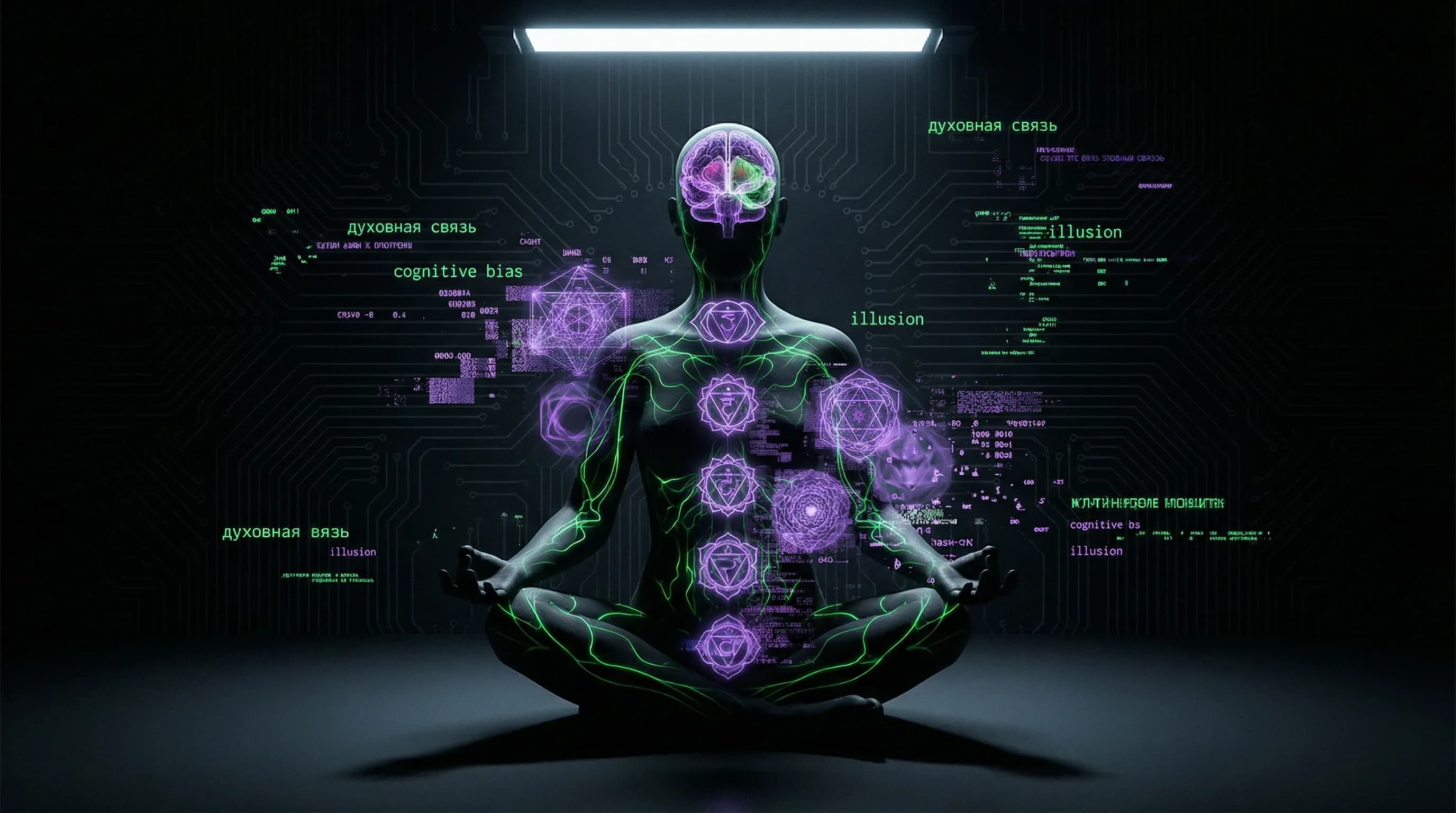
�� Esoteric practices promise what science cannot yet deliver: direct access to higher dimensions of consciousness, connection with universal mind, transcendent experience beyond the material world. Millions of people meditate, practice astral projection, work with crystals and mantras, genuinely believing they're touching something greater than the electrochemistry of neurons. But what if all this "spiritual experience" is not a window into another reality, but a predictable product of brain function, cultural programming, and cognitive biases? ��️ This article is not an attack on personal experience, but an anatomy of the mechanism that transforms neurophysiological phenomena into a convincing illusion of transcendence.
�� What Exactly Esoteric Practices Promise — and Why It's Impossible to Verify Using Standard Methods
Esoteric practices form a specific class of claims about reality: they assert phenomena that are by definition inaccessible to objective verification. "Deepening spiritual connection," "opening the third eye," "astral projection," "contact with the higher Self" — all these terms describe subjective experiences that practitioners interpret as proof of non-material dimensions of consciousness. More details in the section Mediumship and Spiritism.
The critical point: the transition from "I experienced X" to "therefore, objective reality Y exists" is logically unfounded without additional evidence. This doesn't mean the experience isn't real — it's real as a psychological phenomenon. But the reality of the experience doesn't equal the reality of its interpretation.
- Subjective Experience
- A psychological state that a person experiences and can describe. Verifiable only through self-report.
- Objective Reality
- A phenomenon that exists independently of the observer and is verifiable through repeatable methods. Requires external verification.
- Interpretation Trap
- The assumption that subjective experience automatically proves objective reality. The entire architecture of esoteric belief is built on this.
Why Esotericism Uses Language Resistant to Falsification
Karl Popper defined falsifiability as the criterion of scientific validity: a statement is scientific if one can imagine an observation that would refute it. Esoteric claims systematically avoid this criterion.
If a practice "doesn't work," the explanation is always found within the system: insufficient purity of intentions, incorrect technique, karmic blocks, insufficient level of development. The system self-protects from refutation by building explanations for any failures into its structure.
This isn't a design flaw — it's a feature. A system that cannot be refuted becomes psychologically invulnerable. The adherent can never prove to themselves that the system doesn't work, because failure is reinterpreted as a personal deficiency.
�� Five Practices as a Representative Sample
For analysis, we'll take five common practices: transcendental meditation with mantras, working with crystals and "energy fields," astral travel and lucid dreaming, the chakra system and visualization of energy centers, channeling and contact with "higher beings."
| Practice | Promised Experience | Protection Mechanism Against Verification |
|---|---|---|
| Transcendental Meditation | State of pure consciousness, unity with the universe | "The experience is transcendent and cannot be described in words" |
| Working with Crystals | Energy healing, aura harmonization | "Energy is invisible but felt intuitively" |
| Astral Travel | Consciousness leaving the body, visiting other worlds | "This happens in the subtle body, inaccessible to instruments" |
| Chakra System | Opening energy centers, spiritual development | "Chakras are subtle structures, visible only to adepts" |
| Channeling | Direct contact with higher beings or aspects of consciousness | "Beings communicate through intuition and symbols" |
Each practice uses the same pattern: a promise of experience that by definition cannot be objectively verified. This isn't coincidence — it's a structural feature that makes esotericism psychologically resistant to criticism.
Related materials: Reality Shifting and dissociation, quantum mysticism, energy practices.

�� Steelman Argumentation: Five Strongest Arguments for the Reality of Esoteric Experience
Intellectual honesty requires examining the most compelling arguments of the opposing position in their strongest form. This is called "steelmanning" — the opposite of a "strawman." Below are five arguments that esoteric practitioners and consciousness researchers use to justify the reality of transcendent experience. More details in the Witchcraft section.
�� The Argument from Universality: Cross-Cultural Convergence of Mystical Experience
Practitioners from different cultures who had no contact with each other describe strikingly similar experiences: a sense of unity with the cosmos, dissolution of ego boundaries, encounters with "beings of light," experiences of timelessness. William James in "The Varieties of Religious Experience" documented these patterns.
The argument: if these were merely hallucinations, why do they repeat so systematically across independent traditions? (S004) Convergence suggests that practices provide access to an objective reality rather than creating arbitrary fantasies.
�� The Argument from Transformative Power: Lasting Personality Changes
People who have undergone profound mystical experiences often demonstrate long-term changes: reduced fear of death, increased prosocial behavior, enhanced psychological well-being. Research on psychedelic experiences shows that a single session can trigger personality changes that persist for years.
The argument: if this is "just neurochemistry," why is the effect so profound and lasting? Transformative power suggests contact with something real, not a temporary illusion.
�� The Argument from Anomalous Phenomena: Cases Not Explainable by Standard Neuroscience
There are documented cases that are difficult to explain within the materialist paradigm: accurate descriptions of events during clinical death (when EEG shows no activity), cases of "remote viewing" with verifiable details, synchronicities that are statistically improbable.
The argument: science cannot explain all phenomena of consciousness, and it is premature to reject the possibility of non-material aspects of reality. (S005)
�� The Argument from the Limitations of Reductionism: Qualia and the "Hard Problem of Consciousness"
David Chalmers formulated the "hard problem of consciousness": why do physical processes in the brain generate subjective experience? No description of neural activity explains why "being me" feels exactly this way.
The argument: if science cannot explain even basic consciousness, how can it reject the possibility of its transcendent aspects? Esoteric practices may explore dimensions of consciousness inaccessible to objective methods.
The Argument from Pragmatic Value: "It Works" as a Criterion of Truth
Millions of people find meaning, comfort, and psychological support in esoteric practices. If a practice helps a person live better, does it matter whether the underlying metaphysics is "objectively true"?
- The practice brings psychological relief and orientation
- The person demonstrates improved well-being and social adaptation
- The effect is reproduced among many practitioners independently
- The pragmatic criterion of truth (William James) suggests that what is true is what has positive consequences
Esotericism "works" for practitioners, therefore in a pragmatic sense it is true. This is especially compelling for people seeking alternative practices and courses where the result is felt as personal transformation.
�� Evidence Base: What Controlled Studies of Esoteric Practices Show
Moving from philosophical arguments to empirical data. More details in the section Folk Magic.
The critical question: do the data support a transcendent interpretation, or are they consistent with simpler explanations?
Extensive literature on meditation, psychedelics, prayer, and other practices shows: the effects are real, but don't require metaphysics.
�� Meditation and Neuroplasticity: Effects Are Real, But Don't Require Metaphysics
Meditation research shows measurable brain changes: increased gray matter density in the prefrontal cortex and hippocampus, changes in default mode network activity, decreased amygdala activation.
These changes correlate with improved attention, reduced anxiety, and enhanced emotional regulation. However, none of these findings require assuming the existence of immaterial consciousness—all observed effects are fully explained by neuroplasticity.
�� Psychedelics and "Mystical Experience": Pharmacologically Induced States
Psilocybin research (Johns Hopkins, Imperial College London) shows that psychedelics reliably induce experiences that subjects describe as "mystical": unity, transcendence, ineffability, positive affect.
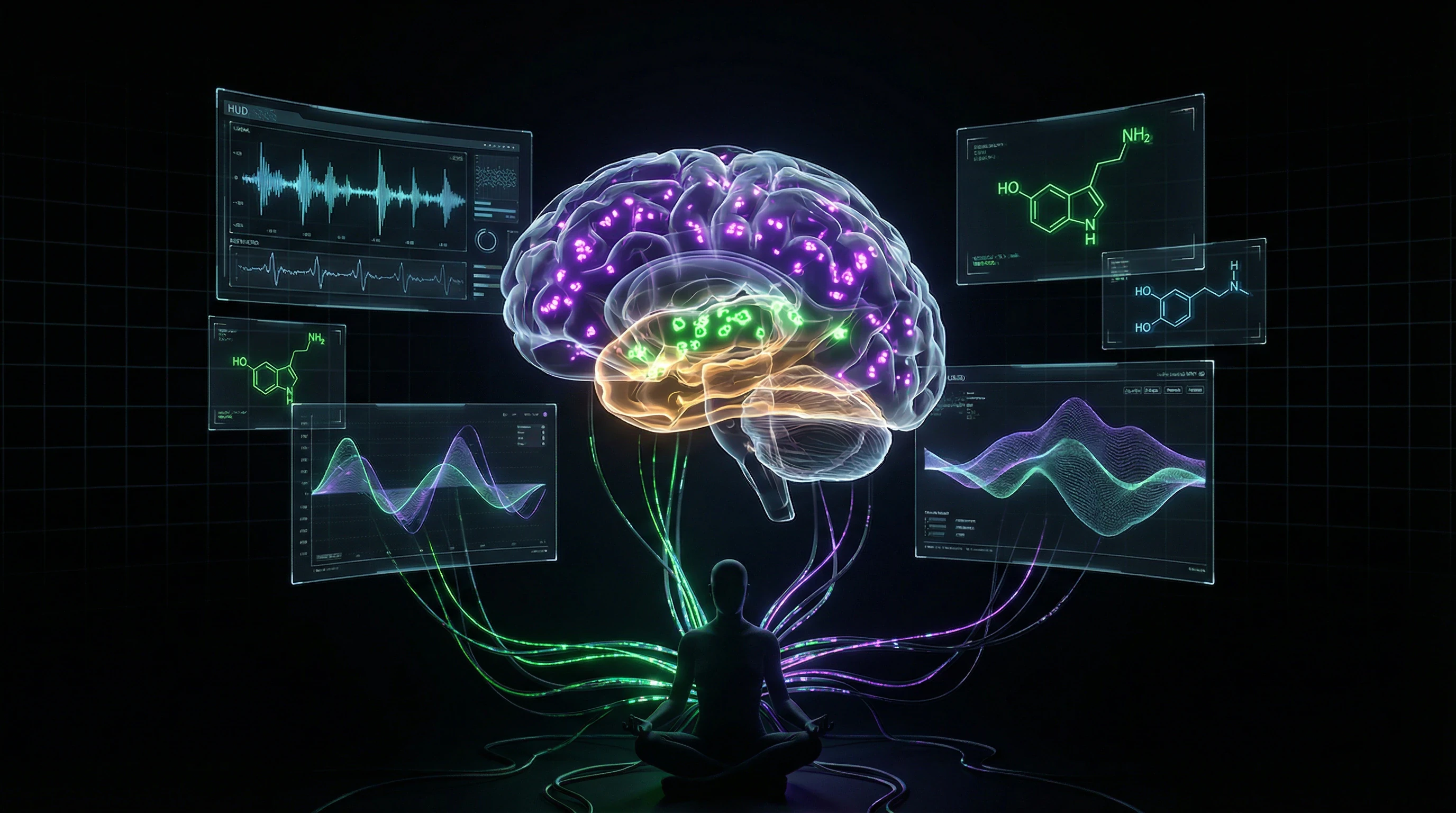
These experiences correlate with therapeutic effects for depression and anxiety. The critical point: if "spiritual experience" can be reliably triggered by a molecule acting on serotonin receptors, this strongly undermines the interpretation of such experience as contact with an independent spiritual reality.
Psychedelics temporarily alter patterns of neural activity, creating specific subjective states. This is a simpler explanation than appealing to the transcendent.
�� Astral Projection and Lucid Dreaming: Phenomenology Without Ontology
Lucid dreams—a state where a person is aware they're dreaming and can control dream content—are well documented in sleep laboratories. Subjects signal with pre-agreed eye movements during REM sleep, confirming awareness.
However, there's no evidence that consciousness during lucid dreaming leaves the body or accesses information unavailable through normal sensory channels. All "astral projections" with verifiable details either fail verification or are explained by cryptomnesia or coincidence.
- Cryptomnesia
- Forgotten memories that surface in consciousness as supposedly new information. Explains why people "remember" details they actually once saw or heard.
- REM Sleep
- Rapid eye movement phase in which most dreaming occurs. This is the phase where lucid dreams are possible.
�� Crystal Work and "Energy Fields": Pure Placebo Effect
Controlled studies find no difference between real crystals and plastic imitations under blind conditions. People report sensations of "energy" regardless of whether they're holding real quartz or a fake, if they believe it's a real crystal.
This is a classic placebo effect: expectation creates subjective experience. Physics provides no mechanism by which a crystal lattice could interact with a person's "energy field"—no such field has been detected by any instruments.
| Claim | What Research Shows | Alternative Explanation |
|---|---|---|
| Crystals emit healing energy | No difference between crystal and imitation under blind conditions | Placebo effect + expectation |
| Meditation opens access to higher consciousness | Measurable changes in brain structure | Neuroplasticity |
| Psychedelics allow contact with spiritual entities | Reliable induction of mystical experiences by a molecule | Pharmacological effects on neurotransmitters |
Channeling and "Contact with Entities": Dissociative States and Cultural Programming
Channeling—a practice where a person claims to serve as a channel for messages from spiritual entities—demonstrates an interesting pattern: the content of "messages" always reflects the cultural context and personal beliefs of the "channel."
In the 1950s, entities spoke about flying saucers; in the 1980s—about crystals and the New Age; now—about quantum physics and multidimensionality. This is consistent with a psychological explanation: channeling is a form of dissociative state in which subconscious material is projected as an external voice.
- Person enters an altered state of consciousness (meditation, hypnosis, ritual)
- Critical thinking weakens, attention narrows
- Subconscious thoughts and cultural programming activate
- These materials are experienced as an external voice or entity
- Social reinforcement (audience believes) reinforces the pattern
The phenomenon of channeling is real, but the interpretation as contact with independent entities is not supported. It's a dissociative state in which cultural programming is presented as an external source.
All these studies point to one conclusion: esoteric practices produce real subjective and even neurophysiological effects. But these effects are fully explained by known mechanisms—neuroplasticity, pharmacology, placebo, dissociation, cultural learning. None of them require assuming the existence of immaterial reality or transcendent consciousness.
This doesn't mean the effects are useless. Meditation really does help with anxiety. Psychedelics really do show therapeutic potential. But usefulness doesn't equal truth of claims about the nature of reality.
�� Neurophysiological Mechanisms: How the Brain Creates the Illusion of Transcendence
If "spiritual experience" is not contact with an immaterial reality, how exactly does the brain create such convincing experiences? Neuroscience offers detailed models of the mechanisms underlying mystical states. More details in the Reality Validation section.
Understanding these mechanisms doesn't devalue the subjective significance of the experience, but it radically changes its ontological interpretation.
�� Default Mode Network and Ego Dissolution
The default mode network (DMN) is a group of brain regions active when we're not focused on external tasks: the medial prefrontal cortex, posterior cingulate cortex, and precuneus. The DMN is associated with self-referential thinking, autobiographical memory, and modeling others' mental states.
During deep meditation and under the influence of psychedelics, DMN activity sharply decreases. This correlates with the subjective experience of "ego dissolution"—the loss of boundaries between self and world.
Mechanism: temporary deactivation of the neural network that normally maintains the sense of a separate "I" creates an experience of unity. This isn't the discovery of a new reality, but the disabling of the filter that constructs it.
�� Serotonin System and "Opening the Doors of Perception"
Psychedelics (LSD, psilocybin, DMT) are agonists of 5-HT2A serotonin receptors, particularly densely represented in the cortex. Activation of these receptors disrupts normal patterns of neural communication, increasing the entropy of brain signals—the brain becomes less predictable, more chaotic.
This creates the experience of "expanded consciousness," where normal perceptual filters weaken. Aldous Huxley called this "opening the doors of perception," but the mechanism isn't that access to a new reality opens up, but rather that normal information processing is temporarily disrupted.
| State | DMN Activity | Signal Entropy | Subjective Experience |
|---|---|---|---|
| Normal consciousness | High | Low (ordered) | Sense of separate "I" |
| Meditation | Reduced | Low | Calm, unity |
| Psychedelics | Reduced | High (chaotic) | Expansion, transcendence |
�� Temporal Lobes and "Sense of Presence"
Stimulation of the temporal lobes (especially the temporoparietal junction) can induce a sensation of "presence"—the feeling that an invisible entity is nearby. This is observed in temporal lobe epilepsy, transcranial magnetic stimulation, and conditions of sensory deprivation.
Michael Persinger experimentally induced a "sense of divine presence" using magnetic stimulation. The mechanism: the temporoparietal junction integrates information about body position in space; its dysfunction creates the illusion of another agent's presence.
This explains encounters with "spiritual entities" without assuming their objective existence. The experience is real, but its cause lies in neurophysiology, not ontology.
Endogenous Opioids and "Spiritual Ecstasy"
Intensive spiritual practices (prolonged meditation, ecstatic dancing, self-flagellation in religious rituals) stimulate the release of endogenous opioids—endorphins and enkephalins. These neurotransmitters create states of euphoria, analgesia, and deep satisfaction.
This explains why mystical experience is often described as "bliss" or "ecstasy." The mechanism is identical to "runner's high"—a state that no one interprets as contact with transcendent reality, though subjectively it can be equally intense.
- Endorphins
- Endogenous opioids released during physical exertion, pain, and stress. Create analgesia and euphoria. In the context of spiritual practices, they're interpreted as "divine blessing," though this is standard biochemistry.
- Enkephalins
- Short-chain opioids that modulate pain perception and emotions. Released during meditation and ritual actions. Their effect is indistinguishable from pharmacological opioids in subjective terms.
- Interpretive Trap
- The subjective intensity of experience doesn't correlate with its ontological reality. A hallucination can be more vivid than perception, but this doesn't make it objective.
All these mechanisms work regardless of whether a person believes in spirituality or not. They're activated by physiological conditions: changes in blood flow, rhythmic movements, sensory deprivation, chemical substances.
This doesn't mean the experience is "fake" in a subjective sense. It means its cause lies in neurophysiology, not in transcendent reality. To understand how the brain creates alternative realities, it's important to distinguish between experience and its ontological status.
Cognitive Anatomy of the Myth: Which Biases Make Esotericism Convincing
Neurophysiology explains how experience arises, but not why people are convinced of its transcendent interpretation. This is where cognitive biases come in—systematic thinking errors that make esoteric explanations intuitively appealing, even when they're logically unsound. More details in the Psychology of Belief section.
�� Confirmation Bias: Seeing Only What Confirms Belief
People practicing esoteric techniques actively seek confirmation of their effectiveness and ignore contradictory data. If something good happens after meditating with a crystal, it's "proof" of the crystal's power. If nothing happens, it's not considered refutation—perhaps more time is needed, or the crystal is "working on a subtle plane."
Asymmetric information processing makes any hypothesis unfalsifiable. A system that accepts confirmations and rejects refutations cannot be tested—it can only strengthen itself.
��️ Illusion of Control and Agency: Seeing Patterns in Noise
The human brain evolved to detect patterns and agents—this was critically important for survival. Side effect: we see patterns even where none exist, and attribute intentional causes to random events.
Synchronicities, "signs from the universe," "answers to prayers"—these are results of normal pattern-detection systems operating under conditions of randomness. We don't notice thousands of "non-coincidences" and focus on rare coincidences that seem meaningful.
| Mechanism | What Happens | Why It Seems Like Magic |
|---|---|---|
| Pareidolia | Brain sees faces and forms in random patterns | "Sign" or "message" in clouds, numbers, events |
| Hyperactive Agency Detection | Attributing intention to random events | "The universe answered my prayer" |
| Selective Attention | Focus on coincidences, ignoring non-coincidences | Confirmation visible, refutation invisible |
�� Expectation Effect and Self-Fulfilling Prophecy
If someone believes a practice will "open the third eye," they interpret any unusual sensations (pressure in the forehead area, visual artifacts with closed eyes) as confirmation. Expectation shapes perception.
Moreover, expectation can physiologically influence experience: if someone expects relaxation from meditation, the parasympathetic nervous system activates, creating real relaxation. This doesn't prove the metaphysical truth of the practice, but creates a convincing subjective experience of a "working" technique. Dissociative states are often interpreted as transcendent, though they're neurophysiological phenomena.
⚠️ Cultural Programming: Interpretive Frameworks for Unusual Experience
The same neurophysiological phenomenon is interpreted differently depending on cultural context. A Christian mystic interprets a vision of light as an encounter with Christ, a Buddhist as an experience of emptiness, a New Age follower as contact with the "higher self."
- Cultural Interpretation
- The content of mystical experience predictably reflects cultural narratives (S004). The brain generates an unusual state, and culture provides an interpretive framework that seems like an explanation but is actually a projection.
- Why This Matters
- If the experience were truly transcendent, its content shouldn't depend on culture. But it does—completely. This indicates that interpretation is generated by the brain, not received from outside.
These four mechanisms work synergistically. Online esoteric courses actively use all four: they teach confirmation, teach pattern recognition, create expectation, and provide cultural narrative. Result: a convincing but entirely self-sustaining belief system.
��️ Verification Protocol: Seven Questions for Checking Any Esoteric Claim
How do you distinguish a well-founded claim about consciousness from unfounded metaphysical speculation? Below is a verification protocol based on principles of scientific skepticism and critical thinking. For more details, see the Physics section.
These questions don't debunk personal experience, but they evaluate how well-founded the ontological conclusions drawn from that experience are.
Question 1: Is the Claim Falsifiable?
Can you imagine an observation or experiment that would disprove the claim? If a claim is formulated so that no observation could refute it, it's not informative.
"Crystals work on a subtle plane inaccessible to measurement" — not falsifiable. "Crystals reduce cortisol levels in saliva" — falsifiable and testable.
Question 2: Does the Explanation Require New Entities?
Occam's Razor: don't multiply entities without necessity. If a phenomenon is explained by known mechanisms (neuroplasticity, placebo effect, cognitive biases), why postulate new entities (astral bodies, energy fields, higher dimensions)?
Additional entities are justified only if they explain data that simpler models cannot.
Question 3: Is the Effect Reproducible Under Controlled Conditions?
Personal experience is not proof. If a practice works, it should produce results in double-blind studies where neither participant nor experimenter knows whether the person is receiving the real intervention or placebo.
Lack of reproducibility under controlled conditions indicates that the effect is generated by expectation, not by the mechanism described in the claim.
Question 4: Are There Alternative Explanations?
Before accepting an exotic explanation, check simpler hypotheses: regression to the mean, placebo effect, confirmation bias, social suggestion, natural disease progression.
- Regression to the Mean
- People often turn to practices at the peak of their symptoms. Improvement may simply be a return to baseline, not a result of the intervention.
- Confirmation Bias
- We notice coincidences that confirm our beliefs and ignore those that contradict them.
- Social Suggestion
- The group, teacher, ritual — all of these amplify expectation and can generate real physiological changes through placebo mechanisms.
Question 5: Who Funds the Research and Promotes the Claim?
Conflict of interest is a powerful source of bias. If a company sells crystals and simultaneously funds research on their effectiveness, the results are predictable.
Check: who profits if the claim is true? This doesn't prove falsity, but it requires a higher standard of evidence.
Question 6: Is Special Language Used to Shield from Criticism?
Phrases like "this works on an energetic level," "only believers will feel it," "skepticism blocks the effect" — these aren't explanations, they're shields against verification.
If a claim requires belief for its verification, it cannot be independently tested. This is a sign that the mechanism either doesn't exist or is hidden from observation by definition.
Question 7: What's the Cost of Being Wrong?
Even if the probability of harm is low, ask: what happens if I believe this claim and it turns out to be false? Replacing medical treatment with esoteric practice can cost lives.
Low risk of harm allows for more tolerance of uncertainty. High risk demands a high standard of evidence.
This protocol is not a tool for humiliating believers, but a map for navigating the space of claims about reality. Apply it to all claims, including scientific ones. Skepticism is not cynicism, but mental hygiene.
For more on the cognitive traps that make esotericism convincing, see the analysis of dissociation and reality shifting. On how these mechanisms work in online environments, see the study of esoteric courses in 2026.