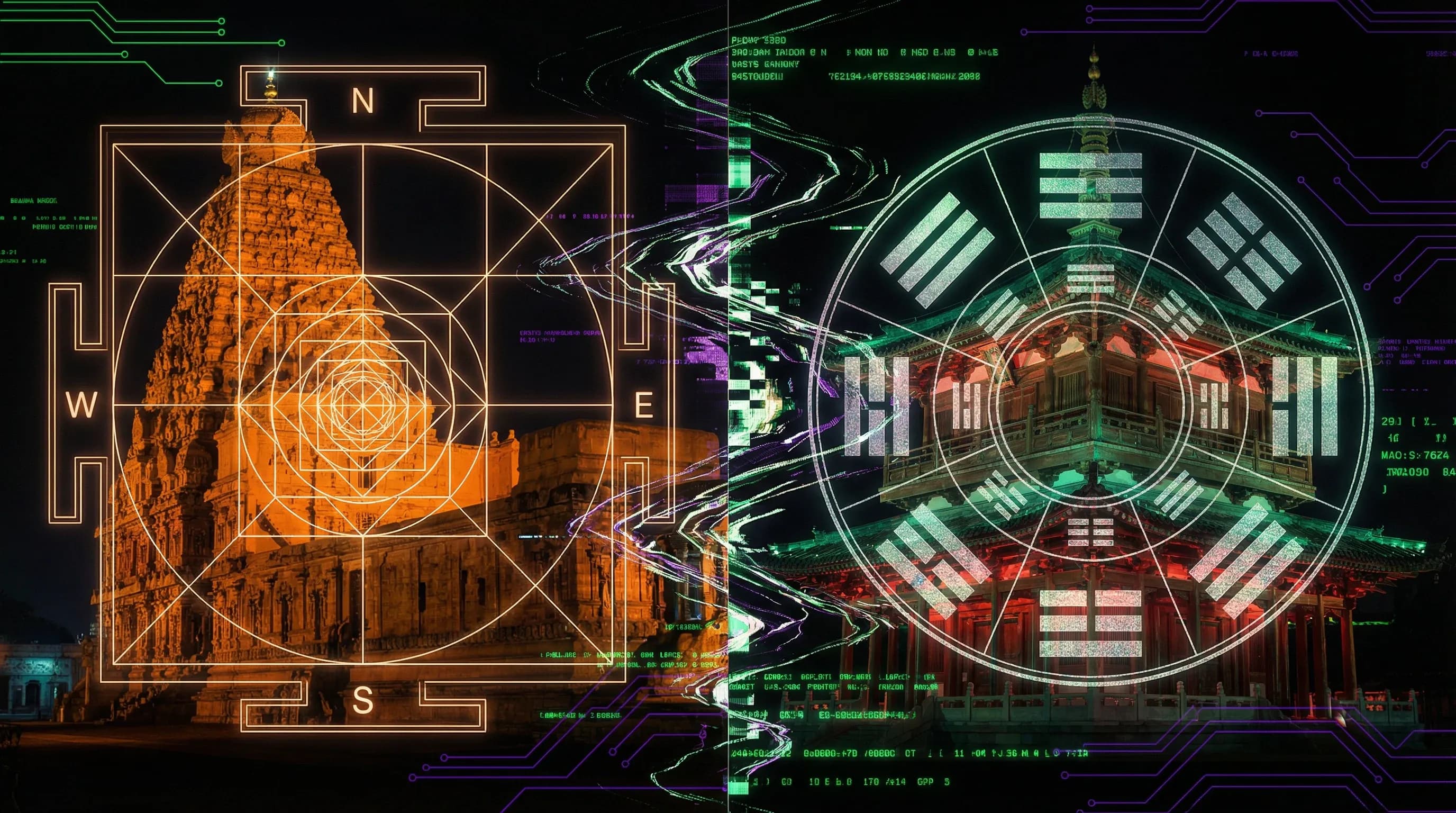
What exactly Vastu Shastra and Feng Shui claim — and why they're called "sciences" without controlled experiments
Vastu Shastra is a Hindu architectural design system based on texts from the 1st millennium BCE, though most surviving treatises date to the medieval period. Feng Shui is a Chinese practice of spatial organization with roots in the Han Dynasty (206 BCE – 220 CE), systematized during the Tang and Song eras. More details in the Occultism and Hermeticism section.
Both systems claim that building orientation, room placement, and interior elements affect occupants' physical health, psychological state, and material prosperity (S001, S002).
🧩 Structure of claims: mixture of observable factors and untestable concepts
Vastu Shastra operates with the concept of "Vastu Purusha Mandala" — a geometric grid overlaid on a site, where each zone corresponds to a deity and has a prescribed functional purpose. The northeast (Ishan) is considered the zone of water and spirituality, the southwest (Nairutya) — the zone of stability and heavy structures.
Feng Shui uses the Luopan compass with 24 directions, the concept of five elements (wood, fire, earth, metal, water), and the notion of "qi" — invisible energy whose circulation determines spatial quality (S002).
| Element | Testable | Untestable |
|---|---|---|
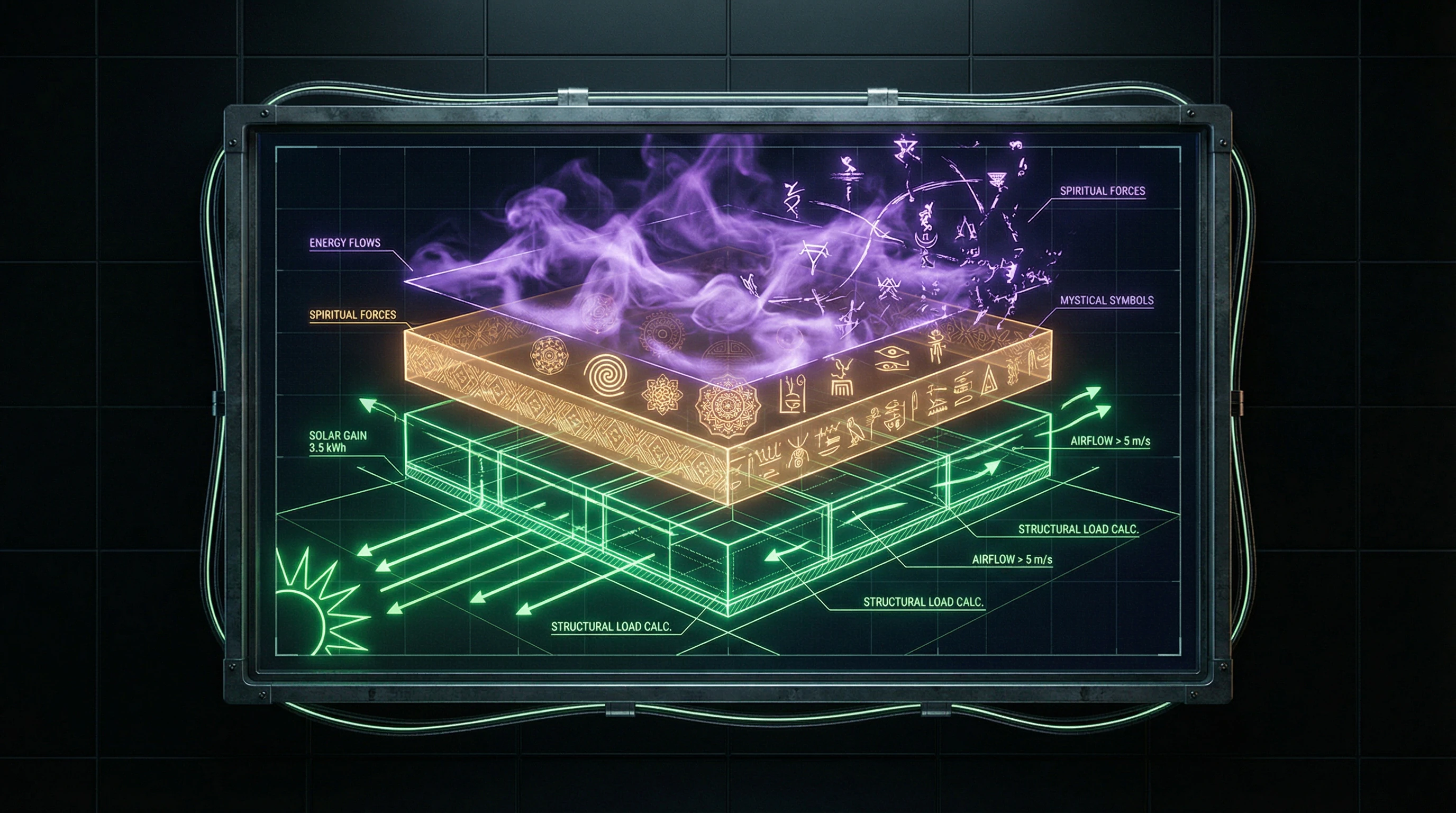
| South-facing windows | Increases solar gain (measurable) | "Attracts favorable energy" |
| Northeast bathroom | No physical mechanism | "Blocks spiritual energy" |
| Avoiding marshy sites | Reduces humidity, mold (engineering-justified) | "Disrupts elemental balance" |
Both systems mix testable principles with untestable ones. Research (S001) notes that "when the field of house construction is considered, the influence of traditional beliefs played a more significant role in Asian countries than in European ones," but provides no controlled experiments demonstrating causal links between rule compliance and measurable outcomes.
⚠️ Why the term "science" is applied without scientific method
"Scientific" status is attributed based on textual antiquity, classification complexity, and use of mathematical proportions. However, none of these criteria correspond to the definition of science as a knowledge system based on falsifiable hypotheses and reproducible experiments.
Researchers acknowledge: "However, a widespread misunderstanding persists, often reducing its profound principles to mere superstitions or a form of pseudoscience" (S001). This is a key admission — the problem isn't critics' "misunderstanding," but proponents' lack of a protocol that would distinguish working principles from cultural artifacts.
- Falsifiability
- A system must specify conditions under which it can be disproven. Vastu and Feng Shui don't do this: any outcome is explained by rule violations or improper application.
- Reproducibility
- Results must be obtained independently by different researchers. For these systems, standardized protocols for measuring "prosperity" or "harmony" are absent.
- Operational definitions
- Each claim must be expressed in measurable terms. "Spiritual energy" and "qi" lack operational definitions.
🔎 Boundaries of applicability: where tradition ends and universal knowledge begins
Contemporary researchers attempt to "reinterpret" Vastu principles in the context of modern practice (S002, S003). But "blending" ancient rules with modern standards doesn't equal validation.
If a modern building complies with building codes (based on engineering calculations) and coincidentally aligns with some Vastu rules, this doesn't prove the latter's effectiveness. It demonstrates that some traditional recommendations — such as avoiding construction on marshy sites — have rational foundations explainable without invoking mystical concepts.
The distinction is critical: when a system provides no criteria for its own falsification, it moves beyond science into the realm of traditional knowledge or belief. This doesn't make it less culturally valuable, but requires honest designation of its status.
Steelman Arguments: Five Strongest Cases for the Rationality of Traditional Systems
Before examining weaknesses, we must present the strongest possible version of proponents' arguments. This is not a straw man, but a steelman—the most convincing interpretation of the opposing position. More details in the Manifestation section.
🌍 Argument 1: Empirical Optimization Through Millennia of Cultural Evolution
Proponents argue: even if the creators of Vastu and feng shui didn't understand physical mechanisms, they accumulated observations about which building configurations correlated with better outcomes. Southern orientation of the main facade in Northern India (Vastu rule) maximizes winter solar gain. Avoiding construction at T-intersections (feng shui rule) reduces noise pollution and accident risk.
Millennia of cultural evolution filtered out non-working practices, leaving those that genuinely improved quality of life. This argument has force for the subset of recommendations explainable by climatic adaptation and common sense.
Problem: it doesn't explain why systems retained vast numbers of rules lacking rational foundation—for example, prohibitions on building on irregularly shaped lots when soil engineering characteristics are adequate.
🏗️ Argument 2: Integration with Sustainable Architecture and Passive Climate Design
Research (S001) compares Vastu, feng shui, and modern sustainable architecture, finding overlaps: the main goal is to analyze these systems as different ideologies and compare them with modern sustainable architecture through parameters of environmental impact, economic viability, and technological advancement.
Indeed, some Vastu principles (natural ventilation use, solar orientation, local materials) align with modern green building standards. But overlap doesn't prove the traditional system as a whole is effective—only that its subset is rational.
- Can we extract these principles while discarding mystical superstructures?
- Or does the system work only as an indivisible package?
- Which rules genuinely improve climate performance, and which don't?
🧠 Argument 3: Psychological Effect and Anxiety Reduction Through Structured Rules
Even if rules don't directly affect physical reality, they may improve psychological state through uncertainty reduction. Research (S003) notes the potential of design principles in reducing anxiety, shaping social norms, and improving guideline memorability.
This argument acknowledges the effect may be purely psychological (placebo), but claims this doesn't make it less valuable. If a person feels calmer in a space organized by Vastu rules, this improves quality of life regardless of mechanism.
Counterargument: placebo effects are real, but this doesn't make the underlying theory true. If the effect depends on belief, it's not universal and cannot be the basis for general building codes.
🔗 Argument 4: Holistic Approach Versus Reductionist Science
Proponents claim that Western science, by breaking phenomena into isolated variables, misses systemic effects. Vastu and feng shui view buildings as holistic systems where element interactions create emergent properties not reducible to the sum of parts.
Modern complexity science acknowledges reductionism's limitations, supposedly rehabilitating holistic traditions. This argument conflates two different claims: (1) systems can have emergent properties (true), (2) traditional systems correctly identify these properties (unproven).
- Holistic Approach
- Doesn't exempt from verification requirements. Modern complexity science uses computational modeling and big data to identify systemic effects—methods unavailable to ancient text creators.
- Emergence
- A real phenomenon, but requires empirical demonstration, not philosophical assertion.
📐 Argument 5: Mathematical and Geometric Sophistication as Indicator of Deep Knowledge
Vastu-shastra employs complex geometric constructions (mandalas with 64 or 81 squares), proportions based on modular systems. Feng shui operates with precise angular measurements of the Luopan compass. Proponents argue: such mathematical sophistication couldn't arise by chance, it must reflect deep understanding of hidden patterns.
Counterargument: mathematical complexity doesn't guarantee empirical accuracy. Ptolemaic astronomy used sophisticated epicycles to predict planetary motion, but was based on a false geocentric model. Complexity may reflect cultural valuation of symmetry and order, not discovery of objective laws.
If a system truly works, its effectiveness should be demonstrable independently of mathematical apparatus complexity. Beautiful geometry is not proof.
Evidence Base Analysis: What Research Shows and Where Data Ends
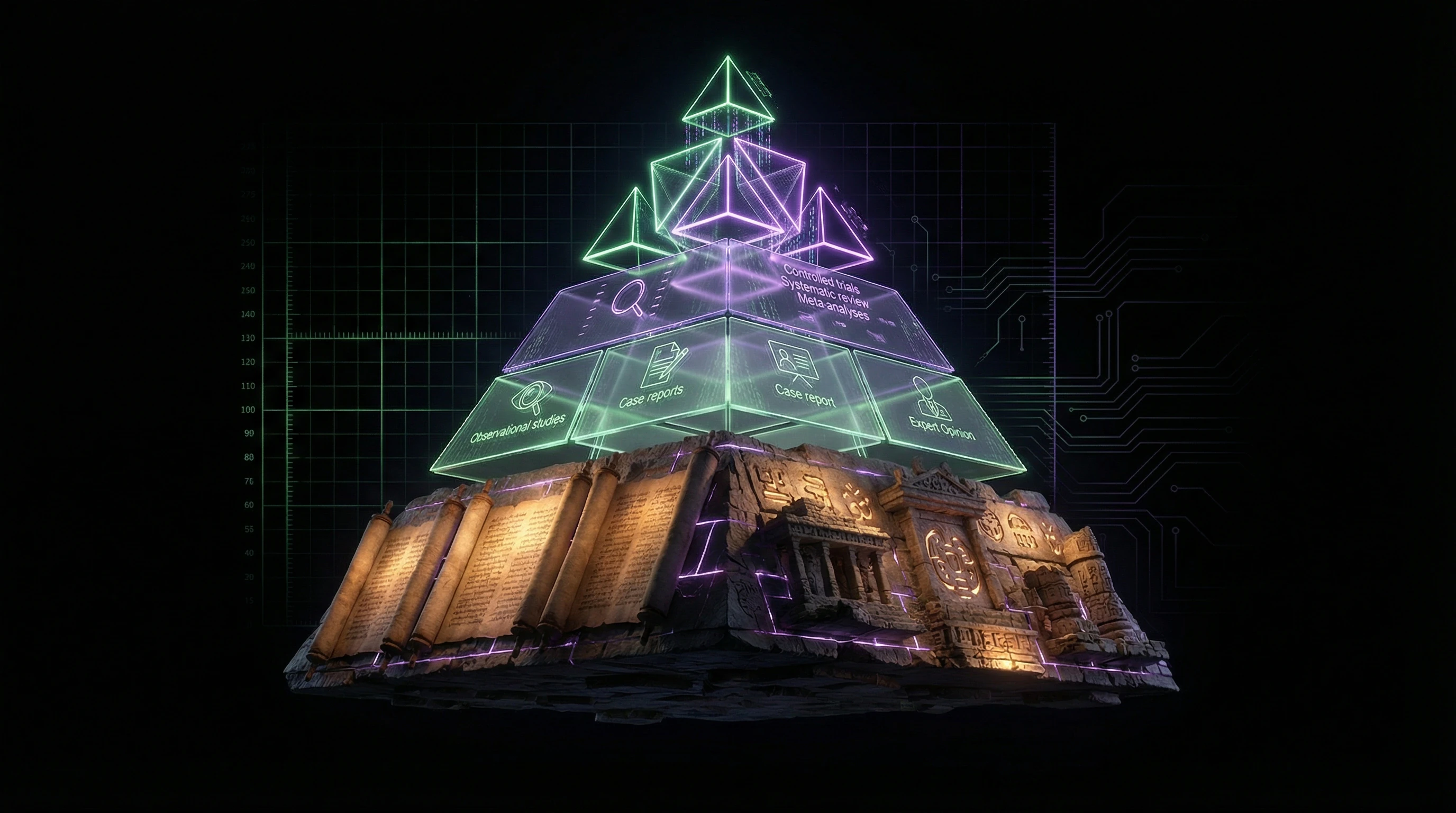
Critical analysis of sources reveals a pattern: most works are theoretical comparisons, historical reviews, or qualitative case studies. Controlled experiments comparing buildings constructed according to Vastu/feng shui rules with control groups on measurable outcomes (energy consumption, occupant health, productivity) are virtually nonexistent. More details in the Divination Systems section.
📊 What Exists: Correlational Observations and Retrospective Interpretations
Study (S002) claims: "This brief study identifies parallels and provides recommendations for implementing these concepts in social development programs." But "identifying parallels" between two traditional systems validates neither.
Work (S003) notes: "This brief study describes common features and proposes guidelines that can be combined to develop rules for improving society." Again: "combining" systems without prior verification of each creates a synthesis of unverified claims.
Modern buildings work because they follow engineering codes, not because they accidentally align with Vastu. If alignment exists, it's because some Vastu rules are rational—but then they're redundant, as they're already included in codes based on physics, not tradition.
🧾 What's Missing: Randomized Controlled Trials and Blind Assessments
None of the reviewed sources provide data from studies such as:
- Randomized allocation of sites to "Vastu-compliant" and "control" groups, with subsequent measurement of occupant health, satisfaction, and economic indicators.
- Blind assessment by feng shui experts of space quality with subsequent verification of whether their evaluations correlate with objective metrics (energy efficiency, acoustics, illumination).
- Retrospective analysis of large building samples, controlling for confounders (socioeconomic status, climate, construction quality), to isolate the effect of traditional rule compliance.
The absence of such studies is not accidental. Conducting controlled experiments in architecture is expensive and complex, but the main problem is conceptual: traditional systems don't provide operational definitions of key concepts.
What is "chi flow"? How do you measure it? If a concept has no measurable manifestations, it's not falsifiable, and therefore not scientific. This isn't a criticism of traditions—it's a statement: they belong to a different type of knowledge than science.
⚖️ The Selective Interpretation Problem: When Matches Count as Confirmation and Mismatches Are Ignored
Source (S001) compares Vastu, feng shui, and sustainable architecture, finding areas of overlap. But the methodology is problematic: researchers select principles that align with modern standards and interpret this as validation of traditions.
| Scenario | Interpretation in Literature | Logical Status |
|---|---|---|
| Vastu recommends southern orientation (rational for insolation in Northern India) | Proof of system wisdom | Confirmation |
| Vastu prohibits L-shaped plots (no engineering justification) | "Cultural context" or "symbolic meaning" | Ignored |
Such asymmetry makes the system unfalsifiable—and therefore unscientific. The system gets credit for hits but isn't penalized for misses. Principles that contradict modern knowledge are either ignored or reinterpreted metaphorically.
This is a classic example of confirmation bias. When every match is interpreted as validation and every mismatch as an exception, the system becomes protected from criticism by definition.
Mechanisms and Confounders: Why Correlation Doesn't Prove Causation in Architectural Traditions
Even if studies showed a correlation between following Vastu/feng shui rules and positive outcomes, this wouldn't prove that the rules work through their claimed mechanisms. Alternative explanations must be ruled out. More details in the Psychology of Belief section.
🧠 Confounder 1: Socioeconomic Status and Construction Quality
People who hire Vastu or feng shui consultants typically have higher incomes. They can also afford better architects, quality materials, and professional workmanship.
If their homes are more comfortable and durable, this may result from overall construction quality rather than adherence to traditional rules. Without controlling for this confounder—for example, by comparing homes of equal budget and quality that differ only in Vastu compliance—it's impossible to isolate the effect of traditional principles.
🔁 Confounder 2: Placebo Effect and Self-Fulfilling Prophecies
If someone believes their home is built according to rules that bring good fortune, they may feel more confident, which influences behavior and decisions. This creates real positive outcomes (e.g., bolder business decisions), but the mechanism is psychological, not energetic.
A person who invested significant money in a feng shui consultation is motivated to believe it works. Cognitive dissonance causes them to interpret random positive events as confirmation.
This doesn't mean the effect is illusory—it's real, but its source isn't in architectural rules but in the person's beliefs. Confirmation bias amplifies this mechanism.
🧷 Confounder 3: Rational Elements Disguised in Mystical Terminology
Some Vastu and feng shui rules have rational foundations but are framed in terms of energies and deities (S001). The recommendation to place the kitchen in the southeast (Vastu) may relate to minimizing smoke spread from hearths into living areas given prevailing winds.
Modern ventilation solves this problem differently, making the rule obsolete. If a Vastu-built home has good ventilation, it may be because the architect applied modern engineering solutions, not because the "fire energy" is correctly positioned.
| Causality Indicator | Medicine (example) | Vastu/Feng Shui |
|---|---|---|
| Dose-response | More medication → stronger effect | Absent: a home is either "compliant" or not |
| Specificity | Drug affects specific organ/process | Non-specific: supposedly improves health, wealth, relationships, career simultaneously |
| Reproducibility | Effect repeats under controlled conditions | No standardized testing protocols |
⚙️ Absence of Dose-Response and Effect Specificity
In medicine, causality is confirmed if the effect depends on dose and is specific to a particular outcome. Vastu and feng shui demonstrate neither property. Claimed effects are non-specific: proper orientation supposedly improves everything at once.
This is a pattern of magical thinking, not causation. Contradictions between Vastu and feng shui strengthen suspicion: if both systems work, why are their recommendations often opposite?
Cognitive Anatomy of Belief: What Psychological Mechanisms Make Traditional Systems Convincing
Why do educated people, including architects and engineers, continue to use Vastu and feng shui despite the absence of rigorous evidence? The answer lies in cognitive biases and social factors. Learn more in the Sources and Evidence section.
🧩 Bias 1: Appeal to Antiquity
Source (S001) is typical: "Vastu Shastra, an ancient Indian architectural science..." The age of the system is presented as proof of its wisdom. This is a logical fallacy: antiquity does not guarantee truth.
Many ancient practices (bloodletting, skull trepanation) were rejected when controlled experiments emerged. Tradition survives not because it works, but because it's embedded in cultural identity and social networks.
The age of an idea is not its currency. Currency is the reproducibility of results under controlled conditions.
🧩 Bias 2: Survivorship Bias and Selective Attention
A person applied Vastu, moved into a new home, and a year later got lucky with work. They recall the rule about the front door and attribute success to the system. Failures are forgotten or reinterpreted.
This is the confirmation trap: the brain seeks evidence for a hypothesis it has already accepted and ignores contradictory data. (S002) notes that modern architects often mix Vastu with practical principles (lighting, ventilation), then attribute results to tradition.
- An event occurs (randomly or due to other factors)
- The brain seeks an explanation it already knows
- Coincidence is interpreted as causality
- Contradictory examples are ignored or reframed
🧩 Bias 3: Social Proof and Groupthink
If an authoritative architect or well-known person uses Vastu, it creates a social signal: "this works, otherwise smart people wouldn't use it." Groupthink reinforces the belief.
Criticism of the system is perceived as an attack on culture or identity, not as hypothesis testing. Paradox: Vastu and feng shui often contradict each other, yet both are considered authoritative. This indicates that belief rests on social, not empirical, foundations.
| Mechanism | Function in System | Result |
|---|---|---|
| Appeal to antiquity | Creates aura of authority | Age = truth |
| Selective attention | Filters contradictions | We see only confirmations |
| Social proof | Legitimizes through group | Criticism = betrayal |
| Cognitive dissonance | Protects investment (money, time, identity) | Strengthens belief when doubts arise |
🧩 Bias 4: Investment Protection
A person spent money remodeling their home according to Vastu or hired a consultant. Admitting it doesn't work means admitting error and loss. Instead, the brain strengthens belief: "I'm seeing results, they're just slower than I expected."
This is cognitive dissonance: conflict between action (spent money) and doubt (maybe it doesn't work?). Resolution of the conflict goes toward strengthening belief, not revision.
🧩 Bias 5: Illusion of Control
Vastu and feng shui offer a sense of control over uncertainty. Life is chaotic, but if you arrange furniture correctly, you can influence fate. This is psychologically comforting, especially during periods of stress or uncertainty.
Belief in a system often works better than the system itself. But this is a placebo effect, not proof of mechanism.
🧩 Why This Matters for Cognitive Immunology
Vastu and feng shui are not enemies of science. They are mirrors reflecting universal cognitive traps: appeal to authority, selective attention, social proof, investment protection.
The same mechanisms operate in pseudoscience, pseudomedicine, pseudo-debunking. Understanding these traps is the first step to overcoming them. (S003) shows that even when attempting to synthesize Vastu with modern architecture, authors often fail to distinguish correlation from causation.
Education does not protect against these biases. Architects and engineers are as susceptible to them as anyone else. The difference is that they can apply verification methodology — if they choose to.