What are Feng Shui and Vastu Shastra: two systems, one promise, opposite rules
Feng Shui (风水, literally "wind-water") — a Chinese system of spatial organization that emerged over 3,000 years ago. The central concept is managing flows of qi (life energy) through proper object placement, building orientation, and use of five elements (wood, fire, earth, metal, water). More details in the Divination Systems section.
Vastu Shastra (वास्तु शास्त्र) — an Indian system of architectural planning rooted in Vedic texts dating back 5,000+ years. Based on the concept of Vastu Purusha Mandala — a cosmic energy grid overlaid on buildings.
Both systems promise the same thing: prosperity, health, harmony. Both claim to describe universal laws of energy and space. Both give concrete, actionable recommendations — not philosophical principles, but precise instructions: "place the bed here," "paint the wall this color."
🧩 Common features: why both systems appear convincing
Appeal to antiquity creates an illusion of time-tested wisdom. A holistic approach connects physical space with psychological well-being, financial success, and health, creating a sense of comprehensive control over life.
Complex terminology and diagrams (bagua, lo shu, Vastu Purusha Mandala) give the systems an appearance of scientific validity. Both allow flexible interpretation: if a recommendation doesn't work, you can always find an additional factor that "blocks" the energy.
- Concrete instructions
- Create an illusion of control and predictability in a chaotic world. A person receives a clear action algorithm instead of abstract advice.
- Flexible interpretation
- Protects the system from refutation. Failure is explained not by method error, but by incorrect application or hidden obstacles.
⚠️ Fundamental contradiction: when "universal laws" don't align
If both systems describe universal laws of energy and space, they should give consistent recommendations. Instead, systematic contradictions emerge across virtually all key aspects.
These contradictions aren't accidental — they stem from different cultural contexts, geographical conditions, and symbolic systems in which the teachings developed. But this very contradiction reveals the mechanism: if a system works through universal energy laws, cultural context shouldn't matter.
| Aspect | Feng Shui | Vastu Shastra |
|---|---|---|
| Primary element | Qi (life energy) | Vastu Purusha Mandala (cosmic grid) |
| Element system | 5 elements (wood, fire, earth, metal, water) | 5 elements (earth, water, fire, air, ether) |
| Foundation | Taoist philosophy, nature observation | Vedic texts, cosmic geometry |
The comparison shows: systems use similar terminology but different mechanisms. This isn't synthesis — it's competition between two incompatible models of reality, each demanding exclusive adherence to its rules.
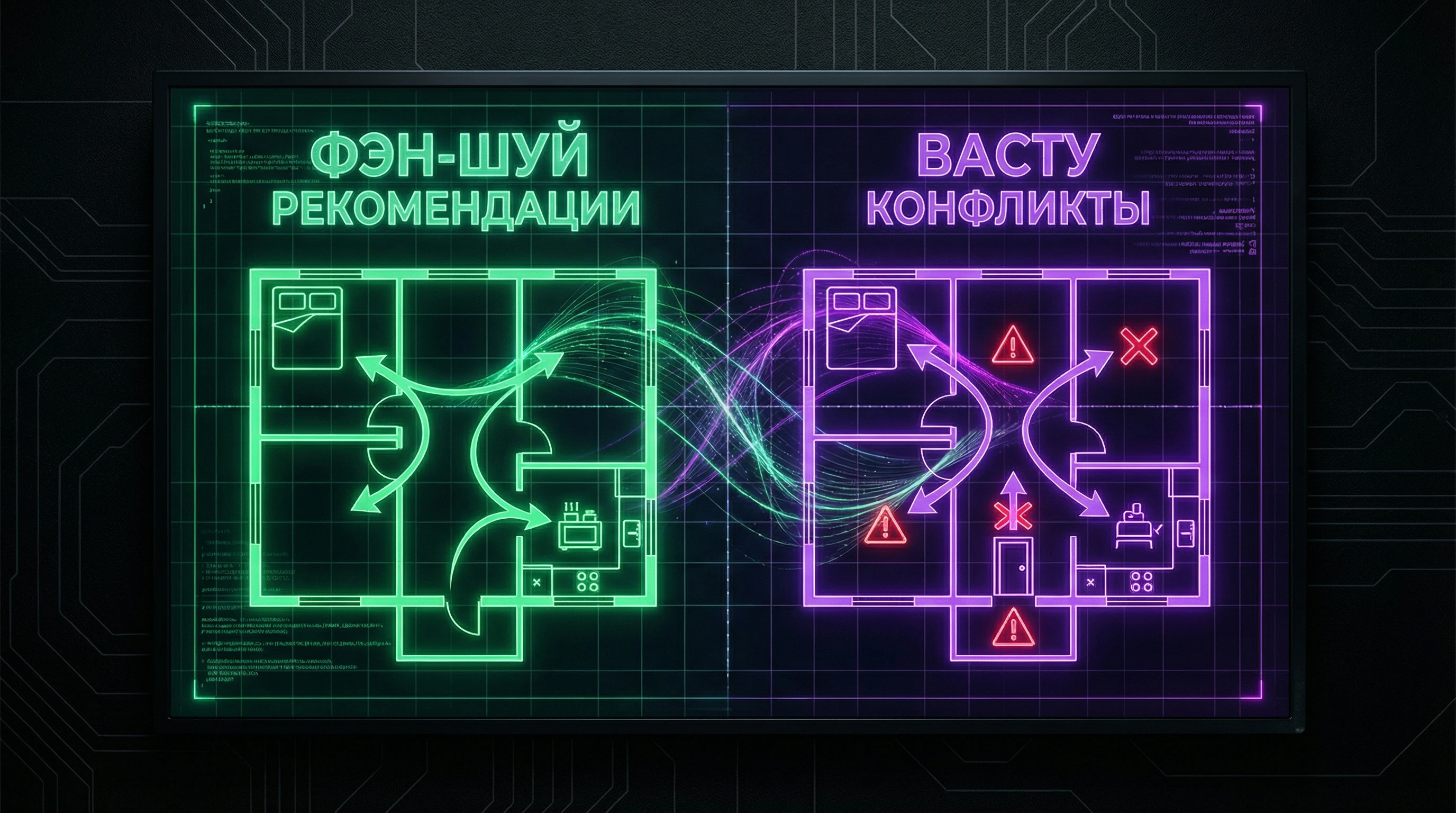
Catalog of Contradictions: Seven Key Areas Where Feng Shui and Vastu Give Opposite Instructions
1. Sleep Direction: East vs. South
Feng shui recommends sleeping with your head toward the east or southeast to attract growth and development energy. The eastern direction is associated with the rising sun and active chi. Some schools also approve north for deep rest. More details in the Astrology section.
Vastu shastra categorically prohibits sleeping with your head toward the north, claiming conflict with Earth's magnetic field. The recommended direction is south or east, with south considered most favorable.
If a person follows feng shui and sleeps with their head toward the east, they fulfill one system's recommendation but violate the other's preferences. Both systems cannot be simultaneously correct if they describe objective energy laws.
2. Kitchen Placement: Southeast vs. Northwest
In Vastu shastra, the kitchen must be located strictly in the southeast, in the zone of the fire god Agni. Placement in other zones, especially the northeast, is considered a serious error.
Feng shui uses the bagua system, where the southeastern zone is associated with wealth (wood element). Placing a kitchen (fire) in the wood zone creates a destructive cycle: fire burns wood, symbolically "burning" wealth. Preferred zones are south or east.
- Vastu: southeast = fire (correct)
- Feng shui: southeast = wood (conflict with fire)
- Feng shui: south or east = elemental harmony
- Vastu: south or east = incorrect for kitchen
3. Front Door: North vs. South
Vastu shastra considers northern and eastern entrances favorable. A northern entrance attracts wealth (direction of the god Kubera), eastern entrance brings health. A southern entrance is associated with the god of death Yama and is considered extremely unfavorable.
Feng shui evaluates the direction of the front door based on an individual birth chart (Gua number). For some people, a southern entrance may be most favorable, for others catastrophic. The system does not recognize universally "bad" directions.
Vastu prescribes universal rules for everyone. Feng shui adapts recommendations to individual characteristics. This is a fundamental difference in methodology, not simply different interpretations of the same phenomenon.
4. Water Elements: North vs. Northeast
In feng shui, water is associated with wealth and career. The northern zone is considered the ideal location for aquariums and fountains. The southeast (wealth) and east (health) zones are also favorable. Placing water in the south is categorically not recommended.
Vastu shastra prescribes placing water elements in the northeast—the zone considered most sacred. The northern direction is also acceptable. Placing water in the southeast (fire zone) is considered a serious error.
| System | Best Zones for Water | Forbidden Zones |
|---|---|---|
| Feng shui | North, southeast, east | South |
| Vastu | Northeast, north | Southeast |
5. Master Bedroom: Southwest vs. Northwest
Vastu shastra insists on placing the master bedroom in the southwestern part of the house. This direction is associated with stability and longevity. Placement in the northeast is considered a catastrophic error.
Feng shui does not prescribe a universal location. Many schools recommend avoiding the southwestern zone, as it is associated with stagnation. Preferred zones depend on the individual chart and may include northwest, west, or east.
A southwestern bedroom: in Vastu—the optimal solution for the head of household, in feng shui—a potential source of stagnation. The same room cannot simultaneously strengthen authority and create a feeling of heaviness.
6. Toilet and Bathroom: Northeast Taboo vs. Flexibility
Vastu shastra categorically prohibits placing toilets in the northeast (zone of water and spirituality) and in the center of the house. Violation is considered one of the most serious errors. Recommended zones are northwest or southeast.
Feng shui also does not recommend toilets in the center of the house, but has no absolute taboos on northeastern placement. The system focuses on ensuring the toilet is not opposite the front door and that the toilet lid is closed.
- Vastu: northeast + toilet
- Categorical prohibition. Pollution of the sacred zone leads to spiritual and financial decline.
- Feng shui: northeast + toilet
- No absolute taboo. A problem arises only if the toilet suppresses a specific zone function in the context of an individual chart.
7. Color Schemes: Elements vs. Directions
Feng shui assigns colors based on the five elements system and their correspondence to bagua zones. The southern zone (fire, fame) requires red and orange shades; northern (water, career)—blue and black; eastern (wood, health)—green and brown.
Vastu shastra also connects colors with directions, but uses a different system. Northeast requires white and light blue shades; southeast—red and orange; southwest—yellow and brown; northwest—white and gray.
- Red in the south: feng shui ✓ (fire), Vastu ✓ (fire)—agreement
- Blue in the north: feng shui ✓ (water), Vastu ✓ (water)—agreement
- White in the northeast: feng shui ✗ (metal, not water), Vastu ✓ (water)—contradiction
- Yellow in the southwest: feng shui ✗ (earth, but not recommended), Vastu ✓ (earth)—contradiction
Even in color schemes, where the systems partially overlap, they diverge in intermediate directions. This indicates that contradictions are not accidental, but built into the very logic of each system.
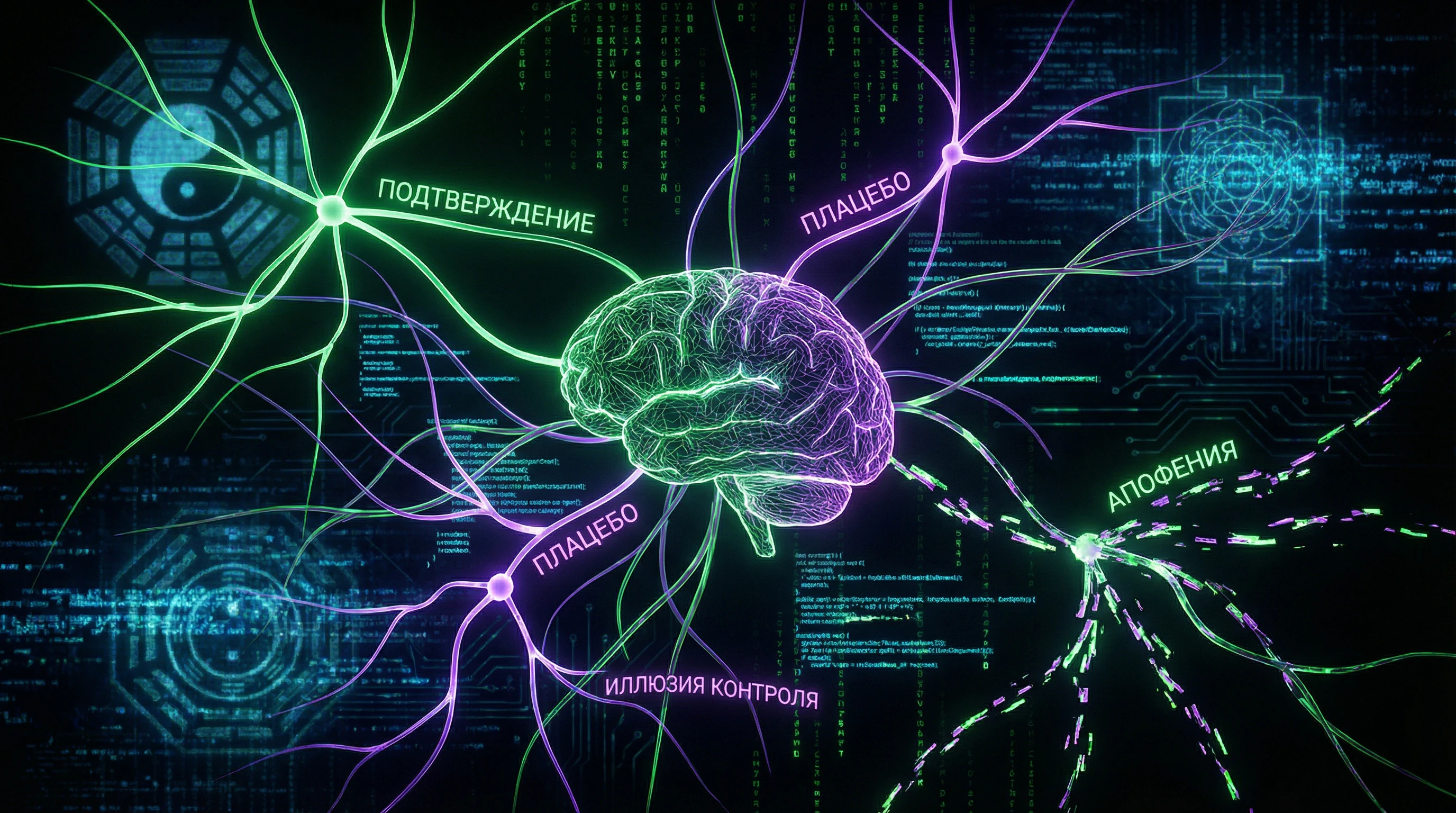
Why Contradictions Don't Bother Practitioners: The Cognitive Anatomy of Pseudoscience Belief
⚠️ Confirmation Bias: Seeing Only What Works
Confirmation bias is the tendency to seek, interpret, and remember information that confirms existing beliefs while ignoring contradictory data. When someone follows feng shui or Vastu recommendations, they actively look for signs of improvement: a small salary increase, a chance meeting with a useful person, improved mood. More details in the Ritual Magic section.
These positive events are attributed to changes in spatial organization, while negative events are ignored or explained by insufficiently precise adherence to the rules. People tend to overestimate the frequency of confirming events and underestimate the frequency of disconfirming ones.
If someone receives an unexpected bonus after rearranging furniture, this is remembered as "proof." If financial problems arise the next month, this is explained by external factors—economic downturn or workplace mistakes, not the system's ineffectiveness.
This asymmetry in information processing creates an illusion of constant confirmation, which strengthens with each noticed "coincidence." The mechanism works regardless of whether feng shui and Vastu rules contradict each other—each system finds its own confirming examples.
🧩 Placebo Effect and Self-Fulfilling Prophecies
Belief in the effectiveness of feng shui or Vastu creates real psychological changes through the placebo effect. When someone is convinced that proper spatial organization will attract success, they unconsciously change their behavior: become more confident, actively seek opportunities, take better care of themselves.
These behavioral changes, not "qi energy" or "Vastu Purusha," lead to real improvements in life. Self-fulfilling prophecy works like this: a person believes that a new bedroom will improve their relationship with their partner, this belief reduces anxiety, improves mood, makes them more open and attentive.
| What the person attributes it to | What actually happens |
|---|---|
| Qi energy, properly directed | Reduced anxiety, improved mood |
| Harmony of Vastu Purusha | More open and attentive behavior |
| Magical influence of space | Partner responds to positive changes |
The effect is real, but the mechanism is psychological, not energetic. Contradictions between systems become invisible because each system activates the same psychological processes.
🔁 Illusion of Control: Rituals Against Chaos
Illusion of control is a cognitive distortion in which people overestimate their ability to influence events determined by chance or external factors. Feng shui and Vastu offer concrete actions: rearrange furniture, change wall colors, hang a crystal.
These actions create a sense of control over uncontrollable aspects of life—career, health, relationships, finances. Psychological research shows that the illusion of control is especially strong in situations of uncertainty and stress.
When someone faces financial difficulties or relationship problems, performing rituals gives the feeling that they're "doing something" to solve the problem. This reduces anxiety and creates psychological comfort, even if the actions objectively don't affect the situation.
The ritual becomes a form of coping with stress, not a real tool for changing circumstances. Contradictions between systems also remain unnoticed here—both systems are equally effective at creating the illusion of control.
🕳️ Apophenia: Seeing Patterns in Randomness
Apophenia is the tendency to perceive meaningful connections between unrelated phenomena, to see patterns in random data. The human brain is evolutionarily tuned to search for patterns—this aided survival, but often produces false positives.
- Mechanism of apophenia in the context of feng shui and Vastu
- The brain automatically connects events, even if they're random or caused by other factors. Someone rearranges their desk according to the system, and two weeks later receives a promotion—in reality, the promotion was the result of a successful project a month ago.
- Why this strengthens belief
- The more such "coincidences" a person notices, the stronger their belief in the system becomes. Each coincidence is perceived as confirmation, each non-coincidence is explained by errors in applying the rules.
- Why contradictions remain invisible
- If feng shui and Vastu give opposite recommendations, the person follows one system and sees confirmations. If they switch to another system, they again see confirmations—apophenia works independently of the system's logical consistency.
These four mechanisms—confirmation bias, placebo effect, illusion of control, and apophenia—work synergistically. They don't require the system to be logically consistent or empirically correct. They only require the system to offer concrete actions and interpretation of results. Contradictions between feng shui and Vastu remain unnoticed because the cognitive mechanisms supporting belief work independently of logic.
Absence of Mechanism: Why "Energy" Explains Nothing
📊 Qi, Prana, and Other Untestable Concepts
The central concepts of feng shui (qi) and Vastu (prana, Vastu Purusha) are described as "life energy," "cosmic force," or "vibrations," but these terms lack operational definitions. An operational definition describes a phenomenon through measurable parameters and reproducible detection procedures. Learn more in the Statistics and Probability Theory section.
For example, "electromagnetic field" is operationally defined: we can measure its intensity, frequency, and direction with instruments, and predict its behavior mathematically. Qi and prana have no such definitions.
Practitioners cannot specify which instruments would measure this energy, what units of measurement to use, or how to distinguish "good" qi from "bad" qi objectively.
When a concept lacks an operational definition, it becomes untestable—any observation can be interpreted as confirmation, and any contradiction explained away with additional ad hoc hypotheses ("the energy is blocked by another factor"). This is a mechanism that protects belief from refutation.
🧬 Earth's Magnetic Field: Real Physics vs. Mystical Interpretations
Vastu Shastra often references Earth's magnetic field as justification for prohibiting sleeping with one's head pointing north. It claims that the north pole of the head (allegedly existing) conflicts with Earth's magnetic north pole, causing health problems.
This claim conflates a real physical phenomenon (Earth's magnetic field) with nonexistent properties of the human body (magnetic poles of the head). Earth's magnetic field does exist and is measurable: its intensity at the surface is approximately 25–65 microteslas.
| Vastu Claim | Physical Reality | Scientific Evidence |
|---|---|---|
| The human head has magnetic poles | The human body is not a magnet and has no poles | No biophysical evidence |
| Orienting the head north harms health | Sleep studies find no differences in physiological parameters (EEG, heart rate, cortisol) based on head direction | No correlation in controlled studies |
| Earth's magnetic field affects human sleep quality | While some biological processes are weakly sensitive to magnetic fields (magnetoreception in migratory birds), this does not extend to human sleep | No scientific evidence of sleep impact |
Here we see a typical trap: a real physical phenomenon (magnetic field) is used as an anchor to lend plausibility to a fictional mechanism (magnetic poles of the head). This creates an illusion of scientific validity.
🧷 Five Elements: Metaphor vs. Physical Reality
Both systems use the concept of five elements, but with different sets: feng shui operates with wood, fire, earth, metal, and water; Vastu with earth, water, fire, air, and ether (akasha). These elements do not correspond to chemical elements on the periodic table or physical states of matter.
They are symbolic categories, metaphors for describing qualities and processes. The problem arises when metaphorical elements are treated as physical entities with real interactions.
- Metaphorical Level (acceptable)
- Five elements as a system for organizing observations about nature and human experience, a thinking tool similar to archetypes in psychology.
- Physical Level (problematic)
- Claims that "water extinguishes fire" in space literally, that red color (fire) in a bedroom causes physiological stress through elemental interactions, that arranging objects by elements changes energy flows.
- Why This Is a Trap
- Metaphor becomes explanation. When the system works (person feels better), it's attributed to elemental action. When it doesn't work, elements are said to be "unbalanced"—but balance isn't objectively defined, so an explanation can always be found.
Feng shui claims that "water extinguishes fire" in space, so a fountain (water) near a red lamp (fire) creates disharmony. But this is a metaphor applied to the physical world without a mechanism. There is no physical process by which water in one part of a room would affect the energetic properties of light in another part.
🔄 Why Absence of Mechanism Isn't Just a "Knowledge Gap"
One might object: "Perhaps the mechanism simply hasn't been discovered yet, just as microbes were once unknown." This is a logical fallacy—appeal to ignorance. Microbes were discovered because testable predictions existed: if disease is caused by microorganisms, they should be visible under a microscope, transmissible in specific ways, and antiseptics should prevent infection.
For qi and prana, there aren't even such predictions. There's no hypothesis about how to detect them if they exist. This isn't "unknown" but "untestable"—a fundamentally different state.
Absence of mechanism means the system can be neither confirmed nor refuted. This makes it not a scientific hypothesis, but a belief.
Belief can be useful (the placebo effect is real), but it shouldn't be presented as knowledge about how the world works. When someone rearranges furniture according to feng shui and feels better, this may result from placebo, environmental change, or psychological sense of control—but not from qi's influence.
The distinction is critical: if you believe qi exists and acts, you may ignore real factors (poor lighting, humidity, noise) that genuinely affect well-being. You might delay seeing a doctor, hoping that proper bed placement will cure insomnia caused by sleep apnea.
This isn't merely a philosophical debate about mechanisms. It's a question of how we make decisions about our health, homes, and lives. The cognitive biases that allow us to believe in untestable mechanisms are the same errors that make us vulnerable to manipulation and self-deception.