Feng shui — an ancient Chinese practice of organizing space — is often perceived as a working system due to a cognitive bias known as confirmation bias. People notice coincidences that confirm their beliefs and ignore contradictory facts. This article examines the mechanism by which the brain creates an illusion of causal connection between furniture arrangement and life events, demonstrates the absence of scientific evidence for feng shui's effectiveness, and offers a self-check protocol to protect against such cognitive traps.
👁️ You rearranged your bed following a feng shui master's advice — and a week later you got a promotion. Coincidence? Or does ancient wisdom actually work? Your brain has already made its decision, and it's almost certainly wrong. Welcome to the world of cognitive biases, where causal connections are born from nothing, and belief in the magic of space is fueled not by qi energy, but by the architecture of neural networks evolutionarily tuned to find patterns even where none exist.
What feng shui actually is in modern context — and why it's not what it appears to be at first glance
Feng shui (风水, literally "wind-water") — a traditional Chinese practice of spatial organization that emerged over two thousand years ago. In its classical understanding, it's a geomancy system based on concepts of life energy flows chi (气), interaction of five elements (wu xing), and yin-yang principles. More details in the Folk Magic section.
Historically, feng shui was applied to selecting burial sites, constructing temples, and planning cities. Classical feng shui operated with complex calculations accounting for terrain topography, water flow directions, and astronomical cycles.
🧩 Transformation of ancient practice into a 21st-century commercial product
Modern feng shui, especially in Western interpretation, differs radically from its historical roots. It's a hybrid construction combining fragments of traditional teachings, New Age philosophy elements, design trends, and marketing strategies.
| Classical feng shui | Modern commercial feng shui |
|---|---|
| Complex calculations, topography, astronomy | Simple rules: "don't place bed opposite door" |
| Applied to cities and temples | Applied to apartments and offices |
| Knowledge system requiring training | Simplified recommendations for mass consumption |
| Connection to geography and climate | Universal advice regardless of context |
Consultants offer to "activate wealth zones" with goldfish aquariums, "harmonize bedroom energy" with mirrors and crystals, "attract love" with paired objects in the southwest sector. This simplified model is perfectly suited for mass consumption — and for exploiting cognitive vulnerabilities.
⚠️ The boundary between spatial aesthetics and magical thinking
Feng shui as a commercial practice systematically mixes two levels: rational recommendations (more light, less chaos) are packaged together with unsubstantiated claims about "energy flows" and "sector activation." The client receives a package where 20% common sense masks 80% magical thinking.
- Ergonomics and psychology of space
- It's scientifically proven that environmental organization affects mood, productivity, and sleep quality. Natural lighting, order, and functional planning have measurable effects.
- Magical claims of feng shui
- The placement of an elephant figurine or curtain color supposedly changes financial situation, attracts a partner, or cures diseases. These claims have no scientific basis.
It's precisely at the point of mixing these levels that confirmation bias kicks in. A person improves lighting (rational step), sees mood improvement, and connects it to "activating the wellbeing zone" (magical explanation). The connection between action and result seems obvious, though the cause is entirely different.
Comparison with other ancient architectural systems shows this problem is universal: wherever traditional knowledge transitions into commercial format, the boundary between useful practice and magical thinking becomes blurred.
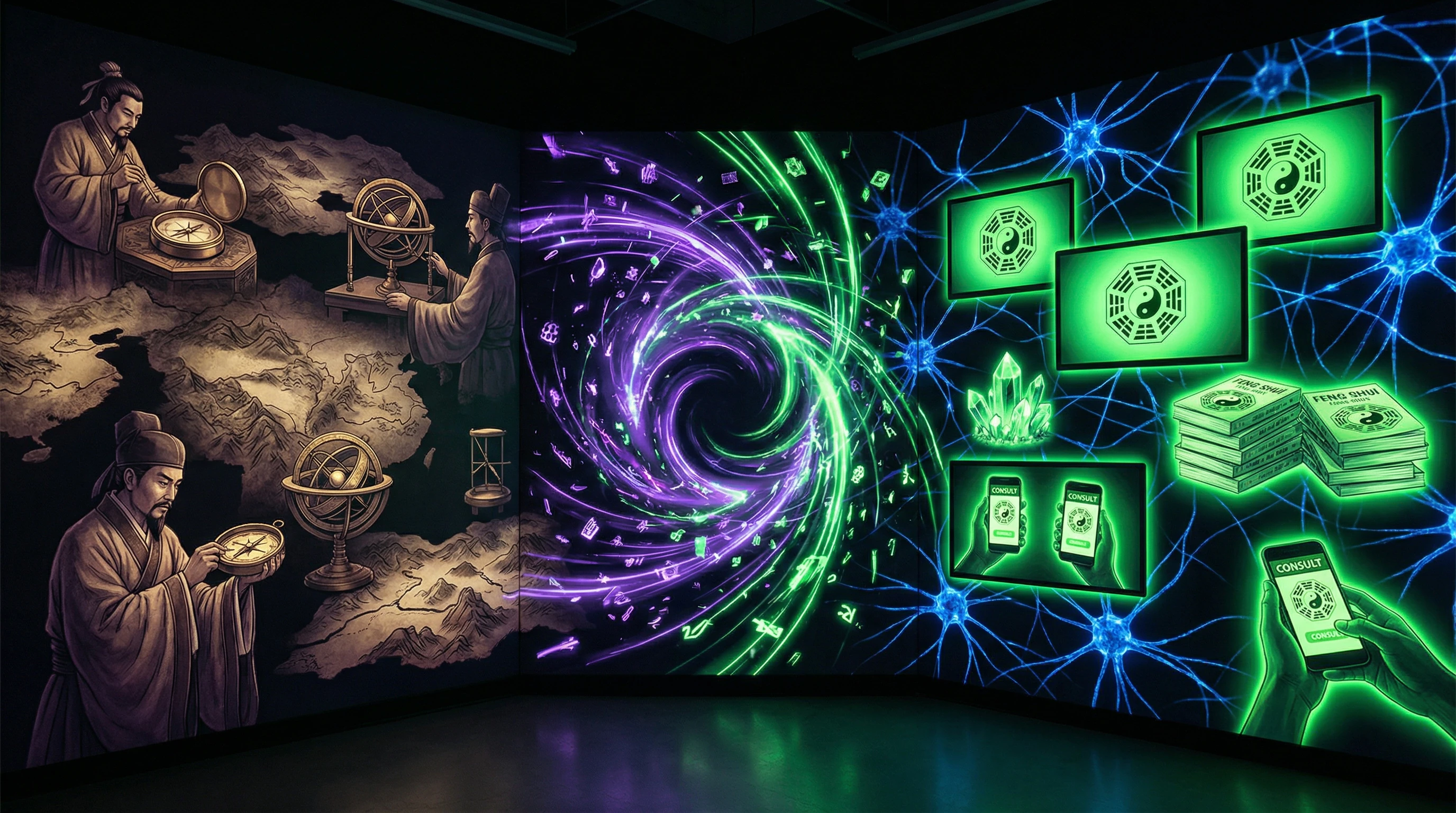
Seven Arguments That Make Smart People Believe in Working Feng Shui — The Steel Man Defense
Before examining the mechanisms of misconception, it's necessary to honestly present the strongest arguments of feng shui proponents. This is not a straw man, but a steel construction — the most convincing version of the position that can be defended intellectually. More details in the section Astral Projection and Lucid Dreams.
🔥 First Argument: Millennia-Old History and Cultural Persistence of the Practice
Feng shui has existed for over two millennia, surviving dynasties, revolutions, and cultural transformations. If the practice were completely useless, it would not have been preserved in cultural memory for such a long time.
Evolutionary logic suggests: what survives possesses adaptive value. Millions of people over centuries have applied these principles — perhaps this collective experience encodes knowledge that modern science cannot yet measure.
- Long-term cultural preservation as a marker of practical value
- Mass application across centuries as indirect evidence of effectiveness
- Adaptation to different historical contexts without loss of popularity
💼 Second Argument: Successful Businesspeople and Corporations Use Feng Shui
Major companies in Hong Kong, Singapore, and mainland China consult with feng shui masters when designing offices, choosing product launch dates, and planning deals. HSBC Bank redesigned the entrance to its headquarters based on consultant recommendations. Donald Trump engaged feng shui specialists for Trump Tower.
If rational business leaders managing billions invest in this practice — perhaps they know something that escapes skeptics.
📈 Third Argument: Personal Experience and Observable Changes After Application
Thousands of people report positive changes after feng shui consultations: improved relationships, career advancement, financial success, better health. These testimonials come from educated, critically thinking people not prone to superstition.
When a person personally experiences correlation between changes in space and life events, it creates persuasiveness that's hard to ignore.
🌊 Fourth Argument: Scientific Ignorance Does Not Equal Scientific Refutation
The absence of scientific evidence for feng shui effectiveness does not mean proof of ineffectiveness. The history of science is full of examples where practices worked long before understanding mechanisms: aspirin, acupuncture, fermentation.
Perhaps feng shui operates through subtle interactions between spatial organization, electromagnetic fields, and psychological effects that current research methods don't yet capture. Absence of measurement does not mean absence of phenomenon.
🧘 Fifth Argument: Psychological Effects as Sufficient Justification
Even if feng shui doesn't work through "qi energy," it may work through psychological mechanisms: placebo effect, increased spatial awareness, creation of intention rituals, anxiety reduction through sense of control.
If a person feels better, makes more confident decisions, experiences less stress — isn't that what matters? The mechanism may be psychological, but the result is real.
🎨 Sixth Argument: Feng Shui as a System of Aesthetics and Harmony
Feng shui principles often align with modern concepts of good design: balance, proportions, natural materials, connection with nature, functionality.
| Feng Shui Principle | Modern Design / Ergonomics |
|---|---|
| Yin-yang balance | Contrast and harmony in composition |
| Free flow of qi | Functional circulation, absence of clutter |
| Connection with nature | Biophilic design, natural lighting |
| Proportions and symmetry | Golden ratio, visual harmony |
Perhaps ancient masters intuitively encoded in the symbolic language of "energies" what we today call ergonomics and psychology of perception.
🔮 Seventh Argument: Openness to Alternative Epistemologies
Western science is not the only way of knowing reality. Eastern traditions operate with different categories, different methods of knowledge validation.
Demanding that feng shui meet the criteria of randomized controlled trials is epistemological imperialism. Perhaps there are forms of knowledge transmitted through practice, intuition, tradition, that cannot be reduced to Western scientific protocols. See also the comparison of ancient architectural systems and their place in modern context.
What the Data Says: Systematic Analysis of the Evidence Base for Feng Shui and Related Practices
Now, having presented the strongest defense, let's turn to the facts. More details in the section Karma and Reincarnation.
📊 Absence of Randomized Controlled Studies of Feng Shui
As of 2025, peer-reviewed scientific databases (PubMed, Scopus, Web of Science) contain no randomized controlled trials (RCTs) demonstrating a causal relationship between applying feng shui principles and measurable life outcomes (health, income, relationship quality).
This doesn't mean such studies are impossible—a protocol could be developed: random assignment of participants to feng shui intervention and control groups, blinding of outcome assessors, measurement of objective indicators. The absence of such studies points to two possible explanations: either the scientific community is ignoring a potentially important field (unlikely, given the commercial scale of the industry), or preliminary attempts haven't yielded results sufficient for publication.
In science, there's publication bias favoring positive results, but complete absence of data is a red flag.
🧪 Spatial Psychology Research: What Works Without Magic
There's extensive literature in environmental psychology studying the influence of space on behavior and well-being. Proven effects include natural lighting on circadian rhythms and mood, color influence on cognitive functions, the connection between clutter and cognitive load, and the impact of natural elements (biophilic design) on stress.
Critically important: these effects are explained through known mechanisms (retinal photoreceptors, working memory, evolutionary preferences), measured with standardized methods, and replicated in independent laboratories.
- None of these effects require:
- the concept of "chi energy"
- specific feng shui rules like "don't place your bed under a beam"
- activation of wealth zones with fountains or mirrors
⚗️ The Problem of Confirmation Bias in Interpreting Personal Experience
Research on cognitive biases shows that confirmation bias—the tendency to seek, interpret, and remember information that confirms existing beliefs—is one of the most persistent patterns of human thinking (S001).
When someone invests time, money, and emotional energy in a feng shui consultation, a powerful motivation arises to find evidence of effectiveness. After changes to the space, the person begins tracking life events through the lens of expectation.
- Positive events (promotion, new relationship, improved well-being) are interpreted as confirmation that feng shui works and are vividly remembered
- Negative events or absence of change are ignored or rationalized ("it needs more time," "I applied the principle incorrectly")
- Forgetfulness about previous expectations and predictions strengthens the illusion of causality (S001)
🧬 Meta-Analyses of Effectiveness: Lessons from Related Fields
While direct meta-analyses of feng shui don't exist, systematic reviews of related practices show a common pattern: interventions based on magical thinking demonstrate effects indistinguishable from placebo under rigorous methodological standards (S007).
Early, methodologically weak studies often show large effects that disappear with improved study design, larger samples, and application of blinding (S006). This is a pattern characteristic of fields where the effect is driven by expectations rather than a specific mechanism.
| Research Stage | Effect Size | Reason for Decline |
|---|---|---|
| Early, open-label studies | Large | Participant expectations, lack of controls |
| Controlled studies without blinding | Medium | Researcher expectations influence assessment |
| Double-blind, large sample | Close to zero or equal to placebo | Systematic biases excluded |
🔍 Specific Problem: Impossibility of Blinding in Feng Shui Research
One of the fundamental problems in testing feng shui is the impossibility of creating adequate blinding. In pharmacological studies, you can give a placebo indistinguishable from the active drug. In feng shui, the participant knows their space has been modified according to the practice's principles.
This knowledge itself creates expectations that influence perception and behavior. Theoretically, you could create a design where participants receive either "real" feng shui or "fake" feng shui (random changes presented as practice principles), but this requires deceiving participants, which creates ethical problems.
If both conditions yield identical results, this indicates the effect is driven by expectations and attention to space, not specific feng shui principles.
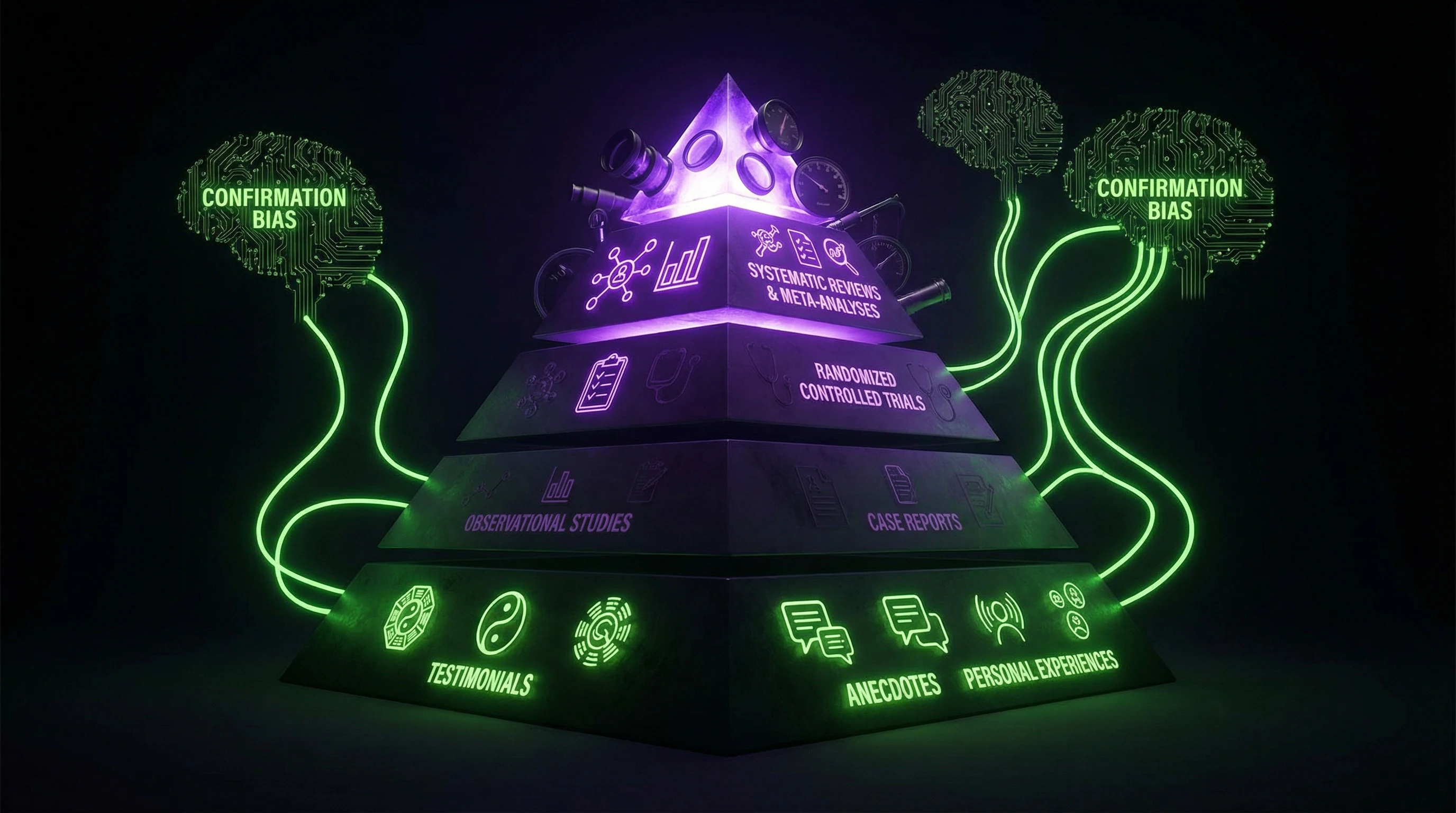
Neurobiology of Causal Illusion: How the Brain Creates Connections Between Unrelated Events
Why do intelligent, educated people see cause-and-effect relationships between furniture placement and life events? The answer lies in the architecture of cognitive systems shaped by evolution to solve survival problems in an environment radically different from the modern world. Learn more in the Thinking Tools section.
🔁 Hyperactive Pattern Detection as an Adaptive Strategy
The human brain is a pattern-detection machine. This ability is critical for survival: recognizing a predator by rustling in the bushes, predicting seasonal changes by star positions, linking consumption of certain plants with illness or recovery.
Evolutionary logic favors hypersensitivity: the cost of a false alarm (seeing a pattern where none exists) is usually lower than the cost of missing a real pattern. The result: cognitive systems are tuned to detect correlations even with insufficient data, to construct causal narratives from sequences of events, to remember coincidences and forget non-coincidences.
This creates a systematic vulnerability to illusory correlations—perceiving connections between variables that are actually independent or linked through a third factor.
🧷 Causal Illusion and Temporal Proximity of Events
When event B follows event A, the brain automatically considers the possibility of a causal connection. This is the post hoc ergo propter hoc heuristic ("after this, therefore because of this").
In the feng shui context: you rearranged your bed (event A), two weeks later you received a promotion (event B). Temporal proximity creates an illusion of causality, even if the promotion resulted from processes that began months ago and had no connection to furniture.
- The brain doesn't automatically conduct counterfactual analysis: you don't think about whether you would have gotten the promotion without rearranging the bed.
- You don't track a control group of people who didn't apply feng shui.
- You don't account for the base rate of positive events in your life.
- The causal narrative forms quickly, intuitively, and requires conscious effort for critical examination.
⚙️ Motivated Cognition and Investment Protection
When a person invests resources (time, money, emotional energy) in a belief or practice, motivation arises to defend that investment. Admitting that feng shui doesn't work means admitting you wasted resources.
Motivated cognition—a process where the desired conclusion influences information processing—leads to asymmetric evaluation of evidence. Information confirming feng shui's effectiveness is accepted with a low threshold of skepticism. Information contradicting its effectiveness undergoes hypercritical analysis, is rejected on procedural grounds, or is ignored.
- Confirming data
- Accepted quickly, without checking sources and methodology. This process is often unconscious.
- Disconfirming data
- Subjected to maximum criticism: "The study was too small," "Conditions aren't representative," "Scientists are biased."
🧬 Neurochemistry of Ritual and the Sense of Control
Applying feng shui principles often includes ritual elements: consulting with an expert, careful measurement of space, symbolic actions (placing crystals, mirrors, plants), periodic adjustments. Rituals activate neurochemical systems associated with anxiety reduction and sense of control.
Performing rituals before stressful events reduces cortisol levels and improves subjective sense of control, even when rituals objectively don't affect outcomes. In the feng shui context: the very process of "doing something" to improve life creates psychological comfort, which is then mistakenly attributed to the specific content of the practice rather than the general effect of ritual and sense of agency.
The brain doesn't distinguish between "I control the situation through feng shui" and "I control the situation through any purposeful action." The neurochemical result is identical.
This explains why people applying feng shui often report improved well-being: they genuinely feel better. But the mechanism isn't in the energetics of space—it's in the psychology of ritual and restoration of sense of agency. The same effect can be achieved through room rearrangement without feng shui, through meditation, through goal planning, or through any other structured practice that creates a sense of control.
Anatomy of a Cognitive Trap: Which Specific Biases the Feng Shui Industry Exploits
Commercial feng shui is not a random collection of superstitions. It's an optimized system that, consciously or not, exploits specific vulnerabilities in human cognition. More details in the Sources and Evidence section.
🕳️ Confirmation Bias: Architecture of Selective Attention
Confirmation bias operates on multiple levels. During information search, you look for success stories, not failures. During interpretation, ambiguous events are construed in favor of the hypothesis. During memory encoding, confirming instances remain more vivid. During communication, you share "working" cases, creating social reinforcement (S001).
The feng shui industry amplifies this effect through client testimonials and case studies. These narratives serve as anchors for potential clients' confirmation bias: "If it worked for them, it will work for me."
The absence of negative reviews is explained not by their nonexistence, but by survivorship bias—only successful cases are visible, while failures silently disappear from the narrative.
🎲 Illusion of Control and Uncertainty Reduction
Life is full of uncontrollable variables: economic cycles, other people's actions, random events. This uncertainty is psychologically uncomfortable.
Feng shui offers an illusion of control: "If you organize your space correctly, you can influence outcomes." This is a seductive proposition, especially for people during periods of life instability.
- You feel uncertainty (job loss, relationship conflict, financial stress)
- You're offered a concrete action protocol (rearrange furniture, activate wealth sector)
- You perform the actions and gain a sense of agency—control over the situation
- Any improvement is attributed to your actions, not to external factors or time
🧩 Apophenia and Pareidolia of Meaning
The brain is a pattern-seeking machine. It sees faces in clouds, causality in coincidences, meaning in noise. Feng shui provides a ready-made interpretation system: every element of space receives symbolic meaning.
- Apophenia
- Perceiving meaningful connections between unrelated phenomena. Feng shui encodes space: mirror = reflection of opportunities, water = cash flow, red color = energy. Any coincidence becomes "proof" of the system.
- Pareidolia of Meaning
- When a system provides an interpretive framework, the brain actively seeks confirmation within that frame. You don't see randomness—you see patterns because the system suggested them.
💰 Monetization of Uncertainty
A feng shui consultant has a financial incentive to maintain belief in the system. Each new space "diagnosis" requires new services: consultation, correction, activation, maintenance.
The client pays not for results (which are impossible to measure), but for anxiety reduction. This creates a sustainable economic model: the more uncertainty in the client's life, the higher the demand for services.
The system is self-sustaining: failure is explained by incorrect application of the protocol, not by its ineffectiveness. This requires new consultation, new corrections, new investments.
🔗 Social Reinforcement and Group Identity
Belief in feng shui is often embedded in social identity. You're not just applying a practice—you're joining a community that shares this belief. This creates social costs for abandoning the belief.
Criticism of feng shui is perceived as criticism of the group to which you belong. This activates defensive mechanisms: you begin seeking counterarguments, ignoring contradictions, strengthening belief. Social pressure becomes a cognitive anchor.
Related materials: feng shui and vastu as systems of contradictory interpretations, ethics of monetizing uncertainty.
Counter-Position Analysis
⚖️ Critical Counterpoint
Skepticism toward feng shui is justified, but requires an honest examination of objections. Here are the main counterarguments worth considering when evaluating the practice.
Cultural Relativism
Feng shui is a millennia-old cultural practice, and demanding Western scientific proof may constitute epistemological imperialism. There are forms of knowledge that cannot be quantitatively verified but hold value within their cultural context.
Underestimating Placebo
The article acknowledges the placebo effect but may underestimate its magnitude. If subjective well-being improves consistently and significantly, doesn't that "work" in a pragmatic sense? The boundary between "real" and "subjective" effects may be artificial.
Lack of Qualitative Research
The focus on quantitative evidence ignores the possibility of qualitative, phenomenological studies of practitioners' experiences. Feng shui may work through mechanisms that modern science cannot yet measure.
Confirmation Bias Among Skeptics
The article itself may be subject to confirmation bias in the opposite direction—selectively ignoring evidence in favor of feng shui and overestimating its weakness. Skepticism can also be dogmatic.
Paradigm Shift
If new physical fields or interactions are discovered in the future (for example, related to quantum biology), some principles of feng shui may receive unexpected confirmation. The history of science is full of examples where "obviously false" ideas turned out to be partially correct in a new context.
FAQ
Frequently Asked Questions

Author of the Cognitive Immunology Hub project. Researches mechanisms of disinformation, pseudoscience, and cognitive biases. All materials are based on peer-reviewed sources.