
What is Cold Reading in the Context of Tarot — Defining the Phenomenon and Distinguishing it from Hot Reading
Cold reading is a technique for obtaining information about a person without prior data, based on observation, statistical generalizations, and dialogue management (S001). Unlike "hot reading," where the reader gathers information in advance through social media or questionnaires, cold reading works "from scratch."
The practitioner uses universal statements (the Barnum effect (S002)), reads nonverbal reactions, and adjusts statements in real time, creating the impression of accurate knowledge. The cards serve not as a source of information, but as a tool for structuring dialogue.
- Cold Reading
- Obtaining information about the client through observation and dialogue management without prior data. The trap: the client fills the cards with personal meaning, attributing supernatural knowledge to the reader.
- Hot Reading
- Preliminary collection of information about the client before the session. Requires preparation, but creates a more convincing illusion of accuracy.
🔎 Three Types of Practices: Where Consultation Ends and Manipulation Begins
Intuitive reading — the practitioner sincerely believes in the magical properties of the cards and acts in good faith. Psychological counseling with Tarot — cards serve as metaphors for discussing the client's problems, as a projective tool. More details in the section Mediumship and Spiritism.
Manipulative cold reading — the reader consciously uses deception techniques to create the illusion of supernatural knowledge for the purpose of exploitation. Characterized by systematic application of influence techniques, avoidance of verifiable statements, and financial motivation.
| Criterion | Intuitive Reading | Psychological Counseling | Manipulative Cold Reading |
|---|---|---|---|
| Practitioner's Belief | Believes in card magic | Uses cards as metaphor | Doesn't believe, consciously deceives |
| Verifiability of Statements | Avoids verification | Open to discussion | Actively avoids specifics |
| Financial Motivation | Secondary | Honest service payment | Primary, often inflated |
⚙️ Three Pillars of Cold Reading: Observation, Generalization, Feedback
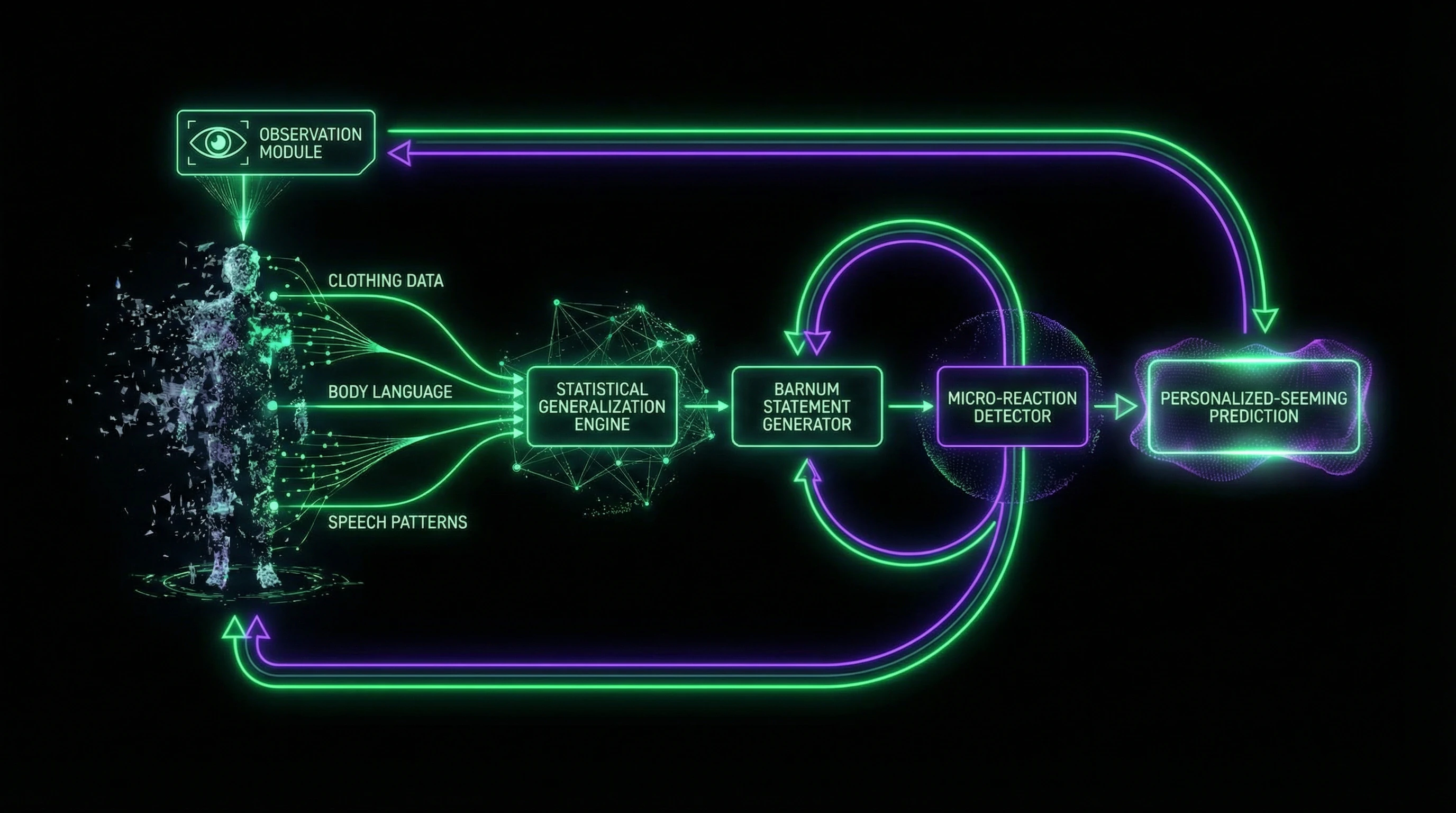
The first pillar is keen observation of the client's appearance, speech, and behavior: clothing, jewelry, manner of speaking, emotional reactions. The reader collects micro-signals that most people don't notice.
The second pillar is using statistically probable generalizations applicable to most people: "You sometimes doubt your decisions," "There have been periods of uncertainty in your life." Such statements are true for 80–90% of the population.
The third pillar is continuous calibration of statements based on verbal and nonverbal feedback. The practitioner begins with broad statements and gradually narrows the focus, tracking which topics trigger emotional responses and developing precisely those.
- Observation: reading micro-signals (posture, gestures, facial expressions, pauses in speech)
- Generalization: applying universal statements true for most people
- Feedback: tracking reactions and adapting the narrative in real time
Steelman Argumentation: Five Strongest Arguments for Tarot Accuracy and Their Rational Reconstruction
Honest analysis requires examining the most compelling arguments of proponents of Tarot's real predictive power in their strongest form before critical examination. More details in the Divination Systems section.
🎯 Argument from Statistical Significance of Matches: "Too Many Accurate Hits to Be Chance"
Tarot defenders point to cases where a reader makes specific statements that turn out to be remarkably accurate—naming a client's profession, describing a recent event, or predicting a specific outcome. The probability of such matches through random guessing appears extremely low.
Proponents cite personal testimonies and claim that accumulated "hit" statistics exceed chance levels. The logic is simple: if a match is incredibly rare, it cannot be random.
Rational reconstruction: the effect works through psychological projection and cold reading (S001). The reader makes dozens of statements of varying generality; the client remembers hits and forgets misses. This isn't statistics—it's selective memory, amplified by (S002) the Barnum effect.
🧬 Argument from Archetypal Psychology: "Cards Activate Deep Structures of the Collective Unconscious"
The Jungian interpretation suggests that Tarot symbols resonate with universal archetypes of the collective unconscious. The card-laying process supposedly activates synchronicity—a meaningful coincidence between internal psychic state and external event.
According to this position, cards don't predict the future mechanically, but reflect psychodynamic patterns that determine probable trajectories of situation development. This makes Tarot a tool for accessing information unavailable to rational consciousness.
Rational reconstruction: archetypes do exist as cultural patterns, but this requires no mystical explanation. Universal symbols (death, love, power) resonate because they reflect universal human situations. The reader interprets the card through the lens of the client's life experience—it's not the card speaking, but the client projecting their expectations onto an ambiguous image.
📊 Argument from Therapeutic Effectiveness: "If It Helps People, Some Real Mechanism Must Be Working"
Many clients report positive psychological effects: reduced anxiety, clarified life goals, decision-making. Defenders claim that systematic production of favorable results indicates the presence of a real mechanism of action.
The pragmatic argument sounds convincing: "it works—therefore it's true in a practical sense."
| Observed Effect | Mystical Explanation | Rational Explanation |
|---|---|---|
| Client feels better after session | Cards opened access to intuitive knowledge | Placebo, reader's attention, problem structuring, ritual effect |
| Person makes a decision that turns out successful | Cards predicted the correct outcome | Client chose the decision themselves; reader voiced their hidden preferences |
| Anxiety decreases | Cards gave confidence in the future | Ritual and attention reduce uncertainty; client received "permission" to act |
🔮 Argument from Historical Persistence of Practice: "The System Has Existed for Centuries and Is Used by Millions"
Tarot as a system has existed since the 15th century, survived numerous cultural transformations, and continues to be actively used. Proponents argue that such historical persistence and mass adoption are impossible if the practice is completely devoid of real value.
Rational reconstruction: historical persistence doesn't prove truth. Astrology, numerology, and runes have also existed for centuries. The reason for persistence isn't predictive power, but psychological utility: people seek structure in chaos, and any system offering an illusion of control will be in demand. This isn't a rational kernel—it's an evolutionary vulnerability of human thinking.
🧪 Argument from Personal Experience of Practitioners: "I Myself Have Experienced Phenomena Inexplicable by Chance"
Many practicing readers are sincerely convinced of the phenomenon's reality based on their own experience. They describe altered states of consciousness during sessions, a sense of "information flow," cases where they "knew" information they couldn't have obtained through ordinary means.
The phenomenological argument: the subjective experience of practitioners is so convincing and consistent that it requires an explanation beyond simple self-deception.
Rational reconstruction: subjective convincingness of experience doesn't correlate with its objective truth (S003). The practitioner is in a state of high motivational involvement: their income, status, and self-identity depend on belief in the phenomenon's reality. This creates a powerful cognitive filter. "Information flow" is cold reading, amplified by the reader's own belief in their abilities. They genuinely don't realize where the information comes from because the process works at the level of microexpressions, intonations, and contextual cues from the client.
Evidence Base: What Controlled Studies Show About Cold Reading Effectiveness and Tarot's Predictive Power
Critical analysis requires examining empirical data from controlled experiments that test the actual accuracy of predictions and the mechanisms creating the illusion of accuracy. More details in the section Karma and Reincarnation.
📊 The Barnum Effect: Experimental Data on Accepting Universal Descriptions as Personal
The Barnum Effect (Forer effect) is the tendency for people to accept vague, general personality descriptions as accurately describing them individually. In Forer's classic experiment (1948), students received supposedly personalized psychological profiles that were actually identical sets of general statements taken from horoscopes.
On average, participants rated the accuracy of descriptions at 4.26 out of 5, considering them highly personalized (S002). This effect has been replicated in numerous studies and explains why clients perceive fortune tellers' general statements as strikingly accurate.
| Experimental Condition | Average Accuracy Rating | Conclusion |
|---|---|---|
| Personal profile (supposedly individualized) | 4.26 / 5 | High acceptance of universal statements |
| Disclosure: everyone received identical text | Overestimation persists | Effect remains even after debunking |
🧪 Controlled Tests of Predictive Power: Double-Blind Experimental Methodology
In controlled experiments where Tarot readers attempt to match card spreads with actual biographical information under double-blind protocols (where neither the reader nor the experimenter knows the correct answers until testing is complete), prediction accuracy does not exceed chance levels (S003).
Research shows that when the possibility of receiving feedback from the client and observing their reactions is eliminated, the "magical" accuracy disappears. This indicates that the source of information is not the cards, but the interaction with the client.
When the reader cannot see the client's face or hear their reactions, cards become just cards. Information comes not from the deck, but from the social channel.
🔎 Session Transcript Analysis: Identifying Cold Reading Techniques in Actual Practice
Linguistic analysis of recordings from actual reading sessions reveals systematic use of cold reading techniques (S001):
- Statements are formulated as questions or suggestions, allowing direction to be adjusted based on reactions.
- "Rainbow statements" are used, containing opposite elements ("You're outgoing, but sometimes need solitude").
- The "shotgun" technique is applied—a series of rapid guesses from which clients remember only the hits.
- Memory asymmetry is exploited: clients remember confirmations and forget misses.
🧠 Neuropsychological Research on Confirmation Bias and Selective Memory
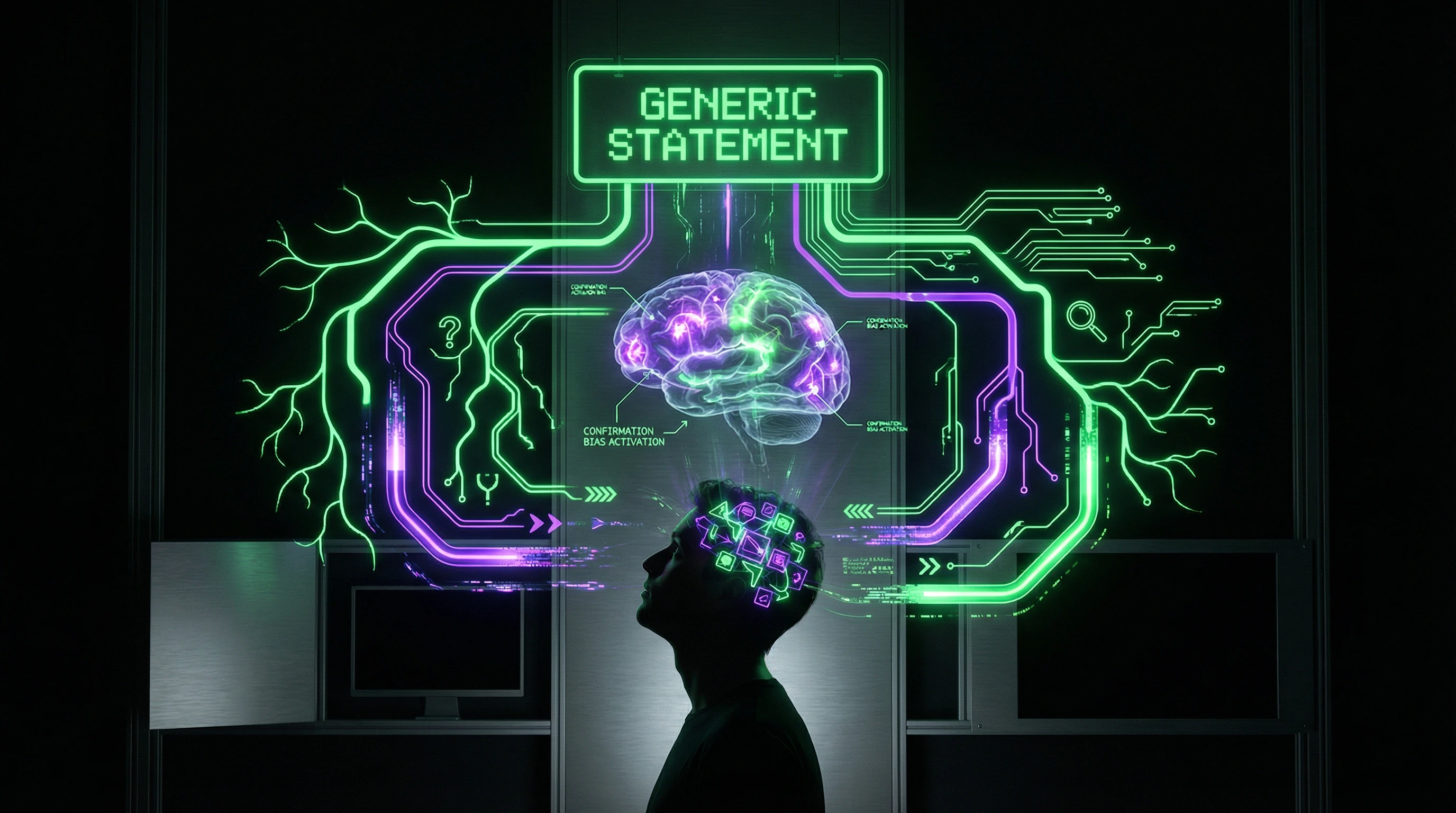
Confirmation bias is the tendency to seek, interpret, and remember information in ways that confirm existing beliefs. Neuroimaging studies show that when processing information consistent with expectations, brain regions associated with reward (ventral striatum) are activated, creating positive reinforcement.
- Confirmation Bias
- Selective search and interpretation of information favoring existing beliefs. Activates brain reward centers, creating positive reinforcement for belief in reading accuracy.
- Selective Memory
- Clients remember "hits" and ignore or rationalize misses, creating a subjective sense of high prediction accuracy.
- Hindsight Bias Effect
- After an event, people overestimate how well they predicted it, even if the prediction was vague or inaccurate.
This explains why Tarot clients tend to remember "hits" and ignore or rationalize misses, creating a subjective sense of high prediction accuracy. The mechanism operates regardless of whether the reader themselves believes in the magic of the cards or consciously uses cold reading.
Mechanisms of Influence: How Cold Reading Exploits the Architecture of Human Cognition and Decision-Making
Cold reading works not despite the brain's logic, but through it. The fortune-teller exploits systematic failures in information processing—the same mechanisms that help us make quick decisions under uncertainty. Learn more in the Epistemology Basics section.
🧩 Availability and Representativeness Heuristics in Evaluating Prediction Accuracy
The availability heuristic causes people to assess the probability of events by the ease with which examples come to mind (S001). When a fortune-teller makes a statement that resonates with a client's recent experience, that experience becomes mentally available—and the client overestimates the frequency of matches.
The representativeness heuristic leads to probability judgments based on similarity to a prototype, ignoring base rates (S002). If the fortune-teller's description "seems like" you, you consider it accurate, without accounting for the fact that it applies to most people.
| Heuristic | Exploitation Mechanism | Result for Client |
|---|---|---|
| Availability | Fortune-teller mentions client's recent events | Overestimation of matches, illusion of accuracy |
| Representativeness | Description matches self-perception | Acceptance of vague portrait as personal |
| Anchoring | First statement sets direction of interpretation | Subsequent details fit into established frame |
🔁 Illusion of Control and the Need for Predictability
In situations of uncertainty, people experience heightened need for a sense of control and predictability. Tarot reading provides the illusion of access to hidden information about the future, temporarily reducing anxiety.
This psychological comfort creates motivation to believe in the accuracy of predictions, even in the face of contradictory evidence. The brain prefers certainty, even false certainty, to uncertainty.
Uncertainty activates threat systems in the brain. Any explanation—even an implausible one—reduces activation. The fortune-teller offers not truth, but relief.
🧠 The Role of Emotional State in Reducing Critical Thinking
Clients often consult fortune-tellers in states of emotional stress, anxiety, or after significant events. Strong emotions reduce activity in the prefrontal cortex—the region responsible for critical thinking and logical analysis.
In this state, people are less inclined to verify claims and more ready to accept information on faith. Fortune-tellers, consciously or intuitively, exploit this vulnerable state.
- Prefrontal Cortex Under Normal Conditions
- Active during analysis, doubt, fact-checking. Slows decision-making.
- Prefrontal Cortex Under Stress
- Suppressed. Limbic system and automatic responses dominate. Accelerates decision-making.
- Fortune-Teller's Strategy
- Amplify emotional tension (mystery, authority, personal details) → suppress criticism → obtain agreement.
⚙️ Semantic Flexibility of Symbols as a Tool for Post-Hoc Rationalization
Tarot card symbols are deliberately ambiguous and open to multiple interpretations (S003). This allows the fortune-teller to adapt a card's meaning to any client situation, creating an impression of accuracy.
If a client reports relationship problems, the "Tower" card is interpreted as destruction of old connections; if career changes—as collapse of old structure. This flexibility makes falsification impossible: any outcome can be presented as confirmation of the reading.
- Fortune-teller makes a vague statement (e.g., "I see changes")
- Client interprets it according to their situation
- Any subsequent outcome confirms the prediction
- Client attributes accuracy to the fortune-teller, not to their own interpretation
Conflicts in the Evidence Base and Methodological Limitations of Cold Reading Research
Honest analysis requires acknowledging areas where data is ambiguous or research methodology has limitations. This doesn't refute conclusions about cold reading mechanisms, but clarifies the boundaries of their applicability. More details in the Media Literacy section.
🧪 The Problem of Ecological Validity in Laboratory Experiments
Critics of controlled studies point out: laboratory conditions don't reproduce the real atmosphere of a session—emotional involvement, trusting relationships, and ritual context are absent (S001). Perhaps the phenomenon requires specific conditions to manifest, which are destroyed by strict experimental control.
If a phenomenon only manifests under conditions that exclude objective verification, how do we distinguish it from self-deception? This isn't a rhetorical question—it's a methodological trap that ensnares both camps.
📊 Absence of Large-Scale Meta-Analyses
Most research on cold reading and Tarot consists of small experiments or qualitative analyses (S003). Large-scale meta-analyses that systematically synthesize results from multiple studies with effect size assessment and control for publication bias are absent.
| Parameter | Current State | Required Standard |
|---|---|---|
| Sample Size | 30–100 participants | 500+ participants |
| Preregistration | Rare | Mandatory |
| Replication | Isolated attempts | Minimum 3 independent labs |
| Publication Bias Control | Not applied | Funnel plot, trim-and-fill |
🔎 Separating Cold Reading Effects from Therapeutic Interaction
In real practice, fortune-telling often includes elements of psychological counseling, empathic listening, and emotional support. It's difficult to separate the effects of cold reading techniques from the effects of therapeutic alliance and nonspecific helping factors.
- Therapeutic Alliance
- Trust, empathy, collaborative goal-setting. Clients receive real benefit not from prediction accuracy, but from the opportunity to articulate problems and receive emotional validation.
- Metaphorical Structuring
- Tarot cards function as a projective tool, helping clients reframe problems. This can be useful regardless of whether the cards contain information about the future.
- The Trap: Confounding Causes
- If a client improves after a session, this proves neither the accuracy of fortune-telling nor the power of cold reading—it could result from any of these factors or their combination.
Research is needed that isolates cold reading from other session components—for example, comparing the effect of pure cold reading with the effect of empathic listening without predictions.
Cognitive Anatomy of Deception: Which Thinking Biases Cold Reading Exploits
Cold reading works not because the fortune-teller possesses supernatural abilities, but because it exploits systematic errors in the architecture of human thinking. More details in the section Extreme Diets and Miracle Cures.
⚠️ Spotlight Effect: Overestimating the Uniqueness of Personal Experience
The spotlight effect is the overestimation of the degree to which others notice and think about us. In fortune-telling, this manifests as the belief that the reader's general statements are specific to you, because you perceive your experience as unique.
When a fortune-teller says "You're going through a period of uncertainty," the client thinks: "She knows about my specific situation!"—not realizing that most people at any given time are experiencing some uncertainty.
🕳️ Apophenia and Patternicity: Seeing Patterns in Random Data
Apophenia is the perception of meaningful connections between unrelated phenomena. Patternicity (Michael Shermer's term) is the tendency to find patterns in noise. Evolutionarily, this ability was adaptive (better a false alarm than a missed threat), but in modern contexts it leads to false conclusions.
Tarot clients see meaningful connections between card symbols and life events, even when these connections are random. The brain actively constructs narratives linking disparate elements into a coherent story.
🧠 Hindsight Bias: "I Always Knew That"
Hindsight bias is the perception of an event that occurred as more predictable than it actually was. When a fortune-teller's prediction comes true (or is interpreted as coming true), the client recalls: "She said exactly that!"—forgetting the vagueness of the original statement and how many other predictions didn't come true.
This bias strengthens the illusion of prediction accuracy after the fact. Memory rewrites history in the fortune-teller's favor.
🔁 Availability Cascade: Social Amplification of Belief Through Others' Testimonies
An availability cascade is a self-reinforcing process in which collective confidence in an idea grows through repetition in public discourse. When many people share stories about "accurate" Tarot predictions, this creates social proof and increases the availability of success examples in collective memory.
| Cognitive Bias | Exploitation Mechanism | Result for Client |
|---|---|---|
| Spotlight effect | General statement perceived as personal | Illusion of specificity |
| Apophenia | Random connections interpreted as meaningful | False correlations |
| Hindsight bias | Memory rewrites history in favor of prediction | Illusion of accuracy |
| Availability cascade | Social testimonies amplify belief | Group confirmation |
New clients arrive with expectations of accuracy, making them more susceptible to cold reading techniques, creating positive feedback. Psychological projection in fortune-telling is amplified by social context.
Verification Protocol: Step-by-Step System for Testing Fortune Teller Claims and Protecting Against Manipulation
Practical toolkit for critical evaluation of fortune-telling sessions in real-time and retrospectively.
✅ Red Flag Checklist: Seven Signs of Manipulative Cold Reading
Manipulative cold reading relies on predictable patterns. Here are seven markers that expose the technique in action.
| Flag | What You Hear | Manipulation Mechanism |
|---|---|---|
| 1. Questions Instead of Statements | "I see something here related to work... perhaps recent changes?" | The fortune teller adjusts direction based on your reaction; you fill in the blanks yourself |
| 2. Rainbow Statements | "You're confident, but sometimes you doubt yourself" | Opposite elements make the statement unfalsifiable for any person (S002) |
| 3. Shotgun Technique | Rapid series of different guesses in succession | At least one hits; the fortune teller then focuses on hits, forgetting misses |
| 4. Decision Pressure | "I see negative influence, need urgent ritual for additional fee" | Creating urgency blocks critical thinking, triggers financial exploitation |
| 5. Avoiding Specifics | All statements are vague, without dates, names, numbers | Impossible to verify retrospectively; any outcome interpreted as a "hit" |
| 6. Rewriting History | "I told you about this" (though they didn't) | You don't remember exactly what was said; the fortune teller redefines the narrative |
| 7. Responsibility on Client | "The cards show possibility, but everything depends on your energy" | Any outcome is your fault; the fortune teller is protected from verification |
🔍 Real-Time Protocol: Four Steps During the Session
Activate your internal auditor. During the reading, apply this framework in parallel.
- Record the statement verbatim (mentally or on voice recorder). Don't interpret, don't elaborate — exact words.
- Ask yourself: is this verifiable? Can this statement be disproven by a concrete fact? If not — it's a rainbow statement.
- Track who fills in the gaps. Is the fortune teller speaking vaguely while you supply the details? That's your imagination, not their information.
- Check the causal logic. If the fortune teller says "this will happen because the cards show it" — that's circular reasoning, not a cause.
Cold reading works because we believe in coincidences and rewrite memory to fit the narrative. The verification protocol is simply an honest record of what was said, and checking against facts.
📋 Retrospective Audit: How to Verify Prediction Accuracy Over Time
After a month, quarter, year, return to the session records. Apply this framework.
- Criterion 1: Specificity
- Was the prediction concrete (date, name, number) or vague? Concrete predictions are easier to verify. Vague ones always "come true" through reinterpretation.
- Criterion 2: Independence from Your Behavior
- Did the event occur independently of your actions, or did you create it yourself? If the fortune teller predicted "you'll meet someone" and you actively sought a meeting — that's not prediction, that's advice you followed.
- Criterion 3: Base Rate Probability
- How likely is this event in general? "You'll experience sadness" — that's nearly guaranteed for any person over a year. That's not prediction, that's statistics.
- Criterion 4: Alternative Explanations
- Could the event have occurred for other reasons, without the fortune teller's involvement? If yes — the fortune teller isn't needed for the explanation.
If most predictions don't withstand this verification — you were dealing with cold reading (S001), not information from cards.
🧠 Cognitive Defense: Three Principles That Block Manipulation
This isn't about distrust, it's about method. Three rules that work against any cold reading.
Principle 1: Separate Information from Interpretation. Is the fortune teller stating a fact? Or interpreting your reactions? These are different things. Facts are verifiable, interpretations aren't.
Principle 2: Demand Specificity. If a statement applies to 90% of people — that's not information, that's noise. Request clarification: date, name, number. The fortune teller can't provide it? That's a sign of technique.
Principle 3: Track Accountability. Who's responsible for the outcome? If the fortune teller — they must provide a verifiable prediction. If you — then the fortune teller is simply an advisor, and you're paying for advice, not information from cards.
Protection from manipulation isn't paranoia. It's an honest record of what was said, and verification against reality. Nothing more is needed.