What exactly tarot proponents claim — and where the boundary lies between interpretation and prediction
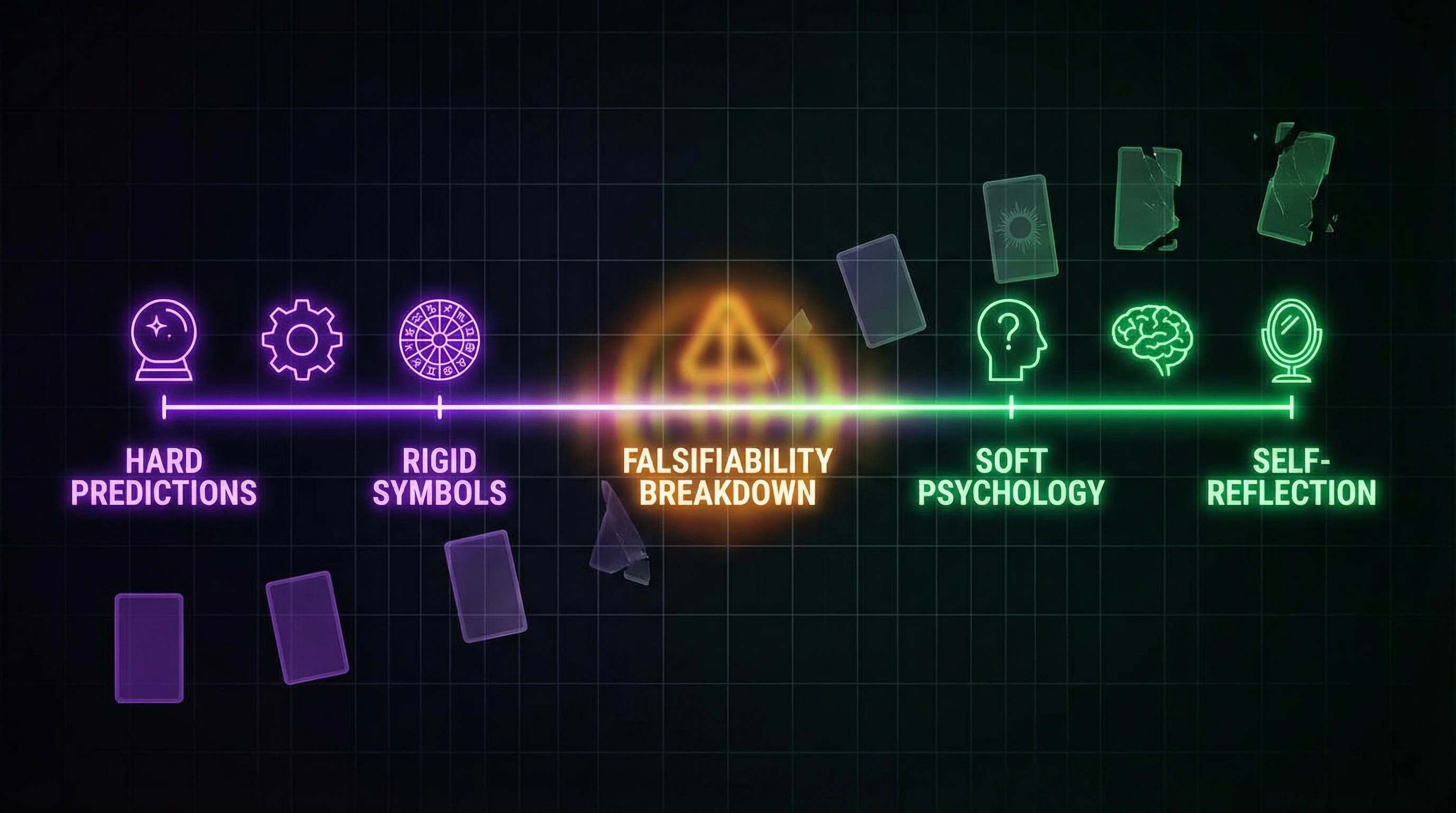
Before analyzing how tarot works, we need to clearly define what practitioners actually claim. There's a wide spectrum of positions — from radical assertions about cards' ability to predict specific events to softer formulations about a "psychological tool for self-discovery." More details in the section Occultism and Hermeticism.
This blurred boundary is itself a protective mechanism: when a prediction fails, one can always cite "incorrect interpretation" or "symbolic rather than literal meaning."
🧩 Hard and soft versions of tarot practice
- Hard version
- Tarot possesses predictive power: cards reveal future events, disclose hidden information about other people or situations to which the reader has no access. Assumes the existence of an information channel connecting cards to reality — an "energy field," "collective unconscious," or "synchronicity" in Jung's sense.
- Soft version
- Tarot is a psychological tool: cards help structure thoughts, reveal hidden emotions, and view situations from new angles. Closer to projective psychological tests (Rorschach inkblots) and requires no mystical explanations. In practice, even proponents of "psychological tarot" often slip into claims about "incredible coincidences" and "working spreads," blurring the line between interpretation and prediction.
🔎 Key elements of the tarot system
The classic deck consists of 78 cards: 22 major arcana (symbolic archetypes like "The Fool," "Death," "The Tower") and 56 minor arcana (four suits of 14 cards each). Each card has multilayered symbolism allowing multiple interpretations.
A reading includes several stages: formulating a question, shuffling and laying out cards in a specific pattern (spread), interpreting the symbols that appear in the context of the question and positions in the spread.
Interpretation is always subjective. The same card in the same position can be interpreted dozens of different ways depending on context, the reader's mood, and the client's expectations. This flexibility allows fitting the result to any outcome.
⚠️ The problem of falsifiability in tarot claims
The main methodological problem with tarot is the impossibility of formulating testable predictions. If a reader says "change is coming," this statement cannot be disproven: any event can be interpreted as "change."
| Scenario | Outcome | Proponents' explanation |
|---|---|---|
| Specific prediction doesn't come true | System remains "valid" | "Incorrect understanding of symbolism" or "shift in energy field" |
| Vague prediction matches event | System "works" | "The cards showed the truth" |
| Vague prediction doesn't match | System remains "valid" | "You misinterpreted" or "it was symbolic meaning" |
This unfalsifiability makes tarot a pseudoscience in Popper's sense: the system is constructed so any outcome can be declared confirmation of its validity. A genuine predictive system must allow for the possibility of error and clear verification criteria — tarot fails to meet these requirements.
The connection between this mechanism and broader thinking patterns is revealed in the section on cold reading in tarot, where the reader actively uses information from the client, creating an illusion of accuracy.
The Steel-Man Version of Arguments for Tarot — What the Most Convincing Advocates Say
To honestly evaluate tarot, we need to examine the strongest arguments in its favor — not caricatured versions, but carefully formulated positions from educated practitioners. This is the "steel-man" principle — the opposite of a straw man. Only by addressing the best arguments can we understand where they break down. More details in the section Karma and Reincarnation.
💎 The Argument from Personal Experience and "Incredible Coincidences"
Thousands of people report astonishingly accurate readings where the cards "knew" things the reader couldn't have guessed. A client comes with a question about career, and the cards reveal a hidden relationship conflict that actually exists.
Or a reading predicts an unexpected encounter that happens a week later exactly as described. Skeptics cite coincidence, but when there are dozens of such "coincidences," the probability of pure chance approaches zero.
Even if the mechanism is unknown, empirical effectiveness doesn't require theoretical explanation. Aspirin worked long before we understood the mechanism of acetylsalicylic acid. Perhaps tarot uses information channels that modern science can't yet detect — but that doesn't make the effect any less real.
🧠 The Argument from Jungian Synchronicity
Carl Jung developed the concept of synchronicity — meaningful coincidences not connected by cause and effect, but by semantic relationship. Tarot may work not through predicting the future in a physical sense, but through resonance with archetypal structures of the collective unconscious.
When a person asks a question and shuffles cards, their psychic state "synchronizes" with the symbols that appear, creating a meaningful coincidence.
- Quantum mechanics showed that the observer affects the observed
- Perhaps the reader's consciousness influences the random shuffling process at the quantum level
- This creates a non-random result — not mysticism, but a hypothesis about consciousness's role in physical processes
- Serious scientists investigate such questions in the context of the measurement problem in quantum mechanics
🔁 The Argument from Therapeutic Effectiveness
Even if tarot doesn't predict the future in a literal sense, it works as a powerful psychological tool. Card symbolism helps people access suppressed emotions, see situations from unexpected angles, and make difficult decisions.
Many clients report therapeutic effects from tarot sessions comparable to psychotherapy. If a tool helps people, isn't that what matters most?
- Projective methods in psychology
- The Rorschach test, TAT, and others are widely used in clinical practice. Tarot is a structured projective system with rich symbolism accumulated over centuries.
- The question isn't whether tarot "works"
- The question is "how exactly it works" — and a psychological explanation is perfectly sufficient. Denying tarot's psychological value means denying all projective psychology.
📊 The Argument from Statistical Anomalies in Research
Studies exist showing statistically significant deviations from randomness in prediction experiments. Meta-analyses of parapsychological research demonstrate a small but consistent effect that can't be explained by publication bias alone.
Even if the effect is weak, its existence challenges the materialist worldview.
| Evaluation Criterion | Medicine | Parapsychology | Problem |
|---|---|---|---|
| Minimum effect size | 0.2–0.3 considered significant | Effect of 0.1 declared "insignificant" | Double standards in evaluation |
| Application of criteria | Uniform standards | Scientific community bias | With identical criteria, some parapsychological phenomena pass the significance threshold |
🌐 The Argument from Cultural Universality of Divination Practices
Divination systems exist in all cultures and eras — from the Chinese I Ching to African bones, from runes to tarot. If this were pure illusion, the practice wouldn't have survived millennia across independent cultures.
The universality of the phenomenon suggests it reflects some real feature of human interaction with the world — even if we don't understand the mechanism.
Evolution doesn't preserve useless practices. If divination provided no adaptive advantage, it would have disappeared. Perhaps the ability to detect subtle patterns and make intuitive predictions through symbolic systems was evolutionarily beneficial — and tarot is the cultural crystallization of this ability.
All these arguments sound convincing at first glance. But each contains hidden assumptions that don't withstand scrutiny. Cold reading in tarot reveals how readers read you, not the cards — and this explains most "incredible coincidences" without invoking paranormal mechanisms.
What Controlled Studies of Tarot Actually Show — Evidence-Based Analysis Without Bias
Now that we've examined the strongest arguments in favor of tarot, it's time to turn to the empirical data. More details in the section Folk Magic.
And if not — why does the personal experience of millions of people diverge so dramatically from experimental results?
🧪 Classic Experiments Testing Predictive Power
The gold standard for testing any predictive method is a double-blind controlled study. For tarot, this looks like: a reader receives minimal information about a client (for example, only birth date), performs a reading, and gives a detailed description of personality, situation, or future events.
Then this description is presented to the client and several other people, who rate how well it fits them. If tarot works, the client should significantly more often choose their own description than random ones.
The results of such experiments are unambiguous: readers show no better than chance results.
A classic study was conducted by psychologist Richard Wiseman: professional tarot practitioners performed readings for volunteers, who then rated the accuracy of the descriptions. The match rate did not exceed what would be statistically expected from random guessing.
Similar results have been obtained in dozens of independent experiments with astrologers, palm readers, and other "fortune-tellers."
📊 The Problem of the Barnum Effect and Subjective Validation
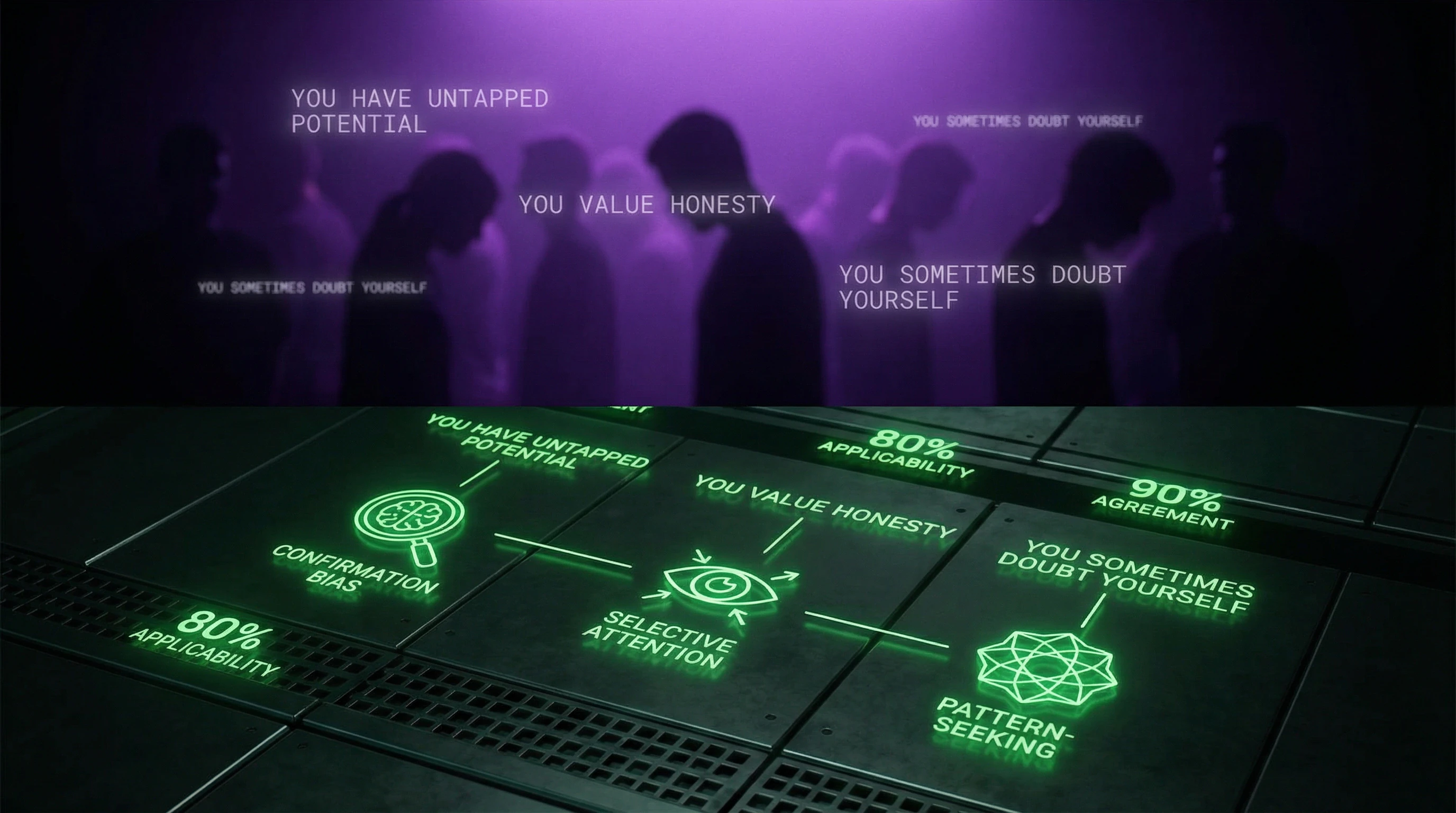
Why then are people convinced of the accuracy of readings if objective tests show randomness? The answer is provided by the Barnum effect (also known as the Forer effect) — a cognitive bias in which people consider vague general personality descriptions to be accurate and specific to themselves.
Psychologist Bertram Forer in 1948 conducted an experiment: he gave students "individual psychological profiles" that were actually identical for everyone and compiled from general horoscope phrases. Students rated the accuracy of the descriptions at an average of 4.26 out of 5.
- Tarot descriptions use the same techniques:
- "You are a person with a rich inner world, but sometimes you doubt yourself" — applicable to 80–90% of people, but each perceives it as uniquely accurate.
- "You have unrealized potential" — a universal statement that works thanks to subjective validation.
- "You value honesty, but understand that sometimes you have to compromise" — a contradiction that allows everyone to find confirmation in their own experience.
Add subjective validation — the tendency to seek confirmations and ignore contradictions — and you get a feeling of "incredible accuracy" with objective randomness.
🧾 Meta-Analyses of Parapsychological Research — What They Actually Show
Defenders of tarot often cite meta-analyses of parapsychological research showing "statistically significant effects." The most cited is Dean Radin's meta-analysis of presentiment experiments.
However, critical examination of this data reveals serious problems.
- Publication bias: studies with null results are published less often, distorting the overall picture. Correction methods (for example, trim-and-fill) show that after accounting for unpublished studies, the effect disappears or becomes insignificant.
- Methodological quality: analysis shows an inverse correlation between study quality and effect size. The stricter the control, the weaker the result. Studies with the best design (preregistration of hypotheses, large samples, independent replication) show no significant effects — a classic sign of an artifact.
- Multiple comparisons problem: when thousands of experiments are conducted, some will show a "significant" result purely by chance (at p<0.05 this is 5% of all tests). Bayesian analysis, accounting for the prior probability of paranormal phenomena, shows that even "significant" results do not substantially change the probability of the effect being real.
🔎 Why Professional Fortune-Tellers Don't Win the Lottery
A simple thought experiment destroys tarot's claims to predictive power: if cards can predict the future, why don't readers use them to predict lottery numbers, stock prices, or sports results?
The standard answer — "tarot only works with personal questions, not material ones" — is a classic example of special pleading: an arbitrary limitation introduced to protect the theory from refutation.
If tarot truly receives information from the future or from an "information field," there are no physical reasons why this information couldn't concern lottery numbers.
The absence of tarot millionaires is not a coincidence, but a direct consequence of the absence of predictive power. Any system that provides information about the future better than chance can be monetized — and the market economy would quickly do so.
The fact that this doesn't happen is sufficient to conclude the effect is absent.
🧬 Neurobiological Research on "Intuition" and "Presentiment"
Some defenders of tarot appeal to research on intuition and "presentiment" at the physiological level. Indeed, there are experiments showing changes in galvanic skin response several seconds before presentation of an emotionally significant stimulus.
However, these effects have a simple explanation through unconscious processing of contextual cues: the brain picks up subtle patterns in the sequence of stimuli and forms an expectation that manifests in physiological response.
| Condition | Result | Mechanism |
|---|---|---|
| Real patterns (card games, imperfect shuffling) | Effect present | Brain detects regularity and forms expectation |
| Truly random sequences | Effect disappears | No patterns to process |
| Tarot reading with properly shuffled deck | Effect absent | Process is random, unconscious processing impossible |
Attempts to link tarot with the neurobiology of intuition are a category error, conflating different phenomena. Physiological markers of intuition only work where there is real information to process.
The Psychological Mechanism of Belief in Tarot — Which Cognitive Biases Create the Illusion of a Working System
If tarot has no predictive power, why are millions of people convinced otherwise? The answer lies not in the cards, but in the peculiarities of how the human brain works. Tarot is not a mystical system, but a perfectly calibrated machine for exploiting cognitive biases. More details in the section Psychology of Belief.
🧩 Apophenia — Seeing Patterns in Randomness
Apophenia — the tendency to perceive meaningful connections between unrelated phenomena. Evolutionarily, this was useful: better to see a predator in rustling bushes than to miss a real threat. But apophenia makes us see patterns where none exist.
Tarot exploits this feature: the rich symbolism of the cards allows finding a "connection" with any life situation. The Tower card appeared before a layoff? "The cards predicted it!" But if no layoff occurred, the same card is interpreted as "destruction of old thought patterns" or "internal transformation."
The system is built so that any outcome confirms the prediction — a classic sign of pseudoscience. The brain, prone to apophenia, doesn't notice this retrofitting and only registers the "hits."
🔁 Confirmation Bias and Selective Memory
Confirmation bias — the tendency to seek, interpret, and remember information in ways that confirm existing beliefs. If a person believes in tarot, they actively seek confirmation: notice coincidences, interpret ambiguous events in favor of the prediction, ignore misses.
Selective memory amplifies the effect: we better remember vivid coincidences and forget numerous mismatches. If out of 20 readings one turned out "strikingly accurate," that's the one that will be remembered and retold. The 19 misses will be forgotten as "incorrect interpretation" or "insufficient concentration."
| What Happens | How the Brain Processes It | Result |
|---|---|---|
| Prediction matched the event | Vividly remembered, retold | "Tarot works" |
| Prediction didn't match | Forgotten or reinterpreted | "I misunderstood the cards" |
| Event occurred without prediction | Not noticed or linked to past reading | "The cards prepared me" |
⚠️ Cold Reading and Active Client Participation
Professional fortune-tellers often use the cold reading technique — extracting information from the client through observation, leading questions, and interpretation of reactions. The reader makes a general statement and watches for micro-expressions: if the client reacts positively, develops that line; if negatively — quickly switches to another interpretation.
Critically important: the client is an active participant in creating meaning. The reader provides vague symbolic descriptions, and the client fills in the gaps with specific details from their life. "I see conflict in close relationships" — and the client themselves recalls a recent argument with their partner, filling the card with personal meaning.
The client doesn't realize they're providing all the information themselves. This isn't conscious fraud — it's the automatic work of both parties' cognitive systems.
🎯 The Barnum Effect and Universality of Interpretations
The Barnum Effect (or Forer effect) — the tendency to perceive vague, general statements as personal and accurate. A person believes the description applies specifically to them, though it's applicable to most people. Tarot is entirely built on this principle.
- "You often doubt your decisions"
- Applicable to 80% of the population. The client thinks: "That's about me!" and recalls specific moments of doubt.
- "A change awaits you in the coming months"
- Statistically almost guaranteed: job change, relationships, residence, health. The client will find a match.
- "Someone close to you doesn't understand you"
- There's misunderstanding in any relationship. The client will remember a specific person and specific conflict.
🔄 Self-Fulfilling Prophecy
A prediction can create conditions for its own fulfillment. If a reader said: "Success awaits you in a new project," the client may subconsciously invest more effort, become more confident, better notice opportunities. Success comes not because the cards predicted it, but because the prediction changed behavior.
The reverse effect also works: a prediction of misfortune can cause anxiety, errors in judgment, avoidance of opportunities. A person interprets neutral events as confirmation of the negative forecast. This is not card magic, but the psychology of expectations.
Tarot works not because the cards have mystical power, but because they trigger psychological mechanisms that change a person's perception and behavior.
💡 Why These Mechanisms Are So Powerful
These cognitive biases are not errors or weaknesses. They're built into our nervous system because in most situations they help us survive. Seeing patterns, confirming one's beliefs, believing in one's own ability to influence events — all of this is adaptive.
Tarot simply found the perfect way to exploit these mechanisms. The system is vague enough to fit any situation, symbolic enough to activate apophenia, and interactive enough for the client to create meaning themselves. This doesn't mean people who believe in tarot are foolish — it means they're human, and their brain works as it evolved to work.
Understanding these mechanisms is the first step toward critical thinking. Not to condemn believers, but to protect ourselves and others from more dangerous forms of manipulation that use the same psychological levers.