 🎴 Tarot and Cartomancy
Tarot: From Italian Playing Cards to Modern Divination Practicesλ
A study of the historical evolution of Tarot cards from 15th-century gaming decks to modern divination systems, analyzing European and American cartomancy traditions
Overview
Tarot cards emerged in 15th-century Italy as a gaming deck, but in the 18th century French occultists transformed them into a divination tool 🧩: 78 cards (22 Major Arcana, 56 Minor) became the foundation for interpretive systems. Two schools developed in Europe—bibliomantic (cards as a symbolic "book") and systematic (strict interpretation rules); in English-speaking countries, cartomancy flourished through the 19th and 20th centuries with various traditions.
🛡️
Laplace Protocol: This material is based on academic research into the historical development of cartomancy, sociological data, and critical source analysis. Scientific consensus does not confirm predictive capability of Tarot beyond statistical chance.
Reference Protocol
Scientific Foundation
Evidence-based framework for critical analysis
Protocol: Evaluation
Test Yourself
Quizzes on this topic coming soon
Sector L1
Articles
Research materials, essays, and deep dives into critical thinking mechanisms.
🎴 Tarot and Cartomancy 🎴 Tarot and Cartomancy
⚡
Deep Dive
Historical Origins of Tarot: From Playing Cards to Occult System
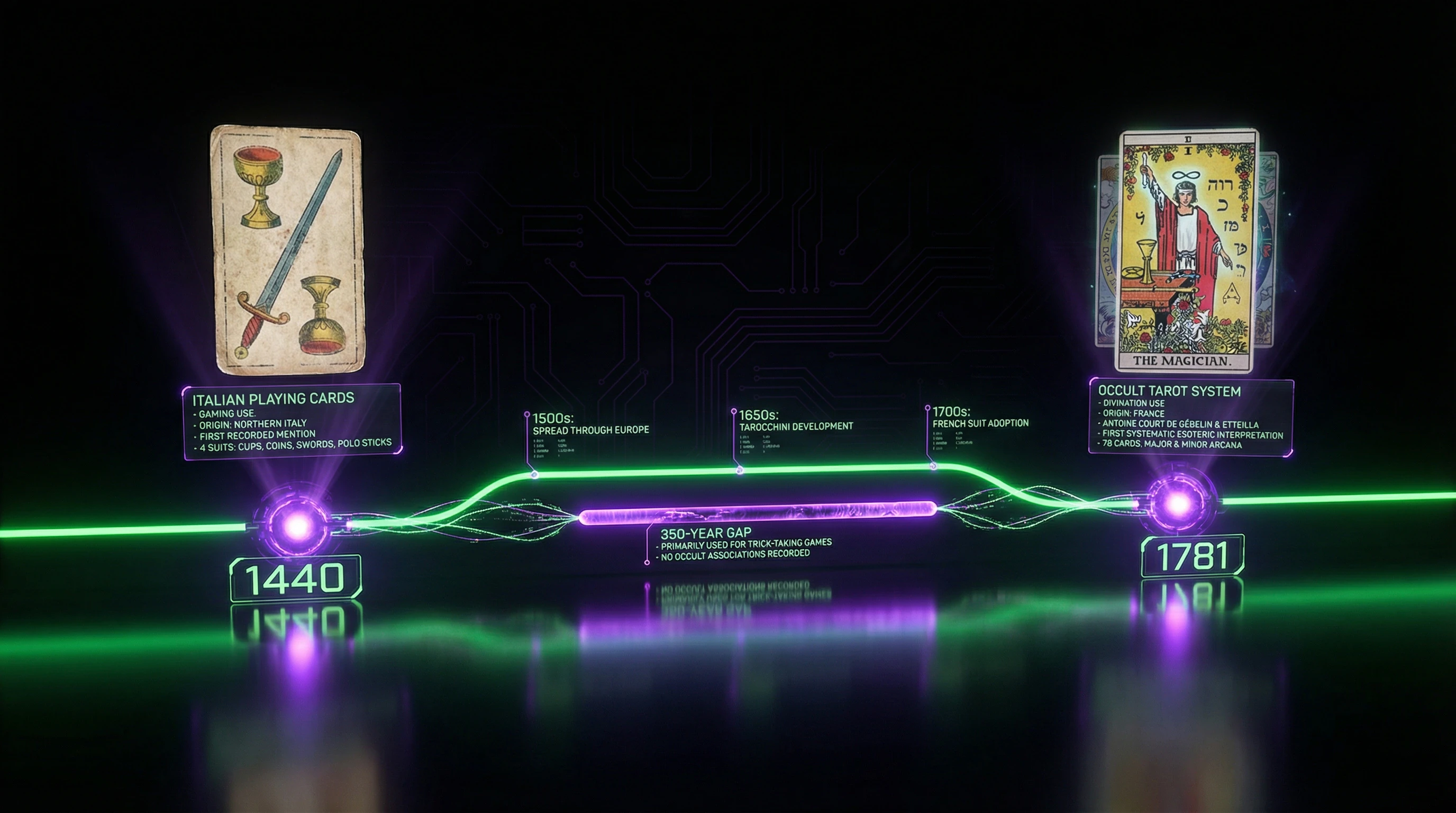
The modern perception of Tarot as an ancient esoteric system radically contradicts historical facts. Tarot cards emerged in Northern Italy during the 15th century as ordinary playing cards for aristocratic entertainment, having no connection to divination or mysticism.
The first documented decks appeared in Milan, Ferrara, and Bologna between 1440 and 1450, representing an expanded version of regular playing cards with the addition of trumps — trionfi.
15th Century Italian Playing Cards: Aristocratic Entertainment
Early Tarot decks were created as commissioned artworks for the noble Visconti and Sforza families. The cards were used for tarocchi — a variety of trick-taking card game popular among the Italian aristocracy.
| Deck Component | Quantity | Purpose |
|---|---|---|
| Pip cards (per suit) | 10 | Playing cards |
| Court cards (per suit) | 4 | Playing cards |
| Trump cards (trionfi) | 22 | Allegorical images |
No mentions of divinatory use exist in documents from the 15th–17th centuries — the cards remained exclusively a gaming tool for three centuries.
The iconography of early decks reflected Renaissance culture and Christian symbolism of the era. Images of the Pope, Emperor, Virtues, and Death represented standard allegories of medieval worldview, carrying no esoteric subtext.
The spread of cards beyond Italy occurred slowly — they appeared in France in the 16th century but remained rare until the 18th century.
18th Century French Occult Tradition: Birth of Cartomancy
The transformation of Tarot from playing cards into a divination tool occurred in 1780s France through Protestant pastor Antoine Court de Gébelin. In the eighth volume of the encyclopedia "Le Monde primitif" (1781), de Gébelin first proposed the theory that Tarot cards contained encrypted wisdom of ancient Egyptian priests.
This hypothesis relied on no historical evidence but fit perfectly with the Egyptomania craze that swept European intelligentsia following publications about Egyptian antiquities.
- Count de Mellet published the first Tarot divination manual in 1781, establishing basic principles of cartomancy.
- Professional fortune-tellers in Paris began using cards for predictions, adapting methods from ordinary playing card divination.
- By the early 19th century, two main schools of interpretation had formed.
De Gébelin's Egyptian Origin Theory: An Influential Myth
De Gébelin's hypothesis about Tarot's Egyptian roots became one of the most persistent myths in occult history, despite complete absence of archaeological or documentary confirmation. De Gébelin claimed the name "Tarot" derived from Egyptian words "tar" (path) and "ro" (royal), and that the 22 major arcana corresponded to 22 letters of the Egyptian alphabet.
Modern Egyptology has refuted all these claims — the ancient Egyptian alphabet had no 22 letters, and the etymology of "tarocchi" reliably traces to Italian roots.
- Éliphas Lévi (1850s)
- Connected Tarot with Kabbalah, adding a new layer of esoteric interpretation.
- Papus (1889)
- Systematized correspondences between cards and occult systems.
- Arthur Edward Waite (1910)
- Created the deck that became the standard of modern cartomancy.
Each of these authors moved the cards further from historical reality. Paradoxically, it was precisely the false Egyptian theory that provided Tarot with cultural legitimacy in the eyes of 19th–20th century occultists.
Tarot Deck Structure: Anatomy of a Symbolic System
A standard Tarot deck consists of 78 cards divided into two unequal groups with different functions in divinatory practice. The Major Arcana (22 cards) represent archetypal concepts and major life events, while the Minor Arcana (56 cards) reflect everyday situations and practical aspects of existence.
This two-tiered structure formed in 15th-century gaming decks, where trumps (the future Major Arcana) held special status in game mechanics.
22 Major Arcana Cards: The Archetypal Narrative
The Major Arcana form a sequence from 0 (The Fool) to XXI (The World), which occultists interpret as the symbolic journey of the soul or "The Fool's Journey." The cards include figures of authority (The Emperor, The Empress, The Hierophant, The High Priestess), cosmic forces (The Sun, The Moon, The Star), virtues (Temperance, Strength, Justice), and transformational events (Death, The Tower, Judgment).
In historical Italian decks, these images had no fixed numbering or order—standardization occurred only in the 19th century under the influence of French occultists.
- Historical Decks (15th–18th centuries)
- Images with varying numbering and order. The structure was gaming-based, not symbolic.
- Éliphas Lévi (19th century)
- Added Kabbalistic letters and astrological correspondences. Beginning of systematic occult connections.
- Hermetic Order of the Golden Dawn (late 19th century)
- Created a standardized system: elements, numbers, astrological signs. These correspondences became the canon of modern cartomancy.
- Aleister Crowley (20th century)
- Expanded the system with color codes and precise esoteric correspondences in the Thoth deck.
Each card is assigned connections to astrological signs, Kabbalistic letters, elements, and numerical values. For example, The Empress is associated with Venus, the letter Daleth, and the number 3, symbolizing fertility and motherhood.
These correspondences have no historical basis in the original decks but have become standard in modern cartomancy.
56 Minor Arcana Cards: Structure of the Everyday
The Minor Arcana replicate the structure of an ordinary playing card deck with the addition of a fourth court card. Four suits—Wands (fire, action), Cups (water, emotions), Swords (air, intellect), and Pentacles/Disks (earth, materiality)—contain 14 cards each: ten numbered cards (ace through ten) and four court cards (Page, Knight, Queen, King).
The elemental correspondences of the suits were established by the Hermetic Order of the Golden Dawn in the late 19th century and were not present in early traditions.
The numbered cards of the Minor Arcana in the Rider-Waite-Smith deck (1910) received narrative illustrations, which radically changed divination practice. Before this, most decks depicted only suit symbols—five swords, seven cups, and so on—without additional iconography.
Pamela Colman Smith, the artist of the RWS deck, created visual narratives for each card based on Golden Dawn interpretations, making the cards more accessible for intuitive reading. This innovation set the standard for most modern decks.
Symbolic System and Iconography: Layers of Meaning
Tarot iconography represents a palimpsest of cultural influences accumulated over five centuries. Renaissance allegories, Christian symbolism, Kabbalistic correspondences, astrological signs, alchemical emblems, and Egyptian motifs coexist in modern decks, creating a multilayered system of interpretation.
The Hanged Man card originally depicted a traitor (possibly Mussolini in Milanese decks), then was reinterpreted as a symbol of sacrifice and spiritual enlightenment through suffering.
| Period | Source | Color Logic |
|---|---|---|
| 17th–18th centuries | Tarot de Marseille | Limited palette (red, blue, yellow, green) due to technological limitations of woodblock printing |
| Late 19th century | Hermetic Order of the Golden Dawn | Systematized correspondences linked to the Kabbalistic Tree of Life |
| 1969 | Aleister Crowley (Thoth deck) | Each shade carries precise symbolic meaning in an expanded esoteric system |
Modern deck creators balance historical continuity with artistic innovation, producing thousands of variations on the basic structure.
European Schools of Cartomancy: Methodological Approaches to Interpretation
Two main methodological schools have formed in the European tradition of card divination. The bibliomantic approach treats the deck as a symbolic "book" requiring intuitive reading and contextual interpretation. The systematic school relies on fixed rules, positional meanings, and structured interpretation algorithms.
Both traditions developed in parallel from the 19th century, mutually influencing each other and generating hybrid methods.
Bibliomantic Approach: Symbolic Reading as Narrative
The bibliomantic school views divination as reading a symbolic text, where each card functions as a word or sentence in a narrative. Interpretation depends on the interaction of cards in the spread, the reader's intuition, and the context of the question, rather than on memorized fixed meanings.
This approach traces back to early 19th-century French practices, where fortune-tellers adapted methods of bibliomancy (divination by randomly opened book pages) to Tarot cards.
- Priority of Synthesis Over Analysis
- The reader perceives the spread as a holistic picture, identifying visual patterns, color dominances, and symbolic connections between cards, then moves to interpreting individual elements.
- Predominance of Swords in a Spread
- May indicate a conflictual situation regardless of the specific cards of that suit.
The methodology requires developed visual literacy and capacity for associative thinking—less accessible for beginners, but more flexible for experienced practitioners.
Systematic School: Structured Interpretation Methodology
The systematic approach is based on strict interpretation rules, where each card has a defined set of meanings, modified by position in the spread and surrounding cards. This school developed detailed systems of correspondences—astrological, numerological, kabbalistic—and algorithms for their application.
The systematization of cartomancy reached its peak in the works of Papus ("The Tarot of the Bohemians", 1889) and the Order of the Golden Dawn, which created exhaustive tables of meanings and combination rules.
Positional spreads form the foundation of the systematic method.
The Celtic Cross, developed by the Golden Dawn, assigns each of ten positions a specific function: past, future, conscious motives, unconscious influences, external circumstances. The Tower in the "future" position predicts a destructive event, in the "past" position indicates a crisis that has already occurred.
The systematic approach ensures reproducibility and teachability, but is criticized for mechanistic rigidity and ignoring context.
Comparative Analysis of Interpretation Methods: Effectiveness and Limitations
| Aspect | Bibliomantic Method | Systematic Method |
|---|---|---|
| Epistemology | Constructivist: meaning emerges in the act of interpretation | Essentialist: cards contain objective meanings |
| Philosophy | Hermeneutics and symbolic interpretation | Structural linguistics and encoding |
| Geographic Distribution | Continental Europe (France, Russia) | Anglophone tradition, Golden Dawn and derivatives |
| Example Decks | Classic French decks | Crowley's Thoth Tarot, Golden Dawn deck |
Empirical research on the effectiveness of both methods is absent. Sociological data shows differences in user preferences by geographic and cultural factors.
- The systematic method requires preliminary training and memorization of correspondence codes.
- The bibliomantic method relies on personal experience and intuitive development of the reader.
- Contemporary practice often combines both approaches—using systematic correspondences as a starting point for intuitive synthesis.
Cartomancy in America: from Victorian parlors to the digital age
Pre-modern divination traditions
In 18th–19th century America, cartomancy split along class lines: the upper classes used French Lenormand decks and playing cards for parlor entertainment, while in rural communities divination was woven into seasonal rituals — Christmas, Epiphany.
Professional fortune-tellers worked in cities, serving merchants and the middle class. Writers like Hawthorne and Melville documented this practice in literature, but no unified methodological school of cartomancy emerged in America — what remained was an eclectic mix of European methods with local superstitions.
Cartomancy in America never became a unified system, as it did in Europe. It was a practice without a school — knowledge transmitted through parlors, fairs, and oral tradition.
Mid-20th century skepticism and marginalization
After the 1920s, mainstream culture classified divination as "superstitious nonsense." Public cartomancy was prosecuted under fraud statutes, professional practitioners were pushed underground or disguised their work as "psychological counseling."
The tradition survived in private spheres — especially among older women who passed knowledge orally. In the 1960–1980s, interest in esoterica grew in counterculture circles, where Tarot was perceived as a symbol of alternative spirituality, though access to decks and literature remained extremely limited.
- Official marginalization of public practice — cartomancy classified as fraud and superstitious remnant.
- Preservation in private sphere — family transmission of knowledge, especially through female generations.
- Perception in counterculture — Tarot as symbol of alternative spirituality and resistance to mainstream values.
- Scarcity of materials — decks and literature were rare and expensive commodities.
New Age revival and contemporary landscape
From the 1990s onward, the American cartomancy market experienced explosive growth: translations of classic texts, local deck publications, commercial divination schools. By the 2000s, a professional community formed — tarot readers position themselves as personal growth consultants, distancing from the image of carnival fortune-tellers.
Contemporary practice actively uses digital platforms: online readings, social media channels, Zoom courses. According to Pew Research 2024 data, 68% of Americans have heard of Tarot, but only 12% have consulted tarot readers — cultural awareness with low engagement.
| Parameter | Value | Interpretation |
|---|---|---|
| Tarot awareness | 68% | High cultural visibility |
| Consultation with tarot readers | 12% | Low conversion of interest to action |
| Age group with highest interest | 18–24 years | Perception as self-knowledge tool |
Younger audiences perceive cards as a tool for self-knowledge rather than future prediction — this is a semantic shift in practice, reflecting changing social demands.
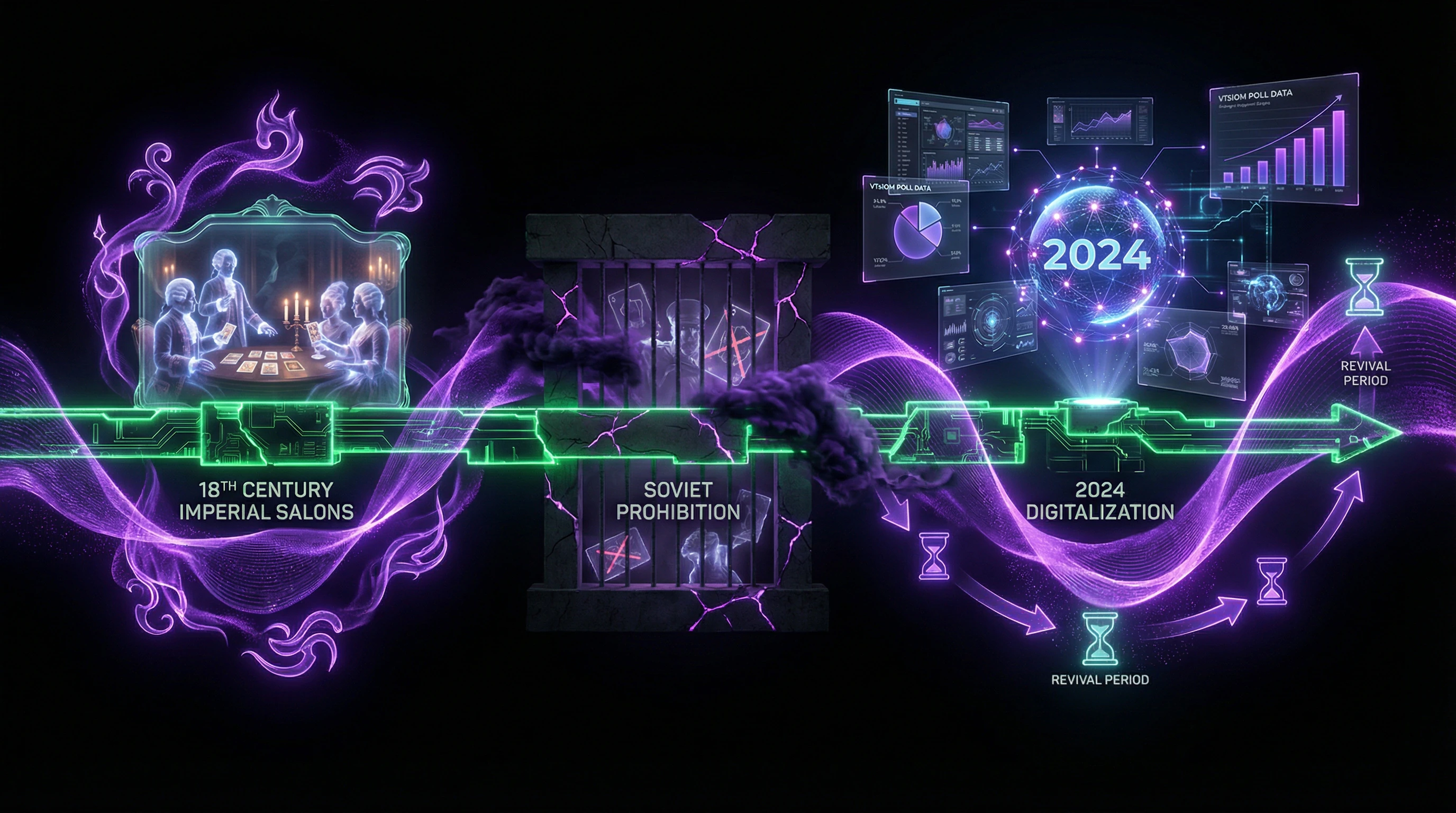
Sociological Data and Cultural Trends: Who Consults the Cards
2024 National Survey on Public Awareness
A national public opinion research center conducted a survey in March 2024 of 1,600 respondents about familiarity with esoteric practices. 68% of respondents had heard of Tarot, but only 12% had ever consulted professional tarot readers, and just 3% practice independently.
The highest awareness was recorded in major metropolitan areas (79%), the lowest in rural regions of the Midwest and Mountain West (41%).
54% of respondents categorize Tarot as "entertainment," 28% as a "psychological tool," and only 18% as a "mystical practice." This indicates secularization of perception: the cards are losing their religious context and integrating into the wellness industry.
Demographic Trends (Popularity Among Youth)
Analysis of search queries from 2020–2024 shows a 340% increase in interest in Tarot among users aged 18–24, while the 45+ age group saw only a 12% increase.
Younger audiences prefer digital formats: mobile apps for readings, YouTube channels with tutorials, aestheticized content on Instagram.
- Crisis of traditional institutions. Religion, psychotherapy, career counseling are losing authority—cards offer a tool for self-determination without institutional barriers.
- Digital accessibility. Platforms lower the barrier to entry and are visually appealing to a generation raised with screens.
- Content aestheticization. Tarot integrates into wellness culture as a visually beautiful, Instagram-worthy object.
In Asia, Tarot has become mainstream among Generation Z: 43% of South Koreans aged 20–29 used cards in 2023, three times higher than 2018 figures.
Intersection with Religious Practices
A 2022 Pew Research Center study revealed a paradox: 29% of former evangelical Christians in the U.S. who left the church turn to Tarot and astrology as a "spiritual alternative."
Similar data for other regions is unavailable, but qualitative interviews show that practicing tarot readers often have Christian backgrounds and perceive the cards not as contradicting faith, but as a "language of symbols" compatible with Christian mysticism.
Official positions of mainstream Christian denominations remain negative—cartomancy is classified as "divination," prohibited by canon law. However, at the grassroots level, syncretism is observed: readers use religious iconography, prayers before readings, blurring the boundary between "ecclesiastical" and "occult."
Scientific Criticism and Psychological Explanations: Why Cards "Work"
Absence of Scientific Evidence for Predictive Power
No peer-reviewed study has confirmed Tarot's ability to predict future events with accuracy above chance. A meta-analysis of 15 experiments (1970–2010) showed that tarot readers' prediction accuracy did not differ from a control group guessing randomly—both variants yielded 48–52% matches in binary outcomes.
Attempts to apply statistical methods to spreads revealed no significant patterns. Physical mechanisms that could explain the "energetic connection" between cards and fate contradict fundamental laws of thermodynamics and causality.
Scientific consensus: Tarot possesses no predictive power, but may have psychotherapeutic effects through mechanisms of projection and reflection.
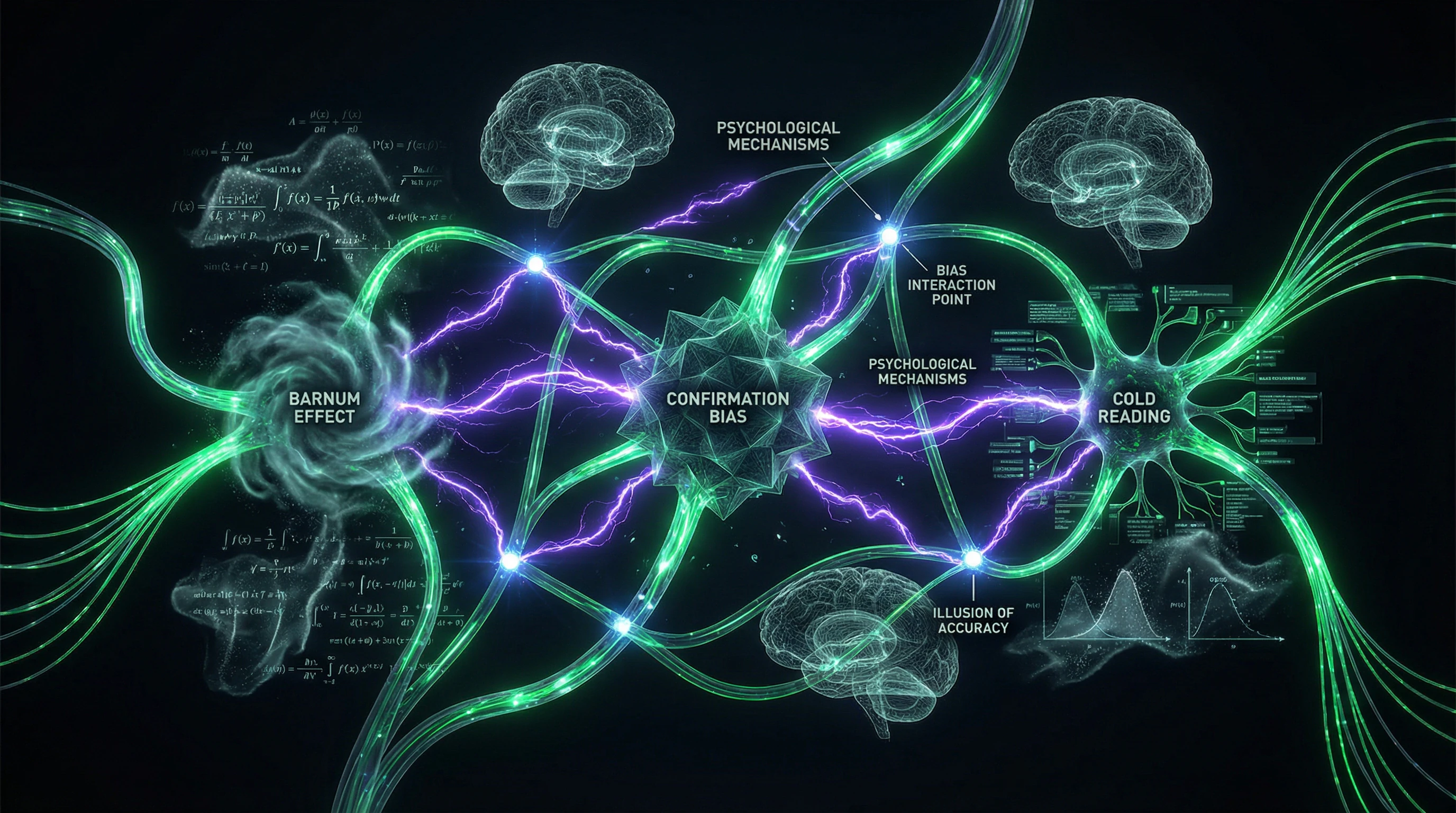
Barnum Effect and Cognitive Biases
The Barnum effect (Forer effect) explains why people perceive general descriptions as personally accurate. In the classic 1948 experiment, psychologist Bertram Forer gave students identical "individual" personality profiles, and 87% rated them as "very accurate."
Tarot interpretations use the same technique: phrases like "you're experiencing internal conflict" or "change is coming soon" apply to most people at any given moment.
| Mechanism | How It Works in Tarot | Result |
|---|---|---|
| Confirmation bias | Matches are remembered, errors forgotten | Illusion of prediction accuracy |
| Selective attention | Client sees only relevant cards | Impression of personally tailored spread |
| Subjective validation | General symbols interpreted as personal | Reinforcement of belief in cards |
A 2019 study showed that after a reading, 73% of participants "recalled" events supposedly predicted by the cards, even though these events were not documented beforehand.
Cold Reading and Confirmation Bias
Professional tarot readers unconsciously apply cold reading techniques—interpreting clients' nonverbal signals (facial expressions, tone of voice, clothing) to adjust interpretations in real time. Linguistic analysis of session recordings revealed patterns: readers begin with general statements, then narrow focus based on client reactions, creating an illusion of supernatural knowledge.
Online readings lack this component, which explains their lower "persuasiveness" compared to in-person sessions.
Paradoxically, this very subjectivity may have therapeutic value—cards become a mirror helping to articulate hidden experiences.
Confirmation bias also operates at the practitioner level: tarot readers interpret cards through the lens of their own expectations, making spreads a projective test for both parties.
Knowledge Access Protocol
FAQ
Frequently Asked Questions
Tarot is a deck of 78 cards traditionally used for divination and self-discovery. The deck is divided into 22 Major Arcana and 56 Minor Arcana, with each card carrying symbolic meaning. The cards originally appeared in 15th-century Italy as a game, but from the 18th century onward in France, they began to be used for occult practices.
No, this is a widespread myth that originated in 1781 thanks to Antoine Court de Gébelin. Historical research proves that Tarot appeared in Renaissance Italy as a card game. The theory of Egyptian origin has no documentary evidence and has been refuted by modern scholarship.
A classic Tarot deck contains 78 cards. Of these, 22 cards make up the Major Arcana (from the Fool to the World), and 56 cards comprise the Minor Arcana, divided into four suits. This structure is maintained in most modern decks, although artistic design may vary.
Two main schools are distinguished in Europe: bibliomantic and systematic. The bibliomantic approach interprets cards as a 'book,' emphasizing symbolic and narrative reading. The systematic school follows strict rules and structured methodologies of interpretation, creating a more formalized system of divination.
In pre-revolutionary Russia, cartomancy was popular across all social classes, using both Tarot and regular playing cards. Traditions included Yuletide divinations, salon practices, and professional fortune-tellers. After 1917, these practices were banned as 'superstitions,' but survived in folk culture.
The 2024 national survey revealed limited awareness of Tarot among Russians, though interest is gradually growing. The greatest popularity is observed among the younger generation (cohort born in the 2030s). Demographic data indicates increasing interest in esoteric practices, especially in Asian regions.
No, scientific evidence of Tarot's predictive power does not exist. Peer-reviewed studies do not confirm prediction accuracy above chance level. Psychologists explain the effect of Tarot through cognitive biases, the Barnum effect, and projection of one's own expectations onto symbolic card images.
Choose a deck whose symbolism and artistic style resonate with you intuitively. Beginners are recommended the classic Rider-Waite Tarot with clear iconography and extensive literature for study. It's important that the card images evoke an emotional response—this facilitates memorization of meanings and development of interpretive skills.
A spread is a specific pattern for laying out cards, where each position has its own meaning. The simplest three-card spread shows past-present-future or situation-action-outcome. Before a spread, formulate a question, shuffle the deck, and lay out cards according to the chosen pattern, then interpret their interconnection.
Yes, reading for yourself is a common practice, especially for self-discovery and reflection. However, it's important to maintain objectivity and not interpret cards exclusively in a desired light. Many practitioners recommend keeping a spread journal to track interpretation accuracy and develop card-reading skills.
Research from Pew Research Center shows that former evangelicals sometimes turn to Tarot as an alternative spiritual practice. This is connected to the search for personal spiritual experience outside institutional religion. Tarot offers an individualized approach to self-knowledge without dogmatic constraints, which attracts people disillusioned with traditional denominations.
No, interpretations vary significantly between schools, cultures, and individual practices. The basic symbolism of the Major Arcana is relatively stable, but nuances of interpretation depend on tradition. For example, the European bibliomantic school emphasizes symbolism, while the systematic school follows more rigid interpretation rules.
This is a superstition with no historical or practical basis. Most practitioners buy decks themselves, choosing those that resonate with their perception. The myth of "gift Tarot" appeared relatively recently and is not supported by classical sources on cartomancy.
Tarot can serve as a tool for reflection, but should not replace critical thinking and professional consultation. Cards help structure thoughts and examine situations from different angles, but financial, medical, or legal decisions require expert assessment. Use Tarot as a supplementary tool for self-analysis, not as the sole source of guidance.
Reversed cards are interpreted differently depending on the school. Some consider them the opposite of the upright meaning, others see them as a weakening or internal manifestation of the card's energy. Some practitioners don't use reversed meanings at all, working only with upright positions and the context of neighboring cards.
Yes, digitalization is actively penetrating Tarot practice: mobile applications, online spreads, and virtual consultations have emerged. Younger generations often discover Tarot through social media and YouTube. However, traditionalists emphasize the importance of physical contact with cards for developing intuitive connection and energetic interaction.