
Ancient Runes: From Historical Writing Systems to Modern Interpretationsλ
A study of Germanic runic alphabets — from the Elder Futhark to modern practices, with emphasis on scientific methodology and critical analysis of historical sources.
Overview
Runes — alphabetic systems of Germanic peoples (2nd–8th centuries CE), created for writing, identification, and documentation. Elder Futhark (24 characters), Younger Futhark (16), Anglo-Saxon Futhorc: 🧩 practical communication tools, occasionally ritual objects. Modern esoteric interpretations often diverge from archaeology and linguistics, so critical source analysis is the only way to separate history from fantasy.
🛡️
Laplace Protocol: This section is based on academic sources and archaeological evidence, with clear distinction between historical facts and modern interpretations. We critically evaluate sources, considering the political appropriation of runic symbols in the 20th century and the commercialization of contemporary practices.
Reference Protocol
Scientific Foundation
Evidence-based framework for critical analysis
Protocol: Evaluation
Test Yourself
Quizzes on this topic coming soon
⚡
Deep Dive
Three Runic Alphabets: How Germanic Peoples Created Writing Systems on Stone and Wood
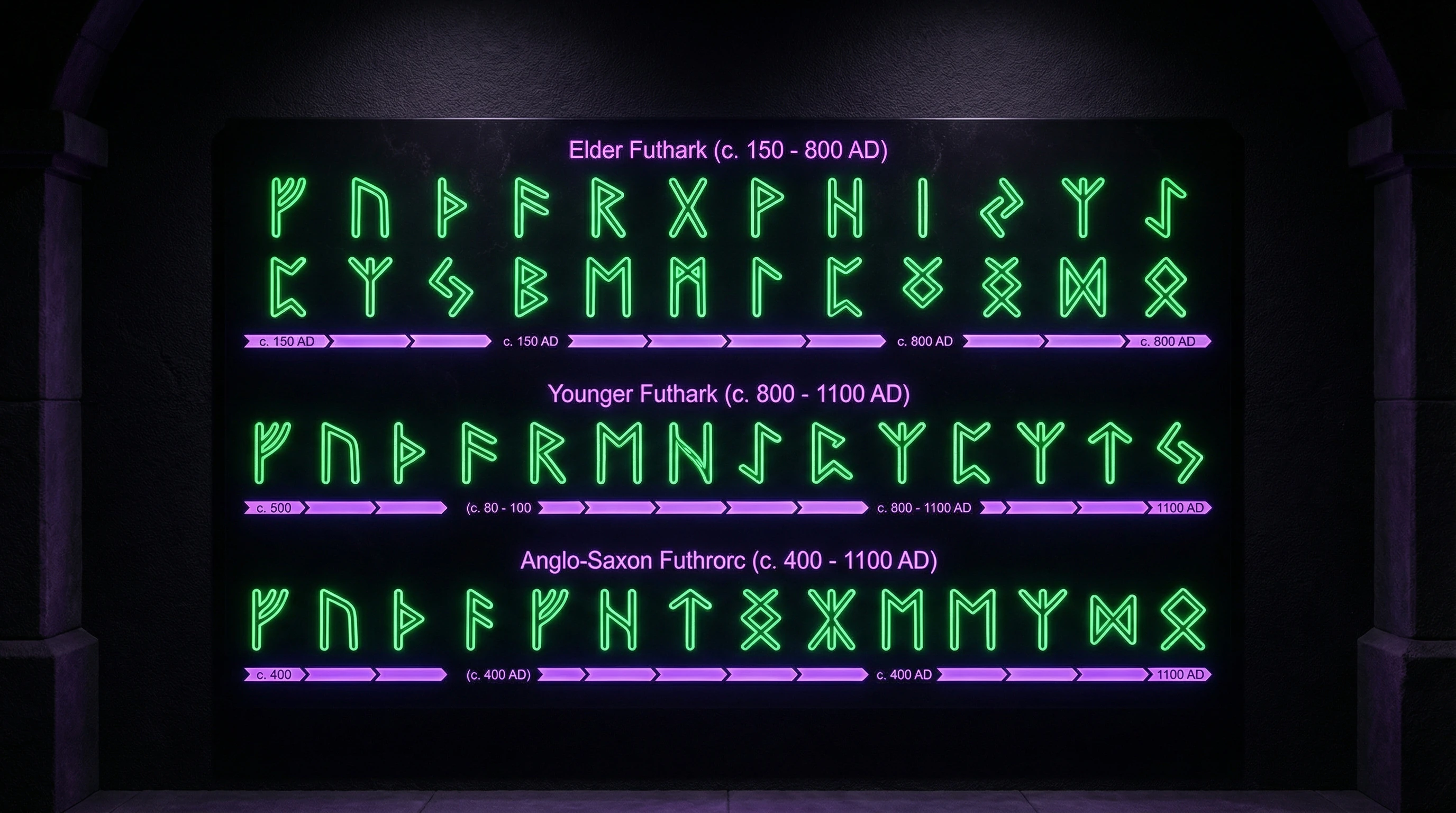
Runes are not a single system, but a family of related alphabets that developed in parallel across different regions of Northern Europe from the 2nd to 12th centuries. Each system reflected the phonetic characteristics of its speakers' language and adapted to writing materials: stone, wood, metal.
Academic study requires understanding how historical peoples—Scandinavians, Anglo-Saxons, Goths—actually used these signs, not modern esoteric interpretations. The characteristic angular forms of the symbols were determined precisely by the practice of carving on hard materials.
| Alphabet | Period | Number of Runes | Region | Reason for Change |
|---|---|---|---|---|
| Elder Futhark | 2nd–8th c. | 24 | Scandinavia, Eastern Europe | Original system |
| Younger Futhark | 8th–12th c. | 16 | Scandinavia | Phonetic changes in Old Norse |
| Anglo-Saxon Futhorc | 5th–11th c. | 28–33 | England | Adaptation to Old English sounds |
Elder Futhark: 24 Runes of Germanic Antiquity
The Elder Futhark is the oldest runic alphabet of 24 symbols, used by Germanic tribes from the 2nd to 8th centuries. The name derives from the first six runes: F-U-Th-A-R-K, reflecting the principle of naming the alphabet by its initial signs.
Each rune had its own name, connected to a specific word in Proto-Germanic, which allowed the symbols to be used both for phonetic writing and for ideographic representation of concepts. The structure was divided into three groups of eight runes—ættir—reflecting mnemonic organization.
Physical characteristics of runic inscriptions from this period show predominantly practical applications: marking ownership, brief memorial texts, craftsman identification. Direct evidence of magical use of runes in this period is extremely limited and often overestimated by modern researchers.
Younger Futhark: Simplification to 16 Symbols in the Viking Age
The Younger Futhark is a simplified version of the runic alphabet, reduced to 16 symbols and used during the Viking Age throughout Scandinavia. This reduction occurred not due to loss of knowledge, but as a consequence of phonetic changes in Old Norse, where certain sound distinctions ceased to be significant.
Paradoxically, fewer runes required greater contextual understanding from the reader: one symbol could represent multiple sounds. The Younger Futhark existed in several variants—Danish runes with long branches for monumental inscriptions and Swedish-Norwegian runes with short branches for everyday use.
- Mass Spread of Literacy
- Inscriptions are found not only on runestones, but also on everyday objects, wooden sticks, coins—evidence that runic writing was a practical tool, not an elite system.
- Contextual Interpretation of Meanings
- Rune meanings varied depending on culture, time period, and context of use. No single universal interpretation existed, which is often ignored by modern esoteric systems.
Anglo-Saxon Futhorc: Expansion to 33 Signs
The Anglo-Saxon Futhorc demonstrates the opposite tendency—expansion of the alphabet to 28–33 symbols for more precise transmission of Old English phonetics. The system was used in England approximately from the 5th to 11th centuries, coexisting with the Latin alphabet and gradually being displaced by it.
Additional runes were created to represent sounds absent in continental Germanic languages, demonstrating the adaptability of the runic tradition to linguistic needs. Anglo-Saxon runic manuscripts, such as the runic poems, provide valuable information about the names and meanings of individual symbols, though these texts were created in the Christian period and may reflect a reinterpreted tradition.
The three runic alphabets reflect not magical evolution, but linguistic adaptation: each people modified the system according to their language and practical needs. This is a history of writing, not a history of occultism.
Archaeological Study Methodology: From Discovery to Interpretation
Scientific research of runic systems is based on rigorous source criticism methodology, prioritizing physical artifacts over speculative interpretations. Wolfgang Krause's critique of Weigel's 1933 publication emphasizes the necessity of identifying errors and unfounded claims in research.
Modern runology applies an interdisciplinary approach, combining archaeology, linguistics, history, and materials science to reconstruct the historical use of runes, avoiding contamination by Nazi appropriations of symbols and modern esoteric overlays.
Methodology for Studying Runic Artifacts: Stratigraphy and Dating
The study of runic inscriptions begins with the archaeological context of the find: stratigraphic position, associated artifacts, monument type.
- Dating through multiple methods — radiocarbon analysis of organic materials, typological comparison of artifacts, paleographic analysis of rune forms, historical context of mentioned events or persons.
- Distinguish primary use of the inscription from possible later additions or reworkings, especially on runic stones that may have been reused.
- Document the technique of inscription application — carving, engraving, inlay — which provides information about the monument's status and the craftsman's skill level.
- Compare runic systems with other symbolic systems, recognizing fundamental differences in structure and cultural context.
Photogrammetry and 3D scanning reveal faintly visible or damaged runes inaccessible to the naked eye. Linguistic analysis of the text determines dialect, dating through linguistic features, possible carver errors or dialectal spelling variants, which is critical for understanding the spread of literacy and regional characteristics of the runic tradition.
Geographic Distribution of Finds: From Greenland to the Black Sea Region
Archaeological discoveries of runic inscriptions span a vast territory — from Greenland in the west to the Black Sea steppes in the east, from Scandinavia in the north to the Mediterranean in the south.
| Region | Characteristics of Finds |
|---|---|
| Scandinavia (Sweden, Denmark) | Highest concentration of monuments (over 3,000 runic stones in Sweden); central role in the development and preservation of the runic tradition |
| Constantinople, Novgorod, Eastern Europe | Runic graffiti and Varangian inscriptions; markers of trade routes, military campaigns, and migrations of Germanic peoples |
| Various find contexts | Monumental stones, household items, weapons; information about the social spread of runic literacy and functions of writing |
Practical Writing vs. Ritual Use: Archaeological Evidence
The dichotomy between practical and ritual use of runes is a false opposition imposed by modern researchers. Historical evidence demonstrates a continuum of functions from utilitarian to ceremonial.
Runes served primarily as a practical writing system for communication, not exclusively as magical tools. Writing itself may have been perceived as possessing special power in a predominantly illiterate society.
The overwhelming majority of runic inscriptions contain prosaic messages: "X made this object," "In memory of Y," "This belongs to Z"—indicating widespread functional literacy among certain social groups.
Practical Writing: Marking, Communication, Memorialization
Most surviving runic inscriptions served utilitarian functions: identifying the owner or maker of an object, brief messages, memorial texts on gravestones.
Wooden runic sticks from Bergen contain everyday correspondence, trade records, love messages, even profanity—demonstrating routine use of runes for written communication in a medieval Scandinavian city.
- Owner or craftsman identification
- Brief messages and correspondence
- Trade and household records
- Memorial inscriptions on stones
Viking Age runestones often follow a standard formula: "X and Y erected this stone in memory of Z, who was [characteristic]," sometimes with added information about the deceased's travels or circumstances of death.
This standardization indicates the existence of professional rune carvers and established conventions of memorial epigraphy, analogous to modern gravestone inscriptions.
Cultural Differences in Interpretation: Scandinavian, Anglo-Saxon, Continental Contexts
The meanings and functions of identical or similar runes varied depending on cultural, temporal, and geographical context—no universal interpretation existed.
| Tradition | Characteristics |
|---|---|
| Scandinavian | Laconic descriptions focusing on the phonetic function of runes. Practical writing dominates the sources. |
| Anglo-Saxon | Elaborate runic poems with Christian reinterpretations of meanings. Symbolism enhanced by religious context. |
| Continental | Early period finds on prestige objects with possible apotropaic functions. Interpretation remains debated. |
The Berkana rune, for example, was associated with growth, care, motherhood, rest, and recovery, but specific connotations differed between Scandinavian and Anglo-Saxon traditions.
Continental Germanic finds demonstrate different uses of runes—often in the context of prestige objects and possible protective functions, though interpretation of the latter remains debated among researchers.
Knowledge Access Protocol
FAQ
Frequently Asked Questions
Runes are ancient alphabetic writing systems of Germanic peoples, used from the 2nd to 12th centuries CE. They served primarily for practical communication: inscriptions on stones, weapons, jewelry, and everyday objects. Possible ritual applications were secondary, not the primary purpose of runic systems.
Elder Futhark contains 24 runes and was used approximately from the 2nd to 8th centuries CE. Younger Futhark is a simplified version with 16 runes that emerged during the Viking Age (8th-12th centuries). The alphabet reduction relates to changes in Scandinavian languages and the need for a simpler writing system.
The scientific community does not recognize the existence of an ancient Slavic runic system. Historically confirmed Slavic writing systems are Glagolitic and Cyrillic (9th century). Modern "Slavic runes" are predominantly modern fabrications or erroneous interpretations lacking archaeological evidence.
Researchers analyze archaeological finds with runic inscriptions, compare contexts of use, and apply methods of historical linguistics. Priority is given to physical artifacts and documented sources rather than esoteric interpretations. Critical source analysis helps separate historical facts from modern speculation.
Runes were primarily a practical writing system, not a magical tool. While some inscriptions may have had ritual significance, most finds are ordinary texts: names, dedications, memorial records. The modern notion of "magical runes" is greatly exaggerated and often based on 19th-20th century fantasy.
Berkana is traditionally associated with growth, nurturing, motherhood, and renewal. In historical inscriptions it was used as the letter "B," while symbolic interpretations developed later. Modern meanings often differ from how the rune was understood in ancient times.
Begin with academic sources on the history of Germanic peoples and archaeology of runic inscriptions. Study a specific runic system (Elder or Younger Futhark) in its historical context. Avoid esoteric books without references to scholarly research—they often contain unreliable information and modern inventions.
Runic divination is a modern practice without direct historical evidence. Archaeological data does not show that ancient Scandinavians used runes in this way. If you're interested in this practice, understand that it's a 20th-century reconstruction, not an ancient tradition.
The Nazi regime appropriated Germanic symbols, including runes, for ideological propaganda, distorting their historical meanings. This created problems for the perception of runes in modern times and requires a critical approach to sources from the 1930s-40s. The scientific community rejects Nazi interpretations as pseudohistorical and politically motivated.
The oldest runic inscriptions (2nd-3rd centuries CE) were discovered in Scandinavia and Northern Europe, including Denmark, Norway, and Sweden. The geographical distribution of finds shows migration and cultural connections of Germanic tribes. Each region had its own characteristics of rune usage, which is important for understanding their evolution.
Celtic and Scandinavian cultures had contact, which led to some cross-influence in symbolism. However, these are distinct traditions with their own writing systems and symbols. The blending of Celtic patterns and runes is often a modern phenomenon that does not reflect historical reality.
Most modern interpretations are based on 19th-20th century reconstructions, when interest in runes revived in Romantic and esoteric contexts. Historical sources are limited, leaving room for speculation. A scholarly approach requires distinguishing between documented facts and modern additions.
Comparative analysis is possible as an academic exercise for studying symbolic systems across cultures. However, runes and the I Ching have different origins, functions, and cultural contexts. Such comparisons should acknowledge fundamental differences rather than artificially merging unrelated traditions.
Scholarly works contain references to archaeological findings, use source criticism methods, and acknowledge knowledge limitations. Pseudoscientific texts make categorical claims without evidence, mix different traditions, and ignore historical context. Verify the author's credentials and whether the work has been peer-reviewed.
The Anglo-Saxon Futhorc is an expanded version of the runic alphabet used in England from the 5th to 11th centuries. It contained up to 33 runes, added to represent sounds in Old English. This system differs from Scandinavian variants and reflects the linguistic features of Anglo-Saxon culture.
Using runes is ethical if based on respect for historical context and avoids cultural appropriation. It's important to distinguish between reconstructing historical practices and creating new traditions. Avoid symbols compromised by Nazism, and be honest about the modern rather than ancient origins of your practices.