 🔢 Numerology
Numerology: The Mysticism of Numbers Without Scientific Evidenceλ
An esoteric practice that attributes mystical influence over fate and personality to numbers, lacking empirical evidence and recognized as pseudoscience by the scientific community.
Overview
Numerology attributes power over fate to numbers — birth dates supposedly determine character, phone numbers influence luck, "unlucky" digits attract misfortune. No controlled study has confirmed a connection between numbers and events: 🧩 statistics show random distribution, while apparent "coincidences" are explained by the Barnum effect and apophenia — the brain's tendency to find patterns where none exist. Numerology exploits cognitive traps, creating an illusion of control through arbitrary numerical manipulations.
🛡️
Laplace Protocol: Numerology is a pseudoscience without scientific evidence base. Critical thinking and reliance on empirically validated methods of psychology and statistics are the only reliable path to understanding personality and making decisions.
Reference Protocol
Scientific Foundation
Evidence-based framework for critical analysis
Protocol: Evaluation
Test Yourself
Quizzes on this topic coming soon
Sector L1
Articles
Research materials, essays, and deep dives into critical thinking mechanisms.
🔢 Numerology⚡
Deep Dive
What Lies Behind the Numbers: Numerology Between Ancient Practice and Misconception
Numerology is an esoteric system claiming mystical connections between numbers and life aspects: personality, destiny, compatibility. The practice has existed for millennia and is often attributed to Pythagoras, though its roots branch across different cultures.
The scientific community classifies numerology as pseudoscience without empirical evidence of effectiveness. The paradox: the practice remains popular in mass culture for analyzing personality, relationships, and "life purpose." This gap between demand and scientific validity requires examining mechanisms, not condemnation.
- Numerology
- An interpretive system where numbers (especially 1–12) are assigned symbolic meanings. Names and birth dates are converted into numbers through calculations, then interpreted according to predetermined codes. The trap: absence of objective criteria and reproducibility.
How Numerology Methodology Works
Practitioners convert source data (name, birth date) into numerical values, then reduce them to a single digit—for example, a "life path number." Each number is assigned ready-made personality characteristics.
Critical vulnerability: different schools of numerology use different calculation and interpretation systems. The same person receives contradictory conclusions depending on the chosen school. Interpretations are so general they fit almost anyone—this is the Barnum effect (subjective validation).
| Criterion | Numerology | Scientific Method |
|---|---|---|
| Reproducibility | Different schools — different results | Same conditions → same results |
| Objective Criteria | Subjective interpretation | Measurable, verifiable parameters |
| Falsifiability | Any result "explained" post-hoc | Hypothesis can be disproven |
Pythagoras and Ancient Roots: The Myth of Scientific Legitimacy
Numerology often appeals to Pythagoras (570–495 BCE), who indeed assigned philosophical significance to numbers. But here's the critical distinction: Pythagoreans studied mathematical relationships in nature and music, not predicting fate from birth dates.
Modern numerology is a syncretic mix: Kabbalah, Chaldean astrology, Greek philosophy. Appealing to antiquity is a logical fallacy: a practice's age doesn't make it true. Geocentrism, the theory of four elements, phlogiston—all were ancient and all disproven.
Historical interest in number symbolism is not equivalent to proof of their mystical influence on life. Cultural significance ≠ scientific validity.
Numerology occupies a niche between esotericism and divination systems, using numerical language as an interpretive tool rather than predictive. This is important for understanding its psychological mechanism in the following sections.

Why Science Rejects Numerology: Absence of Evidence and Methodological Failures
The scientific community classifies numerology as pseudoscience—a system that mimics the external attributes of science but fails to meet its methodological standards. Science requires empirical testability, reproducibility of results, and willingness to falsify theories when confronted with contradictory data.
Numerology satisfies none of these criteria: its claims cannot be tested through controlled experiments, results are not reproducible by independent researchers, and theories are formulated so vaguely that they cannot be refuted.
- Absence of peer-reviewed research demonstrating statistically significant connections between numbers and personality characteristics
- Attempts to test numerological predictions under controlled conditions show results indistinguishable from random guessing
- Different numerologists, using identical data, arrive at different conclusions depending on the calculation system chosen
- Lack of agreement among practitioners indicates subjective interpretation rather than objective measurement
Absence of Empirical Evidence and Reproducibility
Throughout numerology's history, not a single peer-reviewed study has demonstrated a connection between numbers and life events. When numerologists are asked to determine people's characteristics based solely on birth dates in blind experiments, their prediction accuracy does not exceed statistical chance.
If a method truly measures objective reality, different researchers should obtain consistent results when using identical methodology. The absence of such agreement indicates subjective interpretation.
The reproducibility problem is compounded by the fact that different numerologists, using the same source data, arrive at different conclusions depending on the calculation system chosen. This fundamentally contradicts the scientific principle of objectivity.
Criticism from the Scientific Community and Psychological Explanations
The scientific community explains the apparent "accuracy" of numerological descriptions through the Barnum effect—people's tendency to accept vague, general personality descriptions as accurately characterizing them specifically. Numerological interpretations contain statements like "you strive for harmony but sometimes experience internal conflicts"—descriptions applicable to the overwhelming majority of people.
Additional cognitive biases reinforce the illusion of accuracy: confirmation bias (noticing information that confirms beliefs) and selective memory (better recall of "hits" and forgetting "misses"). People interpret ambiguous statements in accordance with their experience and ignore inconsistencies, creating a subjective sense of validity where no objective connection exists.
Five Dangerous Myths About Numerology You Shouldn't Believe
The popularity of numerology has spawned numerous persistent misconceptions that mask its pseudoscientific nature and create a false impression of legitimacy. These myths are particularly dangerous because they exploit the natural human drive for self-knowledge and the search for meaning, offering simple answers to complex existential questions.
Critical examination of the most common misconceptions helps develop scientific literacy skills and protect against manipulation.
The Myth of Numbers Determining Destiny and Character
Numerology's central claim—that numbers associated with a person's birth date or name determine their character, abilities, and life path—has no scientific basis whatsoever.
There is no known physical or biological mechanism through which abstract mathematical entities could influence personality development or life events. Personality is formed through complex interactions of genetic factors, developmental environment, cultural context, and individual experience—none of these factors are connected to numerical values of dates or names.
The illusion of connection between numbers and destiny arises from retrospective interpretation: people tend to find patterns in random coincidences, especially when actively seeking them.
If a numerologist claims that "life path number 7" indicates a tendency toward introspection, a person with this number will unconsciously recall moments of thoughtfulness while ignoring numerous instances of extroverted behavior. This is a classic example of confirmation bias, not evidence of a real connection.
False Connections to Quantum Physics and Modern Science
Some proponents of numerology attempt to give it scientific respectability by referencing quantum physics, information theory, or other areas of modern science. These attempts represent a pseudoscientific tactic known as "quantum mysticism"—the improper use of scientific terminology to justify unscientific claims.
Quantum mechanics does indeed describe the probabilistic nature of subatomic particles, but this has no relation whatsoever to the supposed influence of numbers on human destiny.
- Numbers in mathematics and physics are tools for quantitative description of observable patterns, not mystical entities with their own causal power.
- Professional physicists and mathematicians unanimously reject attempts to link numerology with scientific theories.
- The use of scientific terminology in numerological contexts is a form of intellectual dishonesty designed to deceive people without specialized education.
Psychological Mechanisms Behind Belief in Numerology: Why Smart People Fall For It
The Barnum Effect and Subjective Validation
The central mechanism behind numerology's popularity is the Barnum effect: people accept vague, general personality descriptions as accurately describing them specifically. Numerological characterizations are intentionally formulated to apply to the widest possible range of people.
Subjective validation amplifies the effect—a person actively seeks confirmation in their own experience while ignoring contradictory facts. Research shows people rate universal descriptions as accurate 80–90% of the time, even when they're randomly generated.
Numerologists exploit this cognitive feature, creating the illusion of personalized analysis while using standard templates.
Cognitive Biases and Pattern Recognition
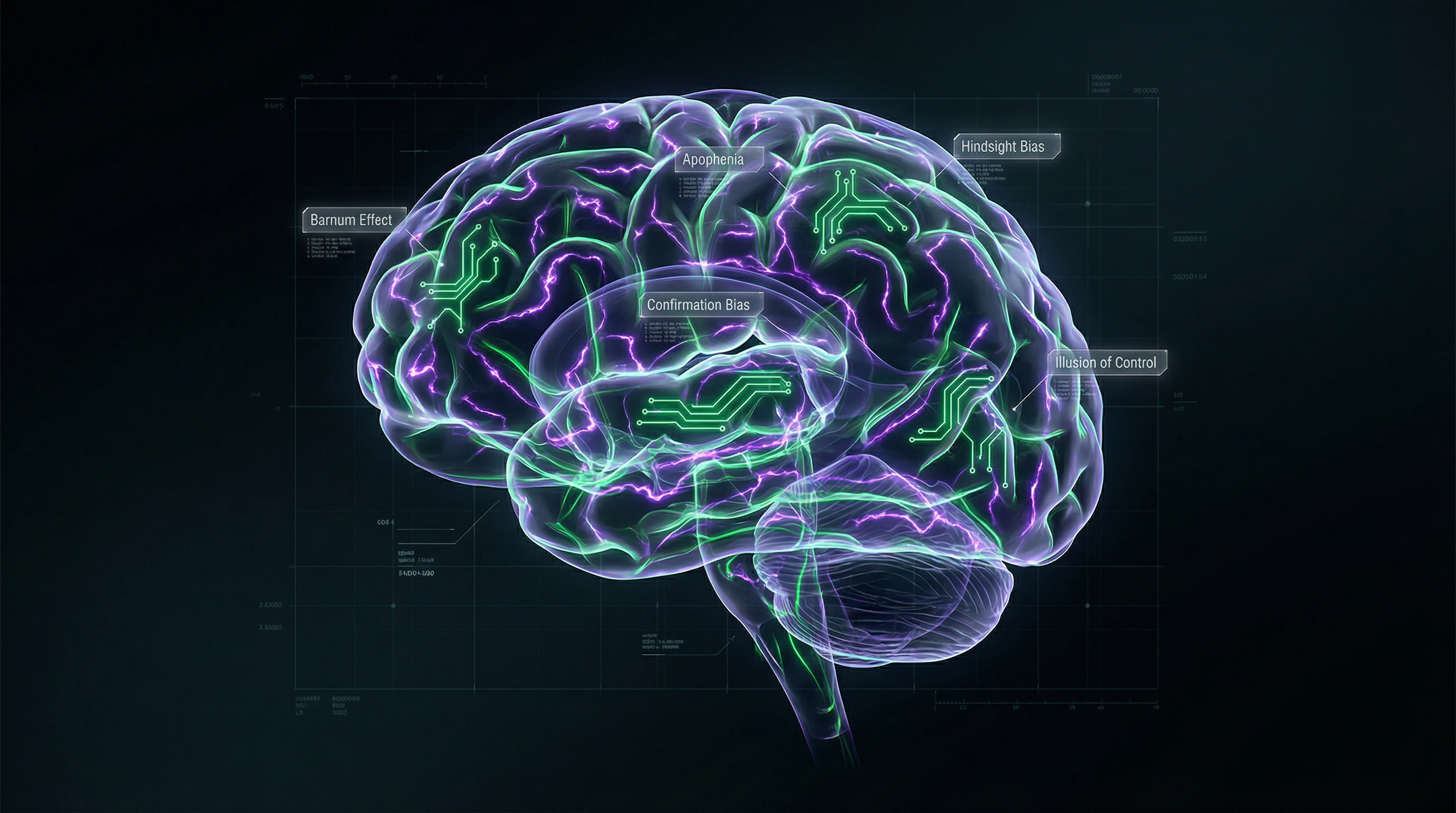
The brain is evolutionarily wired for pattern recognition—a critically important survival capability. But this same ability leads to apophenia: perceiving meaningful patterns in random data.
Numerology provides a ready-made system for interpreting coincidences as meaningful connections. If an important event happened on the 7th and your "destiny number" is seven, the brain registers the match and ignores thousands of days when nothing special occurred.
- Confirmation bias: we remember prediction "hits," forget the misses.
- Hindsight bias: creates the false sense of "I always knew that."
- Automaticity: these mechanisms operate outside conscious control.
The result: numerology is psychologically convincing even for critically-minded people during moments of emotional vulnerability.
Red Flags: How to Recognize Pseudoscientific Claims in Numerology
Signs of Unreliable Sources
The first red flag is the absence of any mention of the scientific consensus on numerology's pseudoscientific status. Reliable sources always note the lack of empirical evidence and the unfalsifiability of numerological claims.
If a website or book presents numerology as "science" or a "proven method" without qualifications—that's manipulation. Using scientific terminology (quantum physics, energy fields, vibrations) without references to peer-reviewed research is a classic hallmark of pseudoscience.
- Numerological predictions are formulated vaguely: "changes are possible in the near future" or "you'll meet an important person."
- Absence of specific, measurable predictions with success criteria—a sign of an illusion-generating system, not a diagnostic tool.
- Reliable psychological methods have validity and reliability metrics published in scientific journals. Numerology provides none.
Commercialization and Exploitation of Existential Questions
Numerology actively exploits fundamental human needs for meaning, predictability, and control over life. Promises to "reveal your purpose," "know your destiny," or "find your place in the world" target people in states of existential crisis, uncertainty, or grief.
Commercial numerology services use emotional manipulation: creating artificial urgency ("find out now before it's too late"), exclusivity ("only for you"), or fear of missing out.
Personal numerology consultations cost from several hundred to several thousand dollars, providing no real value. Particularly dangerous are cases where numerologists recommend abandoning scientific medicine or psychotherapy in favor of "working with numbers."
The ethical principle of informed consent requires that clients know about the pseudoscientific status of the method. Numerologists systematically conceal this information for commercial gain.
Scientific Alternatives to Numerology: What Actually Works
Evidence-Based Psychology and Psychodiagnostics
If you're interested in understanding personality and behavior, there are scientifically validated alternatives to numerology. The Big Five model (openness to experience, conscientiousness, extraversion, agreeableness, neuroticism) is based on decades of empirical research and demonstrates high predictive validity for career success, relationship quality, and psychological well-being.
Unlike numerology, these traits are measured using standardized questionnaires with known psychometric properties. Professional psychodiagnostics employs instruments that have undergone rigorous scientific validation: intelligence tests, personality inventories, projective techniques with proven reliability.
- Each method has published norms and validity indicators
- Limitations of application and scope are known
- Results are reproducible and independently verifiable
- Consulting a licensed psychologist provides scientifically grounded information, not an illusion of knowledge
Statistical Analysis and Critical Thinking
Developing critical thinking skills and a basic understanding of statistics is the best defense against pseudoscientific claims. Understanding concepts of randomness, correlation, and causation helps recognize that numerical coincidences in life are normal statistical phenomena, not mystical connections.
With a sufficient number of events, coincidences are inevitable. If you track dates, phone numbers, addresses, and other numbers in your life, you will inevitably find patterns—but that doesn't make them meaningful.
Scientific skepticism doesn't mean cynicism or closed-mindedness to new experiences—it's a requirement for evidence proportional to the extraordinariness of claims. Numerology makes extraordinary claims (numbers influence destiny) but provides no extraordinary evidence.
Critical thinking offers a more reliable path: basing decisions on evidence, acknowledging uncertainty, and using scientifically validated methods to understand ourselves and the world.

Knowledge Access Protocol
FAQ
Frequently Asked Questions
Numerology is an esoteric practice based on the belief in mystical connections between numbers and events in a person's life. According to this teaching, numbers can influence character, destiny, and the future, however the scientific community classifies numerology as pseudoscience. It has no empirical evidence of its effectiveness and does not meet scientific standards.
No, numerology is officially recognized as pseudoscience by the scientific community. It has no empirical or statistical evidence, its claims cannot be tested by scientific methods, and results are not reproducible. Numerology uses subjective interpretation and does not meet the criteria of scientific knowledge.
Numerology doesn't work due to the absence of causal mechanisms by which numbers influence reality. Its apparent accuracy is explained by the Barnum effect—people accept general descriptions as personal characteristics. No peer-reviewed study has confirmed numerology's ability to predict events or describe personality.
Numerology is often associated with the name of Pythagoras, but this is more myth than historical fact. Pythagoras did study mathematical properties of numbers, but his work was scientific, not mystical. Modern numerology uses his name to lend authority, but has no direct connection to his mathematical discoveries.
No, numerology cannot predict the future—this is one of the main myths. There is no scientific evidence that numbers influence future events. Any coincidences are explained by chance, subjective interpretation, and cognitive biases such as the tendency to notice confirming information.
The Barnum effect is a psychological phenomenon in which people consider general descriptions to be personal and accurate. Numerology uses universal statements that fit most people, creating an illusion of accuracy. This explains why numerological characteristics seem true, although they are not scientifically validated.
Pay attention to promises of accurate predictions, absence of scientific references, and use of emotional manipulation. Pseudoscientific sources ignore criticism, appeal to antiquity as proof, and sell paid consultations. Reliable sources always point out the lack of scientific evidence and warn about the pseudoscientific nature of the method.
No, numerology does not meet scientific standards of psychological assessment. Professional psychodiagnostics uses validated tests with proven reliability, while numerology is based on subjective interpretation without an empirical foundation. Using numerology instead of scientific methods can lead to incorrect conclusions and decisions.
People believe in numerology due to cognitive biases such as pattern seeking and confirmation bias. The brain tends to find patterns even where none exist, and the Barnum effect creates an illusion of accuracy. Numerology also exploits existential questions about the meaning of life and purpose.
Scientific alternatives include evidence-based psychology, validated personality tests (Big Five, MMPI), and professional psychodiagnostics. For self-understanding, it is more effective to consult a qualified psychologist using scientifically validated methods. Critical thinking and statistical analysis help avoid pseudoscientific misconceptions.
No, this is a widespread myth and pseudoscientific manipulation. Quantum physics studies the behavior of elementary particles and has no connection to mystical properties of numbers. Attempts to link numerology with quantum mechanics are an abuse of scientific terminology to give false legitimacy.
Belief in numerology can be dangerous if it influences important life decisions. People may refuse medical care, choose partners or careers based on numbers while ignoring real factors. Financial exploitation through paid consultations and the replacement of scientific psychology with pseudoscience also present risks.
Numerology is popular due to commercialization, ease of understanding, and promises of quick answers to complex questions. Social media algorithms promote emotional content rather than scientifically accurate content. The low barrier to entry and entertainment format make numerology attractive despite the lack of evidence.
No, numerology and science are incompatible in methodology and principles. Science requires empirical evidence, reproducibility, and falsifiability, which numerology does not provide. Attempts to combine them create a false impression of scientific validity for pseudoscience and mislead people about the reliability of information.
Show respect, but gently suggest critically evaluating information sources. Explain the difference between entertainment and making serious decisions based on pseudoscience. Offer scientific alternatives for self-discovery and help develop critical thinking skills without judgment.
No, there is not a single peer-reviewed study confirming the effectiveness of numerology. All attempts at scientific verification have shown no statistically significant results. The scientific community unanimously recognizes numerology as pseudoscience with no empirical basis or theoretical foundation.