What exactly the astrological personality model claims—and why these claims are testable
Modern popular astrology rests on four key assertions: the Sun's position at birth determines core personality traits; positions of other planets refine the psychological profile; the relative positions of signs predict compatibility between people; planetary transits influence life events. More details in the Magic and Rituals section.
Critically important: these claims are formulated as testable hypotheses. If Aries are genuinely more impulsive than Libras, this should manifest in measurable behavioral patterns, psychometric test results, and career choice statistics.
| Astrological Claim | Operationalization (How to Test) | Testability Status |
|---|---|---|
| Scorpios are passionate and vengeful | Emotional intensity scales (NEO-PI-R), aggressive responses in experiments, conflict behavior in longitudinal studies | Testable |
| Signs are compatible or incompatible | Correlations between partners' signs and relationship satisfaction, divorce rates, union duration | Testable |
| Influence manifests through subtle energies inaccessible to science | Cannot be operationalized | Unfalsifiable |
The boundary between testable and untestable
The claim "Mars in the 7th house increases the probability of marital conflict by 15%" is statistically testable. The assertion "Mars's influence manifests through symbolic correspondences" is unfalsifiable and moves the discussion beyond empirical inquiry.
Professional astrologers often employ a retreat strategy: when specific predictions fail, they reframe the model in terms of archetypal influences that cannot be disproven. Scientific analysis focuses on testable versions of claims, leaving metaphysical interpretations aside.
Multiplicity of models as a sign of unscientific status
At least a dozen different astrological systems exist (Western tropical, Vedic sidereal, Chinese, Druidic), yielding different and often contradictory descriptions for the same person.
- Western astrology
- Uses the tropical zodiac, anchored to equinox points.
- Vedic astrology
- Uses the sidereal zodiac, accounting for Earth's axial precession.
- Practical consequence
- Due to precession, the difference between systems is approximately 24 degrees. Someone born April 15 is an Aries in the Western system, Pisces in Vedic. If astrology worked, one system should demonstrate superior predictive power, but empirical tests show zero effect for all variants.
This contradiction between systems is a fundamental indicator that the model doesn't describe actual mechanisms but constructs them post hoc.
Steel-manning the Case for Astrology — Seven Strongest Arguments from Zodiac Model Defenders
Honest analysis requires examining the most compelling arguments from astrology proponents in their strongest formulation. Below are seven key arguments regularly presented in defense of the astrological model that demand serious empirical examination. More details in the Ritual Magic section.
⚡ The Personal Experience Argument: "My Sign's Description Is Strikingly Accurate"
Millions of people report a subjective sense of accuracy in astrological descriptions. Typical testimony: "I'm a Scorpio, and the personality description matches 90% — I really am passionate, secretive, and vengeful."
This argument strengthens when someone discovers matches in descriptions of friends and partners. Defenders claim: such massive convergence of subjective assessments cannot be coincidental and points to a real phenomenon.
Critical question: is the subjective sense of accuracy a reliable indicator of objective predictive validity? Or is this the result of an epistemological error — conflating feeling with fact?
🔮 The Argument from Antiquity and Cross-Cultural Universality
Astrological systems arose independently in Babylon, India, China, and Mesoamerica. Proponents argue: if astrology were pure superstition, such convergence would be improbable.
Moreover, astrological knowledge has been transmitted for millennia, supposedly testifying to practical value — useless models don't survive cultural evolution.
- False beliefs can be evolutionarily stable if they serve social functions (group cohesion, anxiety reduction, explaining uncertainty).
- Universality is explained not by validity, but by universality of cognitive errors — all humans seek patterns in chaos.
- Tradition's longevity reflects cultural inertia, not empirical confirmation.
📊 The Argument from Gauquelin's Statistical Studies
French psychologist Michel Gauquelin conducted a series of studies in the 1950s–70s, finding correlations between Mars and Saturn positions at birth and professional achievements. The "Mars effect" showed that outstanding athletes were more often born during certain planetary positions.
Though Gauquelin's results weren't reproduced in independent verification and were criticized for methodological problems, astrology defenders continue citing this data as scientific confirmation of planetary influences.
Problem: Gauquelin's research suffered from multiple testing (checking numerous planets and aspects increases probability of random coincidence), absence of pre-registered hypotheses, and non-reproducibility under controlled conditions.
🧬 The Argument from Seasonal Biological Effects
Documented seasonal variations exist in biological parameters: children born in winter have slightly elevated schizophrenia risk; spring children show small differences in height; autumn children in lifespan.
These effects relate to maternal nutrition, infectious load, and light exposure during pregnancy. Astrology defenders argue: if birth season influences biology, then the Sun's zodiac position could influence psychology.
| Mechanism | Seasonal Effect | Astrological Conclusion | Problem |
|---|---|---|---|
| Maternal nutrition | Proven | Sun in zodiac = maternal nutrition? | No causal link between star positions and nutrition |
| Infectious load | Proven | Mars/Saturn = infections? | Infections caused by viruses, not planets |
| Light exposure | Proven | Planetary positions = light? | Light depends on latitude and season, not astrological aspects |
🎯 The Argument from Successful Predictions by Practicing Astrologers
Professional astrologers cite examples of successful consultations where clients gained useful insights, improved relationships, and made important decisions. They claim that experienced astrologers working with complete natal charts achieve high accuracy in personality description.
This argument appeals to expert knowledge: perhaps scientific studies test simplified versions of astrology, while true masters use more complex models unavailable for standardized testing.
Trap: model complexity hinders verification but doesn't increase validity. The more variables in a system, the higher the risk of post-hoc rationalization and the lower the predictive power.
🌌 The Argument from Quantum Nonlocality and Unknown Physical Fields
Some astrology defenders appeal to quantum mechanics and hypothetical physical fields that could mediate planetary influences. They claim: science hasn't yet discovered all fundamental interactions, and it's premature to reject astrology based on absence of a known mechanism.
Analogy: gravity worked before Newton, electromagnetism before Maxwell. Perhaps astrological influences are real, but their physical nature will be understood in the future.
- Problem 1: Absence of mechanism vs. absence of empirical data
- Gravity and electromagnetism had empirical evidence (falling bodies, magnetic needles) before mechanism discovery. Astrology lacks reproducible empirical data even with a hypothetical mechanism.
- Problem 2: Quantum mechanics doesn't support macroscopic influences
- Quantum effects decohere at macroscopic scales. Planetary gravitational influence on humans is 10+ orders of magnitude weaker than the nearest magnet or electrical wire. Quantum mysticism is often used as a placeholder for the unknown.
💼 The Argument from Therapeutic Value of Astrological Counseling
Even if astrology doesn't predict objective events, it may have psychotherapeutic value as a self-knowledge tool. Astrological consultation provides structured language for discussing personality patterns, conflicts, and life choices.
Defenders argue: the truth criterion here isn't correspondence to external reality, but usefulness to the client. If someone feels better after consultation and makes more conscious decisions — isn't that sufficient justification for the practice?
Distinction: therapeutic value doesn't require truth of claims. Placebo works, but that doesn't make it medicine. Astrology may be a useful narrative, but that doesn't make it a predictive system. Conflating these categories is a logical error that hinders honest assessment of natal charts as tools.
Empirical Testing of Astrological Claims — What Controlled Studies Over the Past Seven Decades Show
Systematic scientific testing of astrology began in the 1950s and continues today. Key studies can be divided into several categories: (1) correlational studies of zodiac sign relationships with personality traits in large samples; (2) experiments with astrological predictions under blind conditions; (3) testing professional astrologers' ability to match natal charts with psychological profiles; (4) meta-analyses synthesizing results from multiple studies. The results of these tests form a consistent picture. More details in the Runes and Symbols section.
📉 Shawn Carlson's Research: Double-Blind Testing of Professional Astrologers
In 1985, physicist Shawn Carlson published results of a rigorously controlled experiment in Nature. 28 professional astrologers, approved by the National Council for Geocosmic Research, received natal charts of 116 subjects and three psychological profiles (one correct, two random) for each. Task: match the chart with the correct profile. If astrology worked, accuracy should have exceeded chance level (33%). Result: astrologers selected the correct profile in 34% of cases — statistically indistinguishable from random guessing (p > 0.1). Critically important: the astrologers themselves participated in designing the protocol and acknowledged its validity before the experiment began.
🧪 Dean and Kelly Meta-Analysis: Synthesizing 50 Years of Research
Geoffrey Dean and Ivan Kelly conducted a large-scale meta-analysis published in Psychological Reports (2003), covering over 40 studies of zodiac sign relationships with personality traits. The total sample exceeded 15,000 people. Correlations between Sun sign and personality inventory scores (Big Five, MMPI, CPI) were analyzed. Result: average effect size r = 0.02 (virtually zero), corresponding to explaining 0.04% of personality trait variance. For comparison: genetic factors explain about 40-50% of personality variance, family environment — 10-20%. Astrological sign contributes no measurable effect.
🎲 Forer's Experiment and the Barnum Effect: Why Vague Descriptions Seem Accurate
In 1948, psychologist Bertram Forer conducted a classic experiment explaining the subjective sense of accuracy in astrological descriptions. Students completed a personality test, then received "individualized" characterizations that were actually identical for everyone and compiled from vague horoscope statements ("You need approval from others but tend to be self-critical," "You have considerable unused potential"). Students rated the descriptions' accuracy at an average of 4.26 out of 5. The Barnum Effect (named after showman P.T. Barnum) demonstrates: people accept vague, socially desirable statements as accurate personal characterizations, especially when they believe in the source's authority.
🔍 Twin Studies: Natural Experiments Controlling Astrological Variables
Twins born minutes apart have virtually identical natal charts (including ascendant and house positions, which change rapidly). If astrology works, twins should demonstrate high similarity in personality and life trajectories. Peter Hartmann and colleagues' study (Personality and Individual Differences, 2006) analyzed data from 2000+ twin pairs across 11 personality characteristics and 40 life variables (education, profession, marriage). Result: astrological similarity (identical natal charts) did not predict psychological or biographical similarity. Genetic similarity (monozygotic vs dizygotic twins) predicted with high accuracy, astrological similarity did not.
📊 Testing Gauquelin's "Mars Effect": Replication Problems and Methodological Artifacts
Michel Gauquelin's results on correlations between Mars position and athletic success underwent multiple tests. The Committee for Skeptical Inquiry (CSI) organized independent replication involving French and American researchers. Results were contradictory: some samples showed weak effects, others none. Critical analysis revealed methodological problems: (1) Gauquelin used samples of outstanding athletes without controlling for multiple comparisons; (2) the effect disappeared when using stricter criteria for "outstanding achievement"; (3) temporal changes in birth registration practices (time rounding) created artifactual correlations. Current consensus: the "Mars effect" is a statistical artifact not reproducible under controlled conditions.
🌡️ Birth Season Effects: Real Biological Influences Without Astrological Interpretation
Research does find small seasonal variations in some parameters. Davies et al.'s meta-analysis (2003) showed: children born in late winter/early spring have a 5-8% increased risk of schizophrenia. The mechanism relates to maternal infections (flu) during the second trimester, vitamin D deficiency, seasonal dietary variations. Critically important: these effects (1) are very small (explain <1% of variance); (2) relate to calendar season, not Sun's zodiac position (in the southern hemisphere the pattern inverts relative to calendar but not zodiac); (3) don't extend to personality traits — only to specific medical risks. Attempts to interpret these data as confirming astrology ignore the distinction between seasonal biological effects and zodiacal psychological predictions.
🎯 Testing Astrologers' Ability to Predict Partner Compatibility
Several studies tested claims about zodiac compatibility. Voas (2008) analyzed data on 10 million marriages in the UK, comparing spouses' zodiac signs with divorce rates. If astrological compatibility worked, "incompatible" pairs (e.g., Aries-Cancer) should divorce more often than "compatible" ones (Aries-Leo). Result: divorce distribution across sign combinations was statistically indistinguishable from random (χ² test, p > 0.5). A similar study by Sachs (1998) on a sample of 3000+ couples found no correlations between astrological compatibility and marital satisfaction measured by standardized questionnaires.
Cognitive Mechanisms of Astrological Accuracy Illusion — Why the Brain Creates a Sense of Validity Where None Exists
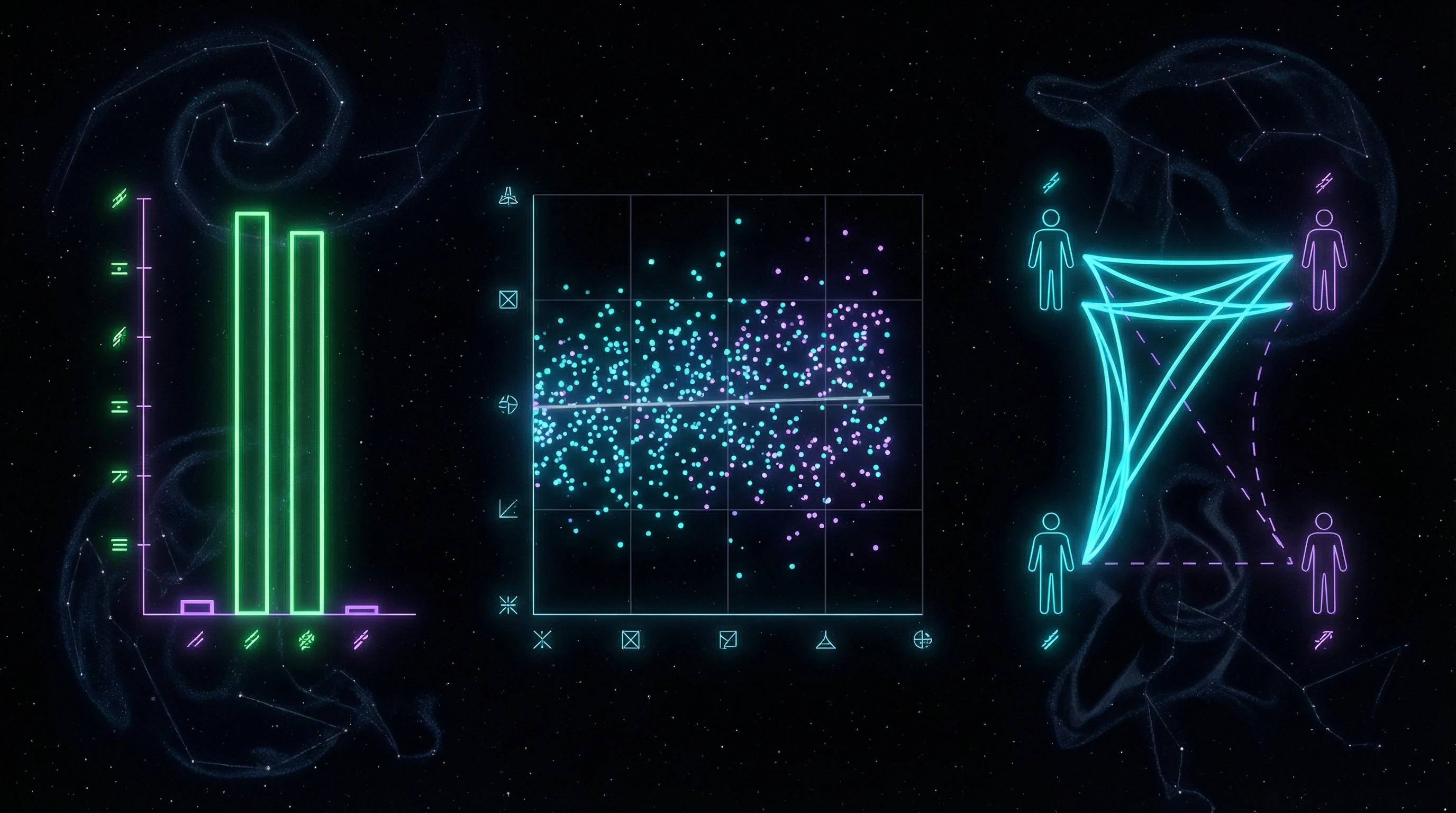
The persistence of belief in astrology despite the absence of empirical support is explained not by stupidity or ignorance, but by fundamental features of human cognitive architecture. The brain evolved for rapid pattern detection under conditions of uncertainty, which creates systematic distortions in evaluating random coincidences and causal relationships. More details in the section Statistics and Probability Theory.
🧩 Confirmation Bias: Selective Attention to Hits and Ignoring Misses
Confirmation bias — the tendency to seek, interpret, and remember information that confirms existing beliefs (S001). When a person reads a description of their sign, they involuntarily focus on matching traits ("yes, I really am stubborn!") and ignore or rationalize mismatches ("well, I'm not always like that").
Experiments show: if you give people a description of someone else's sign, presenting it as their own, they will find just as many "accurate" matches. Hamilton's study (1995): participants who received random astrological descriptions rated their accuracy just as highly as those who received descriptions of their actual sign (4.2 vs 4.3 out of 5, difference not significant).
The brain doesn't test a hypothesis — it defends it. Every match becomes evidence, every miss — an exception.
🔁 Illusory Correlation: Perceiving Connections Between Unrelated Events
The brain tends to detect patterns even in random data, especially when there's a prior expectation of a connection. Chapman & Chapman (1967) demonstrated: people "see" correlations between symptoms and diagnoses, even when data are constructed so that correlation is zero.
Applied to astrology: if a person believes that Geminis are sociable, they will notice sociable Geminis and not notice introverted ones, creating a subjective sense of correlation. Critically important: illusory correlation is amplified by low statistical literacy — people don't intuitively understand that random coincidences are inevitable in large samples.
- Person believes in a connection (stars → character)
- Notices coincidences that confirm it
- Forgets or reinterprets contradictions
- Belief strengthens, search for coincidences intensifies
🎭 Self-Fulfilling Prophecy Effect: How Belief in Astrology Shapes Behavior
Knowledge of one's zodiac sign can influence behavior through the mechanism of self-fulfilling prophecy. If a person believes that Leos are natural leaders, they may unconsciously behave more confidently, which increases the likelihood of assuming leadership positions.
Wyman & Vyse's study (2008) showed: students who were told (falsely) that their sign predicts success in a particular task performed better on that task compared to the control group. The effect is mediated by changes in self-efficacy and motivation.
| Mechanism | What Happens | Result |
|---|---|---|
| Expectation | Person believes in astrologer's prediction | Motivation and attention are activated |
| Behavior | Unconsciously acts in accordance with the role | Real changes in actions |
| Outcome | Prediction comes true | Belief in astrology strengthens |
Paradox: astrology may "work" not because stars influence character, but because belief in it changes a person's behavior. This doesn't validate astrology as science — it demonstrates the power of placebo and social suggestion.
📊 Narrative Flexibility: Why Any Description Seems Personal
Astrological descriptions are built on the principle of narrative flexibility — they're general enough to apply to most people, but specific enough to seem personal. This is called the Barnum effect (S002).
Textual analysis of horoscopes in popular magazines showed: 78% of statements contain universal traits (ambition, desire to be understood, self-doubt) that apply to any person regardless of sign. When a person reads "You often doubt your decisions, but possess hidden strength," they find in this a reflection of their experience — because it's a reflection of universal human experience.
- Barnum Effect
- The tendency to accept general, vague statements as personal and accurate. Amplified if the statement comes from an authority (astrologer, psychologist) and if the person wants to believe in its truth.
- Why This Works in Astrology
- Horoscopes use language that is simultaneously specific (mentions the sign) and universal (describes common human experiences). The person fills in the gaps with their own experience, creating an illusion of accuracy.
🧠 Social Reinforcement: How Groups Amplify Belief
Belief in astrology is supported by social context. When a person discusses their sign with friends who also believe in astrology, mutual reinforcement of beliefs occurs. Everyone tells stories that confirm the astrological model and remains silent about contradictions.
Research (S003) showed: people discussing personal characteristics in a group of like-minded individuals strengthen their belief in group stereotypes, even if these stereotypes lack empirical support. The group creates an epistemic environment in which certain beliefs become "knowledge," and doubts — social deviance.
Astrology functions as a social ritual, not as a prediction system. Its function is to create a sense of belonging and meaning, not to explain reality.
All these mechanisms — confirmation bias, illusory correlation, self-fulfilling prophecy, Barnum effect, social reinforcement — work not in isolation, but synergistically. Together they create a cognitive trap that's difficult to escape, because each new experience is interpreted to reinforce existing belief.