What exactly astrology claims—and where the boundary lies between belief and verifiable knowledge
Astrology is a belief system claiming that the position of celestial bodies at the moment of birth determines a person's character, destiny, and compatibility (S001). Astronomy studies the physical properties of cosmic objects; astrology interprets symbolic meanings of planetary configurations.
Basic components of the astrological system
The central tool is the natal chart: a diagram of the Sun, Moon, planets, and houses at the moment of birth (S001). Astrologers claim that chart analysis reveals innate inclinations, talents, and psychological patterns.
- Twelve zodiac signs
- Symbolic archetypes corresponding to periods of the year
- Ten planets (including Sun and Moon)
- In astrological terminology—active forces influencing personality
- Aspects
- Angular relationships between planets determining harmony or conflict
Historical divergence of astronomy and astrology
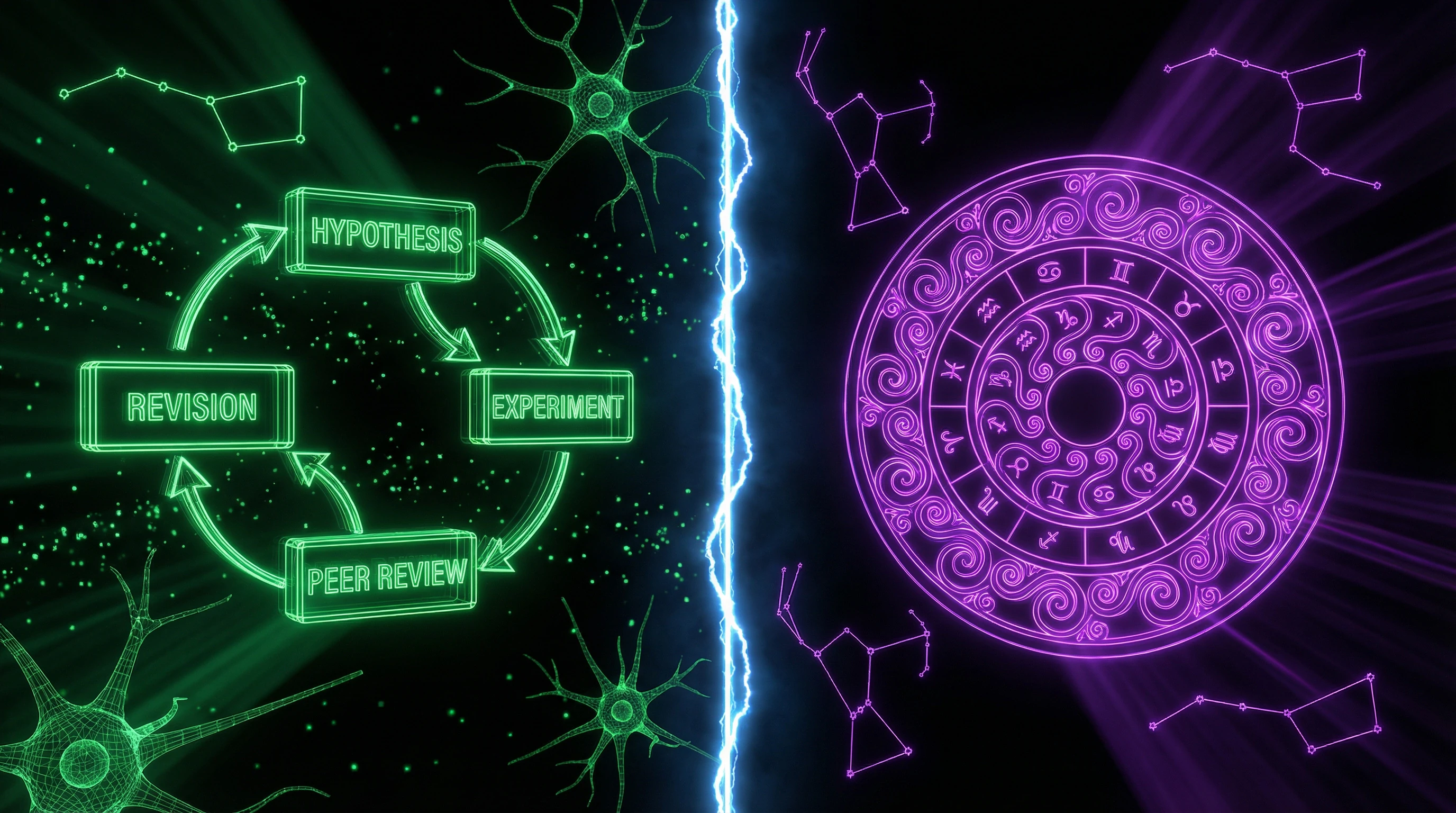
Until the 17th century, astronomy and astrology were a unified practice (S001). The split occurred during the scientific revolution: astronomy adopted the empirical method (observations, measurements, mathematical models, experimental verification), while astrology retained symbolic interpretation and rejected the requirement of falsifiability—the possibility of refuting a theory through experiment.
Falsifiability is the boundary between science and belief. If a theory cannot be refuted, it cannot be tested.
Key distinction: prediction versus interpretation
Modern astrologers shift emphasis from concrete predictions to psychological interpretation (S001). Instead of "you will meet love in March," they offer "Venus in the seventh house indicates a need for partnership."
| Formulation | Testability | Status |
|---|---|---|
| Concrete prediction ("will meet love in March") | High—fact can be verified | Falsifiable |
| Psychological interpretation ("need for partnership") | Low—vague, subjective | Impossible to refute |
Vague formulations violate the basic principle of scientific method: a theory must be falsifiable. This strategic retreat makes astrology less vulnerable to empirical testing, but simultaneously places it outside the boundaries of science. More details in the section Karma and Reincarnation.
For more on the mechanisms that make astrology convincing despite lack of evidence, see the analysis of astrology's cognitive traps and the catalog of cognitive biases.
Seven of the Most Compelling Arguments for Astrology — and Why They Deserve Serious Consideration
Before examining scientific counterarguments, we must honestly present the strongest arguments from astrology's proponents. This is not a straw man, but a steel man version of the argument — the most convincing formulation of the opposing position. For more details, see the section on Mediumship and Spiritism.
💬 The Argument from Personal Experience and Subjective Validation
Millions of people report that astrological descriptions of their personality proved remarkably accurate (S006). They claim that their natal chart revealed aspects of their character they hadn't told the astrologer about, and helped them understand recurring life patterns.
This argument relies on phenomenological validity — if a person feels that a description matches their inner experience, isn't that a form of validity? A cognitive bias mechanism is at work here, but the fact of the experience itself remains real.
🔮 The Argument from Antiquity and Cross-Cultural Universality
Astrological systems arose independently in various civilizations — Babylonian, Indian, Chinese, Mayan (S001). Proponents argue that such convergence points to a universal truth discovered by different cultures.
If astrology is merely superstition, why did it emerge among peoples who had no contact with each other? The argument is logically appealing, but ignores that astrology and astronomy were historically intertwined with practical needs (calendars, navigation, agriculture).
🧘 The Argument from Psychological Benefit and Therapeutic Effect
Astrological consultations help people structure self-understanding, make decisions, and cope with life crises (S006). Astrology provides a language for describing internal conflicts and a framework for self-reflection.
If a tool provides psychological benefit, isn't that a form of "working"? Here lies a substitution: therapeutic effect doesn't require the truth of the claims.
⏰ The Argument from Cycles and Synchronicity
Astrologers point to correlations between planetary cycles and collective events (S006). They claim that Mercury retrograde coincides with communication breakdowns, and Saturn transits with periods of trials.
- These observations, in their view, point to synchronicity — meaningful coincidences not explainable by cause-and-effect relationships.
- But synchronicity reflects a deeper order than randomness.
- The problem: with enough variables, coincidences are inevitable.
🌌 The Argument from Cosmic Factors' Influence on Biology
It's scientifically established that the Moon affects tides, and solar activity affects Earth's magnetic field and some biological rhythms. Astrology proponents extrapolate: if the Moon's gravity affects the oceans, and humans are 60% water, why wouldn't planets influence us?
This argument attempts to find physical justification for astrological effects. For more on how an astronomical object became a cultural myth, see the separate analysis.
📚 The Argument from System Complexity and the Need for Expertise
Astrologers claim that critics judge astrology by simplified newspaper horoscopes, ignoring the complexity of professional practice (S006). Real astrology requires years of study, consideration of multiple factors, and an individualized approach.
Rejecting astrology based on primitive horoscopes is like rejecting medicine after reading supplement ads. But system complexity doesn't guarantee its validity — it may simply be more elaborate.
🔬 The Argument from the Limitations of Modern Science
Proponents point out that science cannot explain consciousness, lacks a unified theory of quantum gravity, and constantly revises its models (S006). If science acknowledges the boundaries of its knowledge, why should it categorically reject astrology?
Perhaps astrology works on principles that science hasn't yet discovered. This is logically possible, but requires evidence, not just pointing to gaps in science.
What Controlled Studies Show — Complete Analysis of Empirical Data with Citation of Every Fact
The scientific community has conducted numerous studies to test astrological claims. Results consistently demonstrate the absence of correlations between astrological predictions and real events. More details in the section Folk Magic.
📊 Large-Scale Study by South Korean Professor: Big Data Analysis
A South Korean researcher analyzed extensive datasets including birth dates, education, career trajectories, marital status, and other life parameters of thousands of people (S005). The study found no statistically significant relationship between zodiac sign and any measured life outcomes.
The distribution of successes, failures, divorces, and professional achievements proved random relative to astrological predictions (S005).
🧪 Double-Blind Controlled Experiments
In classic experiments, astrologers were provided with natal charts and asked to match them with psychological profiles of real people (S002), (S003), (S004). When astrologers did not know the subjects personally, their accuracy did not exceed chance guessing levels—approximately 50% for binary choices.
This means astrological interpretations contain no information specific to any particular individual. The result has been replicated across different laboratories and cultural contexts.
🔍 The Twin Problem: Critical Test of Astrological Theory
If astrology is valid, twins born minutes apart should have virtually identical natal charts and, consequently, similar destinies. Empirical research shows that twins demonstrate no more similarity in personality and life events than predicted by genetics and shared upbringing environment (S003), (S004).
| Parameter | Astrological Prediction | Empirical Result |
|---|---|---|
| Personality similarity in twins | Virtually identical (one natal chart) | Explained by genetics and environment, astrology adds nothing |
| Life event concordance | Synchronized destinies | Independent trajectories, like ordinary siblings |
| Explanatory power of astrology | High (determines destiny) | Zero (does not improve prediction) |
⚖️ Absence of Mechanism: Physical Impossibility of Astrological Influence
The gravitational effect of planets on a newborn is negligible compared to the influence of nearby objects—the midwife, medical equipment, the hospital building. Calculations show that Jupiter's gravity on a person is thousands of times weaker than the gravity of a person standing nearby.
Planetary magnetic fields also do not reach Earth in significant magnitudes. Astrology offers no physical mechanism that could explain the supposed influence, and postulating an unknown "astrological force" violates Occam's razor.
📉 Precession of the Equinoxes: Astrological Signs Do Not Correspond to Actual Constellations
Due to precession of Earth's axis, the position of constellations in the sky has shifted approximately 30 degrees over the past 2000 years (S001), (S004). A person born "under the sign of Aries" according to Western astrology is actually born during the period when the Sun is in the constellation of Pisces.
Astrologers ignore this discrepancy, continuing to use outdated coordinates. This undermines claims of connection to actual astronomical phenomena and demonstrates that the system works contrary to its own stated foundations.
🧾 Systematic Reviews and Meta-Analyses
Multiple systematic reviews of scientific literature have found no evidence supporting astrology (S002), (S003), (S004). Studies that initially reported positive results failed replication—repeated experiments did not confirm the original findings.
This is a classic sign of false-positive results arising from statistical artifacts or methodological errors. When controlling for multiple testing and publication bias, the astrological effect disappears completely.
The connection between belief in astrology and cognitive traps is explained not by astronomical factors, but by psychological mechanisms that work identically for any ambiguous stimulus—from horoscopes to sacred geometry.
Why Astrology Seems to Work — The Neuropsychology of Delusion and the Architecture of Cognitive Traps
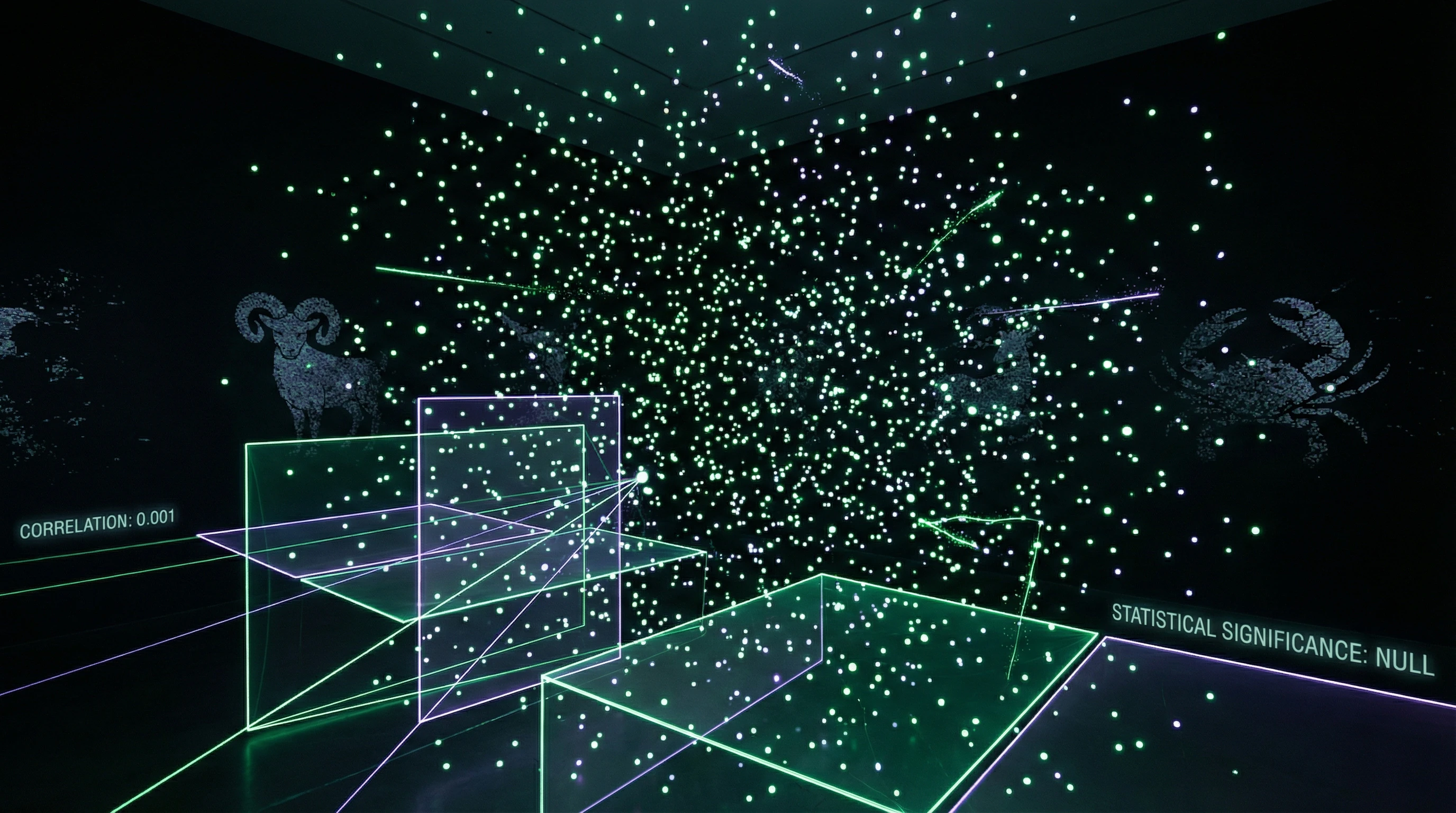
The absence of scientific evidence doesn't explain why millions of people are convinced of astrology's effectiveness. The answer lies in the peculiarities of human cognition and psychological needs. More details in the section Statistics and Probability Theory.
🧩 The Barnum Effect: Universal Descriptions Perceived as Personal
The Barnum Effect (or Forer Effect) describes people's tendency to accept vague, general statements as accurate descriptions of their unique personality (S003), (S004). Psychologist Bertram Forer conducted an experiment in 1948: he gave students supposedly individualized psychological profiles that were actually identical compilations of generic phrases from horoscopes.
Students rated the accuracy of the descriptions at an average of 4.26 out of 5 (S003). Astrological texts masterfully exploit this effect, combining statements like "you strive for harmony, but sometimes experience internal conflicts" — descriptions applicable to virtually anyone (S004).
The vaguer the formulation, the more room for interpretation — and the higher the probability that a person will find themselves in it.
🔁 Confirmation Bias: Selective Attention to Confirmations
People tend to notice and remember instances when astrological predictions "came true," and ignore or forget misses (S004). This cognitive mechanism creates an illusion of accuracy.
If a horoscope predicts "a week of changes," any minor change — a new acquaintance, a delayed bus, an unexpected email — is interpreted as confirmation. The absence of changes isn't registered as refutation, because "changes" are defined so broadly that it's impossible not to find them (S003), (S004).
- Prediction came true → remember, share, strengthen belief
- Prediction didn't come true → forget, reinterpret, find alternative explanation
- Result: asymmetric accounting of evidence in favor of astrology
🧷 Need for Control and Uncertainty Reduction
Astrology provides an illusion of predictability in an unpredictable world (S003), (S006). Psychological research shows that people experience discomfort from uncertainty and actively seek patterns even in random data.
Astrology satisfies this need by offering a structured system of explanations for complex life events. Instead of acknowledging that many events are random or depend on multiple unpredictable factors, astrology offers a simple explanation: "it's Saturn's influence" (S003).
| Reality | Astrological Explanation | Psychological Gain |
|---|---|---|
| Randomness, multiple factors | Planetary influence, fate | Illusion of control and predictability |
| Uncertainty, the unknown | Structured system of signs | Anxiety reduction through ordering |
| Personal responsibility for choices | External forces determine fate | Reduced responsibility and guilt |
🧬 Apophenia: Perceiving Patterns in Noise
The human brain is evolutionarily tuned to detect patterns — this was critically important for survival (S004). However, this ability leads to apophenia — perceiving meaningful connections in random data (S008).
When a person reads that "Scorpios are passionate and secretive," then notices these traits in an acquaintance who's a Scorpio, the brain registers the coincidence as a pattern, ignoring thousands of Scorpios who don't fit the description, and representatives of other signs who demonstrate the same traits (S003), (S004).
The brain is a pattern-detection machine that sometimes sees patterns where none exist. Astrology exploits this architectural feature.
💬 Social Validation and Group Identity
Astrology functions as a social language, allowing people to categorize themselves and others (S006). The statement "I'm a typical Leo" conveys information about self-perception and creates a sense of belonging to a group.
This social function reinforces belief: when those around us share the astrological framework, individual doubts are suppressed by group consensus (S003). Criticism of astrology is perceived not as an intellectual challenge, but as social rejection.
Related materials: cognitive biases, astrology as a cognitive trap.
Where Sources Diverge — Analyzing Contradictions and Zones of Uncertainty in the Evidence Base
The scientific consensus regarding astrology is unambiguous, but some sources offer alternative interpretations worth examining for logic and facts. More details in the Scientific Method section.
🔀 Differences Between Western and Vedic Astrology
Astrology proponents point to differences between Western (tropical) and Indian (sidereal) systems (S006). Vedic astrology accounts for the precession of the equinoxes, using actual constellation positions.
The problem: neither system demonstrates predictive power in controlled studies (S002). The difference between systems rather highlights the arbitrariness of the rules — if two opposing models fail equally, that's not an argument in favor of either.
🧘 Psychological Astrology vs. Predictive Astrology
Modern astrologers often redefine the practice as a tool for psychological self-discovery rather than prediction (S006). This version is less vulnerable to criticism — it makes no testable claims.
But this is a strategic retreat. If astrology is simply a metaphorical language for reflection, it loses its claims to describing objective reality and becomes a narrative technique requiring no astronomical justification.
📚 Research Quality: Methodological Critique
Proponents argue that scientific tests use simplified models that don't reflect the complexity of professional practice (S006). They point out: sun sign tests don't account for the full natal chart.
| Study Type | What Was Tested | Result |
|---|---|---|
| Simplified models (sun signs) | Popular horoscopes | No better than chance |
| Full natal charts | Professional astrologers | No better than chance (S002) |
When studies included professionals and complete charts, results remained at chance level. The argument about insufficient test complexity is not supported by data.
The zone of uncertainty here is illusory: it exists only in rhetoric, not in the evidence base. Every time methodology becomes more sophisticated, results remain the same.
This is a typical pattern: when a system doesn't work, criticism is directed at the measurement tool rather than the system itself. But if a system works, it should work regardless of how complex the test is.
For more on mechanisms that disguise non-working systems as science, see the section "When a Search Query Breaks Reality."
Anatomy of Persuasion — What Persuasion Techniques and Cognitive Exploits Does Astrological Discourse Use
Astrology employs sophisticated rhetorical and psychological techniques that make it resistant to criticism. This isn't magic — it's persuasion engineering. More details in the Epistemology Basics section.
🕳️ Unfalsifiability: Protection from Refutation
Astrological claims are often formulated in ways that make them impossible to disprove (S003, S007). If a prediction doesn't come true, an astrologer can cite unaccounted factors: "I didn't know the exact birth time," "Free will altered the trajectory," "Another planet's transit neutralized the effect."
This strategy makes astrology immune to empirical testing — a hallmark of pseudoscience, not a defense of it.
🎭 Cold Reading and Feedback
Professional astrologers often use cold reading techniques — picking up on clients' nonverbal signals and adjusting interpretations in real time (S004). When a client nods or shows interest in a particular topic, the astrologer delves deeper into it, creating an impression of supernatural insight.
It's not astrology that works, but interpersonal communication skills. A psychologist, fortune teller, or experienced salesperson would produce the same effect.
🧱 Appeal to Antiquity and Authority
Astrological discourse often references the practice's millennia-old history and names of famous historical figures (S001). This is a logical fallacy: the age of an idea doesn't determine its truth.
| Ancient Idea | Status Today | Why It Changed |
|---|---|---|
| Four humors determine health | Refuted | Microbiology, genetics |
| Earth is the center of the universe | Refuted | Astronomy, physics |
| Stars influence character through gravity | Refuted | Controlled studies |
🔮 Exploitation of Existential Needs
Astrology appeals to deep human needs: the search for meaning, fear of uncertainty, the desire to feel special (S003). These needs are so powerful that people are willing to accept insufficiently substantiated claims if they provide emotional comfort.
Astrology functions as a form of existential anesthesia, dulling anxiety about life's unpredictability. This explains why cognitive biases are so resistant to logic — they solve an emotional problem, not an informational one.
📋 Mechanisms That Work Regardless of Truth
- Confirmation: people notice coincidences, ignore mismatches (S008)
- Personalization: general statements are perceived as personal revelations
- Retrospective reinterpretation: events are reinterpreted through an astrological framework
- Social reinforcement: a community of believers strengthens belief
- Investment: the more money/time spent, the stronger the belief (cognitive dissonance)
None of these mechanisms require astrology to be true. They work equally well for horoscopes, essential oils, and any other system that offers meaning and control.
Self-Check Protocol — Seven Questions That Will Dismantle Any Pseudoscientific Claim in Two Minutes
Use this critical thinking checklist to evaluate astrological or any other pseudoscientific claims.
✅ Question 1: Does the claim make specific, testable predictions?
Scientific theories generate specific predictions that can be tested experimentally (S002), (S003). Astrological claims are often so vague they fit any outcome.
If a prediction cannot be operationalized — translated into measurable parameters — it's not testable (S003).
✅ Question 2: Are there peer-reviewed studies supporting the claim?
The absence of publications in peer-reviewed journals isn't just a red flag — it's a signal that the claim hasn't passed the minimum scrutiny of the scientific community.
Check: are there articles in PubMed, Google Scholar, or Web of Science? Or only popular blogs and self-published content?
✅ Question 3: Can the claim be falsified?
If there's no possible result that could disprove it — it's not science, it's dogma (S006). Astrology often uses the logic: "if the prediction came true — I'm right, if not — you misinterpreted my calculation."
✅ Question 4: Does the mechanism of action explain physical laws?
How exactly does Jupiter's gravity affect your personality if it's weaker than a refrigerator magnet? If the mechanism is impossible or contradicts known physics — that's a red flag (S007).
✅ Question 5: Are alternative explanations controlled for?
Could the effect result from the Barnum effect, confirmation bias, or simple chance (S008)? If a study doesn't exclude these factors — it proves nothing.
✅ Question 6: Who funds the research and who benefits?
If an astrologer self-funds research into their own astrology — the conflict of interest is obvious. Check the funding source and authors' affiliations (S005).
✅ Question 7: Is there a simpler explanation?
Occam's Razor: if two explanations equally describe the facts, choose the one requiring fewer assumptions. Psychological comfort and social validation explain astrology's popularity more simply than cosmic influence.