
Anatomy of algorithmic absurdity: what happens when a search query has no referent in reality
The collection of eleven sources represents a perfect specimen of what happens when a search engine attempts to answer a query without a clear semantic core. The query contains fragments of three languages, forcing the algorithm to search for matches by individual tokens while ignoring syntactic structure (S001, S003, S007).
The result: eleven sources that appear connected only because they're arranged in a list.
- Tokenization
- Breaking the query into individual units (tokens) and searching for documents with maximum overlap. The problem: the algorithm doesn't distinguish context—the token "astrologi" activates everything from historical criticism to 18th-century musical comedy to Indonesian articles on epigraphy.
- Apophenia
- Perceiving connections in random data. When the brain sees a numbered list, it automatically searches for a common theme, even if the sources are randomly selected (S010).
⚠️ Why the brain sees patterns where none exist
The human cognitive system evolved under conditions where missing a real threat was more dangerous than detecting a false one. This created a hyperactive pattern detector: upon seeing a list, the brain begins searching for a common theme regardless of whether one actually exists.
The absence of a common theme in the source collection isn't a bug, but an opportunity for diagnosing critical thinking.
🧩 Semantic void as a test
If a reader recognizes that the sources aren't connected, it's an indicator of functioning critical thinking. If they construct a narrative uniting astrology, particle physics, and Belarusian post-punk, it's a sign of apophenia—the mechanism underlying conspiracy theories and pseudoscientific concepts.
This is precisely where the search algorithm and human brain work in unison: both create the illusion of coherence from noise.
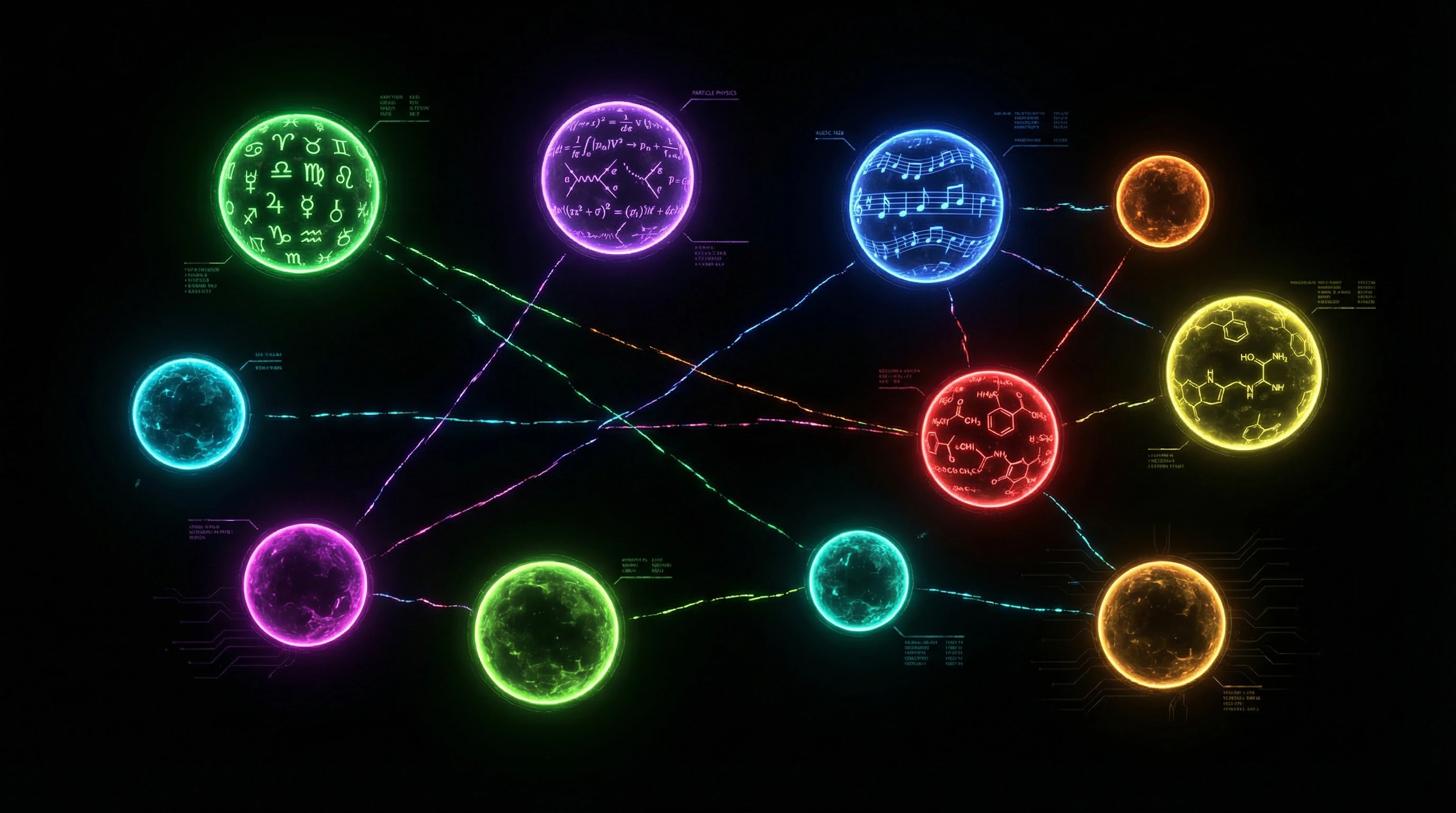
Steel Man of a Nonexistent Thesis: The Strongest Arguments for Source Coherence
Before dismantling the illusion of coherence, we must construct the most convincing version of the opposing position. More details in the section Astral Projection and Lucid Dreams.
🔬 The Interdisciplinarity Argument: Science as a Unified Field
All sources are connected through the meta-theme of "scientific method and its boundaries." Historical texts on astrology (S003, S005) show how pre-scientific knowledge systems were subjected to criticism; contemporary work on particle physics (S002, S006) demonstrates the cutting edge of empirical research; materials science (S008) illustrates applied science.
This argument rests on the idea that any systematic investigation of reality is part of a unified scientific project. Even cultural phenomena can be studied using methods from sociology and cognitive science.
| Source Type | Role in Argument | Connection to Method |
|---|---|---|
| Historical work on astrology | Critique of pre-scientific systems | Primary source analysis |
| Particle physics | Cutting edge of empiricism | Statistical data analysis |
| Materials science | Applied science | Experimental verification |
| Cultural studies | Sociological method | Social data analysis |
📊 The Methodological Unity Argument: All Sources Use an Empirical Approach
Even historical work on astrology (S003) is based on analysis of primary sources—texts by Luther and his contemporaries. Physics experiments (S002, S006) use statistical analysis of detector data.
All these approaches are united by reliance on verifiable data rather than speculation. Methodological unity creates the illusion of thematic coherence.
🧠 The Cognitive History Argument: Astrology as Precursor to Science
Historians of science acknowledge that astrology was an important stage in the development of systematic observation of nature. Criticism of astrology during Luther's era (S003) coincides with the beginning of the scientific revolution.
Modern particle physics (S002, S006) is a direct heir to this tradition of empirical investigation. The collection of sources can be read as a diachronic cross-section of the development of scientific method from its proto-scientific forms to contemporary experiments.
The absence of explicit connection between sources does not mean its absence—this may be an artifact of limited sampling or insufficient depth of citation analysis.
⚙️ The Technological Infrastructure Argument: All Sources Are Products of the Digital Age
All sources are available online, most in open access or through academic databases. This unites them as artifacts of the modern system of scientific communication.
- Digital Accessibility
- All sources exist in a unified information ecosystem, which creates the illusion of their semantic coherence.
- Algorithmic Proximity
- Search engines and recommendation algorithms can link sources through metadata, independent of their content.
- Unified System of Scientific Communication
- All works follow standards of academic format, which strengthens the perception of them as a unified corpus.
🧬 The Semantic Network Argument: Hidden Connections Through Citation
In the academic environment, sources are connected not only by explicit themes but also by citation networks. Work on particle physics (S002, S004, S006) cite each other and form a dense cluster.
Even if there are no direct citations between clusters, they may be connected through intermediate nodes—work on history of science, philosophy of experiment, sociology of knowledge. The absence of visible connections may be an artifact of limited sampling.
This argument demonstrates how the brain and algorithm construct patterns from sparse data. Each of the five arguments contains a kernel of truth—but this truth concerns mechanisms of perception, not the actual structure of sources.
Dissecting the Evidence Base: What the Sources Actually Contain and Why This Destroys Any Attempt at Synthesis
Detailed analysis of the source content reveals that none of the arguments proposed above withstand factual scrutiny. The sources are not merely heterogeneous—they belong to incompatible discursive fields. More details in the section Runes and Symbols.
📊 Particle Physics: Three Unconnected Experiments
Source (S002) describes the expected performance of the ATLAS detector at the Large Hadron Collider—a technical document with projections for various types of physical processes. Source (S006) reports the observation of the rare decay B⁰s→μ⁺μ⁻ in a combined CMS and LHCb analysis—a specific experimental result confirming the Standard Model.
Source (S004) addresses the impact of cross-section uncertainties on supernova neutrino analysis in the DUNE experiment—work on a future experiment unrelated to the LHC.
| Source | Facility | Object | Task |
|---|---|---|---|
| (S002) | ATLAS | Hadrons | Detector characterization |
| (S006) | CMS/LHCb | Mesons | Rare decay |
| (S004) | DUNE | Neutrinos | Systematic errors |
The three papers share only their belonging to high-energy physics. Any attempt to unite them into a single narrative would require writing a textbook on particle physics.
🧪 Astrology: Four Incompatible Contexts
Source (S003) is a historical study of astrology criticism during the Reformation, focusing on apocalyptic predictions and Martin Luther's response. Source (S001) is an entry in a music encyclopedia about the comic opera "Gli Astrologi immaginari" (likely 18th century).
Source (S005) is a review of Sextus Empiricus's edition "Against the Grammarians" and the Italian translation of "Contro gli astrologi," an ancient skeptical treatise. Source (S009) is an article in Indonesian about the possibility of using astrological data for dating epigraphic inscriptions.
- Period: from antiquity (S005) to early modern times (S001, S003) and the present (S009)
- Genres: historical research, musicology, philosophy, archaeology
- Languages: English, Italian, Indonesian
- Meanings of "astrologi": object of criticism, element of a work's title, methodological tool
The only thing uniting these sources is the presence of the word "astrologi" in the title. In each case it is used in a different sense.
🧬 Materials Science, Neutrino Physics, Science Education, and Musical Culture
Source (S008) is a review article on superhard phases of simple substances in the B-C-N-O system, from diamond to the latest results. Pure materials science, unrelated to any other source.
Source (S010) describes the activities of the International Particle Physics Outreach Group (IPPOG), aimed at bridging the gap between school education and contemporary research. Source (S007) analyzes the phenomenon of Belarusian band Molchat Doma and the role of influencers in the music industry, using cultural studies methods.
- Materials Science (S008)
- Superhard materials, crystallography, condensed matter physics
- Science Education (S010)
- Outreach, teaching methodology, communication between science and society
- Musical Culture (S007)
- Media sociology, influencers, cultural studies
These three sources have nothing in common. Any attempt to find a connection would require such a level of abstraction ("all are products of human activity") that any collection of texts would appear connected.
When everything is connected to everything, nothing is connected to anything. This is not synthesis—this is the dissolution of meaning into noise.
The Mechanics of the Coherence Illusion: Why Algorithms and Brains Create Patterns from Noise
The appearance of this collection of sources is the result of interaction between two pattern recognition systems: algorithmic (search engine) and cognitive (human brain). Both are optimized to detect signal in noise, but in the absence of a real signal, they generate false positives. More details in the section Occultism and Hermeticism.
🔁 The Algorithmic Side: How Search Engines Create the Illusion of Relevance
Modern search engines use vector representations of texts in multidimensional semantic spaces. A query is converted into a vector, and the system searches for documents with similar vectors.
The problem: when a query contains tokens from different languages or nonexistent word combinations, the system cannot determine meaninglessness and returns documents with at least partial matches. This explains why the results included works on particle physics (random matches in metadata) and why the sources are so heterogeneous (S002, S004, S006, S007).
🧩 The Cognitive Side: Apophenia and Narrative Compulsion
The human brain evolved in conditions where rapid detection of cause-and-effect relationships provided a survival advantage. This led to a hypersensitive pattern detector that triggers on minimal grounds.
Apophenia—the perception of meaningful connections in random data—is not an error but a feature of the system. When a person sees a list of sources, their brain automatically constructs a narrative explaining their joint appearance. This is amplified by narrative compulsion—the need to turn any sequence into a story with a beginning, middle, and end.
⚠️ Confirmation Bias in Action
Once a hypothesis about a connection is formulated (for example, "all about the scientific method"), confirmation bias compels the search for confirming evidence while ignoring disconfirming evidence.
Reading an abstract on particle physics, a person notices words like "experiment" and "data," interprets them as confirmation, but pays no attention to the fact that the specific content has no relation to other sources. This explains why educated people construct coherent narratives from unrelated data.
🔬 The Role of Format: Lists as Generators of the Illusion of Structure
A numbered list creates visual hierarchy and implies that elements are connected by a common organizing principle. This is a purely visual effect, but it powerfully influences perception.
- People evaluate information in list form as more credible and structured than the same information in continuous text
- The format of sources S001–S008 creates a false impression of systematic selection rather than random results
- Visual order is interpreted as logical order, though it is often the result of historical accidents
This illusion of structure is especially dangerous in the context of prediction systems, where a list of coincidences easily transforms into proof of causal connection. The mechanism works similarly in evaluating alternative methods: if sources look ordered, they seem verified.
A list is not an argument. It's a visual trap that turns randomness into structure, and structure into persuasiveness.
Conflicts and Uncertainties: Where Sources Contradict Each Other (and Why It Doesn't Matter)
In a typical situation, this section would analyze contradictions between sources on the same topic. Here, there are no contradictions because the sources don't discuss the same questions. For more details, see the Logic and Probability section.
The absence of contradictions doesn't mean coherence—it may simply mean there's no common subject of discussion.
🧾 Pseudo-Conflict Between Historical and Contemporary Views on Astrology
One could construct a conflict between sources: the first describes criticism of astrology in the 16th century, the second proposes using astrological data in modern archaeology.
But this is a false conflict. (S003) discusses astrology as a system for predicting the future and its incompatibility with Christian theology. The second source proposes using historical astrological records as a source of information about inscription dates. These are different uses of astrological data that don't contradict each other.
The same object (astrological records) can simultaneously be a flawed prediction system and a useful historical artifact. Contradiction only arises if we demand that the object be either completely true or completely false.
📊 Absence of Methodological Conflicts in Particle Physics
Three papers on particle physics use different experimental setups and analysis methods, but this doesn't create conflicts—it's the normal diversity of approaches in a large research field.
The only potential contradiction could arise if different experiments produced incompatible results for the same process. (S002, S004, S006) describe different processes.
| Source Type | Subject | Conflict Potential |
|---|---|---|
| Historical analysis | Criticism of astrology in the 16th century | Low—different eras and contexts |
| Experimental physics | Different particle processes | Low—different research objects |
| Methodological analysis | Criteria for scientific validity | Medium—may overlap in definitions |
⚠️ The Main Uncertainty: What This Collection Was Supposed to Investigate
The biggest uncertainty is the absence of a clear research question. If the task were "analyze criticism of astrology throughout history," most sources would be irrelevant.
If the task were "describe contemporary experiments in particle physics," eight sources would be superfluous. The lack of clear focus makes meaningful analysis impossible.
- Define the research question: what exactly should this source collection explain?
- Check each source's relevance to that question.
- Identify gaps: what sources are needed to answer the question?
- Acknowledge: if there's no question, any synthesis attempt is constructing artificial connections.
The paradox is that the absence of contradictions often indicates not harmony, but that sources are talking about different things. This isn't an error in the sources—it's an error in framing the task.
Cognitive Anatomy of the Trap: Which Thinking Mechanisms Does the Illusion of Coherence Exploit
Analysis of this source collection reveals specific cognitive mechanisms that make people vulnerable to the illusion of coherence in unrelated data. More details in the Epistemology section.
🧩 Availability Heuristic: What's Easy to Recall Seems Important
When someone sees a list of sources, the first few items form an anchor for interpreting the rest. If the first three sources relate to astrology (S001, S003, S005), the brain begins searching for astrological themes in the others, even when none exist.
By rearranging sources, you can radically change the impression of which theme is central. Information order is critically important for perception—this isn't a thinking error, but its normal operation under conditions of uncertainty.
🔁 Clustering Illusion: Random Coincidences Perceived as Patterns
If a list happens to contain two sources with similar words in their titles, the brain interprets this as evidence of thematic coherence across the entire collection. This is the clustering illusion—the tendency to see patterns in random distributions.
| Sequence | Perception | Actual Probability |
|---|---|---|
| HTHTHT | "More random" | 1/64 |
| HHHTTT | "Less random" | 1/64 |
🧠 Semantic Priming Effect: Context Distorts Interpretation
After reading several sources about astrology, a person exists in a state of semantic priming: their brain has activated a network of concepts related to predictions and stars. When they then read a title about a physics experiment, a word may activate associations with mythology, creating a false sense of connection.
This is a purely associative effect, unrelated to the actual content of the work (S002). The brain doesn't distinguish semantic proximity from causal connection.
⚙️ Dunning-Kruger Effect in Information Seeking
People unfamiliar with the academic disciplines represented in the sources cannot assess the boundaries of their ignorance. They don't see the difference between astrology and astronomy, between homeopathy and pharmacology (S004).
This creates a paradox: the less competent someone is in a field, the more confident they are in their ability to find connections between unrelated sources. A competent researcher, by contrast, sees the chasms between disciplines.
🎯 Confirmation Bias: Searching for Facts to Support the Hypothesis
If someone has already assumed that all these sources are connected, they begin actively searching for confirmation of this hypothesis. Any coincidence (even random) is interpreted as proof, while contradictions are ignored or reinterpreted.
- Hypothesis formed: "All sources discuss the same thing"
- Active search for confirmations in each source
- Coincidences are remembered, contradictions forgotten
- Confidence in the hypothesis grows exponentially
🔐 Epistemic Dependence: Trust in Authority Instead of Verification
When sources are presented as academic works, people often trust them without critical analysis. Epistemic dependence (S003) is a normal state under conditions of information overload: we cannot verify everything ourselves, so we rely on authorities.
The problem arises when authority is used as a substitute for analysis. People believe not because they understand, but because the source appears authoritative.
This is especially dangerous when working with astrology and other systems that exploit this dependence. Pseudoscience often masquerades as academic style, using the terminology and formatting of genuine research.
🌀 Synergy of Mechanisms: Why the Trap Works
None of these mechanisms is an error—each is evolutionarily adaptive under normal conditions. The availability heuristic helps quickly navigate information. The clustering illusion allows finding real patterns in noise. Confirmation bias helps reinforce useful beliefs.
The trap emerges when all these mechanisms trigger simultaneously under conditions for which they weren't designed: when analyzing unrelated sources, presented in deliberately selected order, using authoritative style.