What exactly the lunar cycle myth claims — and why its formulation already contains a trap
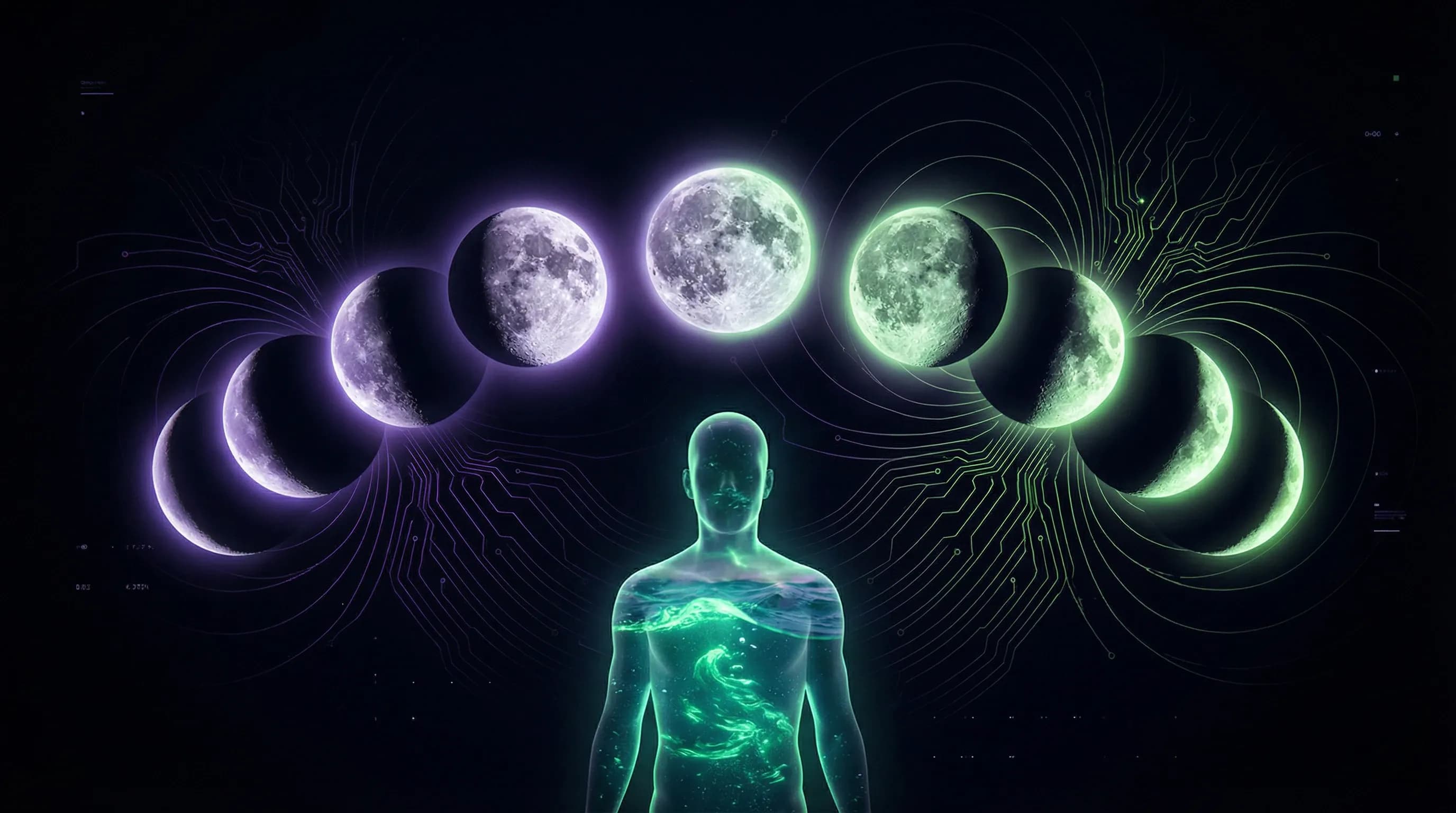
The myth of the Moon's influence on humans exists in dozens of variations, but the core remains unchanged: lunar phases supposedly exert a measurable impact on human physiology, psychology, and behavior. A popular version states: "The Moon causes tides in the world's oceans. And the human body is almost 2/3 water. Imagine what an amazing influence..." (S011)
This analogy sounds convincing — and that's precisely its danger. The myth's formulation exploits several cognitive vulnerabilities simultaneously: it appeals to a real physical phenomenon (tides), creating an illusion of scientific validity; it uses a simple analogy (water in the ocean = water in the body) that seems intuitively logical; it leaves the mechanism of influence undefined, allowing each person to fill the gap with their own expectations. More details in the Esoterica and Occultism section.
When a claim sounds logical but contains no mechanism for verification — that's a sign of a rhetorical trick, not a scientific argument.
Three main versions of the myth and their target audiences
The myth adapts to different contexts and needs. The astrological version claims the Moon influences "energy" and destiny, recommending planning important activities according to lunar phases. The pseudo-medical version links lunar cycles to chronic disease flare-ups, menstrual cycles, and sleep quality. The financial-trading version proposes using lunar rhythms to forecast market movements: some traders incorporate lunar cycles into their trading strategies (S012).
| Myth version | Target need | Attraction mechanism |
|---|---|---|
| Astrological | Control over uncertainty | Predictability, ritual, meaning |
| Medical | Explanation for unexplained symptoms | Causality, cognitive dissonance relief |
| Financial | "Secret advantage" in the market | Illusion of information asymmetry |
All three versions share one thing: absence of a verification mechanism and immunity to falsification. If a prediction fails, the myth isn't to blame — it's "incorrect interpretation" or "external interference."
Why "2/3 water" is not an argument, but a rhetorical trick
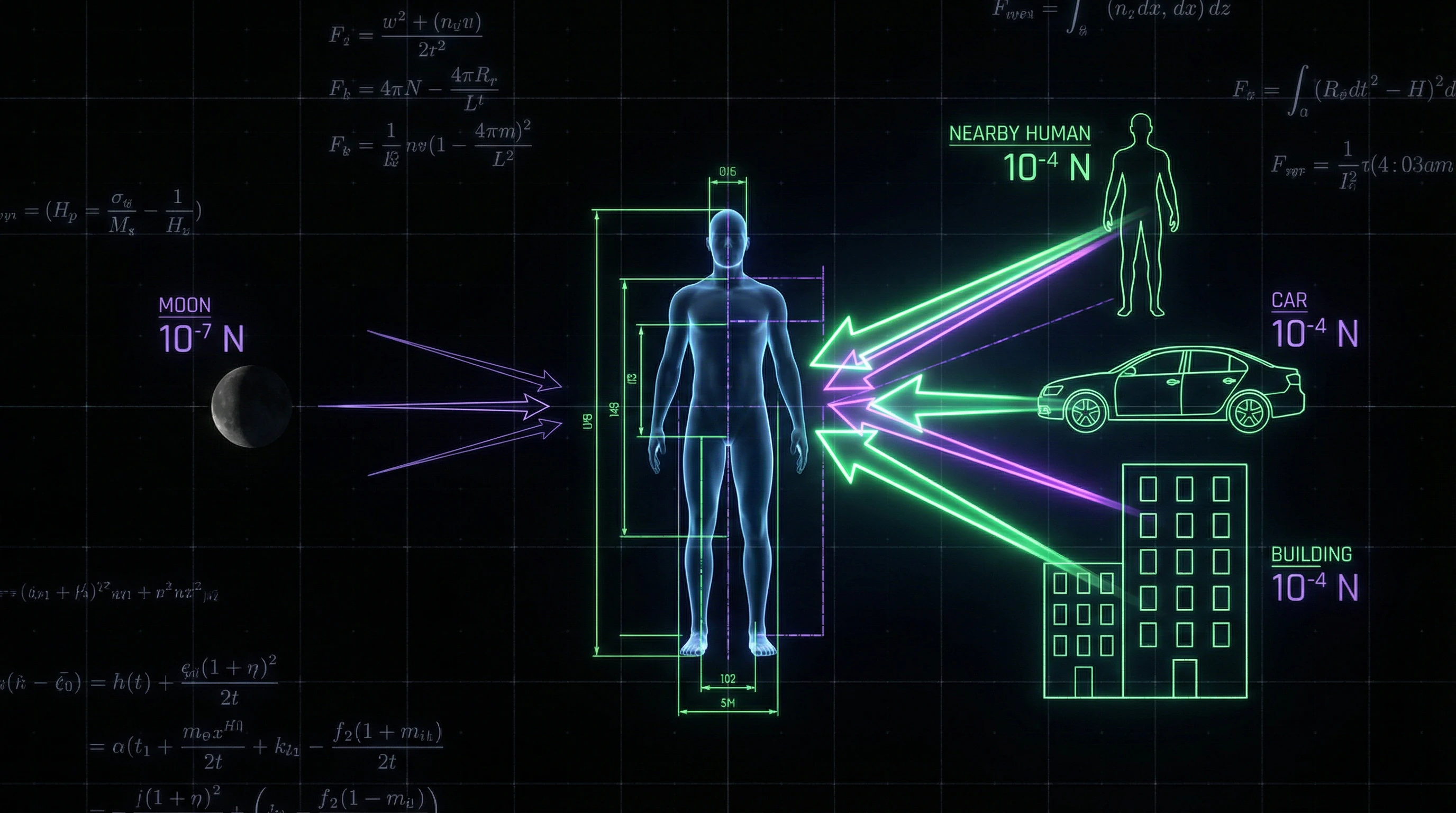
The claim that the human body is "almost 2/3 water" (S011) is technically correct — water content in an adult human body is 55–60%. But this fact has no relation to the Moon's gravitational influence.
Tides occur due to the difference in gravitational pull on opposite sides of a massive body (Earth). For a 70 kg human, the difference in the Moon's gravitational effect between head and feet is on the order of 10⁻⁷ of Earth's gravitational force — millions of times smaller than the influence of gravity from a nearby person or parked car.
- False equivalence
- Two phenomena are linked based on superficial similarity (presence of water), ignoring critical differences in scale. The ocean tide analogy only works for enormous masses of water, where microscopic gravitational differences accumulate over distances of thousands of kilometers. At the scale of the human body, these differences are physically immeasurable.
Boundaries of the myth: what exactly we're testing
For proper verification, we must clearly define the claim's boundaries. We're not testing the Moon's existence, the presence of lunar phases, the fact of ocean tides, or water content in the human body — these are established facts.
- We're testing: whether there exists a statistically significant correlation between lunar phases and measurable parameters of human behavior or physiology
- We distinguish between correlation (statistical association) and causation (mechanism of influence)
- We require identification of a mechanism, even if correlation is found
Even if correlation were discovered, it wouldn't prove causation without a mechanism. But, as we'll see, even correlation is absent. This is the key point: the myth doesn't just incorrectly explain a phenomenon — it describes a phenomenon that doesn't exist.
Absence of correlation isn't just weak evidence. It's refutation of the hypothesis.
The Steel Version of the Argument: Seven Most Compelling Cases for Lunar Influence
Before dismantling a myth, it's necessary to formulate it in its strongest form—this is called a steelman argument, the opposite of a straw man. Below are the seven most convincing arguments made by proponents of lunar influence, presented in their most rational formulation. More details in the section Tarot and Cartomancy.
🌊 Argument 1: The Moon Controls the Oceans—Why Not Humans?
The Moon's gravitational effect on Earth is undeniable: tides are a direct consequence of lunar gravity. If the Moon can move trillions of tons of water, isn't it logical to assume it also affects the water in the human body?
This argument appeals to the principle of nature's unity: the laws of physics are universal, and if a mechanism works at one scale, it should work at another.
Strength: the argument is based on a real physical phenomenon and uses scaling logic. Weakness: it ignores the critical role of scale—gravitational effects depend on system size nonlinearly.
📊 Argument 2: Full Moon Statistics and Incidents
Many medical workers, police officers, and emergency responders report a subjective sense of increased incidents during full moons. Some studies have indeed found correlations between lunar phases and the frequency of suicides, psychiatric hospitalizations, and criminal incidents.
If multiple independent observers notice the same pattern, it demands explanation.
Strength: relies on empirical observations and statistical data. Weakness: subjective observations are prone to systematic errors (confirmation bias), and individual studies with positive results are not replicated in meta-analyses.
🧬 Argument 3: Biological Rhythms and Evolutionary Adaptation
Many organisms demonstrate circalunar rhythms—biological cycles synchronized with the lunar month. Corals spawn during specific lunar phases, and some species of fish and crabs coordinate reproduction with tides.
The human menstrual cycle (averaging 28 days) is close to the lunar month (29.5 days). Perhaps this isn't coincidence, but a trace of evolutionary adaptation to lunar cycles.
Strength: biological rhythms are real, and the evolutionary logic is compelling. Weakness: coincidence in cycle duration doesn't prove causation; the menstrual cycle varies from 21 to 35 days, and its average length doesn't correlate with lunar phases in individual women.
🧠 Argument 4: Illumination and Circadian Rhythms
A full moon increases nighttime illumination by tens of times compared to a new moon. Light is a powerful regulator of circadian rhythms through the suprachiasmatic nucleus of the hypothalamus.
Even weak light at night suppresses melatonin production and can disrupt sleep. Therefore, a full moon could affect sleep quality and, indirectly, behavior.
Strength: the mechanism is biologically plausible and supported by research on light's effect on sleep. Weakness: this is an effect of light, not gravity or "lunar energy"; in modern cities, artificial lighting exceeds moonlight by orders of magnitude, negating this effect.
🔁 Argument 5: Cultural Universality of the Myth
Belief in lunar influence exists in dozens of independent cultures across all continents. If the myth is universal, perhaps it reflects real experience rather than mere cultural transmission.
Universality may point to a common perceptual or cognitive foundation.
Strength: cross-cultural universality is a strong argument in anthropology. Weakness: universality may reflect universal cognitive errors (such as the tendency to see patterns in random data) rather than a real phenomenon.
📈 Argument 6: Financial Markets and Lunar Cycles
Some traders claim that market volatility correlates with lunar phases (S004). If enough market participants believe in lunar influence and act accordingly, this could create a self-fulfilling prophecy.
The market would indeed display patterns linked to the Moon, but not due to physical influence—rather, due to collective behavior.
Strength: the self-fulfilling prophecy mechanism is real and documented in behavioral economics. Weakness: this proves the influence of belief in the Moon, not the Moon itself; empirical tests find no stable correlations.
🧪 Argument 7: Absence of Evidence Is Not Evidence of Absence
Even if modern science hasn't discovered a mechanism for lunar influence, that doesn't mean it doesn't exist. The history of science is full of examples of phenomena that were long denied and later confirmed (meteorites, plate tectonics, the bacterial nature of ulcers).
Perhaps we simply haven't yet developed sufficiently sensitive measurement methods.
- Strength
- Epistemologically correct—absence of evidence is not equivalent to evidence of absence.
- Weakness
- This argument applies to any untestable claim and cannot serve as grounds for accepting a hypothesis; the burden of proof lies with the claimant.
Evidence Base: What Systematic Research and Meta-Analyses Show
Moving from arguments to data. Over the past half-century, hundreds of studies have been conducted testing the connection between lunar phases and various aspects of human behavior. More details in the section Astral and Lucid Dreams.
📊 Meta-Analysis of Psychiatric Hospitalizations and Suicides
One of the most thorough studies of the connection between lunar phases and suicidal behavior was conducted in Estonia (S018). Researchers analyzed data on completed suicides and attempts to detect correlation with lunar phases.
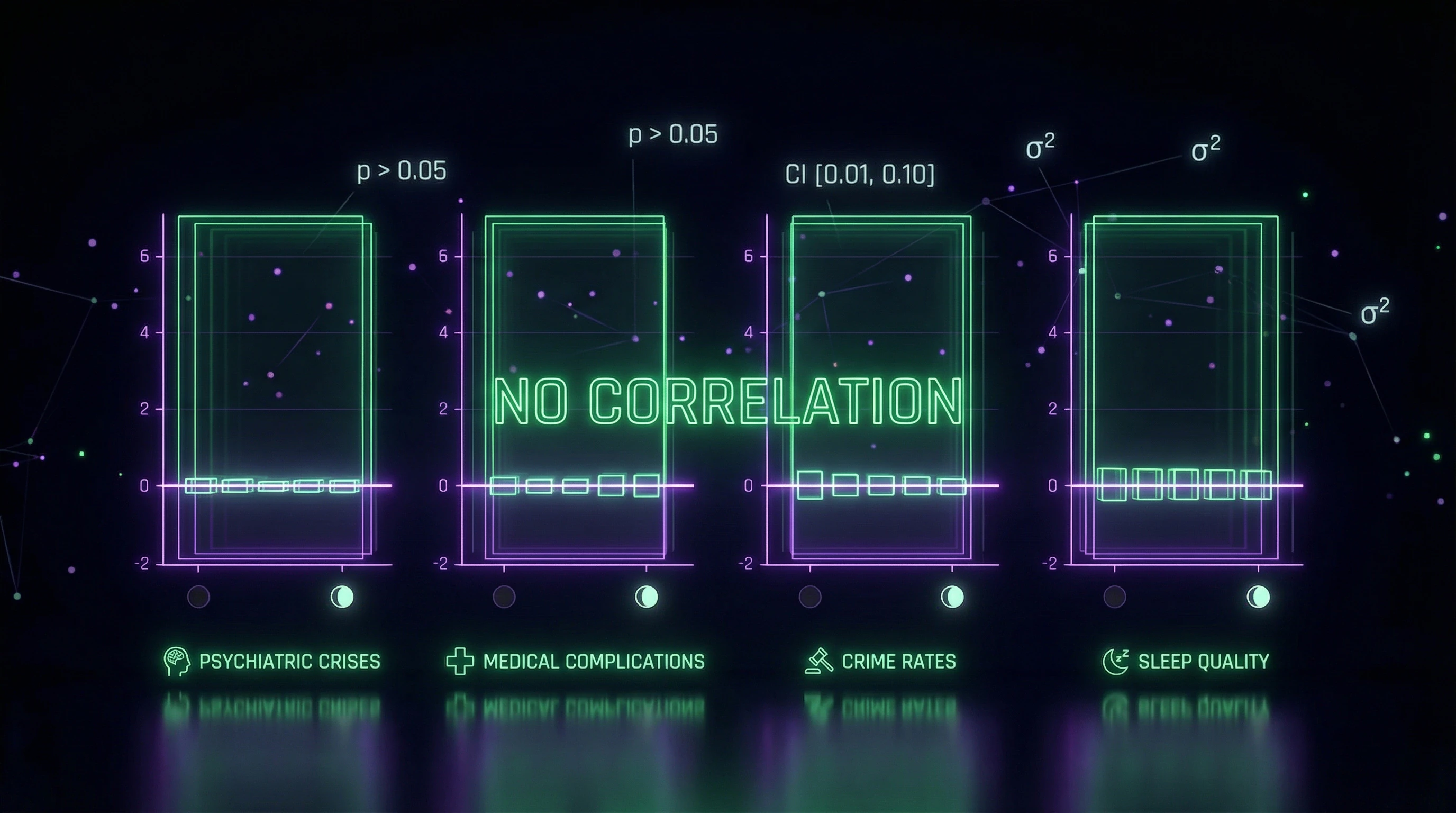
Multiple meta-analyses covering dozens of studies and thousands of cases reach one conclusion: there is no reproducible correlation between lunar phases and psychiatric crises. Individual studies finding positive results are not reproduced when sample size is increased or methodology is improved.
Various cycles (seasonal changes, lunar cycle, etc.) are factors determining the behavior of many living creatures on Earth — but for humans, no statistically significant connection between lunar phases and suicide frequency has been found.
🏥 Medical Statistics: Births, Surgeries, Bleeding
A popular myth claims that the full moon increases the number of births and complications during surgeries. Systematic checks of medical databases, including millions of records, do not confirm these claims.
The distribution of births across days of the lunar cycle is statistically indistinguishable from uniform. The frequency of postoperative complications, blood loss volume, surgery duration — all these parameters do not correlate with lunar phases.
- Why medical data is especially reliable
- In medical research, it's easy to control multiple variables (age, sex, diagnosis, season), making them particularly sensitive to detecting real effects. The absence of correlations in this data is strong evidence against the myth.
🚔 Crime Statistics and Traffic Accidents
Police statistics are an area where the full moon myth is particularly persistent. Analysis of law enforcement databases in different countries shows: the frequency of crimes, arrests, police calls does not correlate with lunar phases.
The same applies to traffic accidents: despite the fact that a full moon increases nighttime visibility (which theoretically should reduce accidents), no statistically significant effect is observed.
| Data Source | Myth Expectation | Research Results |
|---|---|---|
| Police Reports | More crimes during full moon | No correlation |
| Traffic Accident Statistics | More accidents (despite light) | No correlation |
| Hospitalizations | Peaks during full moon | Uniform distribution |
Subjective reports from police officers and medical staff about "crazy full moon nights" are explained by confirmation bias: people remember cases that confirm their expectations and forget contradictory ones.
💤 Sleep Quality and Circadian Rhythms
Sleep studies using polysomnography (objective recording of brain activity, eye movements, muscle tone) do not detect systematic changes in sleep architecture depending on lunar phases. Individual studies reporting reduced sleep depth during full moon have not been reproduced in larger studies with better variable control.
Important exception: in conditions without artificial lighting (for example, in expeditions or among indigenous peoples), a full moon can indeed affect sleep through increased illumination. But this is an effect of light, not gravity or mystical "lunar influence."
In modern cities, where nighttime illumination from streetlights is hundreds of times greater than lunar light, this effect is completely negated. The mechanism works — the conditions for its manifestation do not exist.
🧾 The Problem of Publication Bias
Studies that do not find a connection between the moon and behavior are published less often than studies with positive results. This is called publication bias. Journals prefer to publish "interesting" results, while negative results remain in researchers' desk drawers.
Meta-analyses attempt to correct this bias using statistical methods (for example, funnel plots to detect publication asymmetry). When such correction is applied, even weak correlations found in individual studies disappear.
- Researcher finds weak correlation (p = 0.048) in sample of 50 people
- Result is published in journal as a "discovery"
- Other researchers attempt to reproduce with sample of 5,000 people
- Effect disappears (p = 0.87)
- Negative result remains unpublished
- Meta-analysis sees only positive result and draws incorrect conclusion
This indicates that positive results are artifacts of publication bias, not real effects. To test lunar influence requires not searching for new studies, but honest inventory of all conducted work, including unpublished studies.
The Mechanism of Illusion: Why We See Patterns Where None Exist
If scientific data doesn't confirm lunar influence, why is the myth so persistent? The answer lies in how the human brain works and cognitive mechanisms that evolved to solve other problems but create systematic errors in assessing cause-and-effect relationships. More details in the Debunking and Prebunking section.
🧩 Apophenia and Pareidolia: The Brain as Pattern Detector
Apophenia — the tendency to see meaningful patterns in random data. Evolutionarily, this was useful: better to mistakenly see a predator in rustling leaves than to miss a real threat.
In the modern world, this tendency leads to false correlations. When an unusual event occurs (a fight, an accident, insomnia) during a full moon, the brain automatically connects them, creating an illusion of causality.
The brain doesn't register cases when unusual events occur during other moon phases, or when nothing unusual happens during a full moon. This creates asymmetry in memory: confirming cases are remembered, contradicting ones are ignored.
🔁 Confirmation Bias and Selective Memory
Confirmation bias — the tendency to seek, interpret, and remember information in ways that confirm existing beliefs. If someone believes in lunar influence, they involuntarily pay attention to events coinciding with the full moon and ignore non-coinciding ones.
Experiments show: when people are told it's a full moon today (even when it's not), they report worse well-being, greater anxiety, and poorer sleep. This is the nocebo effect — a negative self-fulfilling prophecy.
- Nocebo
- The expectation of harmful effects creates a subjective sensation of those effects, which is then interpreted as confirmation of the myth. The mechanism works independently of any real physical influence.
- Why This Is Dangerous
- People begin to trust their own experience more than statistics because experience seems like direct proof. In reality, it only proves one's capacity for self-suggestion.
🧬 Illusion of Control and the Need for Predictability
Belief in lunar cycles provides an illusion of control over unpredictable aspects of life. If mood, health, and luck depend on the Moon, then they can be predicted and prepared for.
Research shows: people with high need for control and low tolerance for uncertainty are more likely to believe in astrological and lunar influences.
| Complex Phenomenon | Real Factors | The Myth Offers |
|---|---|---|
| Bad mood | Stress, sleep, diet, social interactions, hormones | Moon phase (one variable, easily tracked) |
| Insomnia | Anxiety, caffeine, screens, temperature, noise | Full moon (predictable, can prepare for it) |
| Accident | Inattention, fatigue, environmental conditions | Lunar cycle (explains it, reduces responsibility) |
The Moon myth functions as a cognitive crutch: it provides a simple explanation for multifactorial phenomena instead of analyzing dozens of variables.
👁️ Cultural Reinforcement and Social Validation
The lunar influence myth is constantly reinforced by cultural narratives: movies, books, articles in popular publications, astrology apps. When millions of people share a belief, it begins to seem true simply by virtue of its prevalence.
This phenomenon is called social validation: if everyone believes it, it must be true. The effect works especially strongly in closed communities (astrology forums, social media groups), where alternative viewpoints are filtered out or ridiculed.
- Person hears about lunar influence (cultural narrative)
- Notices coincidence of event with full moon (apophenia)
- Interprets coincidence as causality (attribution error)
- Seeks additional confirmations (confirmation bias)
- Ignores contradicting examples (selective memory)
- Shares belief with others (social reinforcement)
- Receives community approval (social validation)
- Belief strengthens and becomes part of identity
Each step is logical at the individual level, but together they create a self-sustaining system resistant to facts. This isn't stupidity — it's normal functioning of the human brain under conditions of information overload and uncertainty.
Understanding these mechanisms is important not for condemning believers, but for developing effective media literacy strategies. When people become aware of how their own cognitive traps work, they gain a tool for overcoming them — not through willpower, but through restructuring their information environment and thinking habits.