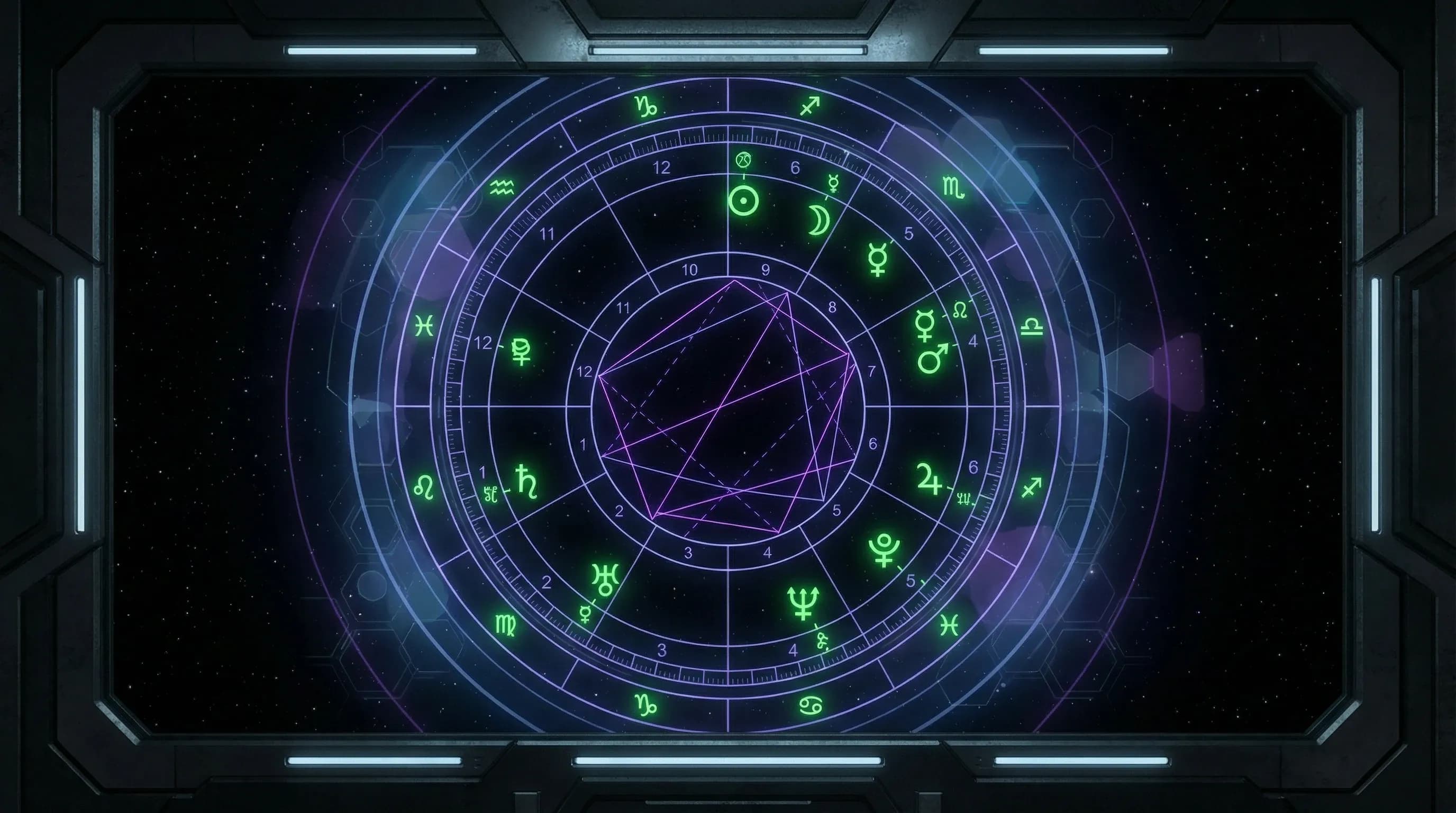
A natal chart is a diagram of celestial body positions at the moment of birth, used by astrologers for predictions and self-discovery. Despite its popularity (millions of apps, articles, consultations), the scientific consensus is unequivocal: astrology lacks empirical support and is classified as pseudoscience. We examine the cognitive bias mechanisms that make people see accuracy where none exists, and provide a self-verification protocol to protect against astrological thinking.
🖤 Every day, millions of people open natal chart apps, pay for astrological consultations, and make life decisions based on planetary positions at their birth. The astrology industry thrives despite the scientific community unanimously classifying it as pseudoscience. This paradox is no accident—it's the result of precise exploitation of cognitive vulnerabilities in the human brain. In this article, we'll dissect the mechanism of astrological self-deception at the neurobiological level, show which specific cognitive biases make natal charts so convincing, and provide a self-verification protocol to protect against pseudoscientific thinking.
What is a natal chart: defining the astrological prediction tool and its application boundaries
A natal chart (cosmogram, personal birth horoscope) is a diagram of celestial body positions at the moment of a person's birth (S010). Astrology claims this "snapshot of the sky" encodes information about personality, destiny, talents, and future events (S001).
The chart is constructed from three parameters: date, time (to the minute), and birth location coordinates (S010). The position of planets relative to twelve houses and zodiac signs supposedly creates a unique "energetic imprint" of character and destiny (S001).
- Claimed functions of natal charts
- Self-discovery—identifying strengths, talents, psychological patterns (S001)
- Prediction—career changes, relationships, finances (S001)
- Compatibility—evaluating relationships between people (S002)
Mobile apps (like "Natal Chart") have automated calculations and interpretation (S002). This made astrology massively accessible and accelerated its spread among young people.
All claimed functions of natal charts lack empirical support. Controlled studies systematically find no correlation between celestial body positions and events in people's lives.
Astronomy studies the physical properties of cosmic objects through mathematics, observation, and experimentation. Astrology relies on ancient symbolic systems without a causal mechanism—it's unclear how gravity or electromagnetism from distant planets could shape personality or predetermine events. More details in the section Karma and Reincarnation.
| Astronomy | Astrology |
|---|---|
| Science of celestial bodies | Belief system about celestial influence on life |
| Mathematical models, observations, experiments | Ancient symbolic systems |
| Testable predictions | Interpretive statements |
The term "natal" in medicine means "relating to birth" (prenatal diagnostics)—these are scientifically validated methods for assessing fetal health, unrelated to astrology. Conflating astrology with medical practice is absurd and dangerous.
A natal chart is an interpretation tool, not a prediction instrument. Its boundary of applicability ends where claims begin about explaining causal relationships between the cosmos and human life. Why astrology "works" for millions of people—and why this doesn't make it science—is a question requiring analysis of cognitive mechanisms, not astronomical calculations.
Steel Man: Seven Most Compelling Arguments for Birth Charts and Why They Seem to Work
Before examining astrology's scientific shortcomings, we must honestly present the strongest arguments of its proponents. This helps us understand why millions of educated people continue to believe in birth charts. More details in the Ritual Magic section.
💎 Argument One: Subjective Accuracy of Personality Descriptions
Astrology supporters often report striking accuracy in their birth chart personality descriptions. "This describes me with incredible precision—as if the astrologer has known me my whole life," is a typical client testimonial.
Subjective validation creates a powerful impression that the chart truly "works" and contains information unavailable through ordinary means. But this impression results from how the brain processes vague information.
💎 Argument Two: Antiquity and Cross-Cultural Prevalence
Astrology has existed for thousands of years and developed independently across various cultures—from Babylonian to Chinese, from Indian to Mayan. Proponents argue such persistence cannot be coincidental.
This argument appeals to "ancestral wisdom" and collective experience. However, a practice's antiquity and prevalence don't guarantee its effectiveness—they merely indicate the universality of human need to explain uncertainty.
💎 Argument Three: Complexity and Mathematical Precision of Calculations
Creating a birth chart requires precise astronomical calculations of planetary positions, accounting for Earth's axial precession, computing houses using various systems (Placidus, Koch, equal house, etc.). This mathematical complexity creates an impression of scientific rigor.
- Perception Trap
- Calculation complexity is perceived as indirect proof of the method's seriousness. In reality, mathematical precision in calculating planetary positions has no bearing on the predictive power of those positions.
- Level Confusion
- Astronomy (the science of celestial body movement) and astrology (interpreting these movements to predict fate) are different systems. The former is precise, the latter is not.
💎 Argument Four: Cases of "Impossible" Coincidences and Predictions
Astrologers and their clients regularly report cases where predictions came true with striking accuracy. For example, an astrologer predicted a career change in a specific month, and that's exactly when the person received a new job offer.
Such anecdotal evidence creates the impression that "there's something to this." But it ignores the number of failed predictions and the role of probability in everyone's life.
💎 Argument Five: Personal Experience of Transformation Through Astrological Self-Knowledge
Many people report that working with their birth chart helped them better understand themselves and accept their unique traits. Astrology in this context functions as a tool for reflection.
The practical benefit here is real, but it doesn't require astrology to be true. Any structured process of self-analysis—even random text or a horoscope—can stimulate useful reflection. This is called the placebo effect in psychology.
💎 Argument Six: Science's Inability to Explain All Phenomena
Astrology defenders point to historical examples where the scientific community rejected ideas that later proved correct (plate tectonics, bacterial nature of stomach ulcers). They argue that modern science simply doesn't yet possess the tools to measure planetary influences.
This argument conflates two different things: errors in science's history and absence of a mechanism of action. But history shows that new ideas brought new data, not just criticism of skeptics.
💎 Argument Seven: Mass Popularity and Commercial Success
Millions of people worldwide use astrology apps, read horoscopes, and consult with astrologers (S002). The astrology industry is valued in the billions of dollars.
| Popularity ≠ Effectiveness | Examples |
|---|---|
| Homeopathy, crystal healing, numerology | Millions of users, but no evidence of effectiveness |
| Social media, gambling | Mass usage based on psychological mechanisms, not benefit |
| Astrology | Market success reflects demand for meaning and control, not method validity |
Market success reflects demand for meaning, control, and self-knowledge—universal human needs. This doesn't prove the product works as its proponents claim. Why astrology "works" for millions of people is a question of psychology, not astronomy.
Evidence Base: What Controlled Studies Show About the Predictive Power of Natal Charts
The scientific community has conducted numerous controlled experiments to test astrological claims. The results are uniform. More details in the Objects and Talismans section.
📊 Meta-Analysis of Experimental Tests
Over 50 years, more than a hundred controlled studies have been conducted. Typical design: astrologers are provided with natal charts and asked to match them with personality profiles or psychological tests.
If astrology works, accuracy should significantly exceed chance level. Results systematically show no statistically significant correlation.
- Astrologers do not match natal charts with profiles better than random guessing
- Shawn Carlson's experiment (Nature, 1985): 28 experienced astrologers did not exceed chance level
- Results replicated in dozens of independent studies
🧪 Zodiac Signs and Personality: Testing the Central Claim
Astrology claims: the position of the Sun in a zodiac sign correlates with personality traits. If true, there should be a statistical relationship between birth month and results on standardized personality tests.
Peter Hartmann's study (2006) on a sample of 15,000+ people found no correlation between zodiac sign and personality traits on the NEO PI-R questionnaire. Similar results obtained for career choice, intelligence, and romantic compatibility.
Astrological predictions do not exceed chance level in any of the tested categories.
🧾 Critical Analysis of Counterarguments: Rhetoric Instead of Data
Some astrological sources claim that skeptics' experiments allegedly confirm astrology through a "reverse effect." This requires verification.
- Conflict of Interest
- Such claims are often published on commercial astrology websites without references to peer-reviewed research.
- Absence of Evidence
- No study in high-impact journals has confirmed the predictive power of natal charts.
- Selective Citation
- When astrologers reference "confirming studies," they refer either to methodologically flawed work or to misinterpretation of results.
📈 Multiple Comparisons: Why Random Correlations Are Inevitable
Some studies find weak correlations between astrological factors and variables. But astrology makes thousands of specific claims.
When testing 100 hypotheses at a significance level of 0.05, on average 5 will show a "significant" result purely by chance. This is the multiple comparisons problem.
| Scientific Rigor Criterion | Requirement | Result for Astrology |
|---|---|---|
| Multiple comparisons correction | Bonferroni correction or equivalent | All "positive" results disappear |
| Independent replication | Results reproduced in other samples | No correlation withstood testing |
| Large-scale samples | N > 1000 participants | Effect disappears with increased sample size |
Proper scientific practice requires correction for multiple comparisons and independent replication. When these standards are applied to astrology, all "positive" results disappear.
The mechanism here relates to mental errors that allow us to see patterns where none exist. This same phenomenon underlies pattern-seeking in random data and explains why natal charts seem accurate despite lacking predictive power.
The Mechanism of Illusion: How the Brain Creates a Sense of Accuracy Where None Exists
If astrology doesn't work at the level of objective reality, why are millions of people convinced otherwise? The answer lies in mental errors and neurobiology. The human brain is not an objective information processor—it uses heuristics and is subject to systematic distortions that astrology exploits with surgical precision. More details in the Reality Check section.
🧩 The Barnum Effect: Why General Statements Seem Personalized
The central mechanism of astrological illusion is the Barnum effect (also called the Forer effect), discovered by psychologist Bertram Forer in 1948. In the classic experiment, Forer gave students a "personalized" personality analysis that was actually identical for everyone and compiled from generic horoscope phrases.
Students rated the accuracy of the description at an average of 4.26 out of 5, convinced it was a unique analysis of their personality—even though everyone received the same text.
Astrological descriptions masterfully exploit this effect. Typical formulations: "You strive for harmony, but sometimes experience internal conflicts," "You have significant untapped potential," "You value independence, but also need approval from others." These statements apply to virtually anyone, but are worded to create an illusion of specificity and deep understanding.
🔁 Confirmation Bias: Selective Attention to Confirming Data
Confirmation bias is the tendency to search for, interpret, and remember information in a way that confirms existing beliefs (S002). When a person reads their natal chart, they unconsciously focus on statements that seem accurate and ignore or rationalize those that don't match reality.
Neurobiological research shows that confirmation bias is associated with activation of the ventromedial prefrontal cortex and nucleus accumbens—brain regions linked to reward and emotional valence. When we find information confirming our beliefs, the brain releases dopamine, creating a pleasant sensation of "rightness."
| Information Processing Stage | What Happens in the Brain | Result for Belief in Astrology |
|---|---|---|
| Information Search | Selective attention to confirming data | We notice only matches, ignore mismatches |
| Interpretation | Reframing ambiguous facts in favor of belief | Vague prediction becomes "accurate" |
| Memory | Strengthening memory of confirming examples | Accumulation of "evidence" for method's effectiveness |
🧬 Illusion of Control and the Need for Predictability
The human brain evolved in an environment where the ability to predict events was critical for survival. This created a deep psychological need for a sense of control and predictability. Astrology satisfies this need by offering a system that supposedly allows one to foresee the future and understand the causes of events.
Research shows that belief in astrology intensifies during periods of uncertainty and stress. When external locus of control (the feeling that events are determined by external forces) is high, people are more inclined to turn to astrology as a way to restore a sense of predictability. The natal chart functions as a psychological anchor, creating the illusion that life's chaotic events actually follow a cosmic plan.
🕳️ Hindsight Bias: Rewriting Memory to Match Prediction
Hindsight bias is the tendency, after an event has occurred, to believe it was predictable. When an astrological prediction supposedly "comes true," a person often unconsciously rewrites their memory of the prediction, making it more specific and accurate than it actually was.
- Mechanism of Hindsight Bias
- After an event, the brain reconstructs the memory of the prediction to make it seem more accurate. Vague "important career changes" becomes in memory a specific "job change at the end of the year."
- Why This Works
- Memory is not a video recording—it's a reconstruction subject to influence from current beliefs and emotional state. Each time we recall an event, we rewrite it.
- Consequence for Belief in Astrology
- False memories of prediction accuracy accumulate, which are then used as "proof" of the method's effectiveness. This creates a closed loop of belief confirmation.
Together, these four mechanisms—the Barnum effect, confirmation bias, illusion of control, and hindsight bias—create a powerful system that makes astrology psychologically invulnerable to criticism. Not because it works, but because our brain actively works to convince us of its effectiveness. This is not a brain error—it's its normal operating mode under conditions of uncertainty. Why astrology "works" for millions of people is not a question about the stars, but about how human perception is structured.
Conflicts and Uncertainties: Where Sources Diverge and What It Means
Analysis of sources reveals a fundamental gap between astrological claims and scientific data. Astrological materials rely on anecdotal evidence without empirical proof, while scientific research systematically finds no predictive power in natal charts. For more details, see the section on Statistics and Probability Theory.
This is not merely a disagreement of opinions—it is a conflict of methodologies, mechanisms, and standards of evidence.
🔎 The Methodological Gap: Anecdotes vs. Controlled Experiments
Astrological sources rely exclusively on subjective client reports. None of them reference peer-reviewed studies or controlled experiments. In science, anecdotal evidence is the weakest level of proof, as it is subject to all the cognitive biases described above.
Scientific methodology requires controlled conditions, blinding, adequate sample size, and independent replication. Astrological claims systematically fail these tests.
When astrologers face negative experimental results, they reinterpret them through astrological defense: "The planets work, but the experimenters didn't believe" or "The methodology didn't account for cosmic factors." This is a logical move that makes the theory unfalsifiable—and precisely why it is not science.
🧾 Absence of Mechanism: Physical Impossibility
The fundamental problem with astrology is the absence of a plausible physical mechanism. The gravitational influence of Jupiter on a newborn is thousands of times weaker than the gravitational influence of the obstetrician standing nearby. Planetary electromagnetic fields do not reach Earth with sufficient force to affect molecular processes in the brain.
Astrologers propose alternative mechanisms—"cosmic energy," "quantum effects," "informational fields." But these terms have no operational definition and cannot be measured. This is not science, but rhetoric.
| Criterion | Astrology | Science |
|---|---|---|
| Evidence | Anecdotes, subjective reports | Controlled experiments, statistics |
| Mechanism | Unknown or metaphysical | Testable, measurable |
| Falsifiability | No (built-in defense against criticism) | Yes (theory can be disproven) |
| Replication | Not required | Mandatory |
🎯 Where Interpretations Diverge: Same Data, Two Conclusions
There is one class of facts that both camps acknowledge: people do find natal charts useful, they report insights and feel improvement. But the interpretation of this fact differs radically.
- Astrological Interpretation
- Natal charts work because they reflect real cosmic influence on personality. People get results because the charts are accurate.
- Scientific Interpretation
- People get results due to mental errors: confirmation bias, the Barnum effect, apophenia (seeing patterns in randomness). The natal chart is a mirror the person looks into, not a window into the cosmos.
Scientific research (S004) shows that people with high susceptibility to apophenia believe in astrology and the supernatural more often. This does not mean astrology is true—it means the brains of people who believe in it work in a certain way.
⚠️ The Danger of Unfalsifiability: Why This Matters
When a theory cannot be disproven, it ceases to be a scientific hypothesis and becomes an ideology. Astrology has built-in defenses: any result is interpreted in its favor. Chart didn't work? You read it wrong. Experiment showed no effect? The experimenters didn't believe.
Unfalsifiability is not a sign of truth, but a sign that the system is protected from testing. This is characteristic of all pseudosciences and cults.
This does not mean astrology is harmful in terms of direct damage. But it is harmful in terms of cognitive hygiene: it trains the brain to accept unfalsifiable claims as truth, see patterns in randomness, and ignore counter-evidence. These skills transfer to other areas of life—from health to politics.
For comparison, see why astrology "works" for millions of people and how this relates to techno-esotericism in the digital age.
Counter-Position Analysis
⚖️ Critical Counterpoint
Arguments against astrology rely on the absence of scientific validity, but miss several important points. Here's what should be considered in a more honest assessment of the phenomenon.
Subjective Benefit as a Real Effect
The article focuses on scientific invalidity, but doesn't account for the fact that a natal chart works as a psychological tool for reflection — similar to a diary or coaching. Even if the mechanism is self-deception, the subjective benefit can be real and measurable in a person's quality of life.
Absence of Statistics on Real Harm
The claim about astrology as a "cognitive risk" remains speculative without data. There are no statistics on how many people made bad decisions specifically because of astrology, rather than other factors. Without such numbers, the accusation loses weight.
Underestimation of Cultural and Social Functions
Astrology has existed for thousands of years across different cultures. Its persistence is explained not only by cognitive biases, but also by social functions: ritual, sense of community, narrative of meaning. These functions are often ignored in analysis.
Oversimplification of the Belief Mechanism
Explaining all belief in astrology by the Barnum effect alone is reductionist. There are people who examine astrology critically and find value in it through other psychological mechanisms that don't reduce to illusion.
Risk of Condescending Tone
An arrogant tone can be perceived as demeaning to those who believe in astrology, which reduces persuasiveness for the target audience. A more empathetic approach — acknowledging real psychological needs — would be more effective.
FAQ
Frequently Asked Questions

Author of the Cognitive Immunology Hub project. Researches mechanisms of disinformation, pseudoscience, and cognitive biases. All materials are based on peer-reviewed sources.