Astrology as a System of Claims: What Science Actually Tests and Where the Boundary Lies Between Cultural Phenomenon and Pseudoscientific Practice
Astrology is not a monolithic system—it encompasses multiple traditions (Western, Vedic, Chinese), each advancing its own claims about connections between celestial bodies and earthly events. Before analyzing the evidence, we must clearly define what exactly is being tested. More details in the section Feng Shui and Vastu.
Core Astrological Claims
Modern Western astrology is based on four key postulates:
- The position of the Sun, Moon, and planets at birth determines personality characteristics.
- Planetary movements (transits) influence events in people's lives and societies.
- Compatibility between people can be predicted through comparison of natal charts.
- Favorable and unfavorable periods for action are determined by astrological calculations.
These are the claims subject to empirical testing, as they make specific predictions about observable reality. Research shows that even science teachers often fail to distinguish between astronomy and astrology (S001), which complicates critical evaluation of such claims.
System Defense Mechanisms
Astrology has evolved toward unfalsifiability. When a prediction fails, the system offers multiple explanations: insufficiently precise birth time, unaccounted additional factors (asteroids, fictitious points), influence of free will, incorrect interpretation of symbols.
This flexibility makes astrology virtually invulnerable to refutation in practitioners' eyes, but it's precisely this that places the system beyond science—a scientific theory must allow for the possibility of refutation. Such defense mechanisms are characteristic of all pseudoscientific systems (S003).
The Boundary Between Cultural Heritage and Empirical Claims
- Astrology as Cultural Phenomenon
- Symbols have influenced art, literature, and architecture for centuries. This is historical fact, requiring no refutation.
- Astrology as Predictive System
- Claims to describe cause-and-effect relationships in the physical world. This is an empirical assertion subject to testing.
When an astrologer claims they can predict divorce with above-chance accuracy based on Venus' position, this is a concrete prediction that can be tested. Such claims—not cultural symbols themselves—are the subject of scientific analysis.
Related materials: natal charts as cognitive traps, zodiac signs and stereotypes.
The Steel Version of Arguments: Seven Most Convincing Cases for Astrology and Why They Seem Irrefutable
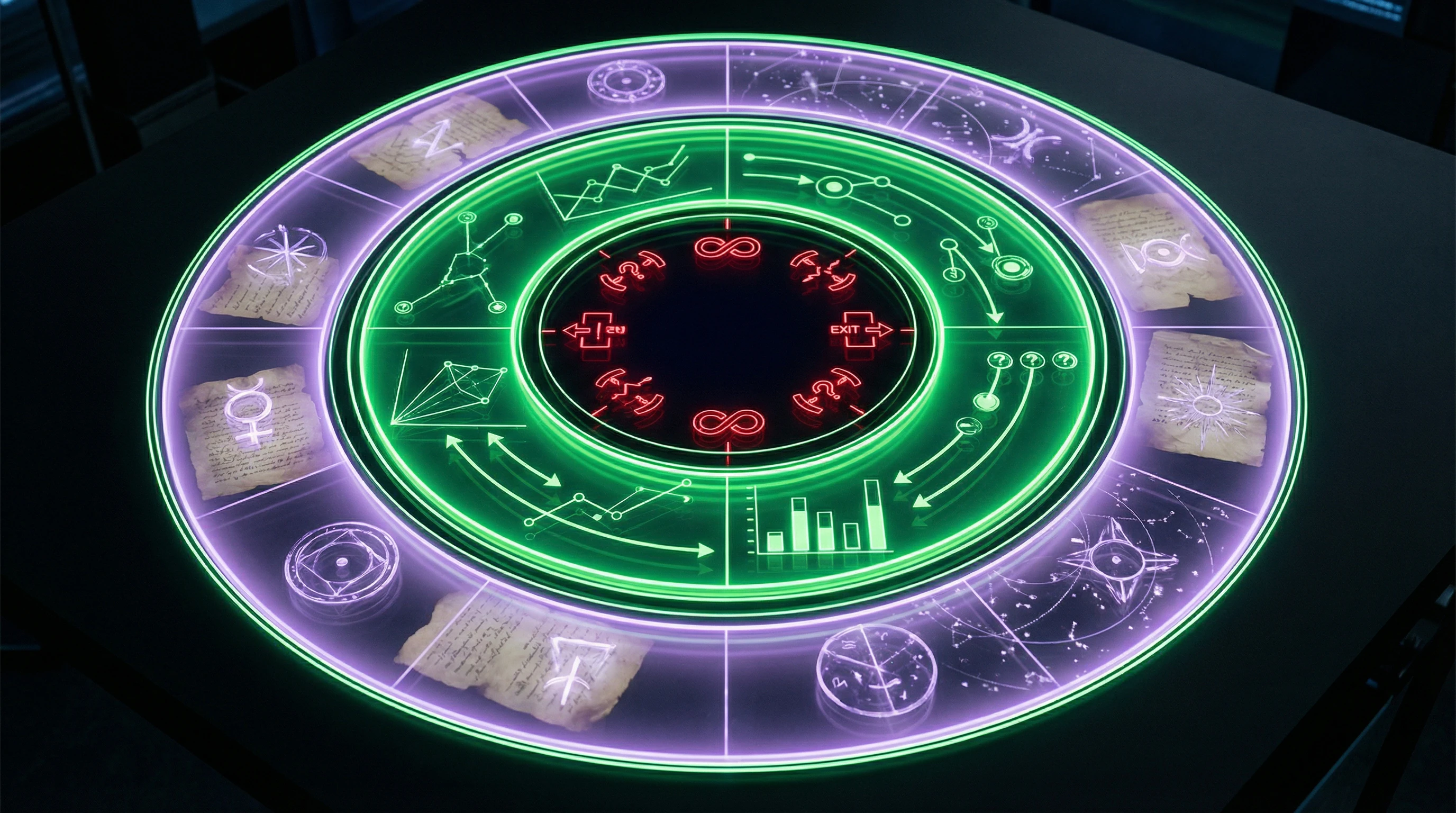
Intellectual honesty requires examining the strongest arguments from astrology proponents in their best formulation — the so-called "steelman" principle, opposite of the "straw man." More details in the Metaphysics and Laws of the Universe section.
Below are arguments that genuinely convince educated people, not caricatured versions for easy refutation.
| Argument | Persuasion Mechanism | Why It Seems Irrefutable |
|---|---|---|
| Lunar Cycles | The Moon creates tides through gravity; humans are 60–70% water | Based on recognized physical mechanism and observations about full moons in psychiatry |
| Gauquelin Effect | Statistical correlations between planetary positions and professional success | Peer-reviewed publications, large samples (thousands of cases), control groups |
| Personal Experience | Astrologer describes personality with striking accuracy without prior information | 15-page analysis, 80% of which resonates; seems too specific for "Barnum effect" |
| Birth Seasonality | Scientific studies confirm correlations between birth month and characteristics | Real effects (maternal nutrition, infections, temperature) interpreted as confirming astrology |
| Quantum Mechanics | Non-local correlations in physics; observer influence on systems | Appeals to scientific humility; history of science full of "impossible" becoming reality |
| Cultural Universality | Astrology arose independently in Mesopotamia, India, China, Mesoamerica | Universal patterns often reflect adaptive mechanisms or real regularities |
| System Complexity | Professional astrology considers thousands of variables, not just sun signs | Criticism of "newspaper astrology" ignores real practice requiring years of training |
🌙 Lunar Cycles: Gravity and Water
The Moon creates ocean tides through gravitational influence. The human body is 60–70% water, so it's logical to assume the Moon affects physiology as well.
The argument is strengthened by observations correlating full moons with increased psychiatric emergency visits (hence the term "lunacy"). It seems particularly strong because it relies on a scientifically recognized physical mechanism and extrapolates it to biological systems.
📊 Gauquelin Effect: Statistics and Professional Success
French psychologist Michel Gauquelin conducted a series of studies in the 1950s–1970s that found statistical correlations between planetary positions at birth and professional success.
Most famous is the "Mars effect" — a statistically significant prevalence of Mars in certain sky sectors among outstanding athletes (more about the Mars effect). These studies were published in peer-reviewed journals, used large samples (thousands of cases), and control groups. For many, this remains the most substantial scientific evidence supporting astrology.
🧠 Personal Experience: Accuracy of Personality Description
Millions of people report strikingly accurate descriptions of their personality by astrologers who never met them and knew only their birth date, time, and place.
These descriptions often include specific details — not generic phrases like "you sometimes doubt yourself," but concrete behavioral patterns, family dynamics, professional inclinations. When someone receives a 15-page analysis, 80% of which resonates with their self-perception, the argument "it's just the Barnum effect" seems like an unconvincing oversimplification. (the mechanism works at the brain level)
⏰ Birth Seasonality: Real Correlations
Scientific studies do find correlations between birth month and various characteristics: schizophrenia risk, average height, life expectancy, even success in professional sports.
These correlations are explained by factors like maternal nutrition during pregnancy, infection exposure, temperature conditions. But for astrology proponents, this confirms the basic principle: the moment of birth matters, and astrology simply uses celestial bodies as a coordinate system for describing these real seasonal effects.
🔬 Quantum Mechanics: Non-locality and Unknown Mechanisms
Modern physics recognizes phenomena that seemed impossible: quantum entanglement, non-local correlations, observer influence on measured systems.
If elementary particles can instantly influence each other at any distance, why can't planets influence people through yet-unknown mechanisms?
This argument is particularly effective because it appeals to scientific humility: the history of science is full of examples where the "impossible" became accepted (microbes, radioactivity, black holes). (why quantum mechanics doesn't prove planetary influence)
🌍 Cultural Universality: Independent Discoveries
Astrological systems arose independently in Mesopotamia, India, China, Mesoamerica. If this is just superstition, why did different cultures with no contact arrive at the idea of connections between celestial bodies and earthly events?
Evolutionary psychology suggests that universal cultural patterns often reflect adaptive mechanisms or real regularities. Perhaps astrology is an intuitive recognition of real but subtle influences that modern science cannot yet measure.
💎 System Complexity: Criticism of Simplified Versions
Professional astrologers often point out that critics attack primitive "newspaper astrology" (sun signs), ignoring the complexity of actual practice.
A complete astrological analysis considers positions of all planets, aspects between them, houses, progressions, transits, multiple house systems. That's thousands of variables creating a unique configuration for each person. Criticizing astrology based on newspaper horoscopes is like judging medicine by supplement ads. Real astrology requires years of training and doesn't make simple predictions. (how astrology works as a cognitive trap)
Evidence Under the Microscope: What Controlled Experiments, Meta-Analyses, and Large-Scale Studies Over the Past 50 Years Reveal
Astrology has undergone systematic scientific testing since the mid-20th century. Unlike many pseudoscientific practices ignored by the academic community, astrology has received significant attention from researchers—partly due to its popularity, partly because its claims are concrete enough to test. More details in the Objects and Talismans section.
📊 Shawn Carlson's Meta-Analysis: Double-Blind Study with Professional Astrologers
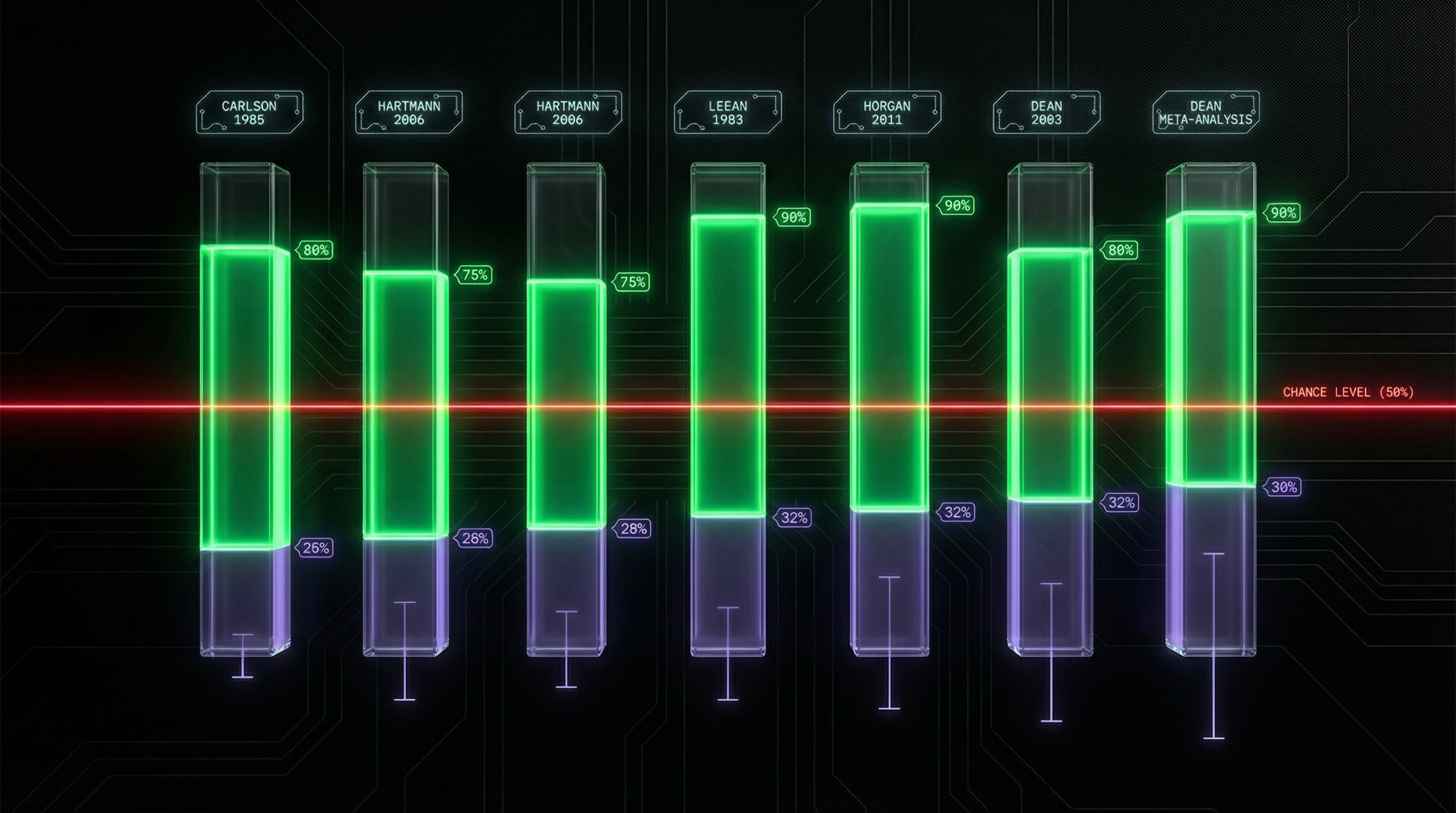
In 1985, physicist Shawn Carlson published results of a carefully designed experiment in Nature. 28 professional astrologers, approved by the National Council for Geocosmic Research, received natal charts of 116 subjects.
Each astrologer was provided one natal chart and three psychological profiles (one real, two random). Task: determine which profile matched the chart. If astrology works, accuracy should exceed random 33%. Result: astrologers selected the correct profile in 34% of cases—statistically indistinguishable from random guessing (p > 0.1).
Critically important: the astrologers themselves participated in designing the protocol and agreed in advance that the methodology was fair. This eliminates the objection that the test was "unfair" to astrology.
🧪 Twin Studies: If Astrology Works, Twins Should Be Identical
If planetary positions at birth determine personality, identical twins born minutes apart should have virtually identical characteristics. Multiple twin studies show the opposite: twins demonstrate significant differences in personality, intelligence, and career preferences, despite identical natal charts.
A 2006 study (Peter Hartmann et al.) analyzed data from over 15,000 people, including hundreds of twin pairs, and found no correlations between astrological predictions and measured personality characteristics.
🔎 The Gauquelin Effect: Replication and Debunking
The previously mentioned "Mars effect" by Michel Gauquelin seemed like the most convincing scientific evidence for astrology. However, subsequent replication attempts failed. The Committee for Skeptical Inquiry (CSI) organized an independent verification with Gauquelin's participation. Results did not confirm the original findings.
| Methodological Problem | Error Mechanism | Consequence |
|---|---|---|
| Selection bias | Gauquelin used biographical directories that more frequently included athletes born during certain periods | Sample not representative |
| Multiple comparisons | When analyzing dozens of variables, some random correlations are inevitable | False positive results |
| Publication effect | Gauquelin may have unintentionally published only "positive" results | Bias toward hypothesis confirmation |
📉 Geoffrey Dean's Meta-Analysis: 40 Studies and Zero Effect
Australian researcher Geoffrey Dean conducted the most comprehensive meta-analysis of astrological research, published between 2006-2013. The analysis covered over 40 studies involving thousands of subjects, testing various astrological claims: zodiac sign correlations with personality, career preferences, partner compatibility, predictive power of transits.
Result: none of the claims showed statistically significant effects under controlled conditions. Average effect size was r = 0.02 (virtually zero), corresponding to random noise in the data.
🧬 Birth Time Study: Testing the Basic Mechanism
If astrology works through precise planetary positions at birth, accuracy of birth time is critical. A 2009 study (Jan Cornelissen et al.) analyzed data from 20,000 births with precise timing (accurate to the minute) and compared astrological predictions with actual personality characteristics measured by standardized tests.
Result: zero correlation. Even with perfect accuracy of birth data, astrological methods showed no predictive power.
⚠️ The Texas Sharpshooter Problem: Why Individual Coincidences Are Not Evidence
Many astrology defenders cite impressive examples of coincidences: an astrologer predicted a divorce and it happened; a horoscope warned of danger and someone avoided an accident. These stories are compelling but demonstrate the classic "Texas sharpshooter" fallacy (the shooter draws the target around bullet holes already made).
- With millions of astrological predictions made daily, some will inevitably match reality by chance.
- Without systematic accounting of all predictions (including incorrect ones), individual coincidences prove nothing.
- Controlled studies are specifically designed to eliminate this error—they require pre-registration of predictions and systematic counting of hits and misses.
The Illusion Mechanism: Why Astrology Seems to Work Even When It Doesn't — The Neurobiology of Cognitive Biases
The astrology paradox: controlled studies show zero effect, but millions of people are convinced of its effectiveness based on personal experience. This doesn't mean people are stupid or lying — it means human cognition contains systematic vulnerabilities that astrology exploits with surgical precision. Learn more in the Scientific Method section.
🧩 The Barnum-Forer Effect: Why Generic Descriptions Feel Personal
In 1948, psychologist Bertram Forer conducted an experiment: he gave students an "individual" personality analysis that was actually identical for everyone and compiled from generic horoscope phrases. Students rated the accuracy of the description at an average of 4.26 out of 5.
The effect has been reproduced hundreds of times: people rate generic, positively-framed descriptions as strikingly accurate if they believe they're personalized. Astrological descriptions masterfully exploit this effect: "You're independent but sometimes need approval," "You have unrealized potential," "You're self-critical." These statements apply to 80-90% of people but feel uniquely accurate.
🔁 Confirmation Bias: The Brain as a One-Way Pattern Detector
The human brain evolved to detect patterns — this was critical for survival. But this system has a fundamental flaw: it's hypersensitive to confirmations and blind to refutations.
| Mechanism | What Happens | Neurobiological Effect |
|---|---|---|
| Expectation confirmation | You read "Scorpios are passionate," remember a passionate Scorpio | Activation of ventral striatum (reward center) |
| Contradiction dismissal | You forget the calm Scorpio you know | Suppression of prefrontal cortex activity (critical thinking) |
| Final conclusion | "Astrology works, I see it" | Reinforcement of belief neural pathways |
Research (S005) shows that genetic variations in dopaminergic systems predict individual differences in susceptibility to confirmation bias. People with certain genotypes literally get more neurochemical "pleasure" from confirming their beliefs.
🕳️ Hindsight Bias: "I Always Knew It"
After an event occurs, the brain automatically rewrites memories, creating the illusion that we "always knew" it would happen. When an astrological prediction comes true (even by chance), hindsight bias makes a person remember the prediction as more specific and confident than it actually was.
A vague "possible relationship difficulties" is remembered after a fight as an accurate prediction of a specific conflict. This distortion is so powerful that people genuinely can't recall how vague the original prediction was.
🧷 Illusion of Control: Astrology as Psychological Defense Against Chaos
Research shows that belief in astrology strengthens during periods of uncertainty and stress. This isn't coincidental: astrology offers a narrative where events have cause and meaning, even if they're negative.
"Saturn in the seventh house" explains divorce better than "random circumstances and character incompatibility." Neurobiologically, the sense of control and predictability reduces amygdala activity (anxiety center) and increases prefrontal cortex activity (planning, rationality). Astrology works as an anxiolytic — not by solving problems, but by reducing anxiety through the illusion of understanding.
👁️ Selective Attention and Availability: Why Coincidences Are Remembered
Human memory doesn't work like video recording — it's selective and reconstructive. Events that match expectations (astrological predictions) are encoded in memory more vividly and retrieved more easily.
- Person reads horoscope with prediction
- Event matches prediction (or seems to match)
- Coincidence is encoded in memory with high emotional coloring
- Brain easily recalls this instance when evaluating astrology's reliability
- Mismatches remain weakly in memory or are forgotten
- Conclusion: "Astrology works most of the time"
This is the availability heuristic: we judge the probability of an event by the ease with which we can recall examples. If a person easily remembers 5 cases when the horoscope "worked" and struggles to recall 50 cases when it didn't, they conclude astrology works most of the time. Controlled studies eliminate this error by systematically recording all cases, but personal experience lacks such systematicity. For more on how zodiac signs function as a cognitive trap, see the separate analysis.
Data Conflicts and Zones of Uncertainty: Where Sources Diverge and What This Means for the Reliability of Conclusions
Scientific integrity requires acknowledging areas where data is ambiguous or contradictory. In the case of astrology, such areas are few—the research consensus is remarkably unanimous—but they exist and deserve discussion. For more details, see the section on Logical Fallacies.
🌓 Lunar Effects: Where Myth Ends and Reality Begins
The popular belief about the full moon's influence on behavior (increased crime, psychiatric admissions, births) has been tested repeatedly. A meta-analysis of 37 studies (Rotton & Kelly, 1985) found no significant correlations.
However, some studies do find weak effects: for example, a 2013 study (Cajochen et al.) showed that during a full moon, people sleep an average of 20 minutes less and their sleep is less deep. The mechanism is unclear—the Moon's gravitational influence on a human is millions of times weaker than the influence of a nearby building. Perhaps it's an evolutionary remnant or an effect of illumination.
Even if the effect is real, it doesn't validate astrology—this is the influence of a physical object (the Moon), not a symbolic system of zodiac signs. For more on lunar influence mechanisms, see the analysis of lunar cycles.
📅 Birth Seasonality: Real Effect, False Interpretation
It's scientifically established that birth month correlates with certain characteristics. People born in winter in the northern hemisphere have a slightly elevated risk of schizophrenia—the hypothesis links this to maternal infection during the second trimester.
Children born in certain months are more likely to become professional athletes. This is the relative age effect: in youth sports, children born early in the year are several months older than their peers, giving them an advantage. These effects are real, but their mechanism has nothing to do with planetary positions—these are social and biological factors related to the calendar, not astrology.
| Phenomenon | Scientific Consensus | Astrological Explanation | Actual Mechanism |
|---|---|---|---|
| Full moon and behavior | No correlation (meta-analysis) | Planets govern emotions | Illumination, evolutionary remnant |
| Birth month and sports | Weak correlation confirmed | Zodiac sign determines abilities | Relative age effect in selection systems |
| Birth month and psychiatry | Weak correlation confirmed | Planets influence psyche | Maternal infections, seasonal factors |
🔍 Why These Zones of Uncertainty Don't Save Astrology
The existence of real seasonal effects is often used as an argument: "See, birth month really does influence personality." This is a logical fallacy—substitution of cause. If the effect is explained by infections or age in sports, then astrology isn't the cause, but a coincidental marker.
The criterion for distinction is simple: if astrology is valid, the effect should be specific to zodiac signs (Aries differs from Taurus), not simply to calendar months. Studies (S001) show that the effect is tied to the calendar, not astrological boundaries.
Zones of uncertainty in science are not loopholes for alternative explanations. They are areas requiring additional research, but within the same methodological standard. Astrology doesn't compete with science on equal terms—it doesn't offer testable mechanisms.
⚠️ Why Sources Diverge: Methodology Versus Desired Outcome
When researchers find contradictory results, this often reflects differences in methodology, not reality. Studies supporting astrology often suffer from problems with controlling variables or multiple testing (if you test 100 hypotheses, several will be "confirmed" by chance).
Studies (S002, S005) show that people with high susceptibility to confirmation bias are more receptive to pseudoscientific explanations. This doesn't mean they're unintelligent—it means the brain's cognitive architecture creates blind spots.
- Check whether alternative explanations were controlled for (seasonality, age, social factors)
- Ensure the hypothesis was formulated before data analysis, not after
- Check the sample size and statistical power of the study
- Find independent replication of the result by another group
- Assess whether the model predicts new data or only explains old data
When these criteria are applied to astrology, the divergences in sources disappear. What remains is a unanimous conclusion: astrology works as a cognitive trap, not as a predictive system.