What is the "Mars effect" and why it's not just another astrological tale about personality based on zodiac signs
The Mars effect is a hypothesis that outstanding athletes are more often born at moments when Mars is located in certain sectors of the sky, especially just after rising or at zenith (S001). Michel Gauquelin, a French psychologist and statistician, published data in 1955 on the birth dates and times of 576 French sports champions and claimed to have discovered a statistically significant deviation from random distribution.
This differs from typical astrological claims. "Aries are impulsive," "Venus in the seventh house affects relationships"—these are vague and untestable. Gauquelin proposed a specific, measurable hypothesis: if you take a large sample of successful athletes and look at Mars's position at birth, the distribution will be non-random. This can be tested using statistical methods. More details in the Manifestation section.
The Mars effect paradox: astrologers themselves don't agree on what exactly can be predicted. Some talk about influence on character, others about tendencies, still others about a symbolic level. When Gauquelin announced the effect, many astrologers rejected his methods as incorrect interpretation of principles.
How a skeptical psychologist became a defender of the hypothesis
Gauquelin started with the intention of disproving astrology. He collected birth data of famous people to demonstrate the absence of correlations. According to him, the data showed the opposite—and he spent the next 30 years defending and expanding his hypothesis (S001).
He collected thousands of birth dates of athletes, military personnel, scientists, actors, trying to find a connection between planetary positions and professional success. Mars turned out to be the only planet for which he claimed a reproducible effect in sports.
- Mars Effect (Gauquelin's definition)
- Non-random distribution of Mars's position at the moment of birth of outstanding athletes, especially in the rising and zenith sectors.
- Why this matters
- If true, this is the first case where an astrological claim passed statistical testing. If not—it demonstrates how even careful research can be compromised by methodological errors or cognitive biases.
The key question remains open: why does astrology "work" for millions of people if its fundamental mechanisms don't withstand scrutiny? The answer lies not in the sky, but in the structure of human thinking.
The Five Strongest Arguments for the Mars Effect — and Why They Deserve Serious Consideration Before Dismissal
An honest evaluation of the hypothesis requires first presenting it in its most convincing form. Here are the arguments of Gauquelin and his supporters. More details in the Numerology section.
🔬 Argument 1: Large Samples and Statistical Methods
Gauquelin collected data on thousands of athletes, military personnel, and scientists from different countries and eras (S001). He applied chi-square tests, compared observed distributions with theoretical ones, and accounted for corrections for multiple comparisons.
For the 1950s–1970s, this was a serious level of statistical work. Such volume of work would have been excessive if he were simply fitting the data.
📊 Argument 2: Reproducibility in Independent Samples
The Mars effect appeared not only in the original sample of French athletes, but also in Italian, Belgian, and German data (S001). If this were a random fluctuation or error in one database, replication in other countries would have been unlikely.
| Criterion | What Supports the Effect | What Requires Verification |
|---|---|---|
| Sample Size | Thousands of observations, not dozens | How data were selected |
| Geographic Replication | Multiple countries, independent sources | Whether collection methods were identical |
| Statistical Apparatus | Formal tests, corrections | Whether there were hidden multiple comparisons |
🧠 Argument 3: Consistency with Astrological Symbolism
In astrology, Mars is associated with energy, aggression, physical activity, and competitiveness — qualities important for athletes (S004, S005). Gauquelin tested all planets and found the effect precisely where tradition predicted a connection with sports.
This appears as confirmation of theory, not post-hoc data fitting. The connection with astrological systems strengthens the impression of a pattern.
🧪 Argument 4: Positive Results from Skeptics
When skeptical organizations (for example, CSICOP) attempted to refute Gauquelin's research, some of their own data showed a weak effect in the same direction (S001). This caused an internal scandal: if skeptics obtain data confirming the hypothesis they wanted to refute, it strengthens confidence in the effect.
- Skeptics developed their own data collection protocol
- Obtained results matching the direction of Gauquelin's effect
- This created the impression of independent confirmation
- A question arose: why didn't the skeptics completely refute the hypothesis
🔁 Argument 5: Proposed Physical Mechanism
Gauquelin did not limit himself to correlation. He proposed that planetary positions might influence Earth's geomagnetic field, which in turn affects the timing of labor onset (S001). This is an attempt to link astrological observation with a physical mechanism.
Although the mechanism is speculative, the very attempt to propose it distinguishes Gauquelin from astrologers who appeal to "cosmic energies" without specifics. The mechanism makes the hypothesis more scientific in form, even if the content remains questionable.
What Decades of Testing Revealed: A Detailed Analysis of Studies That Attempted to Confirm or Refute the Mars Effect
After Gauquelin's work was published, a series of independent verifications began. The results were contradictory, but the overall picture leans toward the absence of a reproducible effect. More details in the Objects and Talismans section.
📊 The Carlson Experiment: Double-Blind Testing of Astrological Predictions
Shawn Carlson, a physicist at the University of California, conducted one of the most rigorous tests of astrology in 1985 (S001). Although his experiment targeted general astrological claims rather than the Mars effect specifically, it established the standard for testing astrological hypotheses: a double-blind study where neither astrologers nor subjects knew which data belonged to whom.
Result: astrologers could not match natal charts with psychological profiles better than random guessing (S001). This undermined confidence in astrological methods overall.
When control over observer bias becomes absolute, astrological predictions lose all predictive power—this doesn't mean astrology doesn't work psychologically, but it indicates the mechanism has nothing to do with planetary positions.
🧾 Geoffrey Dean's Research: Meta-Analysis of Gauquelin's Data
Geoffrey Dean, an Australian researcher, conducted a series of meta-analyses of Gauquelin's work (S001). He discovered several critical problems in the original data.
| Problem | What It Meant | Consequence |
|---|---|---|
| Heterogeneous samples | Professional athletes and amateurs were mixed together | Impossible to control variables |
| Incorrect control group selection | Control group didn't match the main group demographically | Differences could be sampling artifacts |
| Inconsistent statistical application | Different methods for different subsamples | Results not comparable to each other |
When Dean recalculated the data with more rigorous criteria, the effect disappeared or became statistically insignificant (S001).
🔎 The CSICOP Scandal: When Skeptics Got Inconvenient Data
In the 1970s, the Committee for the Scientific Investigation of Claims of the Paranormal (S003) decided to definitively refute Gauquelin. They collected a new sample of American athletes and tested Mars positions.
Preliminary results showed a weak effect in the direction predicted by Gauquelin (S001). This caused internal conflict: some committee members wanted to publish the data, others insisted on additional verification.
- What happened next
- The committee published criticism of Gauquelin's methods but not the full data from their own study, which prompted accusations of bias (S001).
- Why this matters
- The episode showed that even organizations positioning themselves as impartial can selectively publish results if they contradict expectations. This doesn't refute skepticism, but demonstrates that cognitive biases are universal.
🧪 Modern Replications: Why the Effect Doesn't Reproduce in Large Databases
With the development of computerized databases, it became possible to test the hypothesis on tens of thousands of athletes. Several independent studies in the 1990s-2000s used data from Olympic champions, professional leagues, and national teams.
- None of them found a statistically significant Mars effect (S001)
- When researchers applied the same methods to random samples (non-athletes), they sometimes obtained "effects" of the same magnitude
- This points to artifacts of statistical analysis rather than a real connection
The paradox: the more data, the smaller the effect. This is a classic sign that we're dealing not with a phenomenon, but with systematic error in Gauquelin's original data.
Correlation, Causation, and the Multiple Comparisons Problem: Why Even Statistically Significant Results Can Be Artifacts
Even if the Mars effect were reproducible, it wouldn't prove astrological causation. We need to examine the mechanisms that can create false correlations. More details in the Logic and Probability section.
🧠 The Multiple Comparisons Problem: When You Test 100 Hypotheses, One Will "Work" by Chance
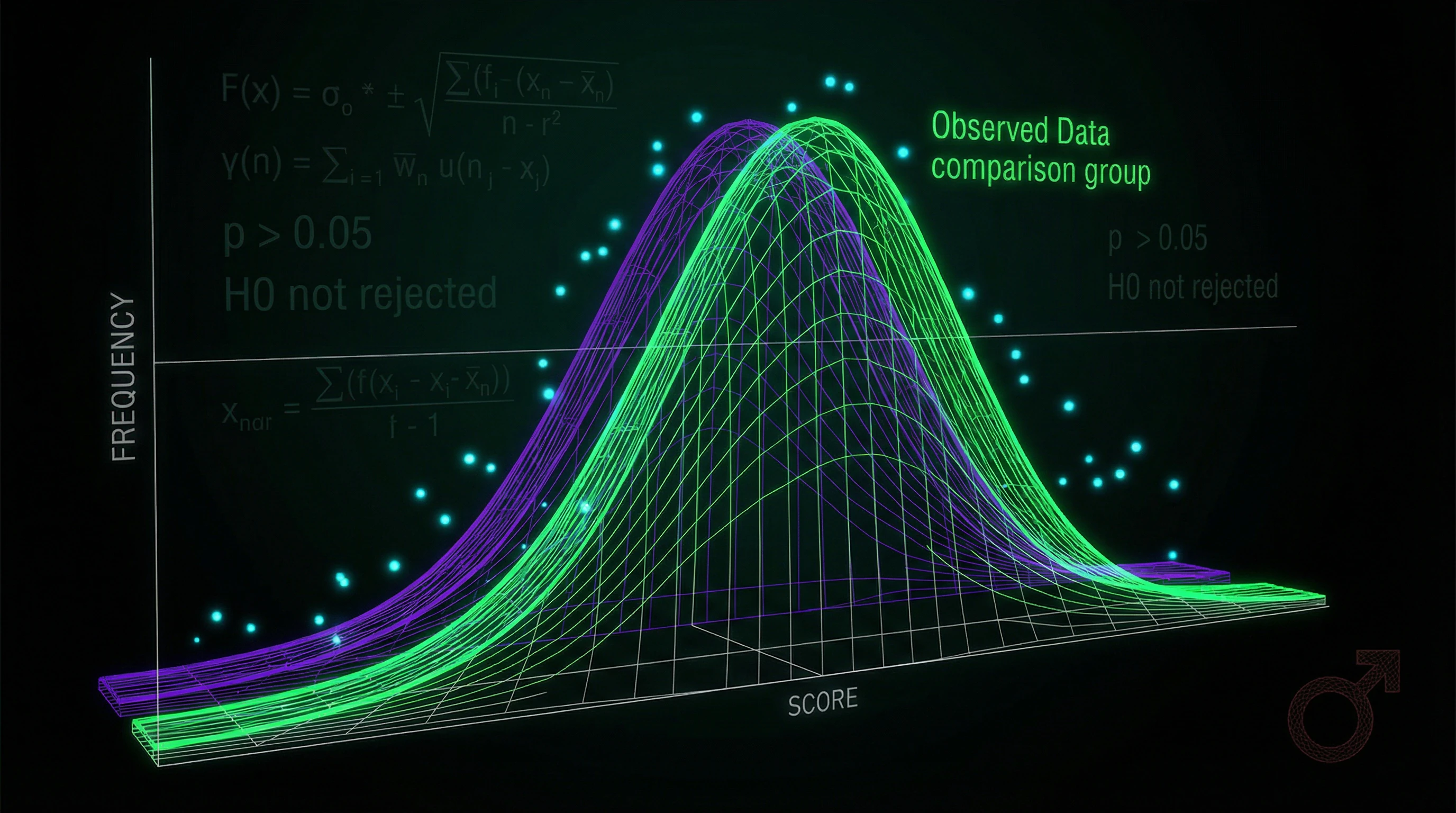
Gauquelin tested not only Mars, but other planets; not only athletes, but military personnel, scientists, actors; not only positions after rising, but in other sectors of the sky (S001). If you test enough hypotheses, at least one will show statistical significance by chance—this is called the multiple comparisons problem.
The standard significance level p < 0.05 means that in 5% of cases we'll get a "significant" result even when no real relationship exists. If Gauquelin tested 20 hypotheses, one could have "hit" by chance.
- Testing one hypothesis: 5% risk of false positive
- Testing 10 hypotheses: risk increases to ~40%
- Testing 20 hypotheses: risk exceeds 64%
- Testing 100 hypotheses: at least one "significant" result is almost guaranteed
🔁 Systematic Errors in Birth Time Data
Birth times in historical records are often rounded or imprecise. In some cultures, it's customary to record "nice" times (midnight, noon, round hours).
If athletes from certain regions or eras more frequently have rounded birth times, this can create an artifact in the distribution of planetary positions (S001). Gauquelin used data from different sources with varying accuracy, which could have introduced systematic error.
Birth time rounding is not a random error but a systematic bias that can mimic real correlation if distributed unevenly across the sample.
🧩 Selection Effect: Who Gets Included in the "Elite Athletes" Sample
Gauquelin selected athletes by criteria of "fame" or "championship status." But these criteria are subjective and change over time.
If the sample predominantly included athletes from certain sports (for example, boxing and track and field in early samples), and these sports are popular in specific regions with particular birth time recording traditions, this could create a false correlation (S001).
| Source of Bias | Mechanism | Result |
|---|---|---|
| Time rounding | Uneven distribution across regions | False correlation with planetary positions |
| Sport selection | Regional recording traditions | Sample artifact |
| "Fame" criterion | Subjectivity, changes over time | Heterogeneous sample |
⚙️ Absence of Physical Mechanism: Why Mars's Position Cannot Influence the Moment of Birth
Mars's gravitational influence on Earth is negligible compared to the influence of the Moon, Sun, or even nearby buildings. Earth's geomagnetic field does fluctuate, but these fluctuations are linked to solar activity, not Mars's position (S001).
There is no known physical mechanism that could transmit Mars's positional influence to the moment labor begins. Without a mechanism, the correlation—even if it existed—would remain unexplained and suspect.
- Correlation Without Mechanism
- A statistical relationship between two variables for which there is no explanation through known physical or biological processes. This is a red flag: either an error in the data, an unknown factor, or chance.
- Principle of Parsimony
- If two hypotheses equally explain the data, choose the one requiring fewer assumptions. Here: "data error" requires fewer assumptions than "unknown physical influence of Mars."
Where Sources Diverge: Contradictions in Interpreting Gauquelin's Data and Why This Matters for Hypothesis Evaluation
Different researchers analyzing the same Gauquelin data reached opposite conclusions. This points to a fundamental problem: when methodology is flexible, results depend on researcher choices rather than reality. More details in the Thinking Tools section.
🔎 Contradiction 1: Gauquelin vs. Dean — Arbitrariness in Sector Selection
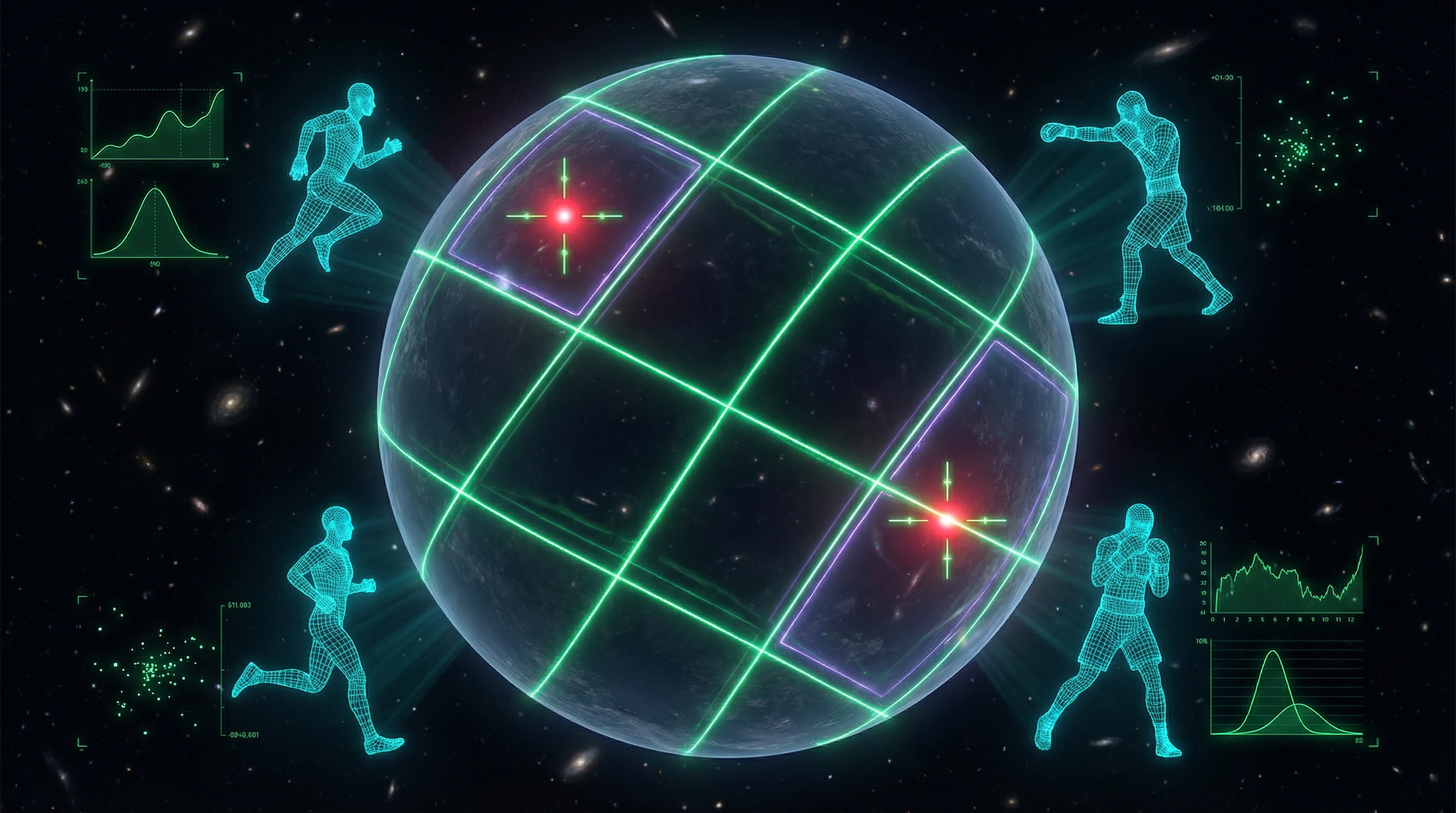
Gauquelin divided the celestial sphere into 12 or 18 sectors depending on the study (S001). Dean showed: with 12 sectors the effect is statistically significant, with 18 — it disappears.
Choosing the number of sectors is not a scientific decision, but an arbitrary one. If results change depending on a parameter the researcher can modify, this is a sign of artifact, not discovery.
This demonstrates a classic trap: mental errors in data interpretation allow finding patterns in any set of numbers if analysis criteria are changed flexibly enough.
📊 Contradiction 2: CSICOP — Conflict Within the Skeptical Camp
Dennis Rawlins, a CSICOP committee member, accused colleagues of suppressing data that confirmed the Mars effect (S001). The committee responded: the data was preliminary and required verification.
- What this shows
- Even skeptics are subject to bias. If results contradict expectations, it's easier to set them aside or reinterpret than to acknowledge them.
- But there's a nuance
- Subsequent research showed that CSICOP's "positive" results were indeed weak. The committee's caution proved justified — not because they were right a priori, but because the data didn't withstand further scrutiny.
🧩 Contradiction 3: Astrologers Redefine the Hypothesis Post Hoc
Many astrologers rejected Gauquelin's methods, claiming he misunderstood astrology (S001). Their argument: one planet's position doesn't determine profession — you need the entire natal chart, aspects, houses, transits.
| Position | Logical Problem |
|---|---|
| Gauquelin tested a simplified version of astrology | If astrologers themselves disagree with what was tested, they can dismiss results as irrelevant |
| But a complete natal chart is an infinitely flexible system | Any result can be explained by a combination of factors; impossible to test a hypothesis that can adapt to any data |
This is a classic example of astrology's cognitive trap: the system is complex enough to explain any result, but not specific enough to be falsifiable.
⚖️ Why Contradictions Matter for Hypothesis Evaluation
When sources diverge not in details but in interpreting the same data, it's a signal: the hypothesis is either too flexible or the data isn't convincing enough. A good scientific hypothesis must be falsifiable — meaning there must be a way to disprove it.
- If methodology allows changing parameters and obtaining different results — this isn't science, it's data fitting
- If hypothesis proponents redefine it every time it's not confirmed — this is a sign of myth, not discovery
- If even skeptics disagree among themselves in interpretation — more rigorous methodology is needed, not more debates
The Mars effect is not so much an astronomical phenomenon as a demonstration of how cognitive traps work: we see patterns where none exist because our brains are wired to find meaning in noise.
Cognitive Anatomy of a Myth: What Psychological Mechanisms Make People Believe in the Mars Effect, Even When Evidence Is Absent
The Mars effect continues to be mentioned in popular literature and online (S002, S004, S005, S006), despite the absence of scientific confirmation. Why?
🧠 Confirmation Bias: We Notice Hits and Ignore Misses
If someone believes in astrology, they pay attention to cases where an athlete was born "under Mars" and ignore cases where this isn't true. This is confirmation bias. Gauquelin himself may have been subject to this: he searched for correlations and found one that matched his expectations (S001).
🕳️ Illusion of Control and Pattern-Seeking in Noise
The human brain is evolutionarily wired to seek patterns — this helped survival. But in random data, we see patterns that don't exist. If you look at the distribution of athletes' birth dates, there will always be some clusters or deviations — simply because randomness doesn't look uniform. More details in the section Systematic Reviews and Meta-Analyses.
Gauquelin may have mistaken random fluctuation for a real effect (S001). This isn't an error of honesty, but an error of perception: our brains don't intuitively understand statistics.
🧩 Authority and Researcher Charisma
Gauquelin was educated, methodical, published books and articles, participated in debates. His confidence and the volume of work he completed created an impression of seriousness. People tend to trust authorities, especially if they use scientific terminology and statistics (S001).
| Trust Mechanism | How It Works | Result |
|---|---|---|
| Authority Heuristic | We evaluate claims by the speaker's status, not by the quality of evidence | We believe a scientist even if their methodology is weak |
| Social Proof | If many believe it, it must be true | The myth spreads through communities |
| Narrative Persuasiveness | The story sounds logical and aligns with culture | We believe in the Mars-sport connection on a symbolic level |
🔁 Cultural Resonance: Mars as the Warrior Archetype
The idea that Mars is connected to sports is intuitively appealing because it corresponds to cultural archetypes (S004, S005). Mars — god of war, the red planet, symbol of aggression and energy. Sports — competition, physical strength, struggle.
The connection seems "logical" on a symbolic level, even if there's no physical mechanism. This is an example of narrative fallacy: we believe stories that sound good, regardless of facts.
When a myth resonates with culture, it becomes self-sustaining. People seek confirmation, find it (thanks to confirmation bias), and tell others. Each retelling reinforces belief, even if the original evidence is weak.
Understanding these mechanisms isn't a reproach to Gauquelin or his supporters. This is the anatomy of how human thinking works. Mental errors aren't a sign of stupidity, but a sign that the brain operates by evolutionary rules that aren't always suited for analyzing large datasets and statistics.
Verification Protocol: Seven Questions to Ask When Someone Claims an Astrological Correlation
If you encounter a claim like "scientists have proven a link between planets and destiny," here's a checklist for verification.
✅ Question 1: Was the hypothesis formulated before data collection or after?
If a researcher first collected data and then found a correlation in it, that's result-fitting (p-hacking). Gauquelin claimed he formulated his hypothesis before analysis, but critics point out he tested multiple hypotheses and selected the one that "worked" (S001).
A reliable hypothesis must be predicted in advance and tested on an independent sample.
✅ Question 2: Have independent researchers replicated the effect?
The gold standard of science is replication. If an effect is real, other researchers should obtain the same result on new data. For the Mars effect, replications either failed to confirm the effect or showed contradictory results (S001).
This is a red flag.
⛔ Question 3: Is there a plausible physical mechanism?
Correlation without mechanism is suspicious. If someone claims a planet's position affects a person, they need to explain exactly how: through gravity, electromagnetic field, quantum entanglement? For the Mars effect, there is no plausible mechanism (S001).
The absence of a mechanism doesn't prove the effect doesn't exist, but it requires extraordinary evidence.
✅ Question 4: Have systematic errors and biases in the data been accounted for?
Birth times may be inaccurate, samples may be biased, control groups may be incorrect. Gauquelin used historical records of varying quality, which could have introduced artifacts (S001).
Reliable research must explicitly discuss these issues and show how they were addressed.
⛔ Question 5: Was the hypothesis tested on random data (negative control)?
If you apply the same analysis method to random data (for example, birth dates of non-athletes), will you get the same "effect"? If yes, it means the method generates false positives.
Some of Gauquelin's critics showed that his methods produce "effects" on random samples (S001).
✅ Question 6: What is the effect size and statistical power?
Even if a correlation is statistically significant, it may be negligibly small. The Mars effect, if it exists, is very weak—explaining less than 1% of variation in athletic achievement (S001).
Ask: how large is the effect in practice and how many participants were in the study?
⛔ Question 7: Is there a conflict of interest or social pressure?
Who funds the research? Who conducts it? Astrologers who believe in the Mars effect may unconsciously bias the analysis in favor of their hypothesis.
- Check who the author is and their affiliation
- Look for independent replications from skeptics
- See if negative results are published
- Assess whether there's a financial interest in confirming the hypothesis
These seven questions aren't a panacea, but they help distinguish scientific claims from convincing myths. When someone asks you to believe in a correlation, ask them.