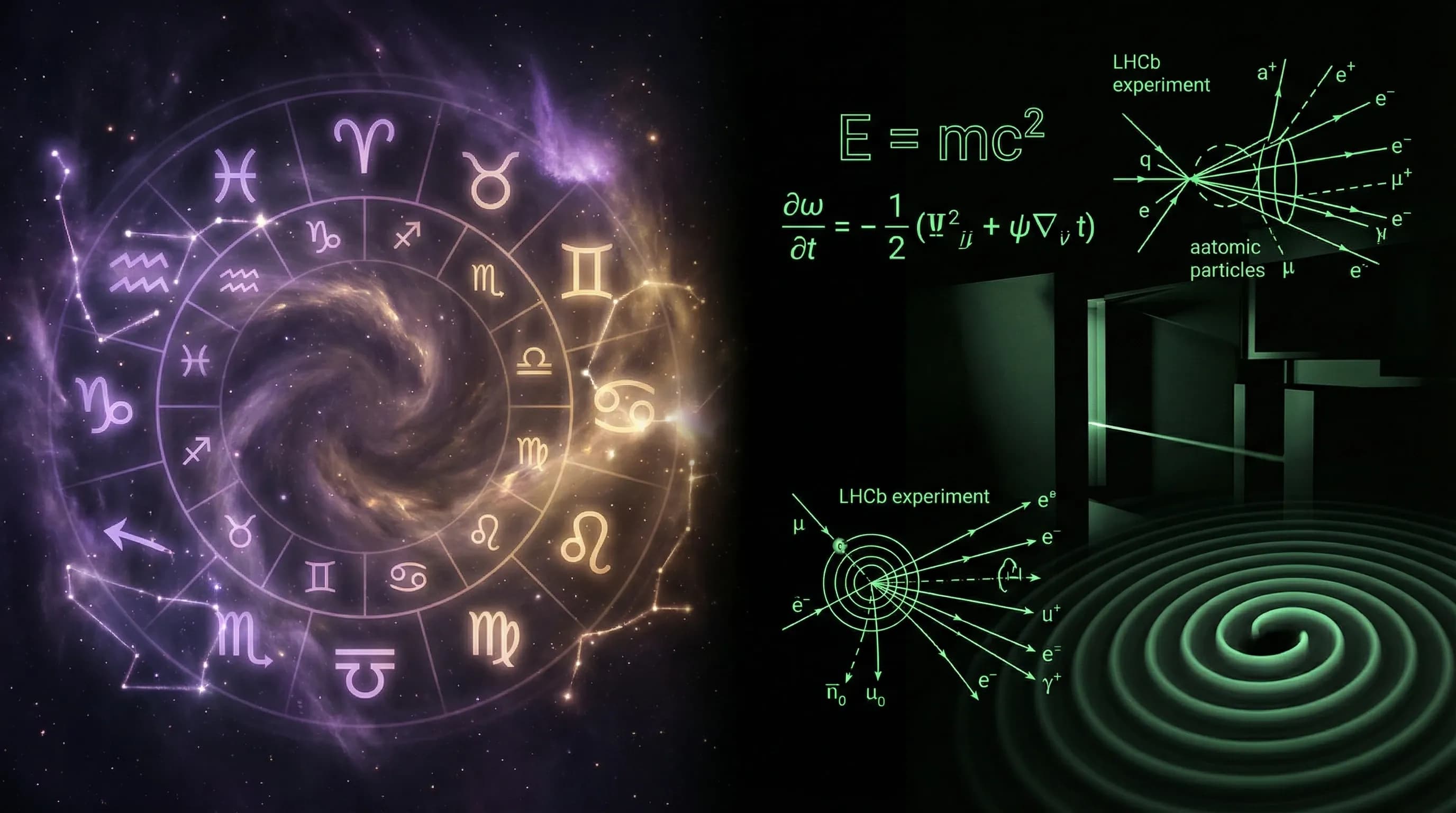
What exactly "scientific astrology" claims — and where the boundary lies between hypothesis and fantasy
Modern astrology rarely appeals to mysticism directly. Instead, it borrows terms from physics: "gravitational fields of planets influence brain biochemistry," "quantum entanglement connects a person to the cosmos at the moment of birth," "electromagnetic radiation from celestial bodies modulates neural activity." More details in the section Objects and Talismans.
These claims sound like scientific hypotheses. But are they actually testable?
- Correlational level
- "People born under sign X more often possess trait Y." Tested by statistics on large samples and requires control of confounders (age, culture, social class).
- Mechanistic level
- "Planet Z affects process W through physical field V." Requires measurement of field strength, demonstration of causal connection, and exclusion of alternative explanations.
- Predictive level
- "Planetary configuration at moment T will predict event E with above-chance accuracy." Tested by blind experiments with pre-established success criteria.
Using the word "quantum" doesn't transform an idea into quantum mechanics. Quantum theory is a mathematical apparatus describing the behavior of systems at atomic and elementary particle scales, with specific predictions testable in particle accelerators (S002, S004).
When an astrologer speaks of a "quantum connection" between a person and Mars, they must present: (1) a quantum system, (2) an interaction Hamiltonian, (3) a decoherence mechanism, (4) an experimental setup for verification. None of these elements exist in astrological literature.
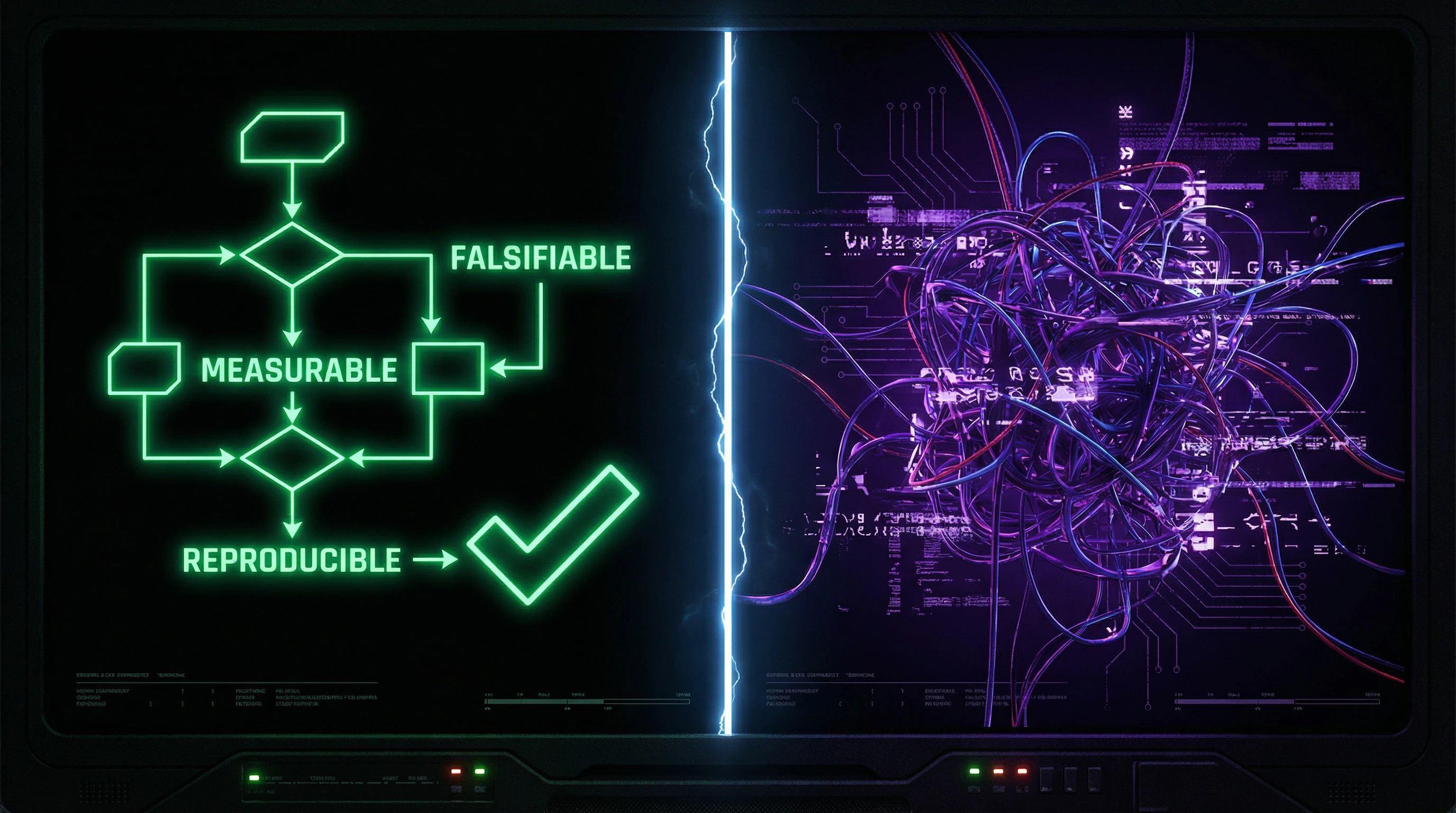
A scientific hypothesis must be falsifiable: one must specify in advance what experimental result would refute it. Astrology systematically avoids this criterion.
When a prediction fails, additional variables are introduced ("influence of other planets," "free will," "karmic factors"). This makes the theory unfalsifiable — and therefore unscientific by Popper's criterion.
| Feature | Scientific hypothesis | Astrological claim |
|---|---|---|
| Falsifiability | Refutation conditions specified in advance | Conditions constantly revised |
| Mechanism of action | Mathematically described and testable | Metaphorically described or not described |
| Variable control | Confounders excluded | Confounders not accounted for |
| Reproducibility | Results independently reproduced | Results depend on interpreter |
Interest in astrology as a cognitive trap is growing precisely because it uses the language of science without following its methods. This creates an illusion of scientificity that is especially convincing for people without specialized training.
Seven Strongest Arguments for Physical Planetary Influence — and Why They Require Verification
Before refuting, it's necessary to formulate the most convincing version of the opposing position. This is called "steelmanning" — the opposite of a strawman. Below are the most physically grounded arguments used by astrology proponents. More details in the Manifestation section.
🌍 Argument 1: Gravitational Effects of Planets on Body Fluids
The Moon causes ocean tides, humans are 60–70% water — therefore, planets can influence the distribution of fluids in the body, including blood and lymph. This argument appeals to a real physical phenomenon (tidal forces) and extrapolates it to biological objects.
The problem is scale: tidal force is proportional to an object's mass and inversely proportional to the cube of distance. Calculations show that the Moon's gravitational effect on a human is billions of times weaker than the effect of surrounding objects.
⚡ Argument 2: Electromagnetic Radiation from Planets and the Sun
Solar flares affect Earth's magnetosphere, causing geomagnetic storms that correlate with increased cardiovascular events. If the Sun has influence, why couldn't other celestial bodies?
This argument is partially correct: the Sun is indeed a source of powerful electromagnetic radiation. However, planets don't emit their own light (except reflected sunlight), and their magnetic fields don't reach Earth in measurable quantities. Jupiter, which has the strongest magnetic field among planets, creates an induction on Earth of about 10⁻¹⁴ T — billions of times weaker than Earth's magnetic field (≈5×10⁻⁵ T).
🧬 Argument 3: Quantum Entanglement and Nonlocal Correlations
Quantum mechanics allows instantaneous correlations between entangled particles at any distance. If humans and the cosmos are parts of a unified quantum system, nonlocal connections not limited by the speed of light are possible.
This is the most sophisticated argument, exploiting the counterintuitive nature of quantum theory. The problem: quantum entanglement requires an isolated system and is destroyed by interaction with the environment (decoherence). Decoherence time for macroscopic objects at room temperature is on the order of 10⁻²⁰ seconds. The human body is an open thermodynamic system in which quantum effects average out to classical behavior.
🔁 Argument 4: Cyclical Biological Rhythms and Planetary Cycles
Circadian rhythms are synchronized with Earth's rotation, the menstrual cycle is close to the lunar month — therefore, the organism is evolutionarily tuned to cosmic cycles. Perhaps longer rhythms exist, linked to planetary orbits.
This argument correctly points to real biological rhythms. However, circadian clocks are the result of internal genetic mechanisms (Clock, Bmal1 genes) that merely adjust to external light but don't depend on gravity or planetary positions. The coincidence of menstrual cycle duration (28 days) and the lunar month (29.5 days) is statistical chance: across mammalian species, cycle duration varies from 4 to 37 days without correlation to celestial periods.
- Circadian clocks are controlled by genetic mechanisms that adjust to light, not planetary positions.
- The menstrual cycle (28 days) coinciding with the lunar month (29.5 days) is coincidental.
- In mammals, reproductive cycle duration varies from 4 to 37 days without connection to cosmic periods.
📡 Argument 5: Resonance Effects and Orbital Harmonics
Planets move in orbits with specific periods, creating resonant frequencies. If a planetary cycle frequency matches the natural frequency of a biological system, a resonant response is possible, amplifying weak effects.
Resonance is a real physical phenomenon used in radio engineering and mechanics. But resonance requires three conditions: (1) a source of periodic influence, (2) a system with its own frequency, (3) an energy transfer mechanism. Planets don't emit periodic signals in ranges that biological systems respond to. Their gravitational influence is static (doesn't oscillate at biologically significant frequencies).
🧠 Argument 6: Epigenetic Programming at the Moment of Birth
The moment of birth is a critical window when external factors (light, temperature, maternal hormones) influence gene expression. Perhaps the planetary configuration at this moment creates a unique pattern of physical fields, leaving an epigenetic imprint.
This argument uses real epigenetics science. Indeed, early experience influences DNA methylation and gene expression. However, an epigenetic effect requires a measurable physical or chemical stimulus. No study has found correlations between planetary positions and DNA methylation patterns. Factors that actually influence newborn epigenetics — maternal nutrition, stress, toxins, microbiome — are orders of magnitude stronger than any planetary influence.
🌌 Argument 7: Unknown Fields and Dark Matter
Modern physics acknowledges that 95% of the Universe consists of dark matter and dark energy, whose nature is unknown. Perhaps planets interact with humans through yet-undiscovered fields that aren't detected by existing instruments.
This is an argument from ignorance (argumentum ad ignorantiam): "we don't know everything, therefore anything is possible." Dark matter and energy are hypotheses explaining specific astrophysical observations (galactic rotation curves, accelerating universe expansion). There isn't a single observation in biology or psychology that requires introducing new fields. Occam's razor principle requires not multiplying entities without necessity.
All seven arguments rely on real physical phenomena but make the same mistake: extrapolating local effects to global scale without verifying magnitudes and mechanisms. This doesn't mean the hypothesis of planetary influence is impossible — it means it requires experimental verification, not appeals to physics authority.
What Controlled Experiments Show: Three Levels of Evidence and Their Results
Scientific testing of astrology has been conducted at three levels: statistical correlations, physical measurements, and blind predictive tests. Each level uses different methods, but all converge on the same conclusion. For more details, see the section on Runes and Symbols.
📊 Level 1: Population Statistics — Searching for Correlations Between Birth Date and Personality Traits
If astrology were valid, there should be a statistically significant relationship between zodiac sign (or precise planetary configuration) and measurable characteristics: personality traits (Big Five), IQ, career choice, disease susceptibility.
Meta-analyses combining dozens of studies with total samples of hundreds of thousands of people find no such correlations (S001, S005, S007). Meta-analysis methodology can detect even weak effects by averaging out random fluctuations from individual studies. The absence of an effect in meta-analysis is strong evidence against the hypothesis.
🧪 Level 2: Physical Measurements — Quantifying Proposed Influences
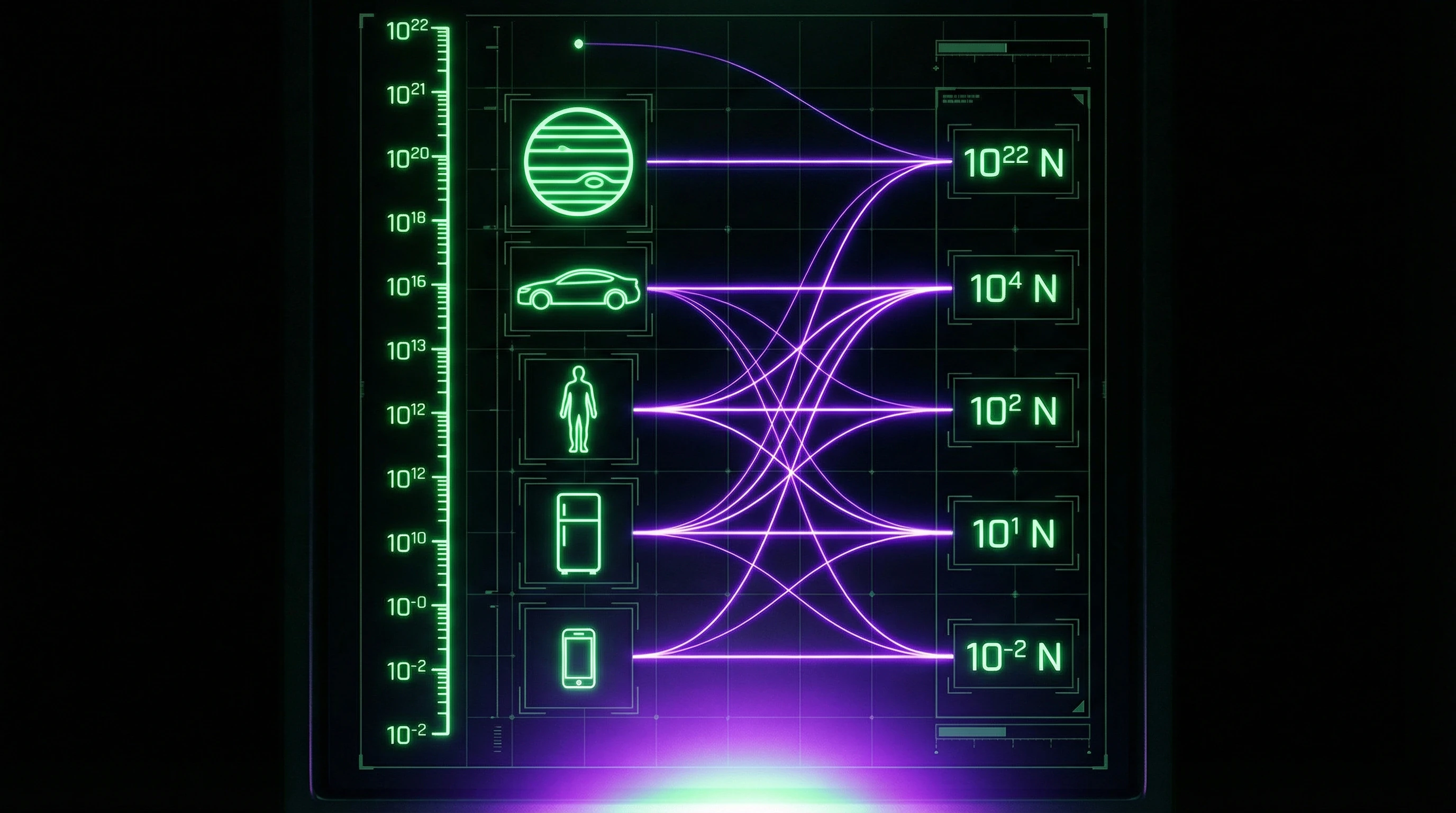
The gravitational force acting on a 70 kg person from Jupiter (the most massive planet) at average distance is F = G × (M_Jupiter × m_human) / r² ≈ 1.4 × 10⁻⁶ N.
| Source of Gravitational Influence | Force (N) | Conclusion |
|---|---|---|
| Jupiter on a person | 1.4 × 10⁻⁶ | Planet |
| Car (1500 kg, 10 m away) | 7 × 10⁻⁷ | Comparable to Jupiter |
| Person nearby (70 kg, 1 m away) | 3.3 × 10⁻⁷ | Weaker than Jupiter, but same order of magnitude |
If gravity determined destiny, the obstetrician in the delivery room would influence it more than Jupiter.
Jupiter's magnetic field at Earth: B ≈ 10⁻¹⁴ T. Earth's magnetic field: 5 × 10⁻⁵ T. Household refrigerator's magnetic field at 1 m distance: ≈10⁻⁶ T. Smartphone's magnetic field: ≈10⁻⁵ T.
Planetary magnetic fields at Earth are 9–11 orders of magnitude weaker than Earth's field and 8–10 orders of magnitude weaker than household sources. There is no physical mechanism by which such weak fields could influence biochemistry.
🎯 Level 3: Blind Predictive Tests — Can an Astrologer Distinguish a Chart from Random
In Shawn Carlson's classic experiment (Nature, 1985), 28 professional astrologers received natal charts and had to match them with psychological test results (California Personality Inventory). The astrologers chose the methodology themselves to avoid accusations of improper experimental design.
Result: matching accuracy was no different from chance (33% with expected 33% for three options). Similar results have been obtained in dozens of replication experiments. When an astrologer knows nothing about a person except their birth date, their predictions are no better than a coin flip.
🧾 Why Individual "Confirmations" Don't Override Statistics
- Confirmation bias
- People remember hits and forget misses. If an astrologer makes 10 statements, of which 2 seem accurate, the client remembers those 2 and forgets the 8 incorrect ones.
- Barnum effect
- Vague statements ("you sometimes doubt yourself," "you have unrealized potential") apply to 80–90% of people but are perceived as personal insights.
- Controlled experiments
- Eliminate these biases by requiring quantitative predictions and blind evaluation. Result: astrology fails the test.
For more on the cognitive mechanisms of belief, see the article on astrology as a cognitive trap and the analysis of zodiac signs and stereotypes.
Causality, Correlation, and the Problem of Hidden Variables: Why Coincidences Don't Prove Connection
Even if a correlation were found between birth date and some trait, it wouldn't prove astrological causality. Correlation does not imply causation — this is a fundamental principle of the scientific method. For more details, see the Reality Check section.
🔁 The Mechanism of False Correlations Through Seasonality
Birth date correlates with season, and season correlates with numerous factors: temperature, daylight duration, food availability, viral load, maternal vitamin D levels.
These factors affect fetal and newborn development. Children born in winter in northern latitudes have a slightly higher risk of schizophrenia — not because of Saturn's position, but due to vitamin D deficiency and seasonal infections in the mother during the second trimester. This is an example of a confounding variable: it appears that zodiac sign correlates with a trait, but the real cause is seasonal biological factors.
| What We Observe | Astrological Explanation | Scientific Explanation (Hidden Variable) |
|---|---|---|
| Correlation between birth date and mental health | Planetary influence on destiny | Seasonal vitamin D deficiency, maternal infections, temperature stress |
| People recognize themselves in their sign's description | Astrology is accurate | Barnum effect (universal statements), confirmation bias |
| Life events coincide with astrological predictions | Planets predict events | Selective attention, forgetting failed predictions |
🧬 Why Planets Cannot Be the Cause, Even If Correlation Exists
Establishing causality requires three conditions: (1) correlation, (2) temporal sequence (cause precedes effect), (3) absence of alternative explanations.
Even if astrology satisfied the first two conditions, the third is not met: simpler explanations exist (seasonality, cultural factors, self-fulfilling prophecies) that don't require introducing new physical mechanisms. Occam's Razor principle requires choosing the explanation with the fewest assumptions.
If two explanations equally describe the data, choose the one that doesn't require new entities. Astrology requires: gravitational influence of planets on psyche, information transmission through an unknown channel, or redefining physics. Seasonality requires only known biological mechanisms.
🧷 Self-Fulfilling Prophecy as an Alternative Mechanism
If a person believes they're a "typical Scorpio" (passionate, vengeful), they may unconsciously adjust their behavior to match this image. This creates an illusion of astrological accuracy, but the cause isn't planets — it's cultural stereotype and cognitive bias.
Experiments show: when people are told a false zodiac sign, they begin displaying traits attributed to that sign rather than their actual one. For more on the mechanisms of this effect, see the article "Zodiac Signs and Stereotypes: Why Astrology Works as a Cognitive Trap, Not a Science of Personality."
- A person learns their sign's description (often universal and vague).
- They begin noticing matches and forgetting mismatches (selective attention).
- They unconsciously adjust behavior to fit the sign's image.
- Others reinforce this image through social expectations.
- An illusion emerges that astrology "works," though the cause is a psychological mechanism, not physics.
Anatomy of a Cognitive Trap: What Psychological Mechanisms Make People Believe in Astrology
Astrology exploits several universal cognitive vulnerabilities that evolutionarily aided survival but in modern contexts create systematic thinking errors. Learn more in the Psychology of Belief section.
🧩 Patternicity: Hyperactive Pattern Detection
The human brain is evolutionarily tuned to find patterns even in random data. This is adaptive: it's better to falsely see a predator in rustling leaves than to miss a real threat.
Applied to astrology, this leads to apophenia—perceiving connections where none exist. When an astrologer says "Mercury retrograde causes communication problems," the brain begins selectively noticing all instances of misunderstanding while ignoring periods of normal communication.
🕳️ The Barnum Effect and the Illusion of Personalization
People tend to accept vague, general descriptions as accurate characterizations of their personality if told the description was created specifically for them. Forer's classic experiment (1948): students were given "individual" psychological profiles that were actually identical and compiled from horoscopes. Average accuracy rating: 4.26 out of 5.
Astrological descriptions deliberately use this technique: "you are strong but sometimes doubt yourself," "you value honesty but can be diplomatic"—statements true for most people.
🧠 Confirmation Bias and Selective Memory
Confirmation bias—the tendency to seek, interpret, and remember information that confirms existing beliefs. If someone believes in astrology, they'll notice when predictions match reality and ignore mismatches.
This is amplified by hindsight bias: after an event, people overestimate how predictable it was. "The astrologer warned about relationship difficulties"—but the warning was so vague it could apply to any conflict.
👁️ Need for Control and the Illusion of Predictability
People experience anxiety under uncertainty and seek ways to predict the future, even illusory ones. Astrology offers a narrative in which life's chaos is ordered by cosmic cycles.
This reduces anxiety by creating a sense of control. The effect intensifies during stress: research shows increased interest in astrology during economic crises and pandemics (S003).
⚙️ The Prestige of Science and Mimicry of Scientific Discourse
Modern astrology deliberately borrows scientific terminology to exploit trust in science. Using words like "energy," "vibration," "quantum," "field" creates an illusion of scientific validity, though these terms are used outside their physical meaning.
- Cargo cult science
- Imitating the external attributes of science (graphs, formulas, research citations) without adhering to the scientific method—controlled experiments, falsifiability, reproducibility. Astrology uses this strategy to increase credibility (S004).
- Social representation
- When astrology embeds itself in cultural narrative as "ancient wisdom" or "alternative way of knowing," it gains social status that shields it from criticism (S001). People believe not only facts but what others believe.
These mechanisms work not because people are foolish, but because they're universal. Even highly educated people are susceptible to apophenia and confirmation bias—they may just articulate their beliefs better (S005). Understanding these traps is the first step to overcoming them.
Verification Protocol: Seven Questions That Expose Pseudoscientific Claims in Two Minutes
When someone offers you "scientific evidence" for astrology (or any other dubious idea), use this checklist. If the answer to at least three questions is negative — you're dealing with pseudoscience. More details in the Daoism and Confucianism section.
✅ Question 1: Is the claim formulated in a way that makes it falsifiable?
A scientific hypothesis must specify what experimental result would prove it false. Ask: "What would have to happen for you to admit your theory is wrong?"
If the answer is evasive or introduces endless additional variables — that's a red flag. Example: "Astrology works, but only if you account for all planets, houses, aspects, and the client's personal energy" — this isn't a hypothesis, it's protection from testing.
✅ Question 2: Is there a mechanism explaining how this works?
Complete understanding isn't required, but there should be at least a plausible chain: cause → process → effect. Jupiter's gravity is too weak to affect a newborn's brain molecules — that's a physics fact, not an opinion.
If they offer "quantum entanglement" or "cosmic energy" without specifics — that's disguising ignorance as scientific jargon.
✅ Question 3: Has this been tested in a controlled experiment?
Anecdotes and coincidences don't count. You need a control group, blind methodology, statistical significance. (S004) shows that critical thinking training reduces belief in pseudoscience — because people learn to distinguish correlation from causation.
If research was conducted — ask for a reference. If there isn't any — that's already your answer.
✅ Question 4: Could alternative factors explain the results?
The coincidence of athletes' birth dates with Mars's position (S005) may be a selection artifact: parents enroll children in sports during a particular season, not because Mars affects muscles.
A good experiment excludes such explanations. A bad one ignores them.
✅ Question 5: Are the results reproducible by independent researchers?
If only one scientist gets results and others can't replicate them — that's not science. (S003) documents how the myth of the Moon's influence on psyche survived dozens of refutations because people remember coincidences and forget negative results.
Demand independent verification.
✅ Question 6: Is there a financial or social incentive to believe this?
An astrologer earns from consultations. An essential oil manufacturer — from sales. This doesn't prove falsity, but it explains the motive for exaggerating results.
Ask: who benefits if I believe? If the answer is "whoever's selling it" — engage your critical thinking.
✅ Question 7: Does this contradict established physical laws?
If yes — extraordinary quality evidence is required. Jupiter's gravity on a newborn isn't a hypothesis, it's a calculable fact. If astrology works, physics must be rewritten.
This hasn't happened. So either astrology doesn't work, or it works through a mechanism physics has already explained (psychology, statistics, coincidence).
How to Use This Protocol
- Ask all seven questions to the idea's proponent or article author.
- Record the answers verbatim.
- If three or more answers are evasive, reference "personal experience," or introduce new variables — you're dealing with pseudoscience.
- This doesn't mean the person is lying. It means the idea hasn't passed the test for falsifiability and reproducibility.
Science doesn't require faith. It requires testing. If an idea can't be tested — it's not science, it's belief. And beliefs have a right to exist, but not the right to be called scientific.
What's next is your choice: dive deeper into astrology's mechanisms or apply this protocol to other areas — from essential oils to financial schemes.