What astrology calls the "ascendant mask"—and why this metaphor sells better than scientific explanations of personality
The ascendant (Rising Sign) in Western astrology is the zodiac sign that was on the eastern horizon at the moment of your birth. Astrologers claim it determines the "mask" you wear when meeting the world: first impressions, communication style, physical appearance, and even your gait (S012, S013, S017).
Unlike the sun sign (which supposedly reflects your "true self"), the ascendant is described as a social shell—what others see before they get to know you. More details in the Numerology section.
🧩 Three key claims of astrological doctrine about the ascendant
- The ascendant determines physical appearance
- Facial structure, body type, and movement patterns supposedly depend on the sign on the eastern horizon. Source S014 claims that with Aries ascendant "the face looks like a mask, hair is curly."
- The ascendant programs behavior in social situations
- How you enter a room, what energy you project, how you react to strangers (S013, S019).
- The ascendant creates a gap between inner and outer self
- This explains why people "don't recognize themselves" in their sun sign descriptions (S012, S015).
⚠️ Why the "mask" metaphor is psychologically irresistible
The ascendant concept exploits a universal human experience: the difference between how you feel inside and how others perceive you. The "mask" metaphor legitimizes this sensation, transforming it from a psychological issue into a cosmic given.
Everyone experiences this dissociation. Astrology simply gives it a name and attributes the cause to the stars instead of explaining the mechanisms of social adaptation and self-presentation.
Source S015 demonstrates typical dissatisfaction: "I understand the usual definitions of the ascendant, but they don't satisfy me." This dissatisfaction arises because astrology attempts to explain complex psychological phenomena through a simplified system of 12 archetypes.
🔎 Boundaries of applicability: where the "mask" ends and personality begins
Astrological sources contradict each other on how deeply the ascendant influences personality. Source S018 presents a discussion: "For some people, neither the ascendant, nor the sun, nor the moon matches their personality—they resemble their dominant signs more."
| Question | Astrological answer | Problem |
|---|---|---|
| If the ascendant is a mask, why does it sometimes describe a person more accurately than the sun sign? | The mask can be more pronounced than the true self | This blurs the distinction between mask and personality |
| Why is the ascendant called a mask, but not the other houses? | The ascendant is the entry point to the chart | The system lacks logical consistency |
This admission points to a fundamental problem: the system cannot explain why its core metaphor sometimes fails. Source S011 asks a critical question: "Why is the ascendant called a mask, but not the other houses?" Astrologers' answers remain vague.
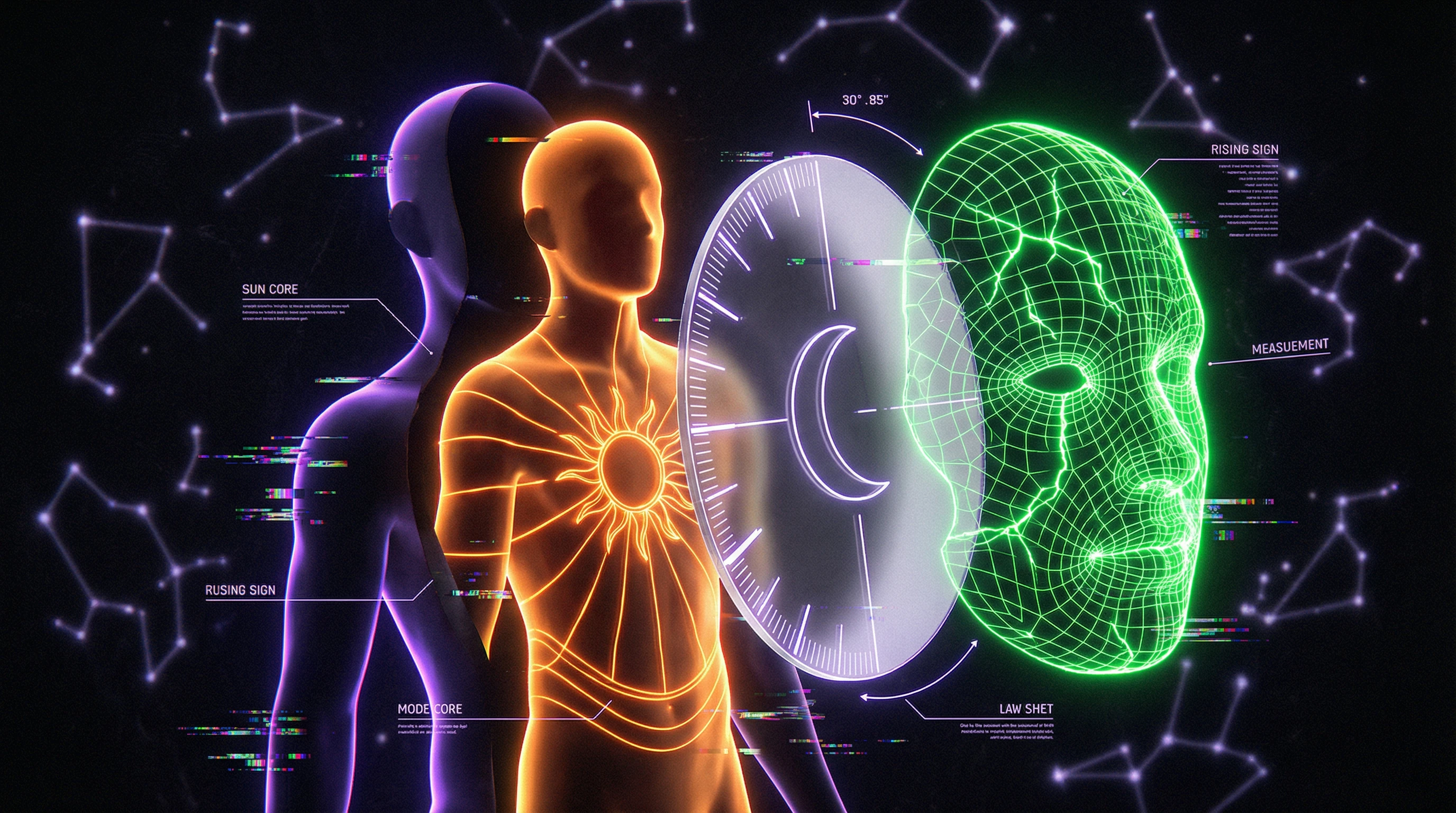
Seven Most Convincing Arguments for Astrological Interpretation of the Ascendant — and Why They Seem to Work
Before examining the evidence against astrology, it's necessary to honestly present the strongest arguments of its proponents. This is not a straw man — this is the steel version of the astrological position, based on real claims by practitioners. More details in the section Tarot and Cartomancy.
🎯 Argument 1: Subjective Validity — "it works for me"
Millions of people report that their ascendant description accurately matches how others perceive them. A person with Libra rising may appear diplomatic and charming at first meeting, even if their sun sign (for example, Scorpio) suggests a more intense inner nature.
This argument relies on personal experience, which is difficult to refute directly: if a person feels the description works, who can tell them otherwise?
🎯 Argument 2: System Complexity as Proof of Depth
Astrology requires precise birth time (accurate to the minute), which creates an impression of scientific rigor. The ascendant changes every two hours, so even twins born minutes apart can have different rising signs.
This complexity is interpreted as evidence that the system accounts for subtle differences unavailable to simplified personality models.
🎯 Argument 3: Explaining Inconsistencies Through Layering
When a person doesn't recognize themselves in their sun sign description, astrology offers a ready explanation: "You're reading the wrong layer." Practicing astrologers use the ascendant to resolve contradictions: if a client doesn't match their sun sign, they can reference the ascendant, moon, dominant planets, or aspects.
This flexibility makes the system unfalsifiable — any inconsistency is integrated as confirmation of the chart's complexity.
🎯 Argument 4: Cultural Continuity and Ancient Tradition
The concept of the ascendant has existed in astrology for over two thousand years. The argument implies that a system surviving millennia cannot be completely false — otherwise it would have disappeared under critical pressure.
- Longevity is interpreted as indirect proof of effectiveness
- Criticism is viewed as a natural test that the tradition has withstood
- Prevalence across different cultures is perceived as independent confirmation
🎯 Argument 5: Correlation with Physical Appearance
Some astrologers claim the ascendant influences physical characteristics: with Aries rising, the face may look mask-like, hair may be curly. If a person with Aries rising actually has curly hair, this is perceived as confirmation.
The problem is that descriptions are vague enough to fit a wide range of appearances.
🎯 Argument 6: Consensus Among Practitioners
Thousands of astrologers worldwide use the ascendant in consultations and report positive client feedback. Astrologers employ social proof mechanisms: "All experienced astrologers agree that the ascendant is critically important."
- Consensus within the community
- Creates an illusion of expert knowledge and scientific validity
- Client testimonials
- Perceived as independent confirmations, though often reflecting cognitive biases
- Professional cohesion
- Strengthens in-group trust and external credibility
🎯 Argument 7: Critics' Lack of Alternative Explanations
Astrologers often point out that skeptics criticize but don't offer equally detailed alternative systems for explaining individual differences. Even within astrology there is a search for more precise models — which is interpreted as a sign of a living, evolving discipline rather than a frozen dogma.
This creates the impression that astrology is honestly improving itself, while critics simply deny without offering anything in return.
Evidence Base: What Controlled Studies Show About the Connection Between Birth Time and Personality Characteristics
None of the astrological claims about the ascendant withstand scrutiny from controlled studies. Over the past 50 years, numerous experiments have tested astrologers' ability to predict personality traits, appearance, or behavior based on natal charts. More details in the section Runes and Symbols.
The results are unequivocal: astrological predictions do not exceed chance levels.
📊 Meta-Analyses of Astrological Predictions: Zero Effect
The largest meta-analysis of astrological claims, conducted by Shawn Carlson and published in Nature (1985), showed that professional astrologers cannot match natal charts with psychological profiles of subjects better than random guessing.
The experiment included double-blind testing: astrologers received natal charts and three psychological profiles (one correct, two random) and had to select the matching one. Accuracy was 33.5%—statistically indistinguishable from random selection (33.3%). Astrologers themselves participated in developing the protocol to eliminate accusations of bias.
When an experiment is designed to exclude all possible objections, and the result still matches chance—this is not a methodological error, but an answer to the question.
📊 Twin Studies: Birth Time Does Not Predict Personality
If the ascendant is determined by birth time accurate to the minute, twins born minutes apart should have different ascendants and, consequently, different "masks."
However, twin studies show that personality differences between monozygotic twins (identical genetics, often identical birth times) are minimal and explained by environmental factors, not astrological ones. A study by Peter Hartmann (2006), published in Personality and Individual Differences, analyzed data from 15,000 people and found no correlation between sun sign or ascendant and Big Five personality traits.
| Astrological Prediction | What the Data Show | Mechanism of Discrepancy |
|---|---|---|
| Twins with different ascendants have different personalities | Personality differences are explained by environment, not birth time | Genetics and experience > cosmic influences |
| Ascendant determines appearance | Appearance correlates with genetics (80% heritability) | Birth time does not affect embryonic development |
| People with the same ascendant are similar | No statistical correlation in physical parameters | Multiple comparisons create illusion of pattern |
🧪 Cold Reading Experiments: The Barnum Effect
Psychologist Bertram Forer conducted a classic experiment in 1948: he gave students supposedly individualized personality profiles based on a psychological test. Students rated the accuracy of the descriptions at an average of 4.26 out of 5.
In reality, everyone received an identical text compiled from vague horoscope statements. This effect (the Barnum effect or subjective validation effect) explains why people find astrological descriptions accurate: statements are general enough to apply to most people, but formulated as if describing unique traits.
- Barnum Effect
- The tendency to perceive vague, general statements as accurately describing one's personality. Works because the brain actively seeks matches and ignores mismatches.
- Confirmation Bias
- People remember "hits" from astrological predictions and forget "misses." This creates an illusion of accuracy, though statistically the matches are random.
- Cold Reading
- A technique where general statements are formulated to appear specific. Astrological descriptions of the ascendant are a classic example of cold reading.
🔬 Neurobiological Data: Personality Is Shaped by Genetics and Environment
Modern neuroscience shows that personality traits have a genetic basis (heritability around 40-60% for Big Five traits) and are formed through gene-environment interactions. No mechanism has been discovered through which gravitational or electromagnetic influence of planets could affect fetal brain development.
Biological processes are governed by molecular mechanisms, not the position of stars. Personality development is linked to neural network formation, synaptic plasticity, and epigenetic changes—all these processes depend on genetics and experience, not birth time.
📊 Statistical Analysis of Astrological Claims About Appearance
The claim that the ascendant influences physical appearance can be tested statistically. If this were true, people with the same ascendant should demonstrate statistically significant similarity in measurable physical parameters (face shape, height, body type).
No study has found such a correlation. Physical appearance is determined by genetics (heritability around 80% for height, face shape) and epigenetic factors during intrauterine development. Birth time does not affect these processes.
- Formulate hypothesis: people with the same ascendant should be physically similar
- Collect sample: minimum 500 people with the same ascendant
- Measure parameters: height, body mass index, face shape (through morphometry)
- Conduct statistical analysis: ANOVA, Pearson correlation
- Compare with control group: people with different ascendants
- Result: no significant differences between groups
🧾 Multiple Comparisons Problem: Why "Hits" Are Inevitable
Astrological descriptions contain dozens of statements about personality, appearance, and behavior. Even if each statement has only a 50% probability of being perceived as "accurate" (due to vague wording), the probability that at least several statements will seem correct approaches 100%.
This is the multiple comparisons problem: the more predictions made, the higher the probability of random matches. People remember "hits" and forget "misses" (S001), creating an illusion of accuracy. This is not a perceptual error—it's normal memory function that astrology uses as a persuasion tool.
If a system makes 100 predictions, and you remember 5 matches and forget 95 misses—this is not proof the system works, it's proof your brain works.
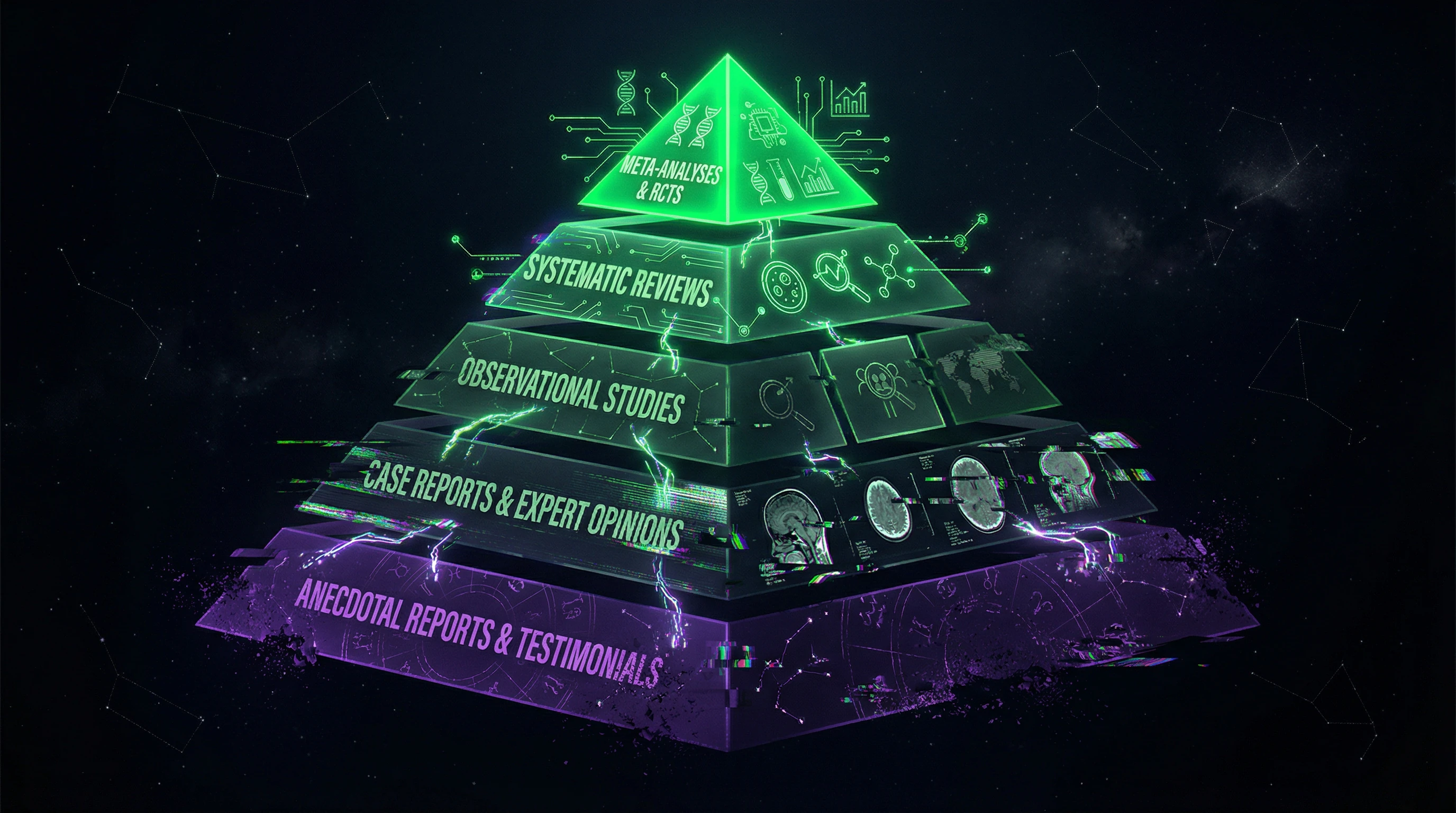
The Illusion Mechanism: How Cognitive Biases Turn Randomness into Patterns
Belief in the astrological ascendant is sustained not by evidence, but by a series of cognitive biases that make the brain see patterns where none exist. Understanding these mechanisms is critical for evaluating any claims about "cosmic influences" on personality. Learn more in the Sources and Evidence section.
🧩 The Barnum Effect: Why Generic Statements Feel Personal
Astrological ascendant descriptions use "cold reading" techniques: statements are formulated to be simultaneously specific (creating the illusion of personalization) and generic (so they apply to most people). The statement "you project confidence, but sometimes doubt yourself internally" applies to virtually anyone, yet is perceived as deep insight into a unique personality.
"Libra rising makes you charming at first meetings." Who doesn't want to think of themselves as charming?
This technique works because the brain actively seeks meaning in self-relevant information. Even when a description is inaccurate, people unconsciously adjust it to fit their experience.
🔁 Confirmation Bias: Selective Attention to Confirmations
People notice and remember information that confirms their beliefs, and ignore contradictory information. If an astrological description contains 10 statements and 3 seem accurate, people focus on those three and forget the seven inaccurate ones.
| Mechanism | How It Works in Astrology | Result |
|---|---|---|
| Selective attention | We notice hits, ignore misses | Illusion of accuracy |
| Relevance overestimation | We assign weight to random coincidences | False correlation |
| Post-hoc explanation | We fit facts to predictions | System appears unfalsifiable |
Practicing astrologers often experience cognitive dissonance: "I'm dissatisfied with ascendant definitions, but continue using them with clients." This indicates the system is sustained not by evidence, but by social and economic factors.
🧬 Illusion of Control: Why People Prefer Astrology to Psychology
Astrology offers simple explanations for complex psychological phenomena: "You behave this way because you were born at a specific time." This creates an illusion of understanding and control.
Scientific psychology acknowledges multiple factors (genetics, environment, chance, free will), but astrology offers a deterministic model: your personality is predetermined by cosmic influences. Paradoxically, this illusion of determinism is perceived as liberating: "I'm not responsible for my flaws—it's my ascendant."
- Illusion of Control
- The belief that we understand and can predict behavior. In astrology: if I know my ascendant, I know how I'll make an impression.
- The Trap
- This illusion blocks development. If behavior is "predetermined," why work on social skills or self-awareness?
- Reality
- First impressions are shaped by context, body language, tone of voice, the observer's prior experience—everything except birth time.
👁️ Social Validation: Consensus as a Substitute for Evidence
Communicating consensus increases trust in claims (S001). Astrology uses the same mechanism: millions believe in the ascendant, thousands of astrologers practice, there are books, courses, apps.
Social consensus within a community of believers is not equivalent to scientific consensus based on empirical data.
Genuine scientific consensus forms through systematic review of evidence, peer review, reproducibility of results (S002). Astrological consensus is agreement within a group that shares the same assumptions and economic interests.
To test any claim about birth time influencing personality, use a verification protocol. This will shatter the illusion faster than any arguments.
Conflicts and Uncertainties: Where Astrological Sources Contradict Each Other
Even within the astrological community, there's no consensus on how the ascendant works. These contradictions point to the absence of an objective foundation for interpretations. More details in the Statistics and Probability Theory section.
🕳️ Contradiction 1: Ascendant as "Mask" or Dominant Trait
Critical question: why is the ascendant called a mask, while other houses are not? Astrologers acknowledge that for some people, the ascendant describes personality more accurately than the sun sign.
This is a fundamental contradiction. If the ascendant is a superficial "mask," why does it sometimes turn out to be a more accurate description than the "true self" (sun sign)? The system lacks internal logical structure to explain this.
🕳️ Contradiction 2: Physical Appearance — Innate or Acquired
Claim: the ascendant determines physical characteristics (face shape, hair, posture). But physical appearance is formed by genetics and prenatal development — processes completed before birth.
If the ascendant is determined by the moment of birth, how can it influence already-formed physical traits? Astrologers offer no mechanism. This is post-hoc rationalization, not prediction.
🕳️ Contradiction 3: Birth Time Accuracy and Its Impact
Astrology requires precise birth time (accurate to the minute). The ascendant changes every two hours — the system is extremely time-sensitive.
But most people don't know their birth time with such precision. In practice, astrologers use "rectification" — adjusting birth time to fit known life events.
| Astrological Claim | Logical Conflict |
|---|---|
| Ascendant determines personality and appearance | Requires precise time, but people don't know it |
| System predicts events | Time is adjusted to fit events (rectification) |
| Mask differs from true self | Mask often describes personality more accurately than true self |
Rectification is circular logic: birth time is determined by events it supposedly predicts. The system becomes unfalsifiable because any outcome can be explained by adjusting parameters.
When a system requires constant correction to match reality, it's a sign the system doesn't work independently of the observer. Reality testing requires predictions that can be verified without reinterpreting the original data.
Verification Protocol: Seven Questions That Will Dismantle Any Astrological Claim in 60 Seconds
When someone offers you an astrological interpretation of the ascendant, ask these questions. If there's no clear answer to even one — the claim has no evidential basis. Learn more in the Epistemology section.
✅ Question 1: Can this claim be tested in a controlled experiment?
A scientific claim must be falsifiable — there must exist an experiment whose result could disprove the claim. Astrological claims about the ascendant are formulated so they cannot be disproven: if the description doesn't fit, the astrologer will say you need to consider other chart factors.
Ask: "What experimental result would make you acknowledge that the ascendant doesn't influence personality?" If the astrologer can't answer — the claim is unscientific.
✅ Question 2: Are there peer-reviewed studies confirming this claim?
Not a single astrological claim about the ascendant has been published in peer-reviewed scientific journals. The sources astrologers cite are websites, forums, blogs. None of them have undergone scientific peer review.
Ask: "Where are the controlled experiment data published?" If the answer is "astrologers know this from experience" — that's not evidence, it's anecdote.
✅ Question 3: How does this explain twins with identical birth times but different personalities?
If the ascendant determines first impressions and social masks, twins should be identical in how others perceive them. They're not identical. This is direct refutation.
Astrologers respond: "You need to look at the Moon, Venus, aspects." But this means the ascendant isn't the primary factor, but one of many, and its contribution cannot be measured.
✅ Question 4: Why does the ascendant description match the sun sign description?
Open two astrology websites. Read the description of Leo ascendant and Leo sun sign. They're nearly identical: leadership, charisma, confidence. If the ascendant is the mask and the sun sign is the personality core, why are they described identically?
Answer: because astrologers use the same archetypes for all signs, regardless of context.
✅ Question 5: Why do people born on the same day in different cities have different ascendants but identical personalities?
The ascendant depends on exact birth time and location. Two people born on the same day in different time zones will have different ascendants. But their personalities can be identical — because personality is shaped by environment, genetics, and experience, not the position of stars.
✅ Question 6: How does astrology explain cultural differences in personality perception?
In Western culture, Aries ascendant is described as "aggressive leader." In Eastern culture, aggressiveness may be perceived as a flaw. If the ascendant is an objective factor, why does its interpretation depend on culture?
Because interpretation isn't science, it's cultural narrative.
✅ Question 7: Why can't astrologers predict someone's personality knowing only their ascendant?
If the ascendant determines first impressions, an astrologer should be able to describe someone's personality knowing only their birth time and location. In practice, astrologers request additional information: birth date, time, location, name, photo.
This means the ascendant is an insufficient factor. But if it's insufficient, why is it sold as the primary tool for understanding personality?
| Criterion | Scientific Claim | Astrological Claim |
|---|---|---|
| Falsifiability | Can be disproven by experiment | Cannot be disproven (there are always "other factors") |
| Peer Review | Published in scientific journals | Published on websites and forums |
| Predictiveness | Allows prediction of outcomes | Requires additional information for interpretation |
| Universality | Works independently of culture | Interpretation depends on culture and astrologer |
These seven questions aren't an attack on astrology. They're a tool for distinguishing between narrative and evidence. If an astrologer can't answer them clearly — you're dealing with a verification system that works as a mask, not as a tool for understanding.
The ascendant can be a useful metaphor for thinking about how you appear in others' eyes. But it's a metaphor, not a mechanism. And between metaphor and mechanism lies a chasm that astrology doesn't cross.