 ♈ Astrology
Divination Systems: Hidden Languages of Reality and Ontological Coordinates of Fateλ
A study of ancient and modern divination systems — from I Ching and Tarot to digital adaptations — through the lens of semiotics, ontology, and Jungian synchronicity
Overview
Divination systems are structured methods for extracting information about the unknown through symbolic interpretation. From the I Ching with its 64 hexagrams to Tarot and runes 🧩: each system functions as a coordinate grid, organizing the chaos of data into readable patterns. Modern science examines them through semiotics, Jungian psychology, and ontology — not as mysticism, but as tools for cognitive mapping of reality.
🛡️
Laplace Protocol: Divination systems are not superstitions, but complex symbolic frameworks with ontological foundations, semiotic evolution, and proven cultural resilience, including adaptation to digital platforms.
Reference Protocol
Scientific Foundation
Evidence-based framework for critical analysis
Navigation Matrix
Subsections
♈
[A1]
Astrology
Everything About Astrology: Complete Guide, Facts and Myth-Busting.
Explore
[numerology]
Numerology
An esoteric practice that attributes mystical influence over fate and personality to numbers, lacking empirical evidence and recognized as pseudoscience by the scientific community.
Explore
[runes]
Runes and Symbols
A study of Germanic runic alphabets — from the Elder Futhark to modern practices, with emphasis on scientific methodology and critical analysis of historical sources.
Explore
[tarot]
Tarot and Cartomancy
A study of the historical evolution of Tarot cards from 15th-century gaming decks to modern divination systems, analyzing European and American cartomancy traditions
Explore
Protocol: Evaluation
Test Yourself
Quizzes on this topic coming soon
Sector L1
Articles
Research materials, essays, and deep dives into critical thinking mechanisms.
♈ Astrology ♈ Astrology
 🎴 Tarot and Cartomancy
 ♈ Astrology
 ♈ Astrology
 🔢 Numerology
 ♈ Astrology
 🎴 Tarot and Cartomancy
 ♈ Astrology
 ♈ Astrology
 ♈ Astrology
 ♈ Astrology
⚡
Deep Dive
Ontological Foundations of Divination Systems: How Symbols Structure Reality
Divination systems are not chaotic superstitions, but strictly organized methodologies for obtaining information about the unknown through symbolic interpretation. They are based on ontological categories: fundamental structures of being that reveal patterns in reality.
These systems possess internal logical consistency and cultural-historical significance that extends far beyond primitive beliefs. They function as tools for understanding current patterns and potential developments of events.
Key misconception: divination systems predict a fixed future. In reality, most traditional systems, especially the I Ching, emphasize dynamic changes and probabilities rather than deterministic predictions.
Categories of Being and Causal Relationships
The ontological approach views divination as navigation through current causal connections between phenomena. The Chinese system Liu Ren integrates the concept of destiny with ontological categories to identify these connections.
Modern semiotic theory explains the functioning of divination systems through the concept of "hidden languages of reality"—coordinate grids that organize information about the environment. These symbolic structures do not create causal relationships, but reveal already existing relations between elements of being.
- Symbolic Interpretation
- A process in which symbols serve as reference points for navigating information space, making hidden patterns accessible to human perception.
- Ontological Category
- A fundamental structure of being that organizes our understanding of causal relationships and allows recognition of recurring patterns.
Coordinate Grids of Reality and Symbolic Languages
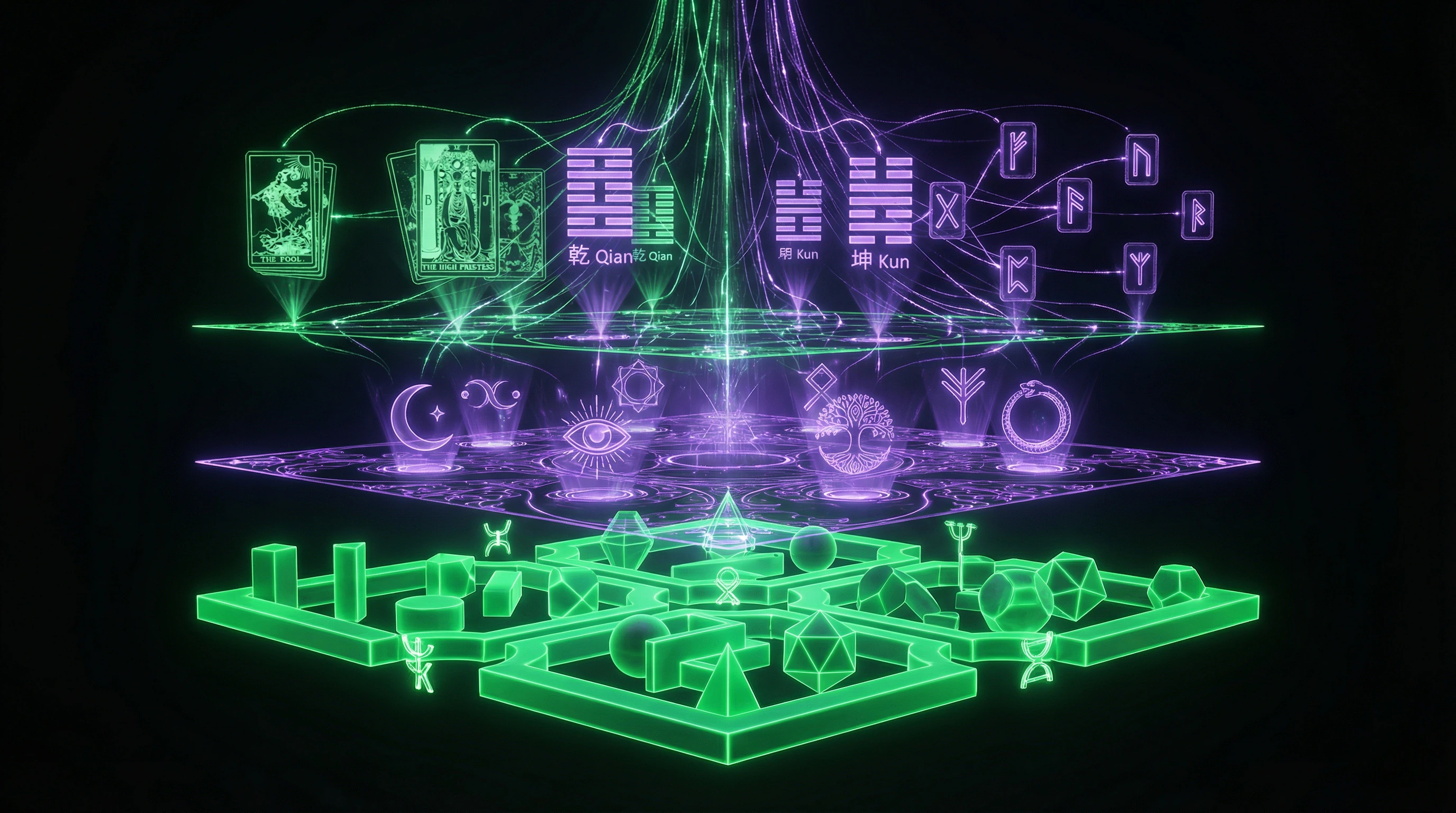
Divination systems function as multidimensional coordinate grids overlaid on reality to structure it. Each system uses its own set of symbols—hexagrams in the I Ching, arcana in Tarot, runes in the Germanic tradition—which serve as reference points for navigation.
| System | Symbolic Language | Ontological Focus |
|---|---|---|
| I Ching | 64 hexagrams | Dynamic changes and probabilities |
| Tarot | 78 arcana | Archetypal patterns of human experience |
| Runes | Ancient symbols | Cosmic forces and their manifestations |
These symbolic languages follow the law of semiotic attenuation: over time their meanings evolve and transform, following identifiable linguistic patterns.
Carl Jung's principle of synchronicity offers an alternative explanation: divination systems represent synchronistic phenomena, where meaningful coincidences occur without direct causal connection. This approach shifts focus from causality to meaningful correspondence between a person's internal psychological state and external symbolic manifestations.
The psychological effectiveness of divination practices is explained not by objective predictive power, but by the ability of symbolic systems to reflect and structure internal psychic processes.
Eastern Traditions: I Ching and Liu Ren as Mathematical Models of Change
Ancient Chinese divination systems represent the most mathematically sophisticated prediction models based on combinatorial principles and the philosophy of change. The I Ching and Liu Ren demonstrate a high level of abstraction, allowing them to be viewed as early forms of symbolic logic and probability theory.
64 Hexagrams and the Dynamics of Transformation
The I Ching is based on 64 hexagrams, each consisting of six lines—solid (yang) or broken (yin). This binary structure creates 2⁶ = 64 unique combinations, representing all possible states of dynamic change.
Each hexagram describes not a static symbol, but a process of transformation: changing lines indicate transitions from one state to another, creating a complex network of interconnected patterns. This mathematical elegance enables modeling of nonlinear processes and cyclical changes.
- Manipulating 50 yarrow stalks or casting three coins generates a random sequence for constructing a hexagram
- The stalk method produces an uneven probability distribution compared to the coin method
- This difference affects interpretation of results and the frequency of obtaining changing lines
The I Ching system functions not as a predictor of the future, but as a tool for structuring uncertainty—it organizes chaos into recognizable patterns that enable decision-making under conditions of incomplete information.
The Concept of Destiny in the Liu Ren System
Liu Ren (六壬, "Six Ren Signs") is a specialized Chinese methodology integrating the concept of ming (命, fate/destiny) with ontological categories to reveal causal connections. Unlike the I Ching, which focuses on universal patterns of change, Liu Ren employs temporal-spatial calculations based on cyclical calendar systems and astronomical observations.
The system operates through combinations of Heavenly Stems and Earthly Branches, creating a multi-layered interpretive matrix. The key distinction is its deterministic approach to fate: certain events are predetermined by the configuration of cosmic forces at the moment of birth or inquiry, yet individuals retain the ability to navigate within these constraints.
The balance between predetermination and free will in Liu Ren reflects the philosophical sophistication of Chinese thought: fate does not exclude choice, but rather establishes its boundary conditions.
This balance explains why the system continues to be used in contemporary feng shui practice and the selection of auspicious dates.
Western Systems: Tarot, Runes, and Geomancy as Archetypal Languages
Western divination traditions developed parallel to Eastern ones, but with an emphasis on visual symbolism and archetypal imagery rather than mathematical combinations. Tarot, runes, and geomancy represent three major streams of European divination, each using a unique symbolic language to interpret reality.
Contemporary research, particularly within Jungian psychology, examines these systems as tools for deep psychological analysis and philosophical interpretation of social life.
Archetypal Structure of Tarot and Spread Methods
The Tarot deck consists of 78 cards: Major Arcana (22 cards) and Minor Arcana (56 cards in four suits). The Major Arcana represent universal archetypes of human experience—from the Fool to the World—forming a symbolic journey of individuation in the Jungian sense.
The Minor Arcana are structured similarly to playing cards and reflect everyday situations through the symbolism of four elements: wands (fire), cups (water), swords (air), pentacles (earth). This two-tiered structure allows interpretation of both deep psychological processes and concrete life circumstances.
Spread methods vary from simple three-card combinations to complex systems such as the Celtic Cross, which includes ten positions with specific meanings. Each position represents a particular aspect of the situation—past, present, future, hidden influences, external factors—creating a narrative structure for interpretation.
Ethnographic research shows that Tarot has successfully adapted to the digital age: mobile divination applications preserve traditional methodologies, demonstrating the system's cultural resilience in a technological environment.
Germanic Runes and Geomantic Figures
Runic systems, originating from Germanic and Scandinavian traditions, use alphabetic symbols as divinatory tools, where each rune carries multilayered meaning—phonetic, semantic, and magical. The Elder Futhark consists of 24 runes, organized into three aettir (groups of eight), reflecting cosmological and social categories.
Geomancy uses 16 figures, generated randomly through points or lines, which are then combined into complex diagrams for interpretation.
| System | Primary Element | Structure | Epistemology |
|---|---|---|---|
| Tarot | Visual cards | 78 cards, two-tier hierarchy | Archetypal interpretation |
| Runes | Geometric symbols | 24 symbols, three groups | Intuitive + phonetic |
| Geomancy | Binary patterns | 16 figures, combinatorial diagrams | Mathematical logic |
Both systems demonstrate the principle of geometric symbolism: runes are based on straight lines, avoiding curves due to technical limitations of carving on wood and stone, while geomantic figures use combinations of single and double points to create binary patterns.
Western systems, unlike Eastern ones, rely more heavily on intuitive interpretation and the practitioner's personal experience than on strict mathematical rules. This reflects differences in epistemological approaches between cultures.
Semiotics and Evolution of Symbols in Divination Systems
The Law of Semiotic Attenuation in Ancient Systems
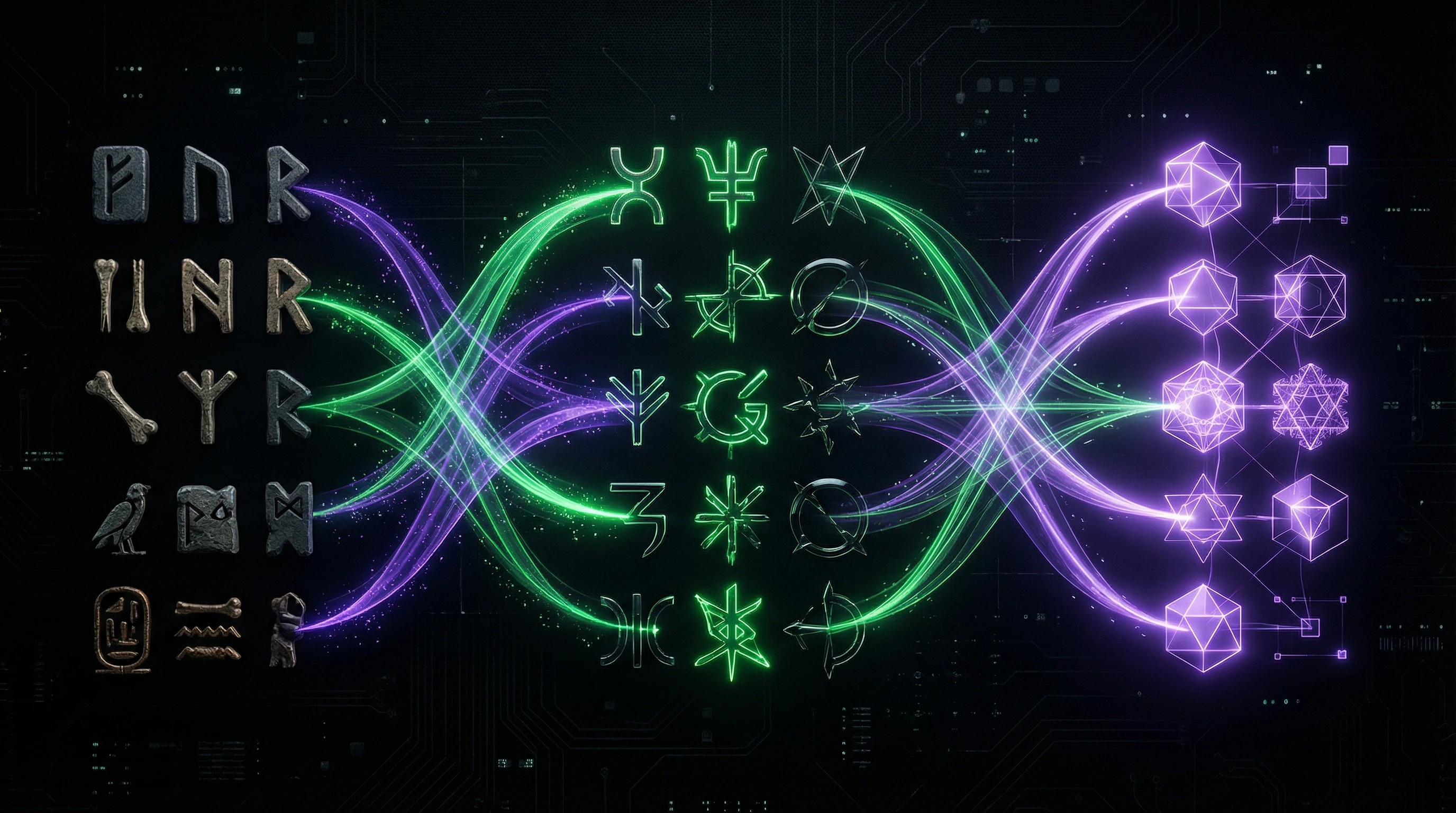
Symbolic meanings in divination systems undergo predictable changes during cultural transmission—a phenomenon known as the law of semiotic attenuation. Original concrete images become abstracted, losing visual connection with their initial referents, but gaining broader interpretative possibilities.
In the I Ching, this is evident in the evolution of hexagrams: from pictographic representations of natural phenomena to abstract combinations of broken and unbroken lines representing the universal principles of yin and yang.
| Transformation Stage | Characteristic | Example |
|---|---|---|
| Concrete Image | Visual connection with referent | Ideograph as drawing of phenomenon |
| Abstract Symbol | Conventional designation of principle | Yin/yang lines in hexagram |
| Interpretative Field | Multiple cultural meanings | One hexagram—dozens of interpretations |
Semiotic attenuation is not degradation, but an adaptive mechanism allowing symbols to maintain relevance in changing contexts. Chinese geomancy feng shui, adapted in the West, lost its specific cosmological connotations but acquired new psychological and aesthetic dimensions.
Linguistic Patterns of Meaning Transformation
Divination systems demonstrate three stable linguistic patterns: metaphorical extension, metonymic shift, and synecdochic generalization.
- Metaphorical Extension
- The Tarot card "The Tower" denoted concrete architectural destruction, then came to symbolize any sudden structural changes—from relationship breakups to worldview shifts.
- Metonymic Shift
- The rune Fehu originally denoted cattle as a form of wealth, later expanding its meaning to any material resources and financial prosperity.
- Synecdochic Generalization
- A particular meaning becomes a universal principle applicable to a broad class of phenomena.
These patterns follow cognitive principles of categorization described in modern linguistics. This confirms that divination systems are not arbitrary constructions, but reflections of universal mechanisms of human cognition.
Research demonstrates how these linguistic patterns manifest in digital adaptations of traditional systems, where algorithmic interpretation must account for the multilayered historically accumulated meanings.
Jungian Synchronicity and Psychological Dimensions
The Principle of Synchronicity vs. Causality
Carl Jung proposed synchronicity as an alternative to causal explanations of divination. Instead of hidden mechanisms governing the future, he described acausal parallels — meaningful coincidences between psychic states and external events.
The I Ching became Jung's primary example (in collaboration with sinologist Richard Wilhelm): the moment of casting coins or yarrow stalks synchronizes with the questioner's state, creating a configuration of meaning. Divination ceases to be prediction — it reveals patterns of significance in the present moment.
The Jungian model explains the subjective effectiveness of divination: people find results meaningful regardless of objective accuracy. Critics object: synchronicity remains philosophically problematic, as it offers no testable mechanism and may serve as post-hoc explanation for any coincidence.
Divination as a Depth Psychology Tool
Contemporary psychotherapy has adapted divinatory systems as projective instruments for activating the unconscious. Tarot is especially popular in Jungian practice: the archetypal imagery of the cards serves as catalysts for exploring the personal and collective unconscious.
The therapist does not interpret cards as predictions, but uses them as mirrors of internal conflicts, hidden motivations, unacknowledged aspects of personality. Divination transforms from predictive practice into a hermeneutic method of self-knowledge.
| Traditional Approach | Psychotherapeutic Approach |
|---|---|
| Cards predict the future | Cards reflect current psychic state |
| Interpretation is fixed | Interpretation is dialogue between client and symbol |
| Goal: learn one's fate | Goal: explore unconscious content |
The structured symbolism of divinatory systems creates a safe container for exploring complex emotional states. The client distances themselves from personal problems through symbolic mediation, gaining alternative narrative frameworks for understanding life situations.
This psychological turn represents academic legitimization of practices previously considered exclusively esoteric. Therapeutic value does not depend on metaphysical beliefs.
Contemporary Adaptations and Digital Ethnography
Mobile Applications and the Technosphere of Divination
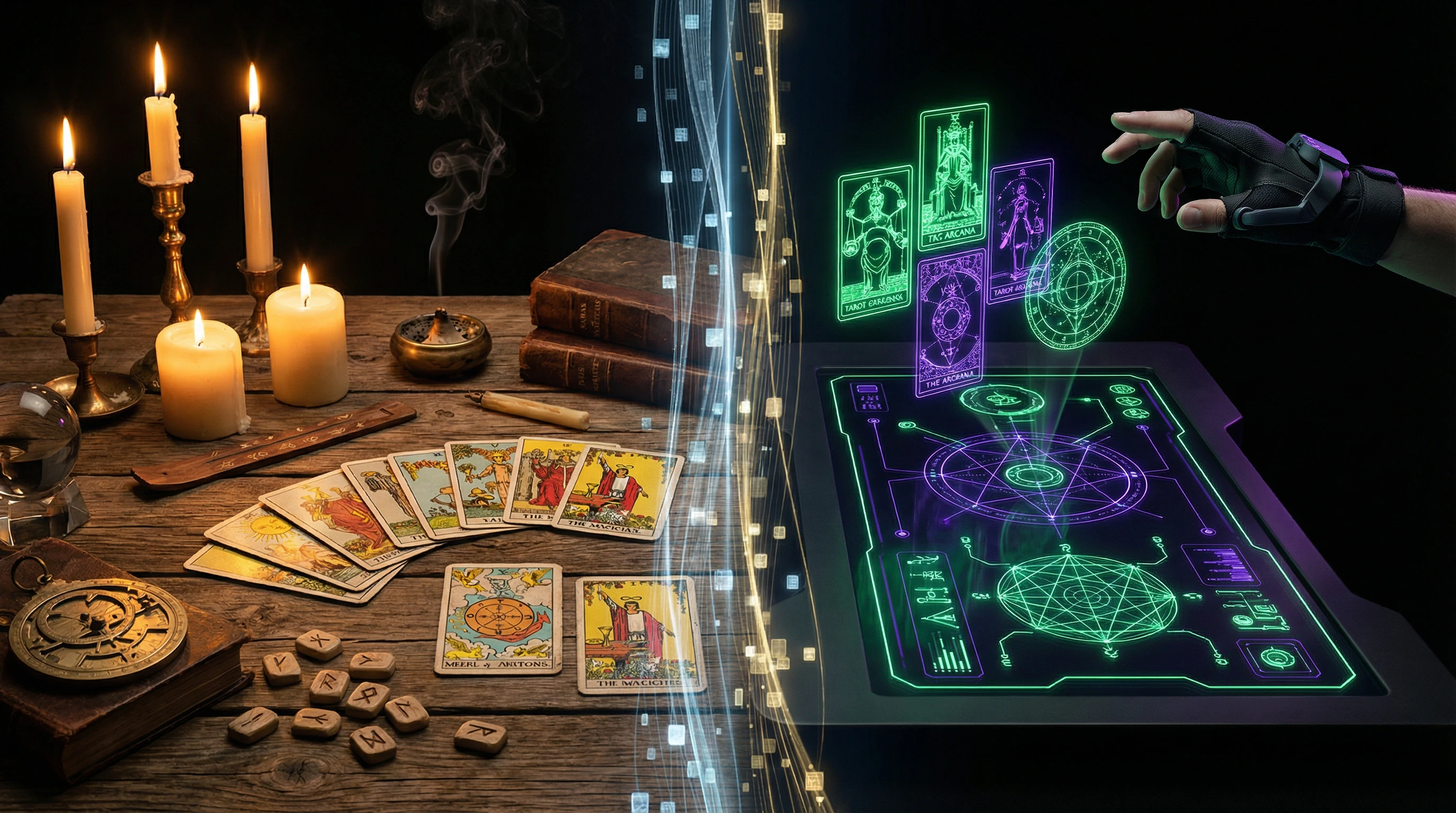
Ethnographic research documents the digital adaptation of traditional divination practices through mobile applications. These apps reproduce classical systems—I Ching, Tarot, runes, numerology—but transform the ritual context: physical interaction with material objects is replaced by screen touches, interpretation is often automated through algorithms.
Users perceive digital versions as legitimate, though they acknowledge the loss of tactile and ritual dimensions. The paradox: technological modernization has not diminished divination's popularity but expanded its accessibility among young urbanized groups who may lack access to traditional practitioners.
| Aspect | Traditional Practice | Digital Adaptation |
|---|---|---|
| Interaction | Physical contact with materials | Screen touches |
| Interpretation | Individual, contextual | Often algorithmized |
| Ritualization | Complete | Reduced |
| Accessibility | Limited | Mass |
Digitization creates new research opportunities: big data on usage patterns, user demographics, and correlations between queries and life circumstances. Simultaneously, it raises questions about the commodification of spiritual practices and algorithmic reduction of complex interpretive traditions.
Academic Legitimization and Interdisciplinary Research
Contemporary academic research on divination systems integrates semiotics, ontology, psychology, ethnography, and cultural studies. This methodological pluralism reflects recognition that divination systems are simultaneously symbolic systems, cultural practices, psychological tools, and philosophical frameworks.
Divination systems cannot be adequately understood through a single disciplinary lens. Their complexity requires dialogue between different fields of knowledge.
Publications in peer-reviewed journals demonstrate growing academic legitimacy for this field. Particularly productive has been the dialogue between Western academic tradition and Eastern philosophical systems, where divination was never separated from serious intellectual activity.
Research on the ontological foundations of divination systems—such as Liu Ren and I Ching—shows that these systems are based on sophisticated metaphysical models of reality deserving philosophical analysis independent of their predictive efficacy. Academic legitimization does not require accepting metaphysical claims, but recognizes the cultural significance, psychological functionality, and intellectual complexity of divination systems as worthy of serious scholarly attention.
Knowledge Access Protocol
FAQ
Frequently Asked Questions
Divination systems are structured methodologies for obtaining information about unknown or future events through symbolic interpretation. They are based on ontological categories that reveal cause-and-effect relationships and function as coordinate grids of reality. Academic research confirms their internal logical consistency and cultural-historical significance.
The I Ching uses 64 hexagrams representing dynamic changes and transformations of reality. Unlike Tarot with its archetypal images or runes with geometric patterns, the I Ching focuses on processes of change rather than fixed predictions. The system emphasizes fluidity and the mutual transformation of states.
No, this is a common misconception. Academic research shows that divination systems represent complex symbolic frameworks with ontological foundations and internal logic. They have cultural-historical significance that extends beyond simple superstition and are studied within semiotics, ethnography, and philosophy.
Jung's principle of synchronicity suggests that divination systems reflect meaningful coincidences without direct causal connection. These are not causal relationships but synchronistic phenomena, where internal psychological states resonate with external symbols. This approach allows divination to be used as a tool for depth psychoanalysis and philosophical interpretation.
Liu Ren (六壬) is a Chinese divination system that incorporates the concept of fate and uses ontological categories to reveal causal connections. The system works with temporal-spatial calculations and six ren signs. It differs from the I Ching in its more deterministic approach to predicting events.
Divination systems can serve as tools for reflection and structuring thought when making decisions. They help organize information and examine situations from different angles, but should not replace critical thinking. Contemporary research views them as psychological instruments for analysis rather than sources of absolute truth.
Begin by studying the archetypal structure of 78 cards: 22 Major Arcana and 56 Minor Arcana. Master basic card meanings and simple spreads (three-card, Celtic Cross). Practice daily single-card draws to develop intuitive understanding of symbols and their interconnections.
This is the principle of evolution and transformation of symbolic meanings in ancient hieroglyphic and divination systems. Research shows that symbols over time undergo identifiable linguistic patterns of change. The law describes how original meanings of signs gradually transform and adapt to new cultural contexts.
No, this is a myth. Most traditional systems, especially the I Ching, emphasize dynamics and variability of possible outcomes. They show tendencies and potential directions of event development, not inevitable fate. Systems work with probabilities and patterns, leaving space for freedom of choice.
Ethnographic research shows that divination has successfully adapted to digital platforms and the technosphere. Mobile applications have made the practice more accessible and democratic while maintaining cultural relevance. This demonstrates the resilience of traditional systems and their ability to integrate into contemporary technological contexts.
Geomancy uses geometric patterns and figures created by random dots or lines on earth or paper. Unlike card-based systems or hexagrams, geomancy works with 16 base figures and their combinations. The system has Arabic and European roots and focuses on spatial relationships.
Yes, contemporary academia studies divination systems within interdisciplinary research frameworks. They are examined through the lens of semiotics, ethnography, cultural studies, psychology, and philosophy. Research focuses on symbolic structures, cultural significance, and psychological mechanisms rather than verification of predictive capability.
Yes, many practitioners use a comprehensive approach, combining different systems to obtain multidimensional perspectives. It's important to understand each system's unique methodology and not mix them mechanically. Comparative analysis shows that different systems can complement each other, offering various levels of interpretation for a single situation.
This concept describes divination systems as structured frameworks for organizing information about the environment. They function as "hidden languages of reality," helping to order and interpret complex patterns. Coordinate grids create symbolic space for navigating uncertainty and revealing hidden connections.
Contemporary theories explain divination's effectiveness through psychological mechanisms: projection, unconscious activation, thought structuring, and the Barnum effect. Jungian psychology offers the concept of synchronicity as an alternative to causal explanation. Neuroscience studies how symbolic interpretation activates the brain's pattern-recognition systems and facilitates insights.
Runic systems use the ancient Germanic alphabet of 24 symbols (Elder Futhark), each carrying multilayered meaning. Practice includes drawing runes from a bag or casting them with subsequent interpretation of positions and combinations. Runes combine linguistic, mythological, and magical dimensions, reflecting the cosmology of Northern traditions.