
What is a "Skinner Box" and Why It Now Fits in Your Pocket — Defining the Boundaries of the Experiment
When people talk about a "Skinner box in your pocket," they usually mean it as a metaphor: the smartphone supposedly turns the user into a lab animal that mindlessly reacts to stimuli. But to understand how accurate this metaphor is, we first need to grasp what operant conditioning is and which specific principles from Skinner's laboratory are actually applied in app design. More details in the section Cognitive Biases.
Without this foundation, any discussion devolves into an exchange of emotional labels. We'll examine the mechanisms, not the labels.
🧱 Operant Conditioning: A Crash Course from the 1930s to the 2020s
Operant conditioning is a process where behavior is modified through consequences: reinforcement increases the likelihood of repeating an action, punishment decreases it. B.F. Skinner developed an experimental chamber (later called the "Skinner box") where animals—rats or pigeons—learned to press a lever or peck a disk to receive a reward (S004).
The key discovery: behavior can be shaped without appealing to "internal states"—it's enough to control the environment and the consequences of actions. Skinner insisted that his approach applies to any organism, including humans, and that mental explanations ("desires," "intentions") are unnecessary for predicting behavior.
Behavior is shaped not by what we think, but by what happens after our actions. This idea is radical and unsettling—because it works.
🔁 Reinforcement Schedules: Why Variable Rewards Beat Fixed Ones
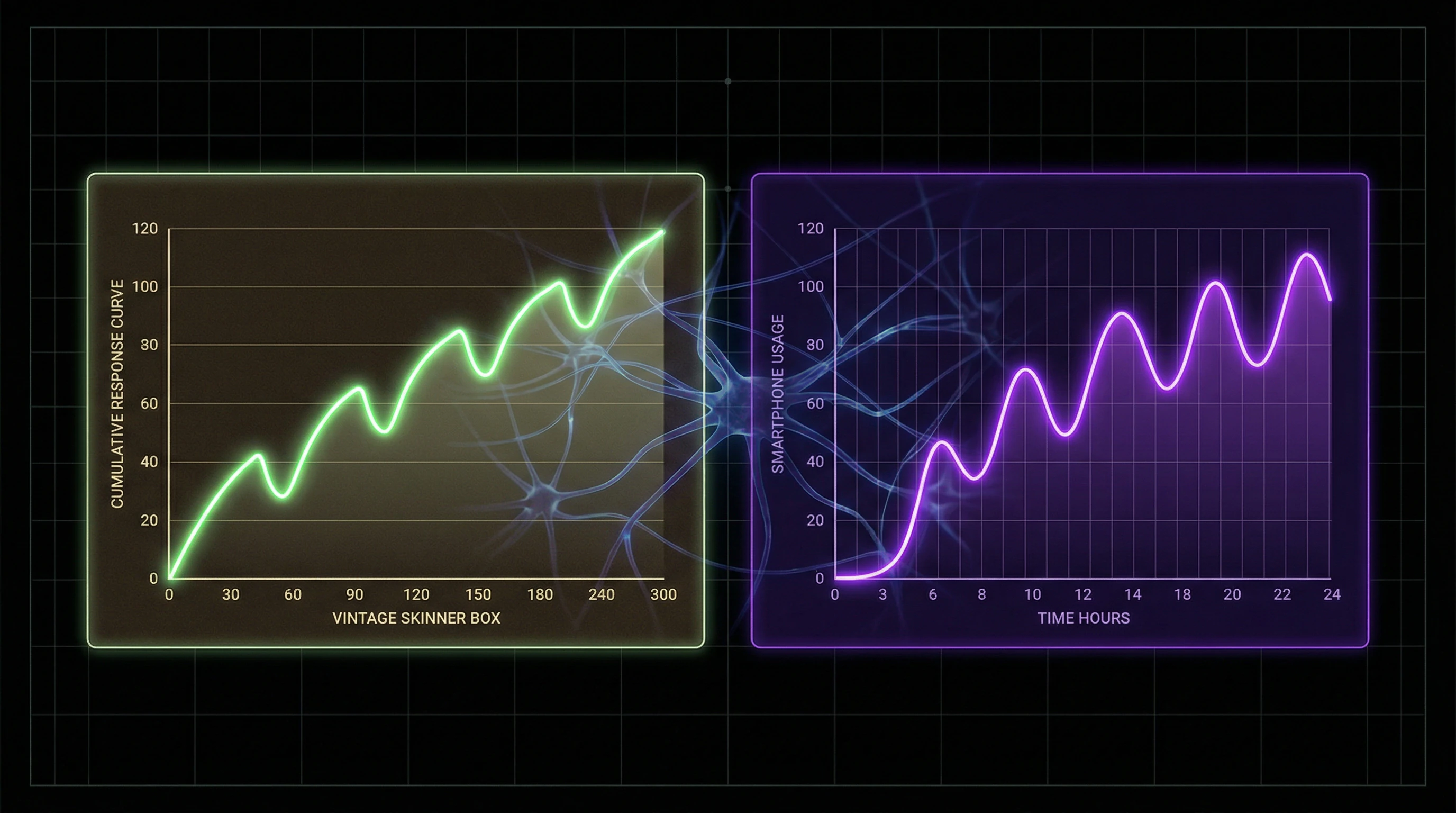
Skinner identified several reinforcement schedules, but one is critical for understanding app design: variable ratio reinforcement. When rewards arrive unpredictably—not after every action, but randomly—behavior becomes resistant to extinction (S004).
| Reinforcement Schedule | Animal Behavior | App Equivalent |
|---|---|---|
| Fixed (after every action) | Quickly extinguishes without reward | Notification every time—habituation |
| Variable (random) | Continues hundreds of times without reinforcement | Social media feed, push notifications |
A rat receiving a pellet after every press quickly stops pressing when the reward disappears. A rat that received pellets unpredictably continues pressing hundreds of times even without reinforcement. This principle underlies slot machines, social media feeds, and push notifications: you don't know if the next feed refresh will contain something interesting, so you check again and again.
🧩 Boundaries of the Metaphor: Humans Aren't Pigeons, But They're Not Free Agents Either
Skinner's critics rightly point out that human behavior isn't reducible to mechanical reactions to stimuli. We possess language, abstract thinking, capacity for reflection. However, behavioral approach defenders respond: Skinner didn't deny the existence of "internal events," he merely argued that they themselves are behavior subject to the same laws.
- For the purposes of this article, what matters:
- Even if operant conditioning doesn't explain all human behavior, it explains enough to be an effective manipulation tool.
- The key question:
- Not "does Skinner work on humans," but "within what limits and under what conditions." This distinction determines where science ends and speculation begins.
A smartphone isn't just a device. It's an environment where every design element (color, sound, vibration, unpredictability of updates) functions as a lever in a Skinner box. The question is how fully this metaphor describes the reality of your interaction with the screen.

The Steel Version of the Argument: Seven Reasons Why Smartphones Actually Work Like Skinner Boxes
Before examining the evidence and limitations, we need to present the strongest version of the thesis. This is not a straw man, but a steel man — the argument in its most convincing form. For more details, see the Critical Thinking section.
If doubts remain even after this, then the criticism is justified.
🎯 First Argument: Choice Architecture Is Designed to Maximize Engagement
Apps are not neutral. Every interface element — from the color of the notification button to the feed sorting algorithm — is the result of A/B testing aimed at increasing usage time.
This isn't a conspiracy theory, it's a business model: advertising platforms sell attention, so their goal is to keep users engaged as long as possible. Designers explicitly use principles of behavioral psychology, including operant conditioning, to achieve this goal.
If a rat in a Skinner box cannot change the rules of the game, then an app user has limited control over the environment that shapes their behavior.
🎰 Second Argument: Variable Reinforcement Is Built Into Every Notification
When you receive a notification, you don't know in advance whether it will be important (a message from a friend) or trivial (an advertisement). This unpredictability creates a slot machine effect: each app opening is a "spin of the reels."
Variable reinforcement is the most powerful schedule for forming persistent behavior (S004). Social networks, email clients, messengers — all use this principle. Even if 90% of notifications are useless, the remaining 10% are sufficient to maintain the habit of constant checking.
- Unpredictability of reward = maximum behavioral persistence
- Each notification is a potential "winning combination"
- Absence of reward doesn't break the cycle, it strengthens it
🧠 Third Argument: The Dopamine System Responds to Anticipation, Not Reward
Neurobiological research shows that dopamine is released not at the moment of receiving a reward, but at the moment of anticipating it. This means that the very act of checking your phone — before you've seen the notification content — already activates the reward system.
Skinner didn't know about dopamine, but his model predicted exactly this mechanism: behavior is reinforced not by the reward itself, but by the connection between action and consequence. Smartphones exploit this connection at the neurochemical level.
Anticipation of reward is stronger than the reward itself — and this is the foundation of all mobile notification architecture.
🔁 Fourth Argument: Infinite Scroll Eliminates Natural Stopping Points
In traditional media — books, newspapers, TV shows — there are natural boundaries: the end of a chapter, the last page, closing credits. These boundaries provide an opportunity to stop and make a decision: continue or not.
Infinite scroll eliminates these boundaries. Each action (swipe down) is immediately reinforced with new content, without pauses for reflection. This is classic operant conditioning: a continuous chain of "stimulus — response — reinforcement" with no way to exit the cycle.
| Traditional Medium | Natural Boundary | Stopping Opportunity |
|---|---|---|
| Book | End of chapter | Yes, explicit |
| Newspaper | Last page | Yes, explicit |
| TV show | Closing credits | Yes, explicit |
| Infinite feed | Absent | No, requires willpower |
⏱️ Fifth Argument: Timers and Counters Create Artificial Urgency
"Your activity streak: 47 days. Don't break it!" Such mechanics (streak counters) turn app usage into an obligation. Missing a day means losing accumulated "capital."
This is a form of negative reinforcement: you continue the action not for a reward, but to avoid loss. Skinner studied such schedules too: behavior maintained by avoidance of punishment can be just as persistent as behavior maintained by reward (S004).
Fear of loss is often stronger than desire to gain — and this is used deliberately.
🎮 Sixth Argument: Gamification Transfers Game Mechanics to Non-Game Contexts
Points, badges, rankings, levels — all these are game design elements built into fitness, learning, and productivity apps. Gamification works precisely because it uses principles of operant conditioning: each action (a run, completed task, correct answer) is immediately reinforced with a virtual reward.
Critics will say: "But this motivates useful behavior!" True. But this doesn't negate the fact: the mechanism is the same as in a Skinner box. The only question is who controls the reinforcement — you or the app developer.
- Operant Conditioning in Gamification
- User action → Immediate virtual reward → Behavior reinforcement. The mechanism is identical to the laboratory, but the context — useful or harmful — depends on the developer's goals.
- Critical Distinction
- The usefulness of behavior doesn't change the fact of conditioning. A fitness app may motivate health, but uses the same dependency architecture as a social network.
📊 Seventh Argument: Behavioral Data Is Used to Personalize Reinforcement
Modern apps don't just apply universal principles — they adapt to each user. Machine learning algorithms analyze which content generates the most engagement and show more of that content.
This is equivalent to a Skinner box adjusting its reinforcement schedule in real time to the individual characteristics of the rat. Personalization makes conditioning even more effective because each user receives an optimized version of the "lever and pellet" tailored to them.
Personalized conditioning is not just applying Skinner's principles, but perfecting them through machine learning. Each user receives an individually optimized trap.
The attention economy and neuroscience converge on one point: smartphone architecture is designed to maximize engagement through mechanisms that Skinner described 70 years ago. The question is not whether this works, but where the boundaries of this effect lie and how inevitable it is.
Evidence Base: What Research Says About Digital Conditioning Mechanisms and Where Scientific Consensus Boundaries Lie
The steel version of the argument sounds convincing, but science demands empirical evidence. More details in the Sources and Evidence section.
🔬 Level One: Skinner's Classic Experiments and Their Reproducibility
The basic principles of operant conditioning have been reproduced multiple times in laboratory conditions across various animal species. Skinner demonstrated that behavior can be shaped through consequence control, and that variable reinforcement creates the most persistent patterns (S004).
However, experiments were conducted in strictly controlled environments where the animal had no alternative sources of reinforcement. Humans in the real world exist in far more complex environments where multiple factors compete for attention.
📊 Level Two: Research on Smartphone Usage Time and Checking Patterns
The average user checks their phone 50–80 times per day, often automatically, without conscious intention. Many checks occur in response to notifications, but a significant portion happen spontaneously, during moments of boredom or anxiety.
This aligns with the operant conditioning model: behavior has become automatic, requiring no conscious decision. But correlation doesn't prove causation—people may check their phone frequently because it genuinely contains important information (work, family, news).
🧬 Level Three: Neurobiological Data on Dopamine and the Reward System
fMRI studies show that notifications and social feedback activate the same brain regions as other forms of reward. The dopamine system responds more strongly to reward unpredictability than to the reward itself—neurobiological confirmation of the variable reinforcement principle.
Reward system activation doesn't mean "addiction" in the clinical sense. The brain responds to any significant stimuli—from food to music. The question is degree and consequences.
⚖️ Level Four: Debates About "Digital Addiction" and Diagnostic Criteria
The term "smartphone addiction" is widely used in popular literature but lacks official status in diagnostic manuals (DSM-5, ICD-11). Addiction criteria include tolerance, withdrawal, loss of control, continued use despite negative consequences.
- Do they apply to smartphones?
- Partially. Some users demonstrate signs of compulsive use, but most don't.
- Scientific consensus
- Problematic smartphone use exists, but calling it "addiction" in the strict sense is premature. Operant conditioning explains habit formation, but not necessarily pathology.
🧾 Level Five: Research on Intervention Effectiveness
If smartphones truly condition behavior through Skinner's mechanisms, then interventions aimed at breaking the "stimulus-response" link should be effective. Disabling notifications reduces checking frequency but doesn't eliminate the habit completely.
"Digital detox" provides short-term relief, but patterns quickly restore after returning to use. This aligns with operant conditioning theory: behavior shaped by variable reinforcement is resistant to extinction. However, this shows that simple interventions are insufficient—environmental change is required, not just individual effort.
🔎 Level Six: Methodological Critique and Alternative Explanations
Critics of the behavioral approach point to several problems. Most research is based on self-reports, which are unreliable: people poorly estimate their smartphone usage time.
- Correlational studies don't prove causation: perhaps anxious people check their phone more often, rather than the phone making them anxious.
- Alternative explanations (social pressure, FOMO, genuine need to stay connected) may be as valid as operant conditioning.
- Ignoring mental processes limits the model's explanatory power: modern cognitive psychology shows that internal states matter.
The connection between the attention economy and surveillance capitalism complicates the picture: the smartphone isn't just a conditioning tool, but a product of a system where your attention is a commodity. This requires analysis not only of psychology, but of economic incentives.
The Mechanics of Causality: How to Distinguish Conditioning from Conscious Choice and Why This Boundary Is Blurred
The central question: if operant conditioning works, does this mean smartphone users lack free will? Or are they making a rational choice in favor of convenience and connectivity?
Let's examine the mechanisms that make this boundary unclear.
🧬 Behavioral Automation: When Habit No Longer Requires Decision-Making
Operant conditioning doesn't eliminate free will, but it makes it less relevant. When behavior becomes automatic—executed without conscious intention—the question of "choice" loses meaning. For more details, see the section Climate and Geology.
You don't "decide" to check your phone; you simply do it, like breathing or blinking. Neurobiology confirms: repetitive actions transition from the prefrontal cortex (conscious control) to the basal ganglia (automatic programs).
This isn't pathology, but normal brain function—conservation of cognitive resources. The problem is that automation can reinforce undesirable behavior just as effectively as desirable behavior.
🔁 The Feedback Loop: How Environment Shapes Behavior That Shapes Environment
Skinner emphasized: behavior is not a property of the organism, but a function of the interaction between organism and environment. You're not "addicted to your phone" in a vacuum—you exist in an environment that constantly reinforces certain actions.
But there's a nuance: your behavior also changes the environment. The more you interact with an app, the more data it collects, the more precisely the algorithm adapts to you, the stronger the reinforcement.
- User interacts with the app
- System collects data about their preferences
- Algorithm optimizes content for their profile
- Reinforcement becomes more precise and effective
- Cycle repeats with increased intensity
The question "who's to blame—the user or the app?" is incorrect: the system functions as a unified whole.
⚙️ Confounders: Social, Economic, and Cultural Factors
Operant conditioning doesn't occur in isolation. A person checks their phone not only because they're "conditioned," but also because their employer expects quick responses, friends organize meetups through messaging apps, and important information is only available online.
| Factor | Influence Mechanism | Status in Analysis |
|---|---|---|
| Professional requirements | Expectation of quick message responses | Economic confounder |
| Social coordination | Organization of meetings and events through apps | Social confounder |
| Information accessibility | News, weather, transit only available online | Structural confounder |
| Cultural norms | Requirement of constant availability | Cultural confounder |
These factors don't negate the role of conditioning, but they show that the problem doesn't reduce to individual "weakness of will." The environment is designed such that refusing to use a smartphone carries real social and economic costs. This relates to a broader phenomenon—see the attention economy and surveillance capitalism.
Conflicts and Uncertainties: Where Sources Diverge and Why Consensus Is Impossible
The scientific community is not united in assessing the role of operant conditioning in digital behavior. We examine key points of disagreement. More details in the Cell Biology section.
🧩 Dispute One: Is the Behavioral Approach Sufficient or Do We Need a Cognitive Model?
Skinner's defenders argue that his approach is self-sufficient: predicting and controlling behavior doesn't require reference to mental states. Critics object: ignoring cognitive processes (expectations, beliefs, goals) makes the model incomplete.
A person may check their phone not because they're "conditioned," but because they expect an important message. This expectation is a mental state that cannot be reduced to reinforcement history.
Consensus: Both approaches have value, but full understanding of digital behavior requires integration of behavioral and cognitive perspectives. The question isn't who's right, but which level of analysis to choose for a specific task.
🔬 Dispute Two: Is "Digital Addiction" a Real Phenomenon or Moral Panic?
Some researchers insist that problematic smartphone use is a serious public health issue requiring clinical recognition. Others consider it moral panic, inflated by media and the "digital detox" industry.
| Argument "For" | Argument "Against" |
|---|---|
| There are people whose smartphone use causes real harm: sleep disruption, reduced productivity, social isolation | Most users don't experience clinically significant problems; the term "addiction" stigmatizes normal behavior |
Consensus is absent because the question is not only scientific but normative: where's the line between "a lot" and "too much"? This is a boundary that science can inform but cannot establish alone.
📊 Dispute Three: Who Bears Responsibility—User or Platform?
If smartphones truly use operant conditioning principles to manipulate behavior, who should bear responsibility for the consequences?
- Libertarian Position
- Users are free to choose how to use technology. Government shouldn't interfere with app design.
- Paternalistic Position
- Platforms possess asymmetric power (data, algorithms, design) and must bear responsibility for ethical design.
- Middle Position
- Responsibility is distributed: users should develop digital literacy, platforms should comply with transparency standards, regulators should establish minimum safety requirements.
Each position rests on different assumptions about the nature of freedom, power, and justice. Scientific data can support any of them—depending on which questions you ask.
🌐 Dispute Four: Is the Mechanism Universal or Does It Depend on Culture and Individuality?
Most research is conducted in WEIRD countries (Western, Educated, Industrialized, Rich, Democratic). Do the same conditioning mechanisms work in other cultural contexts?
Some scientists suggest that individual differences (impulsivity, anxiety, social need) determine susceptibility to digital conditioning more than app design itself. Others point to the role of social norms: in cultures with high collectivism, smartphones may serve as tools for social connection rather than sources of solitary stimulation.
Consensus is impossible without global longitudinal studies that account for cultural variables. Until such data exists, any conclusions remain preliminary.
These four disputes show: the question of the smartphone as a "Skinner box" is not merely a scientific question. It's a question about how we define freedom, health, responsibility, and justice in the digital age. Science can provide facts, but cannot resolve conflicts of values.