
Loot boxes — game mechanics with randomized rewards — are structurally and psychologically identical to gambling, yet exist in a legal gray zone. Research from 2019–2023 demonstrates links between loot box purchasing and problem gaming behavior, as well as gambling addiction. The video game industry employs the same reinforcement triggers as casinos, but without age restrictions or regulation. This article examines the mechanism of impact, the evidence level for addiction links, and a verification protocol for parents and players.
🖤 Your child opens another "treasure chest" in their favorite game. The screen flashes gold, triumphant music plays — but inside, just another common item. "One more time," they think, and their hand reaches for the button to buy the next box. This scene repeats millions of times daily around the world, and the video game industry earns billions of dollars from it. But what if behind the bright packaging lies an exact replica of slot machine mechanics, only without age restrictions and government oversight? 👁️ Welcome to the world of loot boxes — where the line between entertainment and gambling has been erased so skillfully that even researchers debate the terminology.
What Loot Boxes Really Are: From Game Mechanic to Structural Casino Twin
The term "loot box" became firmly established in gamers' vocabulary in the mid-2010s, but its definition remains subject to debate. Researchers propose a broader concept—"Random Reward Mechanisms" (RRM), which includes any game systems with unpredictable outcomes (S002).
This category encompasses virtual items, characters, in-game currency—anything distributed based on chance rather than player choice. More details in the Cognitive Biases section.
🧩 Structural Anatomy: What Makes a Loot Box a Loot Box
At its core lies a simple formula: the player spends a resource (time, currency, or real money) to receive a random reward from a predetermined set.
- Probability opacity—players often don't know the exact odds of obtaining desired items
- Variable reinforcement—rewards vary in value, creating a "near-miss" effect
- Visual and audio design of the opening process, maximizing emotional response
Research identifies two RRM categories: "isolated" from the real economy (rewards cannot be sold for real money) and "embedded" in it (a secondary market exists where virtual items are exchanged for real currency) (S002).
⚙️ Legal Gray Zone: Why Loot Boxes Aren't Considered Gambling
In most jurisdictions, gambling requires three components: stake, chance, and prize. Loot boxes formally meet the first two, but the third remains contested.
Regulators exclude loot boxes from the definition of gambling, arguing that players "always get something" and that virtual rewards supposedly have no real monetary value. This logic ignores the existence of secondary markets and the subjective value of virtual items to players.
The absence of regulation allows companies to implement gambling mechanics in products accessible to children, without age restrictions or warnings (S006).
🔎 Monetization Evolution: From Pay-to-Play to Pay-to-Maybe-Win
Loot boxes emerged as the industry's response to the shift toward free-to-play models. Instead of one-time purchases, developers offered free access with microtransactions.
| Period | Loot Box Character | Monetization Role |
|---|---|---|
| Early 2010s | Earned through achievements, optional | Supplementary revenue |
| Mid-2010s | Paid, contents valuable for progress | Primary revenue source |
| Late 2010s–present | Integrated into gameplay, low probabilities for rare items | Central element of game economy |
Refusing to purchase loot boxes now means significant competitive disadvantage. The mechanic has transformed from optional to mandatory.

Seven Industry Arguments: Why Loot Boxes Are "Not Gambling" — and What Lies Beneath
Before examining evidence of harm, we must honestly represent the position of loot box defenders. The gaming industry advances several arguments that sound convincing at first glance. More details in the Psychology of Belief section.
We'll consider them in their strongest formulation — the steelman principle, the opposite of strawman argumentation.
- Argument 1: Guaranteed Value
- Defenders claim that unlike classic gambling, where players can lose their entire stake, loot boxes always provide some reward. Even an unwanted item has functionality in the game. This argument relies on the legal definition of gambling, which requires the possibility of total loss.
- Critics point out: the subjective value of an unwanted item can be zero, especially if the player already has dozens of duplicates (S001).
- Argument 2: Optionality
- Loot boxes are an additional mechanic; players can enjoy the game without purchasing them. Unlike casinos, where participation is the primary activity, in video games loot boxes are presented as optional.
- Reality: many games artificially slow progress without purchases, and players who don't spend money receive a significantly worse experience. Research shows that many games use "pay-to-win" mechanics, where purchasing loot boxes provides competitive advantage (S002).
- Argument 3: Trading Card Analogy
- The industry compares loot boxes to card packs, stickers, or surprise eggs. These products have existed for decades and aren't considered gambling.
- Critical difference: physical collectibles require a trip to the store and are limited by pocket money, whereas loot boxes are available instantly, 24/7, often linked to a parent's credit card, and can be opened dozens of times per hour (S003).
Parental controls aren't a solution if most parents don't understand loot box mechanics and don't recognize their similarity to gambling.
- Argument 4: Parental Controls Solve the Problem
- Industry representatives point to tools that allow limiting children's purchases. Responsibility lies with parents, not developers.
- Research shows: most parents don't understand loot box mechanics. Moreover, many games deliberately complicate control settings and use "dark patterns" in design to circumvent restrictions (S004).
- Argument 5: Lack of Direct Causal Evidence
- One of the most scientifically grounded arguments: existing research shows correlation between loot box purchases and problem behavior, but doesn't prove causation. Perhaps people prone to gambling addiction simply buy loot boxes more often.
- This is a valid methodological observation, and researchers acknowledge the limitations of cross-sectional data (S005). However, absence of definitive proof of causation doesn't mean absence of risk, especially when protecting children is at stake.
| Argument | Industry Position | Critical Counterargument |
|---|---|---|
| Economic Necessity | Loot boxes are a necessary revenue source to support free-to-play games | Successful games with ethical monetization exist; many companies use loot boxes in paid games where they're unnecessary (S006) |
| Regulation Will Kill Innovation | Strict regulation creates precedent for excessive government interference | Experience from other industries shows: reasonable regulation protects consumers without stifling innovation (S007) |
Each of these arguments contains a kernel of logic, but each also relies on an incomplete picture of reality. Defense of loot boxes works only until we examine design mechanics, psychological effects, and harm data.
Key point: absence of regulation doesn't mean absence of a problem. It means the problem remains invisible to most parents and policymakers (S008).
Evidence Base: What the Data Says About the Link Between Loot Boxes and Problem Behavior and Gambling Addiction
Moving from arguments to facts, it's necessary to assess the quality and volume of research examining the impact of loot boxes on players. Since this mechanic emerged in the mid-2010s, a significant body of data has accumulated, though methodological limitations remain. More details in the Logic and Probability section.
📊 Correlational Studies 2018-2022: Consistent Link with Problem Gambling
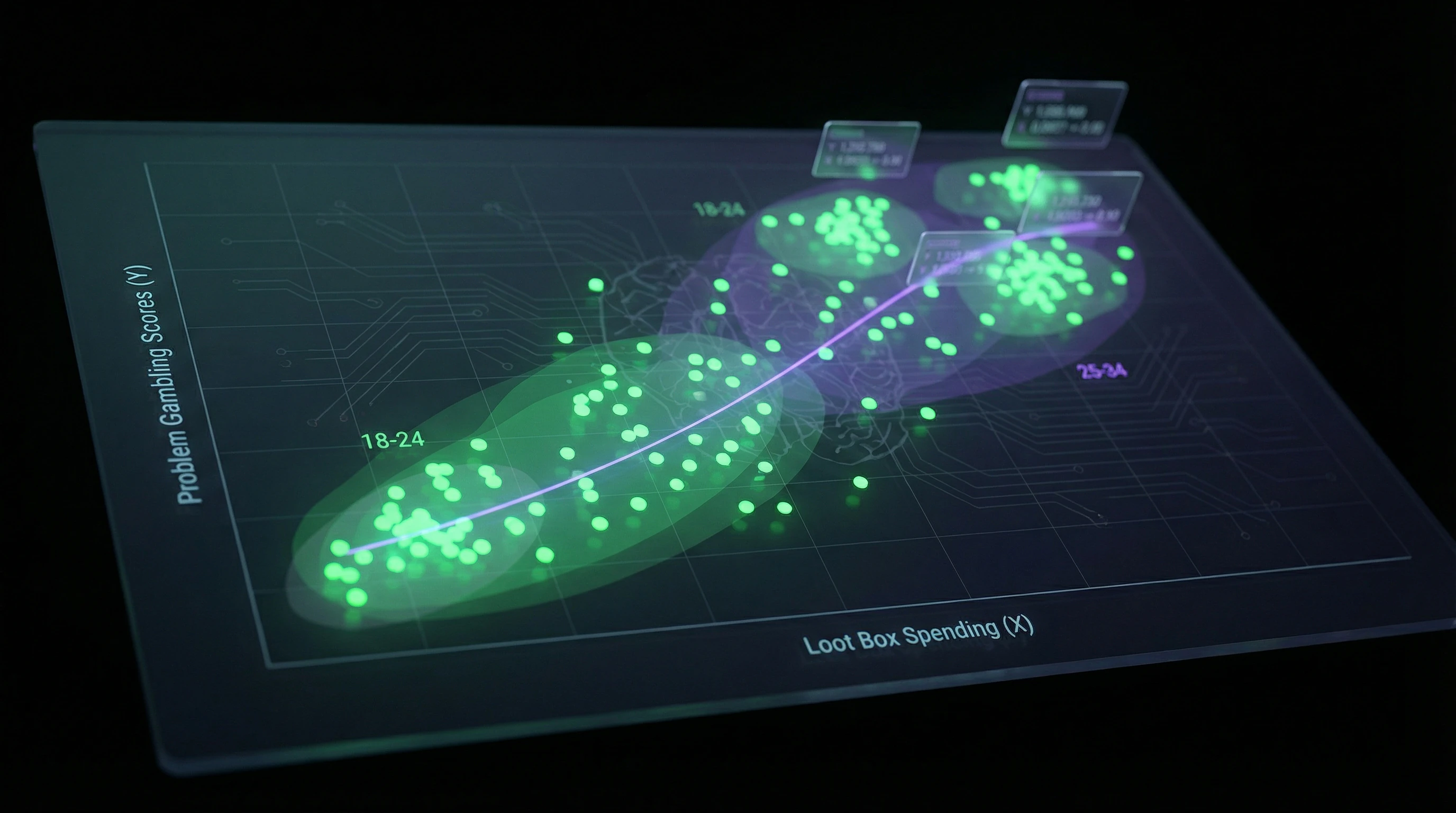
A systematic review of studies shows a consistent correlation between loot box spending and indicators of problem gambling behavior. A 2022 study published in Addictive Behaviors examined whether gamers taking screening tests for gambling addiction actually think about loot boxes when answering questions about "gambling." Results showed that a significant portion of respondents indeed include loot boxes in their understanding of gambling activity, confirming the psychological equivalence of these mechanics in players' perception (S001).
🧪 Mechanisms of Psychological Impact: Variable Reinforcement and Near-Miss Effect
A 2023 study using self-determination theory and the dualistic model of passion offers an explanation for the link between loot boxes and problem behavior (S005). The authors hypothesize that frustration of basic psychological needs (autonomy, competence, relatedness) can lead to the development of obsessive passion for loot boxes, which in turn correlates with problem gaming behavior.
The key mechanism is variable reinforcement: the player doesn't know when they'll receive the desired reward, creating the same behavioral pattern as slot machines. The near-miss effect (when a player "almost" gets a rare item) amplifies motivation to continue trying, activating the same neural pathways as an actual win (S002).
Loot boxes and casino games activate identical psychological mechanisms: outcome uncertainty, variable reinforcement, illusion of control. The difference in visual presentation doesn't change the essence of their impact on the brain.
🧾 Prevalence Data: How Many Players Are Involved
Precise data on loot box purchase prevalence varies depending on the study and gaming platform, but the overall picture is concerning. Research shows that 30% to 50% of players in free-to-play games have made at least one loot box purchase, while a small group of "whales"—players spending hundreds and thousands of dollars—provides the bulk of revenue (S003).
Adolescents are especially vulnerable: their impulsivity, immature prefrontal cortex, and susceptibility to social pressure make them ideal targets for gambling-like mechanics (S004). This isn't a design accident—it's the target audience.
🔁 Longitudinal Data: The Causality Problem
The main limitation of existing research is its cross-sectional design, which doesn't allow establishing the direction of causality. Three scenarios are possible: (1) loot boxes cause problem behavior; (2) people predisposed to problem behavior more often buy loot boxes; (3) there's a bidirectional relationship or a common third factor.
A 2023 study directly addresses this problem: the authors call for longitudinal studies tracking players over time to establish temporal sequence and causality (S005). Without such data, we can speak of association, but not cause.
| Study Type | Strengths | Limitations |
|---|---|---|
| Cross-sectional (2018–2022) | Large samples, quick results, consistent correlation | Don't establish causality, snapshot at one point in time |
| Longitudinal (rare) | Track changes over time, can establish direction of relationship | Expensive, require years of observation, high dropout |
| Experimental (isolated) | Control variables, can prove causality | Ethical constraints, artificial conditions |
⚖️ Comparative Studies: Loot Boxes vs Traditional Gambling
Several studies have directly compared the psychological and behavioral patterns of players purchasing loot boxes with patterns of people engaged in traditional gambling. Results show significant overlap: players regularly buying loot boxes demonstrate similar cognitive distortions (illusion of control, gambler's fallacy), emotional reactions (excitement when opening, disappointment at failure), and behavioral patterns (chasing losses, stake escalation) (S006).
This similarity isn't accidental—many loot box developers consult with gambling design experts or directly borrow mechanics from casino games. The link between loot box spending and problem gambling remains significant regardless of specific mechanic features (cash-out possibility, pay-to-win elements) (S001).
🌍 International Perspective: Differences in Regulation and Their Effects
Different countries have responded differently to the loot box problem. Belgium and the Netherlands have recognized certain types of loot boxes as gambling and banned them. The UK conducted a parliamentary inquiry but hasn't yet imposed a ban. China has required developers to disclose item drop probabilities.
These natural experiments allow assessment of different approaches' effectiveness. Preliminary data shows that probability disclosure has limited effect on player behavior, while direct bans effectively eliminate the problem but may displace players to unregulated platforms (S008).
- Probability Disclosure (China)
- Players know the odds, but this doesn't reduce purchases. Reason: information doesn't change the psychological mechanism of variable reinforcement. A person may know the probability is 1%, but this doesn't stop attempts.
- Direct Ban (Belgium, Netherlands)
- Effective in eliminating the mechanic, but creates a displacement problem to gray markets. Players seek alternatives on unregulated platforms.
- Age Restrictions and Spending Limits
- Theoretically logical, but difficult to implement. Require age verification and spending tracking, which the industry resists.
Neurobiology of Addiction: Why the Brain Can't Tell a Loot Box from a Slot Machine
Loot boxes exploit ancient evolutionary brain systems that aren't adapted to modern manipulation technologies. To understand the mechanism of attention capture and repetitive behavior formation, we need to examine the neurobiology of reward. More details in the Modern Movements section.
🧬 Dopamine System and Reward Prediction
Dopamine is released not when receiving a reward, but in anticipation of it—especially when the outcome is uncertain. The ventral tegmental area and nucleus accumbens are maximally activated precisely in the moment of uncertainty.
Loot boxes amplify this effect through opening animations: spinning items, building music, visual tension. Peak dopamine occurs before the player learns the result (S001). Even a disappointing reward doesn't cancel the neurochemical release that already occurred—the behavior is reinforced regardless of the final outcome.
The brain rewards anticipation, not results. A loot box is the engineering of that moment of uncertainty.
🔁 Variable Reinforcement: The Most Persistent Learning Pattern
Operant conditioning research has shown: variable reinforcement (reward arrives unpredictably) creates behavior most resistant to extinction. Loot boxes operate on exactly this principle.
| Reinforcement Type | Behavior | Resistance to Extinction |
|---|---|---|
| Continuous (reward every time) | Forms quickly, disappears quickly | Low |
| Variable (random reward) | Forms slower but deeper | High |
| Loot box (rare items, random timing) | Maximum motivation to continue | Extremely high |
The player doesn't know which box will contain the desired item. Each failure is interpreted by the brain not as a signal to stop, but as an indicator: "next time I'll definitely get lucky" (S001). This gambler's fallacy has a neurobiological basis in prefrontal cortex function and its interaction with the limbic system.
⚡ Near-Miss Effect: Loss as Reward Activator
Near-miss—when a player "almost" gets the desired item—activates the same brain regions as an actual win. Neuroimaging studies confirm: the illusion of progress motivates continued attempts (S002).
Loot boxes are often designed to show rare items during the opening process, even when the algorithm has already determined the player won't receive them. This visual manipulation exploits limitations in human probability perception and creates a false sense of proximity to the goal.
- Near-Miss Effect
- Activation of the reward system during a loss that's close to a win. The brain interprets this as "I was close," not "I lost."
- Why This Is Dangerous
- Loss becomes a motivator rather than a deterrent. The player continues attempts, convinced of imminent success.
🧷 Adolescent Brain Immaturity: Window of Vulnerability
The prefrontal cortex—the region for impulse control and long-term consequence evaluation—doesn't fully mature until age 25. In adolescents and children, this area is still developing, while the limbic system (emotions, reward) is already fully functional.
This imbalance creates a critical period when young people are especially susceptible to impulsive decisions and immediate reward mechanics. Research indicates: loot boxes in video games can condition children toward gambling behavior precisely when the brain is most plastic (S003). This isn't just entertainment—it's the formation of neural patterns during a critical developmental period.
🔄 From Conscious Choice to Automaticity
With repeated behavior, control shifts from the prefrontal cortex to the basal ganglia—structures of automatic actions. Loot boxes accelerate this transition: one click, constant availability of new boxes, integration into gameplay.
- First purchases—conscious decision (prefrontal cortex active)
- Repetition—formation of associations (basal ganglia activate)
- Habit—automatic action (prefrontal cortex disengages)
- Addiction—behavior resistant to rational control
When behavior becomes automated, a person continues buying loot boxes even when consciously understanding its irrationality (S004). The brain works against its own decision.
Habit is when the prefrontal cortex surrenders control to the basal ganglia. A loot box is the engineering of that transition.
Data Conflicts and Uncertainties: Where Research Diverges and What It Means
Scientific integrity requires acknowledging areas where data is contradictory or insufficient. Loot box research is a relatively young field, and some questions remain open. More details in the section Crystals and Talismans.
🧩 The Definition Problem: What Counts as Problem Behavior
Different studies use different tools to measure problem behavior: Problem Gambling Severity Index (PGSI), DSM-5, proprietary scales. Result: the same player may be classified as "at risk" in one study and "normal" in another.
This doesn't mean the data is false. It means that the correlation between loot boxes and problem behavior exists (S001, S005), but its magnitude depends on how we define "problem."
| Instrument | Focus | Risk of Underestimation |
|---|---|---|
| PGSI | Financial losses, control | Psychological dependence without money |
| DSM-5 | Clinical addiction criteria | Subclinical behavioral forms |
| Custom scales | Video game specificity | Incomparability between studies |
📊 Effect Size: How Large Is the Correlation Really
Research shows a link between loot box spending and problem behavior, but the correlation magnitude varies: from r = 0.25 to r = 0.50. This means loot boxes explain 6–25% of the variance in problem behavior.
The remaining 75–94% is family, mental health, social isolation, genetic predisposition, access to money. Loot boxes are one factor, not the sole cause.
But this isn't an excuse. Even if loot boxes explain 10% of risk, they remain a modifiable factor — unlike genetics or family history.
🔄 Reverse Causality: Who Chooses Whom
Critical question: do people predisposed to gambling choose games with loot boxes, or do loot boxes create this predisposition?
- Hypothesis 1: Selection
- People with high impulsivity and low control already seek gambling mechanics. Loot boxes attract them but don't create the problem.
- Hypothesis 2: Sensitization
- Loot boxes train the brain in variable reinforcement patterns. Even people without predisposition can develop problem behavior.
- Hypothesis 3: Mutual Reinforcement
- Both processes work simultaneously. Predisposition + design = accelerated addiction development.
Longitudinal studies (which track the same people for years) could separate these hypotheses, but they're scarce. (S001) shows correlation, but not causality in the strict sense.
🌍 Cultural and Age Differences
Most research is conducted on Western samples (USA, Europe, Australia). Data on Asia, Latin America, Africa is virtually absent. This means we don't know how cultural differences in attitudes toward money, gambling, and control affect results.
Age effects are also unclear: adolescents 13–15 and young adults 18–25 may react to loot boxes completely differently, but most studies combine these groups.
⚡ What This Means for Practice
Uncertainty in science is not a reason for inaction. It's a reason for precaution and transparency.
- Regulators must act based on available data (S006), not wait for the perfect study.
- Industry must fund independent longitudinal research, not just defend its interests.
- Parents and educators must know: loot boxes aren't just "cosmetics," they're mechanics that activate the same neurobiological systems as casinos.
- Players must have access to information about probabilities, spending, and risks — just like in real casinos.
Conflicts in data are normal. But they shouldn't be a pretext for ignoring the problem.
Counter-Position Analysis
⚖️ Critical Counterpoint
The arguments below point to methodological limitations of research, insufficient evidence of causality, and the risk of excessive data interpretation. They do not deny the existence of the problem, but require a more cautious conclusion.
The causality problem remains unresolved
All cited studies are based on cross-sectional data, which does not allow us to claim that loot boxes cause addiction. Reverse causation is possible: people with a predisposition to gambling or impulsivity are more likely to purchase loot boxes. The headline and tone of the article may create an impression of proven causality, although this is not methodologically justified.
Heterogeneity of mechanics is underestimated
The term "loot boxes" is used generically, but the difference between isolated and embedded reward systems is enormous. Isolated loot boxes may be no more dangerous than collectible cards or Kinder Surprises. Equating all mechanics under one term may lead to excessive regulation of harmless systems.
Absence of long-term effects data
There are no longitudinal studies showing that children who purchased loot boxes are more likely to become problem gamblers in adulthood. The analogy with casinos is intuitive, but not empirically proven. The conditioning effect may be overestimated.
Ignoring positive aspects of engagement
The article focuses on risks, but does not consider that for many players, loot boxes are a source of enjoyment, social interaction (item trading, discussing drops), and motivation to play. Self-Determination Theory shows that satisfying needs through gaming can be harmonious, not just obsessive.
Risk of moral panic
Historically, new technologies (comics, rock music, video games) have raised concerns about their impact on children, which later proved to be exaggerated. Perhaps the current criticism of loot boxes is part of a moral panic cycle, and in 10 years data will show that the risks were overestimated. The article could have emphasized this uncertainty more strongly.
FAQ
Frequently Asked Questions

Author of the Cognitive Immunology Hub project. Researches mechanisms of disinformation, pseudoscience, and cognitive biases. All materials are based on peer-reviewed sources.