
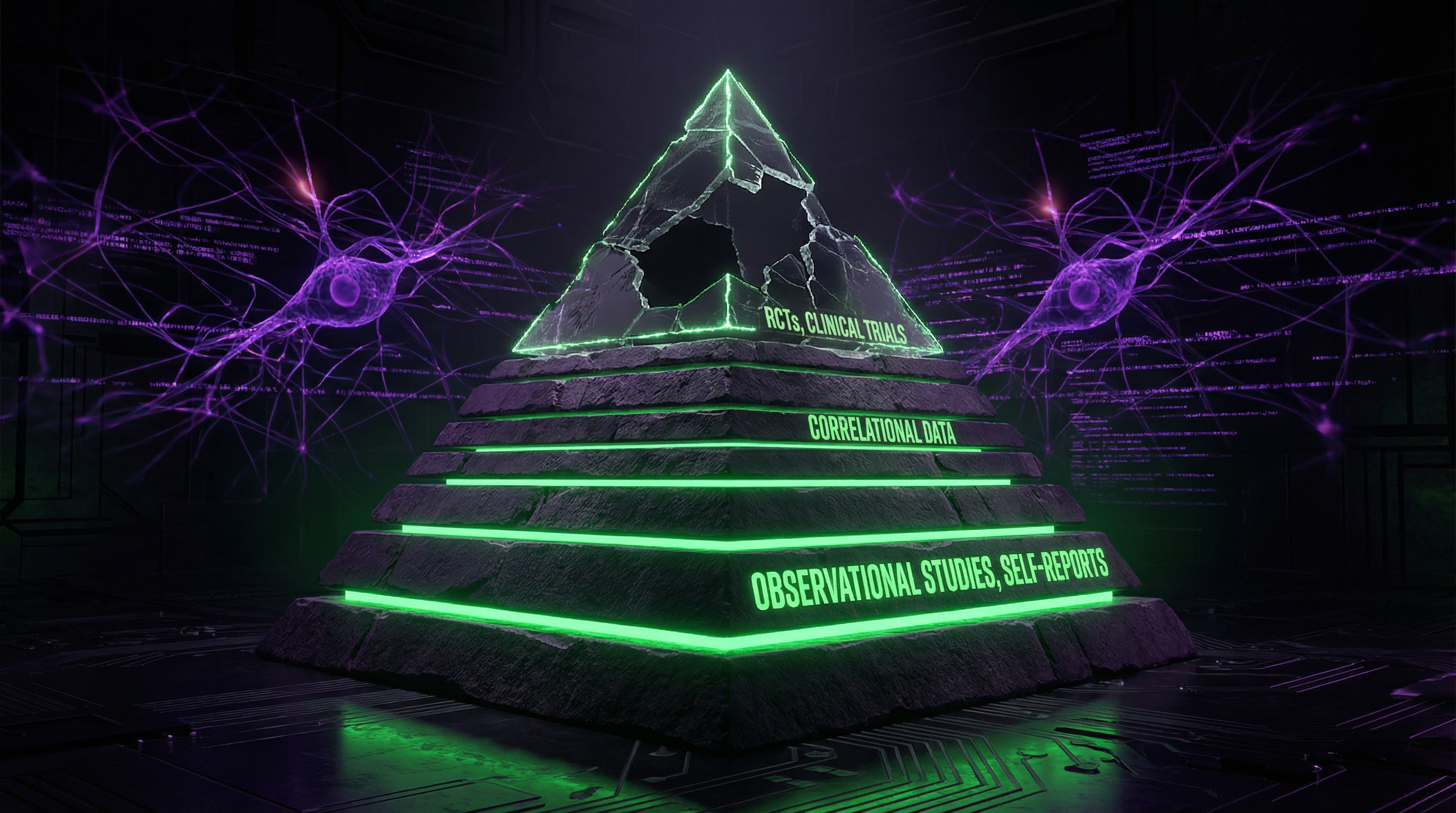
Infinite scroll is not just a convenient interface—it's an engineered attention capture system that exploits the brain's dopamine loops. The mechanism is based on unpredictable reinforcement, similar to slot machines, and creates behavioral addiction without chemical substances. Despite growing research on user experience and attention neuromechanics, direct evidence of clinical addiction to infinite scroll remains insufficient—most data is based on observational studies and self-reports. This article examines the trap mechanism, demonstrates the level of evidence, and offers a cognitive hygiene protocol to protect against attention manipulation.
👁️ You open Instagram while waiting in line for coffee—"just for a minute." Twenty minutes later you're still scrolling, your coffee has gone cold, and you don't remember what you were even looking at. This isn't a failure of willpower. This is the result of engineering work by hundreds of specialists who turned an interface into an attention capture machine. Infinite scroll isn't a bug—it's a feature, designed so you can't stop. And it works at the neurochemical level, not the level of conscious choice.
What is infinite scroll and why it became the standard of digital interaction
Infinite scroll is an interface pattern where content loads automatically as the user moves down the feed, without needing to click a "Load More" button or navigate to the next page. First implemented at scale by Twitter and Facebook in the late 2000s, this technology became the dominant model for social networks, news aggregators, and video platforms. More details in the Logical Fallacies section.
Evolution from pagination to infinite stream
Traditional pagination created natural stopping points — moments when users had to make a decision: continue or close the tab. Infinite scroll eliminated these "friction points."
The infinite scroll mechanism significantly affects user behavior, creating a continuous cycle of content consumption (S011). Research on the Chinese short-video app Douyin showed that the absence of natural boundaries between sessions amplifies engagement time.
Technical components of the trap
Infinite scroll relies on three pillars: asynchronous data loading (AJAX), algorithmic content curation, and adaptive interest prediction. Each subsequent feed item is not selected randomly, but based on analysis of previous interactions — likes, viewing time, scrolling patterns.
- Asynchronous loading
- Content loads in the background while the user views the current screen. No visible waiting — no reason to stop.
- Algorithmic curation
- The system learns to predict exactly what will make you stay for "one more post." Each item is the result of calculating engagement probability.
- Adaptive prediction
- The interest profile updates in real time, creating the illusion that the feed "knows you better than you know yourself."
Boundaries of the phenomenon: convenience vs manipulation
Infinite scroll as a neutral technology serves convenience — in medical databases, educational platforms, catalogs. But when combined with algorithms optimized for attention retention at any cost, and with content specifically selected to provoke emotional reactions, the technology transforms into a capture instrument.
The distinction between these two applications lies not in the code, but in the system's objective function. One maximizes utility, the other — engagement time. One assumes the user can leave at any moment, the other is designed to make leaving as difficult as possible.
The connection between interface and behavior is not magical — it's the result of engineering calculation. Understanding this mechanism is critical for analyzing how algorithms transform connection into dependency.

Seven Arguments That Infinite Scroll Actually Creates Addiction
Before examining the evidence, we need to present the steelman version of the argument — the strongest form of the claim that infinite scroll creates genuine behavioral addiction. This is not a straw man, but the most compelling position that can be built from available data and theoretical models. For more details, see the Critical Thinking section.
🔁 Argument One: Unpredictable Reinforcement Activates the Same Neural Pathways as Gambling
The infinite scroll mechanism is built on the principle of variable ratio reinforcement schedule — the same model used in slot machines. You don't know whether the next post will be interesting, funny, or shocking.
This unpredictability creates stronger motivation to continue than predictable rewards. Psychological constructs related to sources of cognitive brain activity show that such stimulation patterns form persistent behavioral loops (S010).
| Reinforcement Type | Motivation Strength | Resistance to Extinction |
|---|---|---|
| Constant (reward every time) | Medium | Low — stops quickly |
| Variable (random reward) | High | High — persists long |
| Infinite scroll | Maximum | Maximum — self-sustaining |
🧠 Argument Two: The Dopamine System Responds to Anticipation, Not Receipt of Reward
Neurobiological research shows that dopamine is released not at the moment of receiving a reward, but at the moment of anticipating it. Each downward finger swipe on the screen is a micro-bet that the next content will be valuable.
Even if 90% of posts are uninteresting, the remaining 10% create sufficient reinforcement to continue the behavior. The system is optimized not for satisfaction, but for maintaining a state of seeking.
⚙️ Argument Three: Absence of Natural Stopping Points Eliminates Cognitive Barriers to Quitting
Human behavior is structured around completed actions (closure). When you finish reading an article or watching a movie, a natural sense of completion arises that makes it easier to shift attention.
Infinite scroll deliberately eliminates these points. The feed never ends, there's always "one more post." This creates a state of incomplete action (Zeigarnik effect), which is psychologically harder to interrupt.
📊 Argument Four: Usage Metrics Show Patterns Characteristic of Addictive Behavior
Social media usage data demonstrates signs typical of addiction: increasing usage time over time (tolerance), discomfort when access is unavailable (withdrawal), continued use despite negative consequences (loss of control), unsuccessful attempts to reduce usage time.
- Tolerance: increasingly more time required to achieve the same level of satisfaction
- Withdrawal: anxiety and irritation when access is absent
- Loss of control: using longer than planned
- Dissociation: loss of awareness of time spent in the app
Research on Douyin showed that users often don't realize how much time they've spent in the app, indicating a dissociative state characteristic of addictive behavior (S011).
🧬 Argument Five: Individual Personalization Creates a Unique "Dose" for Each User
Machine learning algorithms adapt content to individual vulnerabilities. If you respond to political content — you'll get more politics. If to cute animals — more animals.
The system finds your personal "hook" and exploits it with increasing precision. This is analogous to how drugs of different strengths affect different people, but here the "dose" is selected automatically and continuously optimized. For more on algorithmic manipulation mechanisms, see the article on social media and algorithms.
🕳️ Argument Six: Social Comparison and FOMO Amplify Compulsive Behavior
Infinite scroll doesn't just show content — it shows a curated version of other people's lives. This activates mechanisms of social comparison and fear of missing out (FOMO).
Each pause in scrolling carries the risk of missing important news, a viral meme, or a social event. This fear creates an additional layer of motivation to continue, regardless of actual enjoyment from the process.
⚠️ Argument Seven: Designers Consciously Apply Principles of Behavioral Psychology to Maximize Retention
This is not a conspiracy theory — it's documented practice. Companies hire behavioral design specialists whose job is to increase app usage time.
Techniques from the casino industry, neuromarketing, and behavioral economics are used. The goal is not to make the product useful, but to make it irresistible. Infinite scroll is one tool in this arsenal, designed with understanding of human cognitive vulnerabilities. Similar mechanics are used in video games with loot boxes and other digital products.
Evidence Base: What Research Says About the Link Between Infinite Scroll and Addictive Behavior
Let's move from arguments to facts. More details in the section Cognitive Biases.
📊 User Experience Research: Behavioral Patterns
A study of infinite scroll in the Chinese app Douyin found significant increases in session time with infinite scroll compared to traditional navigation (S011). But this was an observational study without a control group or randomization—causal relationships cannot be established.
| Study Type | What It Measures | Limitation |
|---|---|---|
| Observational | Session time, number of views | No variable control, no causality |
| Correlational | Link between usage and self-reports | Doesn't exclude third factors (content, social connections) |
| RCT (Randomized Controlled Trial) | Isolated effect of interface | Virtually nonexistent in this field |
🧾 Limitations of Current Evidence Base
Most studies are based on self-reports, correlational data, and observations. Randomized controlled trials that would isolate the effect of infinite scroll from content, social connections, and algorithmic curation do not exist.
Claims about "dopamine addiction" often extrapolate data from chemical dependency research to behavioral patterns without direct neurobiological measurements. None of the DSM-5 or ICD-11 criteria for clinical addiction have been systematically tested specifically for infinite scroll.
The absence of RCTs means we don't know whether the interface itself causes addictive behavior or whether it's the result of content, social reinforcement, and recommendation algorithms.
🔎 Neurobiological Research: Brain Activity During Social Media Use
Research shows that different types of stimuli activate different neural networks (S010). However, no direct studies using fMRI or PET scanning specifically during infinite scroll have been found.
Existing data on social media in general show activation of reward areas (nucleus accumbens, ventral tegmental area), but these studies don't separate the interface effect from the content effect. This is a critical distinction: a like from a friend and infinite scrolling are different stimuli with different mechanisms.
- Nucleus accumbens
- Brain region associated with reward processing. Activated by social approval (likes, comments), but not necessarily by the act of scrolling itself.
- Ventral tegmental area (VTA)
- Source of dopamine. Activated by reward anticipation, but its activation during social media use may be caused by content, not interface.
- Variable isolation
- No study has measured brain activity during infinite scroll without social content or without algorithmic curation.
🧪 Comparative Studies: Infinite Scroll vs. Pagination
Direct comparisons of long-term effects of infinite scroll and pagination on psychological well-being are virtually nonexistent. Most studies measure short-term metrics: time on site, number of views, bounce rate—important for business, but not answering the question about mental health impact.
This means we don't know whether infinite scrolling itself causes long-term behavioral changes or whether it's an artifact of short-term session time increases. The link between increased usage time and development of clinical addiction has not been established.
- Find a study that compares infinite scroll and pagination on the same content
- Check whether it measures long-term effects (weeks, months), not short-term (minutes, hours)
- Ensure that social factors are controlled (likes, comments, algorithm)
- Verify whether DSM-5 or ICD-11 criteria were used to assess addiction
Such a study has not been found in available literature. This doesn't mean infinite scroll is harmless—it means the evidence of its harm is weaker than often claimed.
Neuromechanics of Attention Capture: How the Dopamine Loop Works at the Brain Level
To understand why infinite scroll is so effective, it's necessary to examine the basic neurobiology of the reward system and how it's exploited by digital interfaces. More details in the section Statistics and Probability Theory.
🔁 The Dopamine System: Not Pleasure, but Prediction and Motivation
Common misconception: dopamine is the "pleasure hormone." In reality, dopamine is linked to reward prediction and motivation for action.
When you anticipate a reward, dopamine levels rise, creating a state of "wanting" that differs from "liking." Infinite scroll exploits precisely this "wanting" system: each downward swipe is an action in anticipation of potential reward (interesting content), which maintains high dopamine levels and motivation to continue.
Dopamine isn't the reward—it's the anticipation of it. The system runs on expectation, not receipt.
🧬 Variable Reinforcement and Habit Formation: Why Unpredictability Beats Predictability
Classic experiments by B.F. Skinner demonstrated that variable reinforcement (when rewards arrive unpredictably) creates more persistent behavior than fixed reinforcement.
This explains why people spend hours playing slot machines: they don't know when the win will come, but they know it's possible. Infinite scroll works similarly: you don't know if the next post will be valuable, but the probability is high enough to keep going (S001).
| Reinforcement Type | Predictability | Behavior Persistence | Example |
|---|---|---|---|
| Fixed | High | Low | Monthly paycheck |
| Variable | Low | High | Slot machine, infinite scroll |
🧷 Cognitive Load and Automation: How Scrolling Becomes Unconscious
With repetition, an action transitions from a controlled process (requiring conscious attention) to an automatic one (performed without awareness). Scrolling through a feed is a motorically simple action that quickly becomes automated.
This means you can continue scrolling without making a conscious decision to do so. Automation lowers the cognitive barrier to continuing the behavior and makes it more resistant to attempts at volitional control. The automation mechanism is one of the key factors why social media algorithms are so effective at capturing attention.
- Controlled Process
- Requires conscious attention and volitional effort. Example: opened the app for the first time, consciously decided to check the feed.
- Automatic Process
- Executed without awareness or volitional control. Example: opened the app "on autopilot" while waiting, not remembering when it happened.
⚙️ The Role of Contextual Triggers: How Environment Activates the Pattern
Behavioral habits are linked not only to internal states but also to external contexts. Certain situations (waiting, boredom, loneliness) become triggers for opening the app and starting to scroll.
Over time, the connection between context and behavior strengthens, and the action launches almost automatically when entering a familiar situation. This explains why people open Instagram "on autopilot" without even realizing they're doing it. Understanding these mechanisms is critical for developing protocols to protect against manipulative design.
- Context activates the association (boredom → open app)
- Action is performed automatically, without conscious decision
- Variable reinforcement maintains the behavior
- Context-behavior connection strengthens with each repetition
Conflicting Data and Areas of Uncertainty: Where the Evidence Diverges
Scientific integrity requires acknowledging: not all researchers agree that infinite scroll creates addiction, and significant gaps exist in the data. Learn more in the Epistemology Basics section.
⚠️ The Attribution Problem: Infinite Scroll or Content?
A key methodological challenge: it's impossible to clearly separate the effect of the interface (infinite scroll) from the effect of the content. Perhaps people spend extensive time on social media not because of infinite scrolling, but because the content is genuinely interesting or socially significant.
Studies that isolate these variables—for example, comparing identical content with and without infinite scroll—are virtually nonexistent. This means most conclusions about "interface addiction" rely on correlation rather than causation.
🔎 Individual Differences: Why Not Everyone Becomes "Addicted"
If infinite scroll truly creates addiction through universal neurobiological mechanisms, why don't all users demonstrate problematic usage? Significant individual differences exist in vulnerability to addictive behavior, linked to genetics, personality traits, mental health, and social context.
The absence of research identifying risk factors specifically for problematic infinite scroll usage limits the ability to make universal claims about addiction mechanisms.
Without this data, we cannot distinguish whether infinite scroll is a trigger for vulnerable groups or simply a neutral design element that amplifies pre-existing predispositions.
📊 The Measurement Problem: How to Quantify "Addiction" to an Interface
No validated clinical instruments exist for diagnosing "infinite scroll addiction" (S001). Existing scales measure problematic social media use overall or internet addiction, but don't isolate the specific contribution of interface patterns.
- Tools currently used:
- Bergen Social Media Addiction Scale, Internet Addiction Test—assess behavior overall, without separating design components.
- What's missing:
- Metrics that would measure the impact of infinite scroll specifically, separating it from content, social pressure, and other factors.
- Practical consequence:
- The claim "infinite scroll creates addiction" remains operationally undefined—we can neither prove nor disprove it with existing tools.
This methodological blind spot doesn't mean infinite scroll is harmless. It means the current evidence base is insufficient for causal conclusions. The distinction between "the interface may contribute to problematic use" and "the interface creates addiction" isn't semantics—it's a matter of scientific precision.
Moving forward requires studies that isolate variables, track individual differences, and develop specific measurement instruments. Until then, conflicting data remains an unresolved problem, not evidence for either claim.
Cognitive Anatomy of the Myth: What Psychological Vulnerabilities Does the "Dopamine Trap" Narrative Exploit?
Paradoxically, the narrative about "dopamine addiction" to infinite scroll may itself exploit cognitive biases. More details in the Evolution and Genetics section.
🧩 Technological Determinism: The Allure of Simple Explanations
The idea that technology "makes us addicted" is appealing because it offers a simple explanation for complex social and psychological problems. Instead of unpacking the multifactorial nature of problematic technology use (social isolation, lack of meaning, economic instability), we point to a specific interface element as the "culprit."
This is a fundamental attribution error at the level of technological discourse: we transfer responsibility from the system (attention economy, incentive design) to the object (infinite scroll), even though the object is merely an instrument of the system.
⚠️ Moral Panic and Technophobia: A Historical Pattern
History is full of examples of moral panics around new technologies: novels in the 18th century, comic books in the 1950s, video games in the 1990s. Each time, a new media form was accused of "corrupting youth" and creating addiction.
Many of these fears were not confirmed under rigorous scientific analysis (S002). This doesn't mean concerns about infinite scroll are unfounded, but it requires critical engagement with alarmist claims and distinguishing between real harm and projection of historical anxieties.
🧠 Neurobiological Reductionism: Dopamine as Magical Explanation
Referencing "dopamine" lends scientific legitimacy to an argument, but is often used reductionistically. The dopamine system is involved in virtually all motivated behaviors—from eating to learning (S001).
- Reductionist Move
- "Infinite scroll activates dopamine" → "Therefore, it creates addiction." Logical fallacy: neurotransmitter activation ≠ pathological addiction.
- What's Required to Conclude Addiction
- Nuanced analysis of activation patterns, long-term changes in neural networks, clinical outcomes (tolerance, withdrawal syndrome, loss of control). Current research lacks sufficient evidence (S007).
When neurobiology becomes popularized, it's often simplified to a level where any mention of the brain sounds like a definitive explanation. This is a cognitive bias: we mistake mechanistic description for causal explanation.
🎯 Psychological Vulnerabilities That the Myth Itself Exploits
- Illusion of control through knowledge. If I know that infinite scroll is a "dopamine trap," I feel I'm in control, even though nothing has actually changed.
- Externalization of responsibility. The problem isn't with me, it's with the algorithm. This reduces cognitive dissonance but blocks action.
- Narrative persuasiveness. The story of a "trap" is more memorable and emotionally resonant than nuanced data analysis (S005).
- Social proof. If everyone is talking about dopamine addiction, it must be true. Consensus is often wrong.
Defending against these vulnerabilities requires not denying the problem, but lateral reading of sources and distinguishing between "this sounds scientific" and "this is evidence-based."
Cognitive Hygiene Protocol: How to Protect Your Attention from Interface Manipulation
Regardless of whether we consider infinite scroll a clinical addiction or simply an effective attention capture tool, there are practical strategies for regaining control over your own attention.
✅ Step One: Digital Behavior Audit
Most people significantly underestimate the time spent on social media. Use built-in screen time tracking tools (Screen Time on iOS, Digital Wellbeing on Android) or third-party apps to obtain objective data.
Record not only total time, but also number of sessions, time of day, and usage contexts. This creates a baseline for evaluating the effectiveness of interventions.
Without measurement, there is no awareness. Awareness is the first step toward choice.
⛔ Step Two: Creating Friction Points
If infinite scroll eliminates friction points, create them artificially. Delete social media apps from your phone, leaving access only through a browser.
Use browser extensions that block news feeds (News Feed Eradicator for Facebook, Unhook for YouTube). Set timers on apps. Each additional step between impulse and action increases the likelihood of conscious choice.
- Delete the app from your smartphone
- Install a feed blocker in your browser
- Activate app timer in system settings
- Check the effect after one week
🧭 Step Three: Pattern Replacement
Identify situations that trigger automatic app opening: waiting for transportation, work breaks, before bed.
For each trigger, prepare an alternative action: brief meditation, reading a pre-downloaded article, physical exercise. Replacement works better than simple abstinence—the brain receives stimulation, but in a controlled format.
🔍 Step Four: Information Source Verification
Social media often becomes the primary source of news, which reinforces dependency. Use lateral reading to verify information you see in your feed.
Subscribe to alternative information channels—RSS feeds, newsletters, podcasts. This reduces dependence on a specific platform's algorithm.
⏱️ Step Five: Monitoring and Adaptation
After two weeks, return to your baseline data. Has time in apps changed? Number of sessions? Sleep quality? Anxiety levels?
The cognitive hygiene protocol is not a one-time action, but an iterative process. Interfaces constantly evolve, traps become more sophisticated. Your defense must be equally adaptive.
Attention is a resource you can reclaim. But only if you start protecting it now.
Counter-Position Analysis
⚖️ Critical Counterpoint
The article's position on the manipulative nature of infinite scroll relies on assumptions about designers' intentions and the universality of effects. Here's where the logic may crack.
Overestimating the Degree of Manipulation
Infinite scroll is primarily a convenient interface, not necessarily a malicious trap. Users derive real value: entertainment, information, social connections. Calling it a "trap" means denying their agency and capacity for self-control, and the problem may lie not in the design but in the absence of digital hygiene skills.
Insufficient Data for the Term "Addiction"
The article acknowledges the absence of randomized controlled trials and consensus, yet still uses the term "dopamine trap" — this can be seen as alarmism. Most users don't experience clinically significant problems, and extrapolating the mechanism to everyone is an unwarranted generalization.
Ignoring Positive Effects
Infinite scroll can lower barriers to information access and help people with disabilities — for example, it simplifies navigation for users with motor impairments. It also creates a sense of connection in conditions of isolation. A one-sided focus on harm may be biased.
Technological Determinism
The article may create the impression that design completely determines behavior, ignoring individual differences, cultural context, and personal responsibility. Not all users are equally vulnerable, and a focus on "protection" may infantilize the audience.
Obsolescence of Conclusions
If platforms implement mandatory time control tools under regulatory pressure, or if new interface patterns emerge, current conclusions may become outdated. The article is based on the current state of design, which may change.
FAQ
Frequently Asked Questions

Author of the Cognitive Immunology Hub project. Researches mechanisms of disinformation, pseudoscience, and cognitive biases. All materials are based on peer-reviewed sources.