What exactly we mean by the knowledge crisis in medicine — and why it's not just "people believe nonsense"
The knowledge crisis in medicine is not a deficit of information. It's an excess of competing narratives in the absence of reliable credibility filters, where false information gains structural advantages over verified facts (S007).
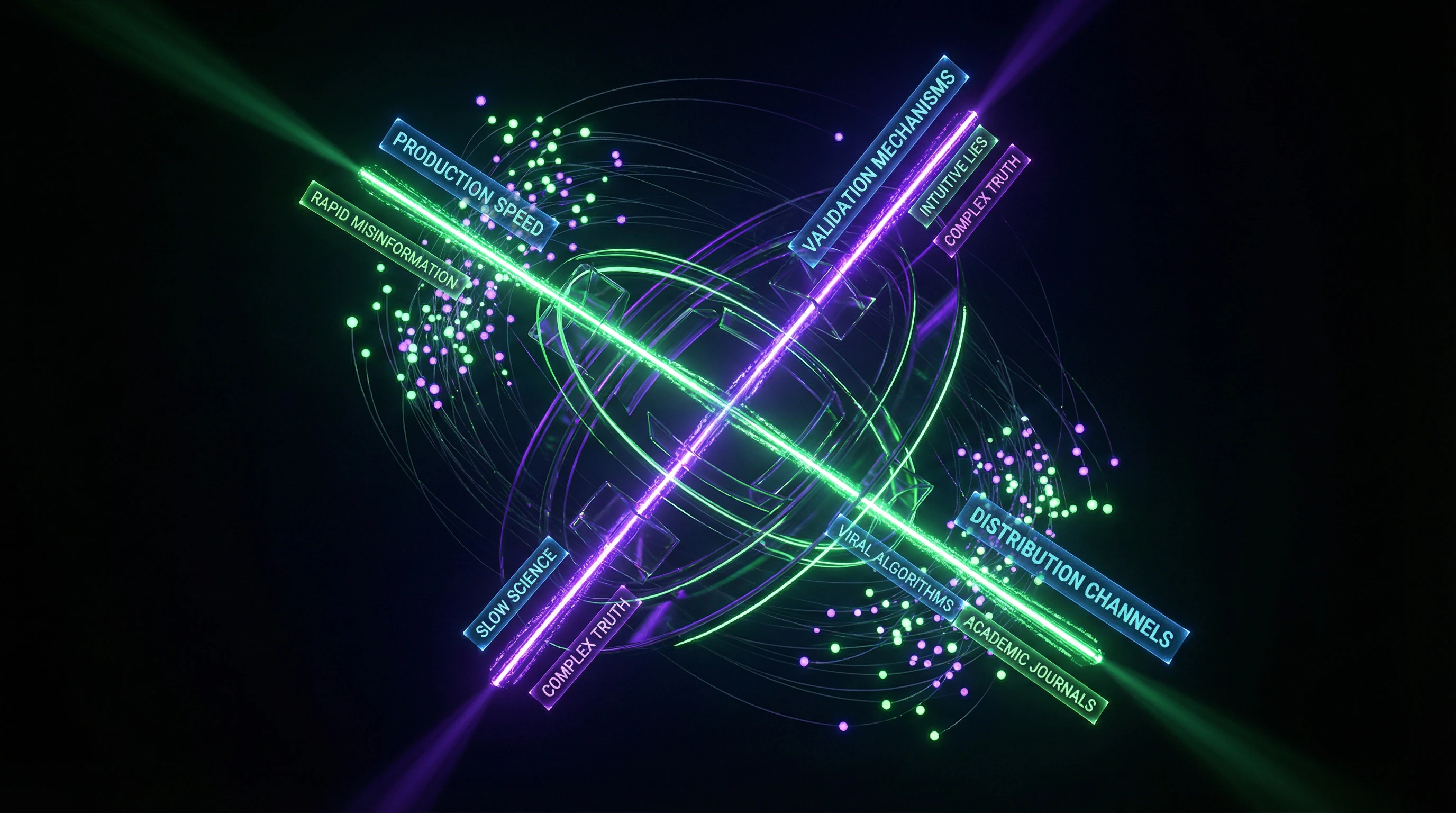
The systemic disruption affects three levels simultaneously: data production, validation, and dissemination. Each level operates by different rules, and it's precisely this asymmetry that creates the crisis. More details in the Logic and Probability section.
🧩 Three dimensions of the crisis
- Production
- Academic science generates data through multi-stage peer review and replication processes. Misinformation producers work in real-time, adapting narratives to current audience anxieties.
- Validation
- The scientific community uses complex methodological criteria incomprehensible to the general public. Pseudoscientific claims rely on intuitively appealing but false criteria: "it's natural," "they're hiding this," "simple explanation."
- Dissemination
- Social platform algorithms are optimized for engagement, not accuracy. This creates a structural advantage for emotionally charged but false content.
⚠️ Asymmetry of effort: why debunking loses to myth
Debunking requires an order of magnitude more cognitive resources than creating a myth. The claim "vaccines contain microchips" takes three seconds to say.
Its scientific refutation requires explaining vaccine manufacturing technology, principles of radio-frequency identification, biological incompatibility of silicon structures with immune response, and demonstrating the absence of corresponding components in the formulation.
This asymmetry creates an insurmountable advantage for misinformation in conditions of limited attention. This isn't a question of audience education — it's a question of information environment architecture.
🔎 Boundaries of the problem: what's included in the crisis
| Included in the crisis | Remains outside the scope |
|---|---|
| Systematic dissemination of verifiably false claims about disease mechanisms, treatment effectiveness, and intervention safety | Legitimate scientific discussions about uncertain questions |
| Exploitation of cognitive vulnerabilities to promote ineffective or dangerous practices | Criticism of specific healthcare system shortcomings |
| Undermining trust in public health institutions through conspiracy narratives | Cultural differences in health and illness perception that don't contradict basic biological facts |
The distinction is critical: without it, any criticism of science becomes "misinformation," and any doubt becomes "ignorance." The knowledge crisis is not an absence of critical thinking. It's the structural advantage of falsehood over truth in an information environment where algorithms, cognitive traps, and economic incentives work against accuracy.
Five Most Compelling Arguments That Experts Can Actually Unite Against Misinformation
Before analyzing the failures of academic communication, it's necessary to honestly examine the strongest arguments for the effectiveness of expert collaboration. Steelmanning — presenting the opposing position in its most convincing form — is critically important for avoiding straw man fallacies and understanding the real mechanisms of the problem. More details in the Thinking Tools section.
🔬 First Argument: The Cumulative Power of Expert Consensus
When multiple independent experts from different institutions reach the same conclusions, it creates a powerful epistemological signal. Historical examples show that scientific consensus ultimately prevails: germ theory displaced miasma theory, evolutionary biology became the foundation of modern medicine, the link between smoking and lung cancer was eventually acknowledged even by tobacco companies.
Expert collaboration amplifies this signal, making it discernible even through the noise of misinformation. Joint statements from professional associations, inter-university research consortia, and international scientific collaborations should theoretically create insurmountable authority.
📊 Second Argument: Resource Advantage of Academic Institutions
Universities and research centers possess enormous resources: access to data, computational power, expertise in research design, networks for rapid hypothesis testing. Expert attempts to unite against misinformation, as in initiatives combating COVID-19 myths, demonstrate the ability to quickly mobilize these resources (S001).
Coordinated efforts enable the creation of debunking databases, training of fact-checkers, development of educational materials, and execution of large-scale information campaigns. Theoretically, this resource advantage should be decisive against scattered misinformation producers.
🧪 Third Argument: Reproducibility as an Insurmountable Advantage
Scientific claims can be independently verified in different laboratories, by different researchers, using various methodologies. Pseudoscientific claims cannot withstand such scrutiny.
When experts unite for systematic verification of popular medical myths, they can demonstrate the non-reproducibility of false claims. Numerous independent studies have failed to reproduce the claimed effects of homeopathy, leading to changes in reimbursement policies in several countries. The cumulative force of negative replication results should demolish myths.
🛡️ Fourth Argument: Institutional Legitimacy and Regulatory Power
Academic experts don't just produce knowledge — they occupy positions in regulatory bodies, advise governments, and determine clinical protocols. When experts unite, their recommendations become official healthcare policy.
- Physicians follow clinical guidelines based on expert consensus
- Regulators approve drugs based on expert review
- Insurance companies reimburse procedures recognized as effective by the expert community
- Institutional power translates into control over medical practice
🧬 Fifth Argument: Long-Term Victory Through Next-Generation Education
Universities control the education of future physicians, researchers, journalists, and policymakers. Even if the current generation is susceptible to misinformation, systematic training in critical thinking, scientific methodology, and media literacy should create a cohort resistant to medical myths.
Expert collaboration in educational initiatives, as demonstrated by attempts to integrate digital literacy into medical curricula (S003), can transform the basic cognitive skills of the population. This is a long-term strategy, but potentially unbeatable. For more on information verification methods, see lateral reading and fundamentals of epistemology.
What the Data Shows: Systematic Analysis of Expert Coalition Effectiveness Against Medical Misinformation
Moving from theoretical arguments to empirical data, it's necessary to analyze what actually happens when experts attempt to unite against the medical knowledge crisis. More details in the section Statistics and Probability Theory.
📊 The COVID-19 Case: The Largest Natural Experiment in Expert Mobilization
The COVID-19 pandemic became an unprecedented test of the expert community's ability to counter misinformation. Research on New Zealand's discursive approach shows that even with strong political leadership and attempts to create a unified expert front ("Unite against COVID-19"), the communication strategy faced serious challenges (S001).
The key problem wasn't the absence of expert consensus on basic facts, but rather the inability of this consensus to compete with emotionally resonant alternative narratives in the digital space.
Analysis of pandemic policy revealed that the rapid shift to digital technologies created new vectors for misinformation spread that traditional academic institutions weren't prepared to address (S003). Universities possessed expertise in virology and epidemiology but lacked effective mechanisms for translating this expertise into the digital public sphere where mass beliefs were being formed.
🧪 Data from Other Areas: Dementia, Mental Health, Chronic Diseases
Expert attempts to unite against misinformation aren't limited to infectious diseases. The initiative to unite experts to strengthen dementia research demonstrates a different pattern: successful coordination in knowledge production doesn't automatically translate into effective public communication (S004).
- Experts collaborate effectively in research consortia
- Their findings don't reach broad audiences susceptible to myths about "natural" methods
- Conspiracy theories about the pharmaceutical industry spread in parallel
Research on the pandemic and global mental health shows that even when experts formulate clear recommendations, their implementation encounters barriers at the level of public perception and trust (S006). The problem isn't the quality of expertise, but the gap between expert knowledge and public understanding.
🧾 Meta-Analysis of the Knowledge Crisis: Structural Factors of Ineffectiveness
Comprehensive research on anthropogenic challenges provides a broader framework for understanding the problem (S007). The medical information crisis is part of a more general crisis of epistemological institutions in the digital age.
| Traditional Truth-Establishment Mechanisms | Digital "Credibility" Establishment Mechanisms |
|---|---|
| Peer review, institutional certification | Social validation, emotional resonance |
| Academic reputation, methodological rigor | Tribal identity, viral spread |
| Acknowledgment of uncertainty, cautious formulations | Narrative simplicity, confirmation of existing beliefs |
Expert coalitions, even when successful in producing quality knowledge, prove ineffective in the public sphere. Experts optimize communication for academic credibility criteria, while misinformation is optimized for viral spread criteria.
This isn't competition on equal terms—it's competition by different rules in different games. Misinformation operates in the ecosystem of social networks and emotional resonance; expert knowledge operates in the ecosystem of methodological rigor and institutional validation.
The gap between expert knowledge and public understanding, which misinformation exploits more effectively than scientific communication bridges it, requires rethinking the very mechanisms of knowledge translation. This isn't a problem of insufficient experts or their inability to unite—it's a problem of structural mismatch between how the modern information ecosystem works and how traditional institutions of knowledge production and dissemination operate.

Mechanisms of Failure: Why Academic Communication Structurally Loses to Disinformation
Understanding why experts cannot effectively unite against medical disinformation requires analyzing deep mechanisms, not surface symptoms. The problem isn't a lack of effort or competence—it's a fundamental mismatch between the nature of scientific knowledge and the demands of the modern information ecosystem. More details in the Mental Errors section.
🧬 Asymmetry of Cognitive Load: Why Lies Are Easier Than Truth
Scientific truth about medical questions is almost always more complex and less intuitive than attractive lies. Explaining why vaccines are safe requires understanding immunology, statistics of rare events, the difference between correlation and causation, the concept of herd immunity. The claim "vaccines are dangerous because they contain toxins" appeals to simple intuition: "poison in the body—bad."
This asymmetry of cognitive load creates an insurmountable advantage for disinformation in conditions of limited attention and cognitive resources of the audience (S001). When experts try to unite to debunk myths, they inevitably increase cognitive load: they add nuances, caveats, acknowledge areas of uncertainty.
Each caveat is perceived not as a sign of intellectual honesty, but as a sign of uncertainty or hidden motives. Disinformation has no such constraints—it can be absolutely categorical because it's not bound by the obligation to correspond to reality.
🔁 The Problem of Time Scales: Slow Science Versus Fast Memes
Scientific knowledge is produced slowly. Research goes through design, data collection, analysis, peer review, publication, replication—a process taking months or years. A medical myth can be created, spread, and embedded in mass consciousness within hours (S002).
When experts unite to respond to a new wave of disinformation, their response comes too late—the myth has already become part of certain groups' identity, and debunking is perceived as an attack on group belonging, not as providing information.
- Scientific understanding evolves as data accumulates (epistemologically correct)
- Publicly this looks like "experts constantly change their minds" (undermines trust)
- Disinformation remains consistent, not updating (paradoxically increases perceived reliability)
The COVID-19 pandemic dramatically demonstrated this problem (S005). Scientific understanding of the virus evolved correctly, but publicly it looked like inconsistency. Disinformation, not bound by the need to update according to new data, could remain consistent.
⚙️ Institutional Inertia: Why Universities Cannot Adapt Fast Enough
Academic institutions are optimized for producing reliable knowledge, not for rapid public communication. Incentive systems in universities reward publications in peer-reviewed journals, not viral social media posts. Career advancement depends on citations in academic literature, not on reach in the public sphere.
When experts try to unite to fight disinformation, they do so in their spare time, without institutional support, often risking their reputation in the eyes of colleagues who may perceive public communication as low-status "popularization."
| Academic Culture | Digital Public Sphere Requirements | Result |
|---|---|---|
| Caution, nuance, acknowledging limitations | Categoricalness, simplicity, confidence | Expert loses in public communication |
| "Data suggest with moderate confidence" | "I know for sure" | The latter sounds more convincing |
| Long verification processes | Instant dissemination | Truth arrives too late |
Universities cannot quickly adapt to the demands of the digital public sphere without losing their epistemological identity. This isn't a question of will or competence—it's a structural contradiction between the logic of knowledge production and the logic of its dissemination under conditions of information overload (S008).
Related materials: how social media turns attention into addiction, disinformation category, epistemology.
Cognitive Anatomy of Successful Medical Misinformation: Which Vulnerabilities It Exploits
To understand why uniting experts is insufficient, it's necessary to analyze which specific cognitive mechanisms make medical misinformation so effective. This is not accidental success—it's systematic exploitation of predictable features of human cognition. More details in the Epistemology section.
🧩 Availability Heuristic: Why Vivid Stories Beat Statistics
The human brain assesses the probability of events based on how easily examples can be recalled. One vivid story about a child who allegedly developed autism after vaccination psychologically weighs more than statistical data on millions of safe vaccinations.
Medical misinformation systematically exploits this heuristic by creating emotionally charged narratives with specific "victims" (S001). When experts respond with statistics and abstract data, they lose at the level of basic cognitive processing.
🕳️ Motivated Reasoning: Why People Defend Beliefs Rather Than Seek Truth
Cognitive science shows that people are not neutral information processors. When information threatens existing beliefs or group identity, defensive mechanisms activate.
Refuting a medical myth is perceived not as providing useful information, but as an attack on identity. If someone has publicly stated that vaccines are harmful, admitting error means a social cost—loss of status within their peer group.
Motivated reasoning drives people to find ways to discredit experts ("they're paid off by pharmaceutical companies") instead of revising beliefs (S002).
🧠 Backfire Effect: When Refutation Strengthens the Myth
Paradoxically, attempts to refute medical misinformation can strengthen it. Research shows that repeating a myth even in the context of refutation increases its familiarity, and familiarity is perceived as credibility.
- Large-scale refutation campaigns inadvertently increase the visibility of the myths themselves
- Aggressive refutation activates reactance—the psychological tendency to defend freedom of belief when it's perceived as being threatened
- The effect is amplified in information bubbles where people see only confirming content
🔁 Availability Cascades and Algorithmic Filtering
In the digital environment, information spreads through social networks, creating availability cascades—processes by which a belief becomes increasingly widespread simply because people observe others adopting it (S005).
| Mechanism | How It Works | Why Experts Lose |
|---|---|---|
| Algorithmic Curation | Content is selected based on user's previous behavior | Refutations aren't shown to those who believe the myths—algorithms optimize for engagement, not truth |
| Information Bubbles | People see predominantly information that confirms their beliefs | Expert messages don't reach the target audience that needs them most |
| Social Proof | Visibility of a belief in the network is perceived as its validity | Misinformation spreads faster due to emotional charge, not accuracy |
When experts attempt to unite to disseminate accurate information, they confront the architecture of the platform itself, which works against them. This is not a question of insufficient coordination—it's a question of incompatibility between the logic of expert knowledge and the logic of digital information distribution systems.
Cognitive Self-Defense Protocol: Seven Questions That Dismantle Medical Misinformation in 90 Seconds
Recognizing the structural limitations of expert consensus, we can develop an individual verification tool. Requires no advanced degrees — only consistency. More details in the Esoterica and Occultism section.
Misinformation operates on three levels: emotional capture, social proof, and cognitive overload (S001). The protocol below breaks each one.
- Who benefits? Identify the beneficiary — financial, reputational, political. If the gain is vague or hidden, that's a red flag.
- Where's the evidence? Demand the primary source, not a retelling. If the link leads to another retelling — the chain is broken.
- Why now? Check whether publication coincides with a crisis, fear, or information vacuum. Misinformation is a parasite on uncertainty.
- Who's saying this? An expert in this field or a popularizer? Is there a conflict of interest? Source verification methods are a standard tool.
- What's omitted? Which counterarguments, limitations, alternative explanations aren't mentioned? Completeness is a marker of honesty.
- How can this be tested? Can the claim be falsified? If not — it's not science, it's dogma.
- What am I feeling? Anger, fear, urgency? Emotion is a signal that cognitive defenses are down. A 24-hour pause is minimum.
Misinformation doesn't require perfection — it only requires that doubt outlive truth. The protocol inverts this: truth is verified in 90 seconds, doubt is resolved by fact.
Lateral reading is a professional method that accelerates this process. Open three tabs: the original text, a search for the author, a search for the opposing view. Parallel comparison reveals manipulation in minutes.
Information overload is not a system bug, but its mechanism (S008). The protocol works precisely because it reduces cognitive load to seven questions. Everything else is noise.