Belief as Cognitive Architecture: What Actually Happens When We "Believe" Something
When we talk about belief, most people think of religious convictions. But the psychology of belief encompasses a much broader spectrum: from confidence that the sun will rise tomorrow, to conviction in the correctness of political views or the effectiveness of a particular diet. More details in the section Scientific Method.
Belief is a cognitive state in which the brain accepts a particular statement as true without the need for constant verification (S001). This is not a weakness of thinking, but an architectural necessity: the brain cannot verify every fact in real time.
🧠 Neurophysiological Substrate of Beliefs: Where Belief Lives in the Brain
Beliefs are not localized in one brain area, but represent a distributed network of activity. When a person encounters information confirming their beliefs, the ventromedial prefrontal cortex (associated with reward) and the nucleus accumbens—the pleasure center that also responds to food, sex, and drugs—are activated (S007).
Confirmation of our beliefs triggers literal physical pleasure. When a person encounters contradictory information, the insular cortex is activated—an area associated with disgust and physical discomfort. The brain perceives threats to beliefs as physical threats.
This reaction is universal: regardless of culture, contradiction of beliefs triggers the same activation pattern in the brain.
🧩 Epistemological Boundaries: What Counts as Belief vs. Knowledge
The classical definition of knowledge requires three components: a statement must be true, a person must believe it, and they must have justification. However, psychology shows that in reality these boundaries are blurred.
Most of our "knowledge" consists of beliefs with varying degrees of justification, which we rarely subject to critical examination (S001). Research shows that beliefs form at three interacting levels:
- Individual
- personal experience and cognitive processes
- National
- cultural norms and social institutions
- Global
- universal cognitive mechanisms common to all humanity
🔁 Functional Role of Belief: Why the Brain Needs Beliefs
From an evolutionary perspective, belief serves a critically important function: it allows the brain to conserve cognitive resources. If we had to re-verify every statement about the world each time, we would be paralyzed by information overload.
Beliefs work as cognitive heuristics—quick decision-making rules that are accurate enough for survival in most cases. Additionally, beliefs serve a social function: shared beliefs create group identity and facilitate coordination of actions.
| Function of Belief | Mechanism | Effect |
|---|---|---|
| Cognitive Economy | Heuristics instead of full verification | Fast decisions under uncertainty |
| Social Integration | Shared beliefs create identity | Group cohesion and coordination |
| Psychological Stability | Predictable worldview | Reduced anxiety and uncertainty |
People fiercely defend their beliefs because threats to beliefs are perceived as threats to group belonging, and therefore to survival. This explains why conspiratorial thinking is so resistant to refutation: it serves not only an informational function, but also a social one.
Steel Version of the Argument: Why Wishful Thinking Can Be a Rational Strategy
Before analyzing the mechanisms of self-deception, we need to present the strongest version of the argument in favor of wishful thinking. This is a serious position defended by philosophers and psychologists, not a strawman. For more details, see the Sources and Evidence section.
💎 The Pragmatic Utility Argument: When Belief Creates Reality
Wishful thinking increases the probability of its fulfillment—a phenomenon known as self-fulfilling prophecy. An athlete who believes in victory increases motivation and concentration, which genuinely improves performance. An entrepreneur who believes in project success overcomes obstacles and convinces investors.
Optimistic beliefs correlate with better outcomes in health, career, and relationships (S007). People with an internal locus of control demonstrate greater persistence and achieve better results than those who see themselves as victims of circumstances.
- Belief increases motivation and readiness to act
- Action leads to better outcomes
- Outcomes confirm the original belief
- The cycle reinforces itself
🧠 The Cognitive Economy Argument: The Impossibility of Complete Rationality
Complete rationality is cognitively impossible—the brain has limited computational resources and cannot process all available information. Under conditions of uncertainty, using heuristics and beliefs is not an error but a necessary adaptation.
Attempting to constantly question all beliefs leads to cognitive paralysis. Philosophical skepticism, taken to its logical conclusion, makes any action impossible.
A certain degree of "cognitive closure"—willingness to accept some statements without constant verification—is a necessary condition for functioning.
🔁 The Social Cohesion Argument: Belief as Society's Glue
Societies cannot function without a set of shared beliefs about values, norms, and goals. These beliefs don't necessarily have to be "true" in a strict empirical sense to fulfill the function of social coordination (S002).
Shared historical narratives and national myths play a critical role in creating social cohesion. Even if these narratives simplify historical reality, they are functionally necessary for maintaining social order (S002).
🛡️ The Existential Necessity Argument: Belief as Protection from Absurdity
Certain beliefs are necessary for psychological survival. Belief in the meaning of life, justice in the world, or the possibility of controlling one's fate may be illusory, but these illusions protect against existential despair.
People who have experienced extreme states of consciousness often form beliefs that help integrate these experiences into a coherent worldview (S007). These beliefs may not align with scientific consensus, but they serve an important psychological function.
📌 The Epistemic Humility Argument: Recognizing the Limits of Knowledge
Our knowledge of the world is fundamentally limited. Many important questions—about the nature of consciousness, the meaning of life, moral values—have no definitive empirical answers.
- Domain of Uncertainty
- Questions where empirical data don't provide a definitive answer
- Competing Belief Systems
- Logically consistent but incompatible interpretations of reality
- Epistemic Humility
- Recognition that choosing between them cannot be made solely on the basis of data
In these domains, belief may be no less justified than skepticism. This doesn't mean all beliefs are equally valid, but it emphasizes that in some areas, the choice between competing belief systems goes beyond pure empirics.
Evidence Base: What Science Actually Knows About Belief Formation Mechanisms
Let's move to a systematic analysis of empirical data on how beliefs actually form and what cognitive mechanisms underlie this process. More details in the Critical Thinking section.
🧪 Neurobiology of Confirmation: How the Brain Processes Confirming and Contradicting Information
Confirmation bias is one of the most reliably established findings in cognitive neuroscience. When a person encounters information confirming their beliefs, brain regions associated with reward activate: the ventromedial prefrontal cortex and nucleus accumbens, with a release of dopamine—the neurotransmitter of pleasure and motivation (S007).
Contradicting information activates entirely different regions: the anterior cingulate cortex (conflict detection) and the insula (disgust and discomfort). The brain literally perceives contradiction as a threat.
People seek information confirming their beliefs and avoid contradicting information—not from conscious strategy, but from an automatic brain response seeking to minimize cognitive dissonance and maximize positive emotions. This tendency manifests even in highly educated individuals.
🔁 The Role of Emotions in Belief Formation: Why Feelings Beat Facts
The traditional model of rational thinking assumes beliefs form through logical analysis of evidence. However, emotions play the primary role, while rational arguments often serve merely as post-hoc justifications for emotionally driven positions.
Emotional response to a stimulus forms faster than conscious evaluation. The amygdala—the brain's emotional center—reacts to potentially significant stimuli within milliseconds, long before the prefrontal cortex conducts rational analysis (S003). Our primary reaction to information is emotional, and this reaction then influences interpretation.
- Emotional Heuristics Under Uncertainty
- When information is ambiguous or requires complex analysis, people rely on emotional signals: "This feels right" or "This causes discomfort." These reactions are then rationalized through selection of confirming arguments.
🧬 Social Influence and Conformity: How Group Beliefs Shape Individual Ones
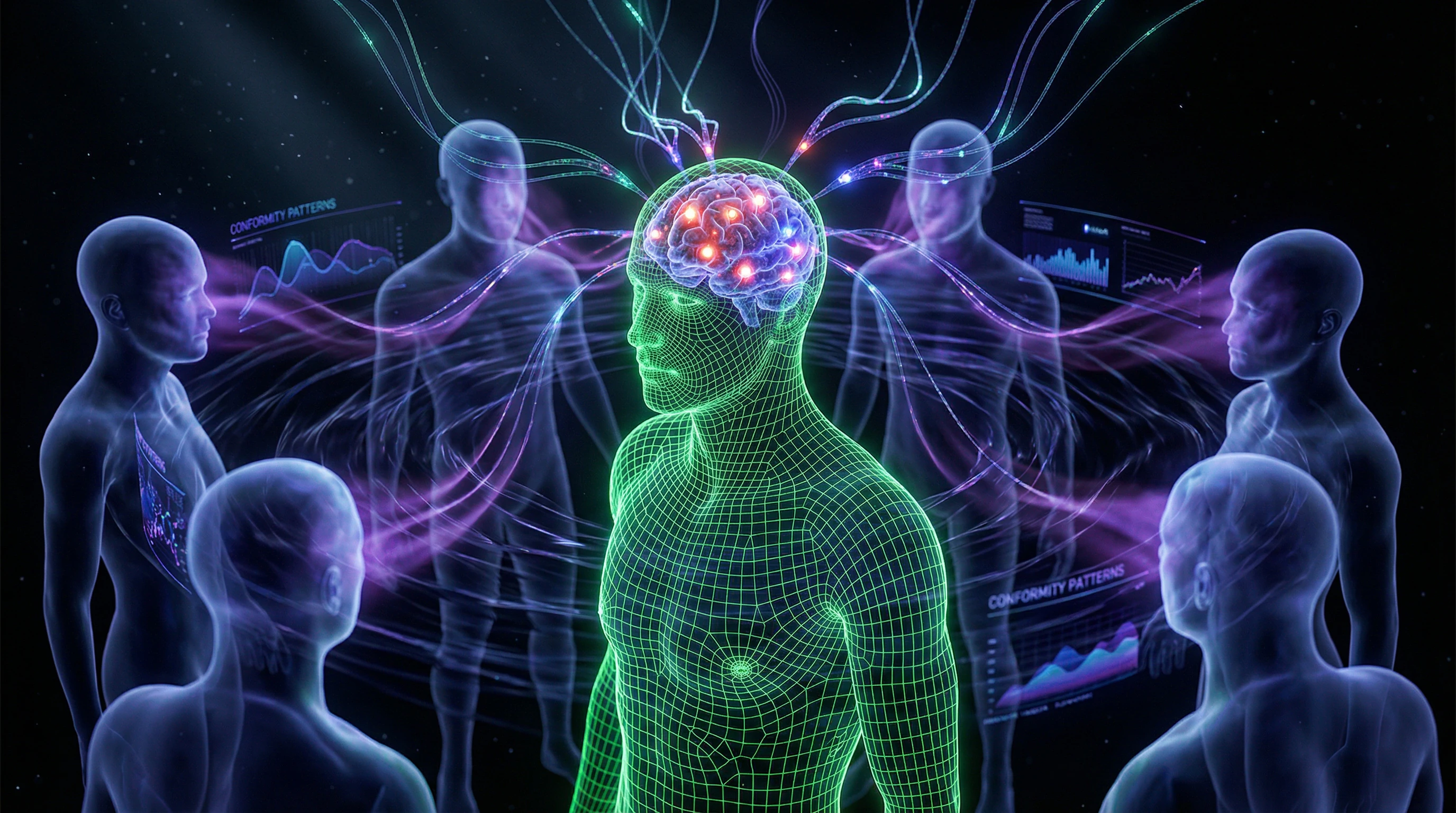
Beliefs don't form in a vacuum, but in the context of social interactions. Social pressure can make people deny obvious facts and accept clearly false statements if the group shares them.
Solomon Asch's classic conformity experiments showed: about 75% of participants agreed with an obviously incorrect answer at least once if the group majority gave it. Modern research demonstrates this effect is especially strong for beliefs tied to group membership (S002).
| Mechanism | Neurobiological Correlate | Function |
|---|---|---|
| Social rejection | Activates physical pain regions | Motivates conformity |
| Adoption of group beliefs | Activates reward centers | Creates positive reinforcement |
| Group identity | Strengthens emotional attachment | Consolidates beliefs |
🧾 Cognitive Biases: Systematic Errors in Information Processing
Beyond confirmation bias, there exists a spectrum of cognitive biases that systematically distort belief formation. These aren't random errors, but predictable patterns leading to consistent deviations from rationality.
- Availability heuristic—overestimating the probability of events that are easy to recall. After hearing about a plane crash, we overestimate flight danger, though aviation remains the safest form of transportation.
- Anchoring effect—excessive reliance on the first information received when making decisions.
- Dunning-Kruger effect—people with low competence overestimate their knowledge, while experts often underestimate theirs. The least qualified people are most confident in their beliefs.
Knowing these biases exist doesn't protect against them. Even professional scientists are subject to cognitive biases in areas outside their expertise. This underscores that these biases are fundamental features of human cognition, not results of insufficient education.
Cognitive biases are universal and inevitable. They're not signs of stupidity, but consequences of how evolution optimized the brain for rapid decision-making under uncertainty, not for absolute accuracy.
For deeper understanding of belief mechanisms, see the analysis of conspiratorial thinking and epistemology of belief.
Mechanisms of Causality: How Beliefs Influence Perception of Reality and Behavior
Beliefs form through specific cognitive mechanisms, but this doesn't yet explain how they influence perception and behavior. Here we analyze the causal relationships between beliefs and their consequences. More details in the section Psychology of Belief.
👁️ Perceptual Filtering: How Beliefs Determine What We See
Perception is not passive registration of reality, but active construction, where beliefs function as filters: they determine which information will be noticed, which ignored.
People with different beliefs literally see different things when looking at the same scene. Someone convinced of danger notices threats and ignores safety; the opposite pattern occurs in optimists. This effect extends to information seeking, source selection, and interpretation of ambiguous data.
Beliefs determine perception → perception confirms beliefs → beliefs strengthen. A self-sustaining cycle.
Result: we see what we expect to see, and this confirms our expectations. The mechanism operates independently of objective reality.
⚙️ Motivational Effects: How Beliefs Direct Behavior
Beliefs determine behavior through motivation. Belief in the outcome of an action increases the likelihood of performing it; belief in futility leads to avoidance.
Beliefs about self-efficacy are among the strongest predictors of behavior. People who believe in their ability to achieve a goal show greater persistence, exert more effort, and achieve better results than people with low self-efficacy at equal objective abilities.
| Belief Type | Effect on Behavior | Risk |
|---|---|---|
| Optimistic | Motivates toward challenging goals, increases persistence | Underestimation of risks, unfounded decisions |
| Pessimistic | Protection from disappointment, realistic assessment | Self-fulfilling prophecy of failure |
Both types of beliefs create real consequences through behavior, regardless of their correspondence to reality.
🧬 Physiological Consequences: How Beliefs Affect Health
Beliefs influence physiology directly. The placebo effect demonstrates: belief in treatment effectiveness produces real physiological changes—pain reduction, immune improvement, changes in brain structure.
People with strong religious or spiritual beliefs often demonstrate better health indicators and faster recovery from illness (S007). Mechanisms of this effect include stress reduction, improved adherence to medical recommendations, and activation of endogenous recovery systems.
- Belief activates expectation of outcome
- Expectation triggers neuroendocrine mechanisms
- Neuroendocrine changes produce physiological effect
- Physiological effect confirms belief
These effects don't mean beliefs replace medical treatment. They show: psychological factors play a significant role in health, and ignoring them leads to incomplete understanding of disease and recovery. More on psychosomatic mechanisms in analysis of psychosomatic myths.
Beliefs are not merely subjective states. They are embedded in cognitive architecture and produce measurable effects on perception, behavior, and physiology. Understanding these mechanisms is critical for evaluating any claim about the influence of beliefs on reality.
Conflicts and Uncertainties: Where Sources Diverge and What It Means
Honest analysis requires acknowledging areas where scientific data is ambiguous or contradictory. The psychology of belief is an actively developing field, and consensus has not yet been reached on many questions. More details in the Techno-Esotericism section.
⚙️ Debates on Rational Belief: Can One Believe Rationally?
The central philosophical dispute: can belief be rational? Evidentialists insist that rational belief must be proportional to evidence—we should only believe what we have grounds for.
Pragmatists counter: under conditions of uncertainty, believing in the desired outcome may be strategically justified if it motivates action leading to results (S004). The debate isn't about logic, but about what counts as "rational"—correspondence to facts or achievement of goals.
Evidentialism vs pragmatism is not a scientific question, but a question about the criteria of rationality. Science can show how the brain believes; philosophy must decide how it *should* believe.
📊 Where Data Diverges
- Interpretational biases and depression: research shows a connection (S007), but the causal mechanism remains disputed—does bias cause depression or does depression generate bias?
- Role of basic psychological needs: data confirms the influence of autonomy, competence, and belonging (S008), but their weight varies across different contexts.
- Political polarization and social media: correlation between algorithms and beliefs is evident (S006), but the causal chain remains subject to debate.
Each of these points has empirical support, but interpretation of the data depends on the researcher's theoretical position.
🔗 Connection to Broader Context
Understanding conflicts in the psychology of belief helps make sense of conspiratorial thinking—the same mechanisms of interpretational bias and social reinforcement operate there.
Similar processes work in esoteric practices and psychosomatic myths: belief activates the same neurobiological systems, regardless of whether the object of belief corresponds to reality.
⚠️ What This Means for Practice
Uncertainty in science is not grounds for skepticism toward everything. It's grounds for methodological honesty: distinguishing where we have solid data, where we have hypotheses, where we have philosophical questions.
For cognitive immunology, this means: not seeking the "correct" belief, but developing the ability to see the mechanisms that form it—independent of the belief's content.