
What is the Barnum Effect and Why It Turns Generic Phrases Into "Revelations About Your Soul"
The Barnum Effect is a cognitive bias in which people accept vague, general personality descriptions as accurate individual characterizations. The name comes from showman Phineas Taylor Barnum and his principle of "we have something for everyone"—a perfect metaphor for the effect's mechanics. Learn more in the Mental Errors section.
The scientific name "Forer Effect" traces back to psychologist Bertram Forer's classic 1948 experiment, which first demonstrated the phenomenon under controlled conditions.
⚠️ Forer's Classic Experiment: How Students Accepted Identical Text as Unique Analysis
Forer asked students to complete a personality test, then supposedly provided each with an individual analysis. In reality, everyone received identical text compiled from horoscope phrases.
"You have a need for other people to like and admire you. You have a tendency to be critical of yourself. While you have some personality weaknesses, you are generally able to compensate for them."
Students were asked to rate accuracy on a 0–5 scale. Average rating: 4.26. The overwhelming majority found the description accurate or very accurate, despite its universality.
🔬 Three Components of the Effect: Vagueness, Positivity, and Belief in Personalization
- Vagueness of Statements
- Assertions are general enough to apply to a wide range of people, yet specific enough to create an illusion of specificity. This creates a "fitting" effect: people find in the text what they're looking for.
- Positive or Flattering Nature
- People tend to accept information that presents them in a favorable light or confirms their self-perception. Criticism or neutral descriptions generate less agreement.
- Belief in Personalization
- The effect is maximized when people are convinced the description was created specifically for them based on unique data—test results, birth date, card spread. Ritual and authority strengthen this belief.
📊 Quantitative Parameters of the Effect: 70% to 90% Acceptance Depending on Context
Meta-analyses demonstrate the reproducibility of the Barnum Effect across various cultural contexts. The percentage of people rating general descriptions as accurate ranges from 70% to 90% depending on conditions.
| Condition | Impact on Effect |
|---|---|
| Authority figure (psychologist, expert, Tarot master) | Strengthens acceptance of description |
| Emotional stress or uncertainty | Person is more receptive to interpretations |
| Description contains desired traits | Confirmation of self-perception increases agreement |
| Ritual and procedure (test, spread, consultation) | Creates sense of seriousness and individual approach |
The Barnum Effect is not an individual perceptual error, but a universal mechanism built into how the brain processes self-related information. Understanding this mechanism is critical for analyzing any systems claiming personal prediction or diagnosis.

Seven Arguments Used by Tarot Accuracy Advocates — and Why They Seem Convincing
Before analyzing the evidence base, we need to present the strongest possible version of arguments supporting Tarot reading accuracy — not a caricature, but an honest formulation of the position. Refuting weak versions is easy, but intellectually dishonest. More details in the Sources and Evidence section.
Below are seven of the most convincing arguments presented by practicing Tarot readers and their clients.
- Subjective experience: the reading described a specific situation with details supposedly unknown to the reader. The "Ten of Swords" card is interpreted as "betrayal by someone close," and the client recalls a recent conflict with a friend. The sense of coincidence is so strong that alternative explanations (commonality of situations, retrospective interpretation) seem implausible. The argument's strength lies in the immediacy of personal experience, which is always more convincing than abstract statistics.
- Mathematical complexity: 78 cards in various positions create an astronomical number of combinations. Even a simple three-card spread yields 456,456 variations (78 × 77 × 76). This creates the illusion that each reading is unique and cannot be "generic." The argument is strengthened by complex interpretation schemes that account for reversed cards and interactions between positions.
- Historical tradition: Tarot has a centuries-old history, creating a sense of time-tested validity. If the system didn't work, would it have survived for centuries? Millions of people across different cultures have found it useful — supposedly evidence of real effectiveness.
- Therapeutic effect: consultations with Tarot readers often bring psychological relief, help structure thoughts, and facilitate decision-making. If people feel better and gain useful insights, doesn't that prove effectiveness? The argument shifts focus from "are predictions accurate" to "is the practice useful."
- Reader's intuition: accuracy depends not only on the cards but also on the practitioner's experience. A skilled master supposedly reads the client on a deep level, using cards as a tool to focus intuition. Nonverbal signals, tone of voice, reactions — everything helps provide more accurate interpretations.
- Synchronicity: a more philosophical version appeals to Carl Jung's concept of meaningful coincidences not connected by cause-and-effect relationships. Tarot supposedly works not through prediction but through reflecting archetypal patterns of the collective unconscious. Cards resonate with psychological states through mechanisms science doesn't yet understand.
- Specificity of interpretations: criticism about generic statements is countered by claiming the problem lies not in the system but in unqualified practitioners. An experienced Tarot reader supposedly gives concrete, specific answers, avoiding vague phrases. Generic platitudes are signs of a particular reader's low qualification, not a flaw in the method.
Each of these arguments relies on real psychological mechanisms: personal experience truly seems more convincing than statistics, system complexity truly makes verification difficult, therapeutic effect truly exists. That's precisely why they seem convincing — they're not fabricated but built on genuine cognitive traps.
The problem isn't that these arguments are logically impossible. The problem is they don't distinguish between "could be true" and "probably true." Each argument contains a kernel of truth, but that kernel doesn't prove the system's predictive power.
For example, the therapeutic effect is real — but placebo also has a therapeutic effect, and that doesn't mean placebo contains an active ingredient. A reader's intuition can help — but that's help from a person, not from cards. Historical tradition may indicate usefulness — but astrology, alchemy, and bloodletting also had centuries-old histories.
The strength of these arguments is that they appeal to availability heuristic: personal experience is always more accessible to memory than statistics. They also exploit cognitive biases that make coincidences more noticeable than non-coincidences.
The next step is to examine what controlled studies show when these arguments meet methodology that excludes subjective coincidence and retrospective interpretation.
Evidence Base for the Barnum Effect: What Controlled Studies and Meta-Analyses Show
The Barnum effect has been studied for over 70 years. An extensive evidence base has accumulated, demonstrating its reliability and universality regardless of culture, language, or educational level. For more details, see the Scientific Method section.
📊 Reproducibility of the Effect: From the Original Experiment to Modern Replications
Forer's original 1948 experiment has been replicated across various cultural contexts and populations. Average accuracy ratings for generic descriptions range from 4.0 to 4.5 on a five-point scale—categories of "accurate" or "very accurate."
Critically: the effect persists even when participants are informed about its nature in advance. Knowledge of the cognitive bias does not provide complete protection.
🧪 Factors That Amplify the Effect
| Factor | Mechanism | Result |
|---|---|---|
| Source Authority | Descriptions allegedly created by experts or based on "scientific tests" | Accepted as more accurate than anonymous texts |
| Illusion of Personalization | Person believes the description was created specifically for them | Maximum effect; decreases if informed about generic nature of text |
| Positive Valence | Flattering or desirable characteristics | Accepted more readily than neutral or negative ones |
| Emotional State | Anxiety, uncertainty, search for meaning | Increased susceptibility to the effect |
🧠 Neurocognitive Mechanisms
Confirmation bias plays a key role—the tendency to seek, interpret, and remember information that confirms existing beliefs. When a person reads a Tarot spread, the brain automatically scans memory searching for events that can be interpreted as matching the description, while ignoring inconsistencies.
This process occurs rapidly and largely unconsciously, creating a subjective sensation of "recognizing" oneself in the text.
🔍 Subjective Validation: Selective Attention and Self-Confirmation
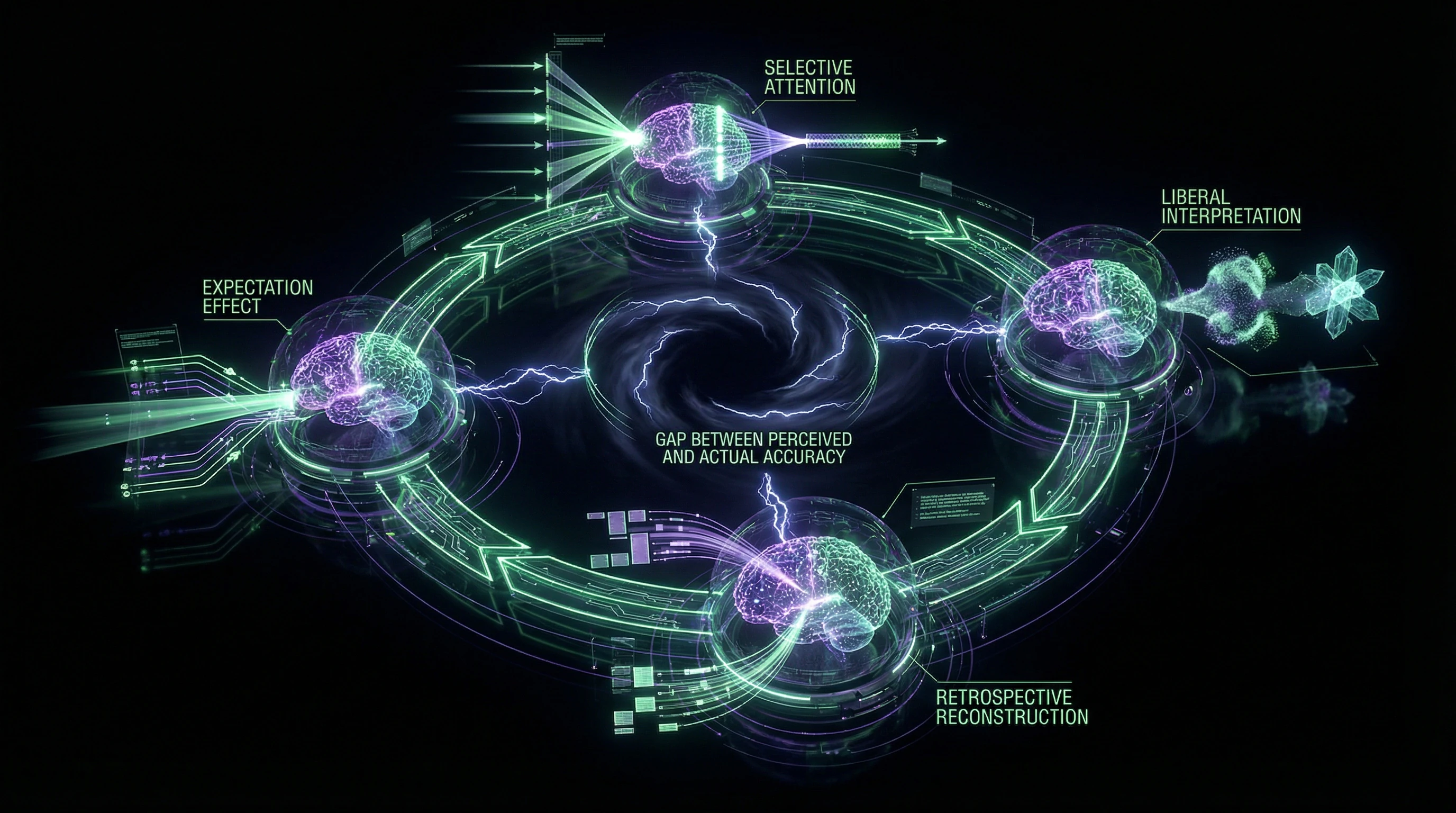
Subjective validation is the process by which a person finds personal meaning in random or vague information. The mechanism operates through four cognitive operations:
- Selective attention—focusing on relevant elements, ignoring the rest
- Liberal interpretation—expansive reading of vague formulations
- Retrospective reconstruction—reframing past events in light of the description
- Expectation effect—active search for confirmations in future experience
These processes create a closed loop of self-confirmation, in which any experience can be interpreted as validation of the reading.
📈 Quantitative Data: False Positive Rate
Controlled experiments allow estimation of the false positive rate—cases where people accept demonstrably generic or random descriptions as accurate personal characteristics. Participants receive either a genuine individual analysis, a generic text, or a randomly generated description, without being told which variant they received.
People rate random descriptions as accurate in 70–85% of cases, which is statistically indistinguishable from ratings of genuine individual analyses.
🧾 Meta-Analyses and Systematic Reviews
Methodological standards of systematic reviews show how the Barnum effect manifests in popular self-help literature. (S001) points to the problem of false self-diagnoses arising when people accept generic symptom descriptions as personal diagnoses—a direct parallel to the mechanism of Tarot readings.
Vague descriptions of psychological states are perceived as accurate individual characteristics. Systematic reviews in psychology show that the Barnum effect is one of the most reliably replicated phenomena in social psychology, with effect sizes ranging from medium to large depending on conditions.
The connection to statistics and probability theory is critical: without understanding basic principles, people cannot distinguish random coincidence from causal connection. Ignoring base rates exacerbates the perception of accuracy—a person notices hits and forgets misses.
Causal Mechanisms: Why Correlation Between Readings and Life Doesn't Mean Predictive Power
The critical distinction between correlation and causation is fundamental to analyzing the apparent accuracy of Tarot readings. Even if someone observes coincidences between card interpretations and life events, this doesn't prove predictive power. Alternative explanations must be considered. Learn more in the Logical Fallacies section.
Coincidences between readings and life may result from four mechanisms: reverse causality (behavior changes due to interpretation), confounders (third variables), regression to the mean (natural normalization of extreme states), or base rate neglect (overestimating the rarity of coincidences).
🔁 Reverse Causality: How Reading Interpretation Influences Behavior and Creates Self-Fulfilling Prophecies
A self-fulfilling prophecy is a mechanism where expecting an outcome influences behavior such that the expected outcome becomes more likely. A reading predicts "new career opportunities"—the person begins actively seeking such opportunities, notices offers they previously ignored, takes initiative in networking.
When an opportunity appears, it's perceived as confirmation of the reading's accuracy. The actual causal relationship is reversed: the cards didn't predict the event; the interpretation changed behavior, which created the event.
🧩 Confounders: Third Variables Creating the Illusion of Connection
A confounder is a variable that influences both the reading interpretation and subsequent events, creating a false appearance of connection. Someone consults a Tarot reader during a life crisis. The crisis influences card interpretation (tendency to see confirmation of anxieties) while simultaneously resolving naturally over time.
The situation's improvement is attributed to the reading's accuracy, though the real confounder is the natural dynamics of crisis states, which tend to resolve regardless of interventions. This relates to base rate neglect—we underestimate how often crises resolve on their own.
📉 Regression to the Mean: Why Extreme States Naturally Give Way to Neutral Ones
Regression to the mean is a statistical phenomenon where extreme values of a variable tend toward the average upon repeated measurement. People turn to Tarot during emotional peaks—crises, conflicts, major decisions. These states are inherently unstable and tend toward normalization.
If a reading occurs at peak anxiety, subsequent improvement will be perceived as resulting from insights gained or confirmation of the prediction "difficulties will pass." The improvement would have occurred with high probability regardless of the reading.
🎲 Base Rate of Events: Why "Rare" Coincidences Are Statistically Expected
Events that seem rare and specific often have high base rates in the population. "Conflict with someone close," "unexpected opportunity," "period of doubt," "important decision"—categories so broad that most people experience them regularly.
- A reading predicts "a meeting that will change your path"
- The probability that some meeting interpretable as significant will occur in the coming weeks is very high. Base rate neglect leads to overestimating the specificity of coincidences.
- Error Mechanism
- We notice coincidences that confirm the reading and ignore numerous predictions that didn't come true. This is a cognitive bias related to selective attention and memory.
All four mechanisms operate simultaneously, creating a compelling illusion of predictive power. Their influence can only be separated through controlled studies where readings are compared with placebos and random predictions.
Conflicts in the Evidence Base and Areas of Uncertainty: Where Data Are Contradictory or Absent
Honest analysis requires acknowledging areas where the evidence base is incomplete or contradictory. While the Barnum effect as a cognitive bias is well-documented, some aspects of the phenomenon remain subjects of debate. For more details, see the section on Cognitive Biases.
🔬 Individual Differences in Susceptibility: Why Some People Are More Resistant to the Effect
Research shows significant individual differences in susceptibility to the Barnum effect. Some people demonstrate high critical thinking toward vague statements, while others easily find personal meaning in them.
What exactly determines this resistance—level of education, cognitive abilities, personality traits, or situational context—remains disputed. Different studies identify different predictors, and their weight varies depending on methodology.
- Education and critical thinking: correlate with resistance but don't guarantee it
- Openness to experience: can both increase susceptibility and promote reflection
- Motivational state: a person in crisis is more vulnerable than one in stability
- Cultural context: in societies with high belief in fate, the effect may be stronger
There is no consensus on which factor dominates. This creates a methodological problem: it's impossible to predict who will succumb to the effect without additional information about personality and situation.
📊 The Boundary Between the Barnum Effect and Legitimate Psychological Insight
Where does manipulation through vagueness end and honest psychological work begin? The boundary is blurred.
A good psychologist uses open-ended questions and observation to help the client find meaning themselves. A charlatan uses the same tools to create an illusion of understanding. The difference lies in intention and verifiability of results, but in real life they're difficult to distinguish.
Research doesn't provide a clear criterion for where one ends and the other begins epistemologically. This leaves room for interpretation and abuse.
🎲 Rare Cases When Readings Match Reality: Coincidence or Pattern?
Sometimes a tarot reading actually describes a situation more accurately than can be explained by chance. But how do we distinguish coincidence from pattern?
The problem is that with enough readings and sufficiently broad interpretations, coincidences are inevitable. This is base rate neglect: we notice hits and forget misses.
But there's another side: could the structure of tarot archetypes accidentally align with universal patterns of human experience? There isn't sufficient data to refute or confirm this.