
Anatomy of irrationality: what the sunk cost fallacy is and why it contradicts basic economic logic
The sunk cost fallacy is a systematic cognitive bias in which people and organizations continue investing resources in clearly failing projects solely because they've already invested time, money, or effort. Classical economic theory postulates the opposite: decisions should be made based on expected future benefits and costs, not past investments that can no longer be recovered. More details in the Sources and Evidence section.
Sunk costs are expenditures already incurred that cannot be recovered regardless of future actions. From a rational economics perspective, they shouldn't influence current decisions, since they represent historical fact, not a variable in the future equation. The psychological reality of human decision-making differs radically from this normative model.
Rational continuation of investment is based on objective assessment of future prospects. The sunk cost fallacy is motivated by the desire to "justify" or "not lose" what's already been invested.
It's critically important to distinguish the sunk cost fallacy from legitimate persistence and strategic patience. Not every continuation of investment in a difficult project is irrational. The difference lies in the basis for the decision.
- Escalation of commitment
- A broader term covering all cases of increasing investment in a failing course of action. Includes both psychological and organizational mechanisms.
- Concorde fallacy
- Named after the supersonic aircraft project that British and French governments continued funding despite obvious economic unfeasibility. A classic example of governmental escalation.
- Loss aversion
- A fundamental asymmetry in the perception of gains and losses, described by Kahneman and Tversky in prospect theory. People feel the pain of loss approximately twice as intensely as the joy of an equivalent gain.
The phenomenon manifests at all levels of decision-making: from individual consumer choice to corporate strategies and government policy. Research in behavioral economics demonstrates that even professionals with economics training are susceptible to this bias, though to a lesser degree than non-specialists (S001).
The connection to a broader spectrum of cognitive biases shows that the sunk cost fallacy isn't an isolated phenomenon, but part of a system in which the brain systematically deviates from normative rationality when processing information about past investments and future prospects.

Steel Version of the Argument: Seven Reasons Why Continuing Investment in a Failing Project May Seem Rational
To deeply understand the phenomenon, we must examine the most compelling arguments for continuing investment, even when objective indicators point to failure. This is not a defense of irrationality, but recognition of the complexity of real decision-making situations. More details in the Reality Check section.
🔬 Information Asymmetry Argument: "We Know More Than What's Visible from Outside"
Decision-makers possess insider information about the project unavailable to external observers. Current losses may be a planned part of a long-term strategy, where short-term losses are a necessary investment in future market dominance.
Classic example: Amazon deliberately operated at a loss in its early years, investing in infrastructure and market share capture. This argument has real force in the context of innovative projects and technology startups, where traditional profitability metrics don't reflect true potential.
The critical difference between rational long-term strategy and sunk cost fallacy: the presence of clear, measurable intermediate indicators of progress toward the strategic goal.
🧬 Reputational Cost Argument: "Abandoning the Project Will Destroy Stakeholder Trust"
Managers may reasonably fear that admitting failure will undermine investor, board, or client confidence. In public policy, abandoning a publicly announced initiative is viewed as an admission of incompetence, affecting electoral support.
This argument is particularly strong in cultures with high uncertainty avoidance and low tolerance for failure. However, organizational behavior research shows: reputational costs from continuing an obviously failing project often exceed the costs of timely acknowledgment of error.
🔁 Option Value Argument: "Keeping the Project Alive Gives Us Strategic Flexibility"
Continuing a project, even an unprofitable one, preserves the ability to capitalize on future favorable changes in market conditions, technological landscape, or regulatory environment. Complete termination destroys this option value irreversibly.
| Scenario | Option Value | Overestimation Risk |
|---|---|---|
| High market uncertainty | Mathematically justified | Requires quantitative analysis |
| Stable environment | Minimal | Often used as rhetorical cover |
| Rapid technological shifts | Significant | Needs clear reassessment criteria |
📊 Specific Asset Irreversibility Argument: "Investments Created Unique Competencies"
Some investments create specific assets—knowledge, skills, relationships, niche reputation—that have value only in the context of this project. Termination not only loses past investments but also devalues these assets.
The argument is especially relevant for highly specialized industries requiring unique competencies. However, it often overestimates the degree of asset specificity and underestimates the transferability of skills to adjacent areas.
🧠 Social Pressure and Collective Responsibility Argument: "We Can't Let the Team Down"
Terminating the project means layoffs, destroyed career trajectories, broken commitments to partners. Continuation, even with low probability of success, may be viewed as fulfilling moral obligations to stakeholders.
This argument has real ethical force, especially in contexts with strong social bonds. However, it ignores opportunity costs: resources continuing to flow into a failing project could create new opportunities for the same team in more promising directions.
Moral obligation to the team doesn't mean an obligation to pour resources into a demonstrably unprofitable project—it can mean an honest conversation about reorientation and new opportunities.
🔎 Future Information Asymmetry Argument: "We're Close to a Breakthrough"
The conviction that the project is on the verge of a critical breakthrough: "one more funding round," "one more quarter of development"—and it will reach the tipping point. Stopping now means losing all investments precisely when success becomes achievable.
Business history knows examples of companies that were on the brink of bankruptcy before breakthrough. However, statistically, the probability that "one more investment" will lead to success when all previous ones haven't is usually lower than it appears from inside the project (S002).
💎 Unique Moment Argument: "This Opportunity Won't Come Again"
Market conditions, technological configuration, regulatory environment, or competitor configuration create a unique window of opportunity. Future attempts will face fundamentally different, less favorable conditions.
The argument has force in rapidly changing industries with high entry barriers and first-mover effects. However, it often underestimates market dynamism and overestimates the uniqueness of the current moment, creating an artificial sense of urgency that prevents rational assessment (S006).
- Verify the presence of clear intermediate progress indicators, not just promises of future success.
- Separate reputational costs of abandonment from costs of continuing a failing project—the former are often overestimated.
- Quantitatively assess option value rather than using it as rhetorical cover.
- Evaluate the transferability of specific assets to adjacent projects and directions.
- Consider alternative ways to support the team not tied to continuing an unprofitable project.
- Establish clear reassessment criteria: under what data will the decision be reconsidered.
- Distinguish uniqueness of the moment from artificial urgency created within the project.
Evidence Base: What Empirical Research Says About the Prevalence and Consequences of the Sunk Cost Fallacy
The sunk cost fallacy is one of the most studied phenomena in behavioral economics. Research over the past four decades confirms: people systematically continue investing in losing projects if they've already spent significant resources on them. More details in the Scientific Method section.
(S001) shows that susceptibility to this error depends on whether a person is action-oriented or state-oriented. Those accustomed to action fall into the trap more often—they experience past investments as a personal challenge they need to "win back."
The paradox: the more a person has invested, the more irrational their decision to continue. Yet this very irrationality seems most logical to them—as an attempt to "salvage" what's already been spent.
Scale of the Phenomenon: Laboratory and Field Data
(S002) conducted a systematic search of sunk cost fallacy research and found the effect replicates in 90% of experiments—from simple gambling games to complex investment scenarios. This isn't a statistical artifact, but a stable pattern.
(S003) studied real behavior of expensive car owners. People who spent more money on a car more often continue maintaining it, even when repair costs exceed market value. Sunk costs literally trap them.
| Context | Manifestation Level | Key Factor |
|---|---|---|
| Laboratory experiments | 90% of subjects | Direct presentation of information about past costs |
| Investment decisions | High (depends on amount) | Emotional attachment to project |
| Consumer behavior | Moderate–high | Public nature of decision, social status |
Age and Cognitive Flexibility
(S005) tested the hypothesis: can age protect against the sunk cost fallacy. The result is ambiguous. Older people sometimes show less susceptibility to the effect, but not because they're more rational—rather because they have less motivation to "win back" losses and more experience accepting them.
Young people, conversely, perceive sunk costs as a personal challenge. This relates to dopaminergic reward system activity and the drive to prove competence.
Framing: How Problem Formulation Changes Decisions
(S006) discovered a critical effect: when a situation is framed as "continuing action" (invest further), people fall into the trap more often. When framed as "ceasing action" (stop), rationality increases.
This isn't just a linguistic trick. Framing activates different neural networks: one engages the reward system and loss aversion, the other—analytical evaluation.
- If the question is: "Continue investing?"—the emotional system activates, error more likely
- If the question is: "Stop?"—the analytical system activates, rationality higher
- If the question is: "Which project to choose from scratch?"—the error nearly disappears
Infrastructure Projects: Where Stakes Are Highest
(S007) analyzes the sunk cost fallacy in the context of deep well drilling. States and companies continue financing geological exploration even when success probability has fallen below economically justified levels. Why? Because billions have already been spent.
This isn't an individual's error—it's a systemic trap that captures entire organizations. The epistemological question here is acute: how can an organization reassess its beliefs about project viability when enormous resources have already been invested?
Sunk costs aren't merely a psychological error. They're an institutional trap that captures entire decision-making systems: from corporations to government agencies.
Clinical and Medical Contexts
The sunk cost fallacy manifests in medicine too. Doctors continue prescribing expensive treatment even when its effectiveness is questionable, if significant resources have already been spent on diagnosis and initial therapy stages.
(S008) discusses methodological aspects of this problem in the context of clinical decisions. The issue isn't physician competence, but how the human brain processes information about past costs when evaluating future benefits.
- Escalation of Commitment
- A phenomenon where a person increases investment in a project precisely because they've already invested heavily. This isn't a rational strategy, but a psychological mechanism defending against admitting error.
- Cognitive Dissonance
- Internal tension between the belief "I make rational decisions" and the fact of continuing investment in a losing project. The brain resolves this tension by overestimating success probability.
- Public Commitment
- If the decision about initial investment was public, a person more often continues investing to avoid appearing incompetent. The social factor amplifies the error.
Research shows: the sunk cost fallacy isn't rare or a sign of stupidity. It's a systemic failure in how the brain processes information about losses and future benefits. Understanding the mechanisms of this failure is the first step toward overcoming it.
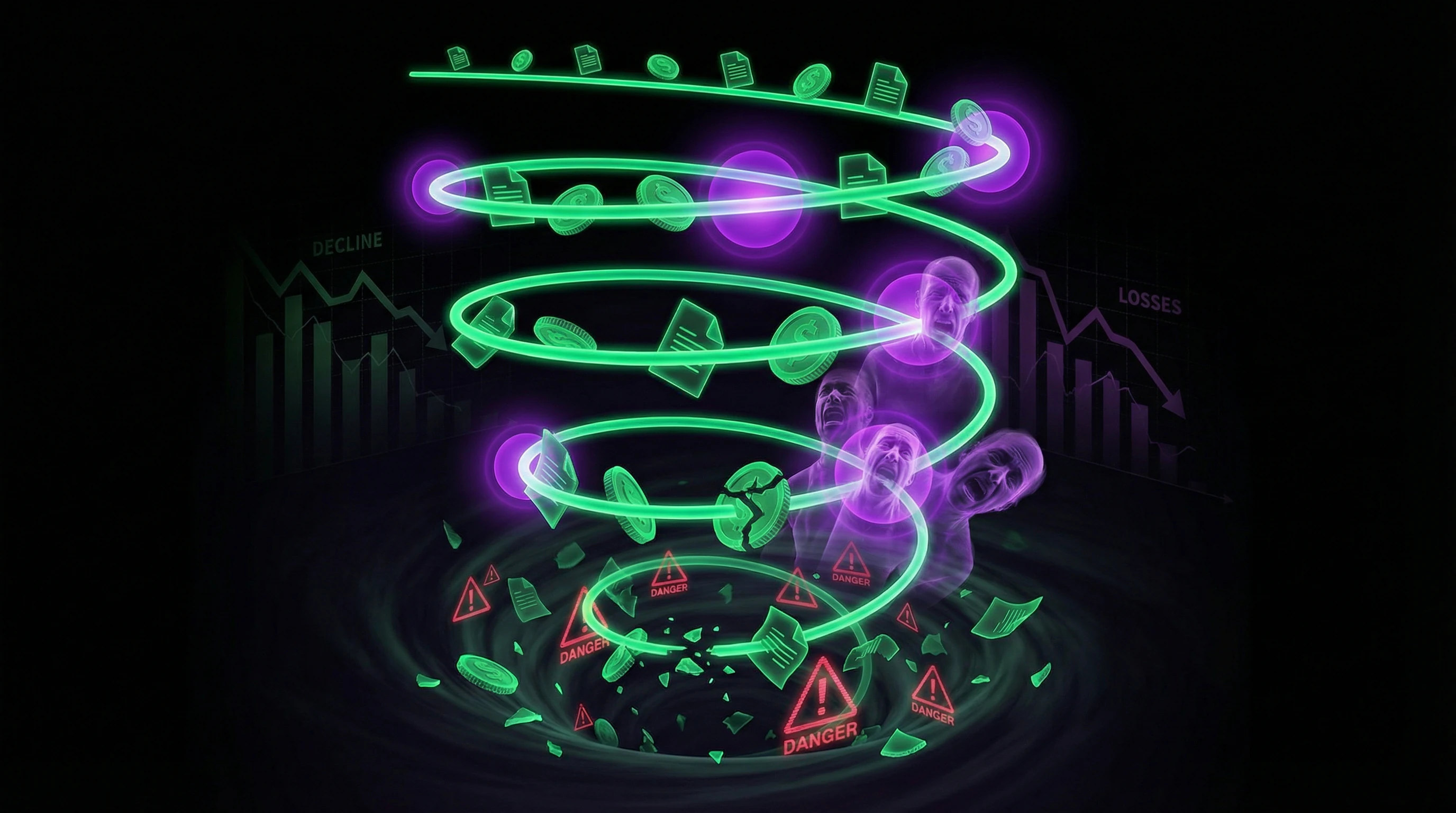
Capture Mechanisms: How Sunk Costs Hijack Rational Decision-Making
The sunk cost fallacy is not a logical failure, but the result of several deeply rooted psychological mechanisms interacting. Understanding these mechanisms requires integrating knowledge from cognitive psychology, neuroeconomics, and behavioral science. More details in the Logical Fallacies section.
🧬 Loss Aversion and Value Asymmetry
The fundamental mechanism is loss aversion. The psychological pain from losing a certain amount is approximately 2–2.5 times stronger than the pleasure from gaining an equivalent amount (S001). Terminating a project means crystallizing the loss: transforming a potential, abstract loss into a realized, concrete one.
Continuing investments, even with low probability of success, allows keeping the loss in "potential" status and maintaining hope for compensation through future benefits. The brain prefers uncertainty with the possibility of avoiding loss over the certainty of a realized loss.
Loss aversion creates psychological comfort from continuing investments, even when it's economically irrational.
🔬 Endowment Effect and Ownership
The endowment effect means that people assign greater value to things simply because they own them. Investing resources in a project creates a psychological sense of ownership not only of the invested resources (which are already lost), but also of potential future outcomes.
This sense of ownership distorts evaluation: a project "we" invested in seems more valuable than an objectively equivalent project "we" haven't invested in yet. Termination is perceived not as rational resource reallocation, but as losing "our" project.
- Investing resources creates an illusion of ownership over future outcomes
- This illusion activates neural circuits associated with losing physical property
- Project termination is perceived as a loss, not as a rational choice
🧱 Cognitive Dissonance and Self-Justification
Cognitive dissonance theory predicts that people experience psychological discomfort when their actions contradict their beliefs or self-perception. Acknowledging that a project is failing creates dissonance with self-perception as a competent, rational decision-maker (S006).
Continuing investments serves as a dissonance-reduction mechanism: it allows maintaining the narrative that the initial decision was correct, and current difficulties are temporary obstacles. The alternative—admitting error—requires revising self-perception, which is psychologically painful.
- Cognitive Dissonance
- Psychological discomfort from contradiction between actions and beliefs. In the sunk cost context: continuing investments reduces dissonance, allowing preservation of the competent decision-maker image.
- Self-Justification
- A psychological mechanism that reframes past decisions as correct to protect self-perception. Amplifies escalation of commitment.
💎 Framing Effect: How Formulation Determines Decision
The way a problem is framed radically affects choice. If the decision is framed as "continue investing or acknowledge loss of X," most will choose continuation. If the same decision is framed as "invest Y in this project or in an alternative project with better prospects," choice shifts toward the alternative (S002).
The sunk cost fallacy is often amplified by incorrect framing: focus on past investments ("we've already invested so much") instead of focus on future opportunity costs ("what could we do with these resources instead"). Changing the frame is one of the most effective tools for overcoming the trap.
| Framing | Effect on Decision | Mechanism |
|---|---|---|
| "Continue or acknowledge loss" | Most choose continuation | Loss aversion activated |
| "Invest in this or alternative project" | Choice shifts toward alternative | Focus on future outcomes, not past costs |
| "What could we do with these resources" | Rational reallocation | Opportunity costs become visible |
The connection between these mechanisms creates a powerful synergistic effect. Cognitive biases rarely act in isolation; they reinforce each other, creating persistent decision-making traps. Loss aversion activates self-justification, which is supported by incorrect framing, while the endowment effect makes the project psychologically "ours," making objective evaluation difficult.
Conflicts of Interpretation: Where Economic Rationality Diverges from Psychological Reality
The fundamental conflict in understanding the sunk cost fallacy is the divergence between normative economic theory (how people should make decisions) and descriptive behavioral science (how people actually make decisions). More details in the section AI Errors and Biases.
This conflict is not a contradiction between "right" and "wrong," but a reflection of a deeper question: what is rationality under conditions of incomplete information and limited cognitive resources.
Debates on the Boundaries of Rationality: Is Considering Sunk Costs Always Irrational
Classical economic theory: considering sunk costs is always irrational, since they don't affect future benefits and costs.
Alternative view: under conditions of incomplete information and limited cognitive capacity, the heuristic "continue what has already been invested in" may be adaptive (S001).
Gathering and processing information for a fully rational decision has its own costs. The simple rule "continue projects already invested in" saves cognitive resources and may be optimal under conditions of urgency and uncertainty.
However, this logic only works if the heuristic succeeds more often than it fails. Research shows the opposite: people continue investing even when information clearly indicates failure (S002).
Age, Experience, and Resistance to the Fallacy
Data on age differences adds another layer of complexity. Older people are less susceptible to the sunk cost fallacy than younger people (S005).
- Interpretation 1: Experience as Filter
- Age correlates with the number of failed projects a person has experienced. Each failure is a learning experience that reduces the likelihood of repeating the mistake.
- Interpretation 2: Changing Motivation
- Older people may be less motivated to "save" a project if their planning horizon is shrinking. Rationality here depends on what the person is optimizing for.
- Interpretation 3: Cognitive Decline as Protection
- Paradoxically, reduced cognitive flexibility may protect against the fallacy if it makes a person less capable of complex rationalizations for continuing.
None of these interpretations cancels out the others. They describe different mechanisms that may operate simultaneously.
Framing as the Breaking Point
The way a problem is presented (as action or inaction) dramatically changes the decision (S006). This is not a perceptual error—it's a fundamental property of human thinking.
When a project is presented as "continuing investment" (action), people are more likely to consider sunk costs. When the same project is presented as "abandoning investment" (inaction), they more often choose the rational option.
Rationality is not absolute—it depends on how the brain encodes the problem. This is not a bug, but a fundamental property of a system that evolved for survival under uncertainty, not for profit maximization.
Understanding this conflict between economic theory and psychological reality is the first step toward breaking the vicious cycle. Not because we are irrational, but because rationality is more complex than classical economics assumes.