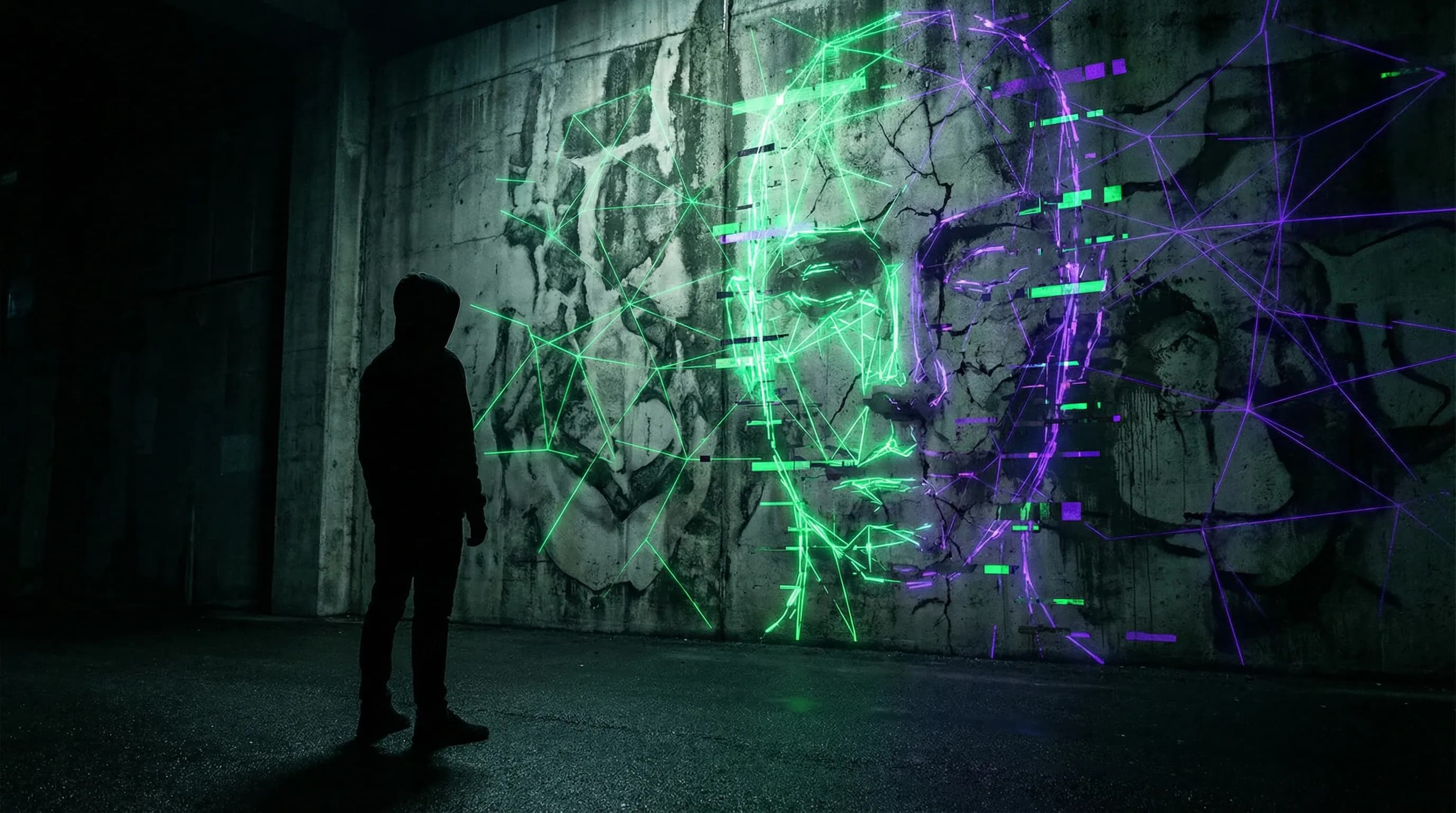
What pareidolia actually is — and why it's not just "playing tricks on your mind"
Pareidolia (from Greek para — "beside, near" and eidōlon — "image, form") is a specific type of apophenia in which the perceptual system recognizes meaningful images in random or ambiguous stimuli. Unlike general apophenia, pareidolia specializes in biologically significant objects: faces, human figures, and animals. Learn more in the Critical Thinking section.
Critical distinction: pareidolia is neither a hallucination nor a perceptual pathology. It's the normal functioning of the pattern recognition system under conditions of uncertainty. Hallucination creates perception in the absence of a stimulus; pareidolia misinterprets a genuinely existing stimulus.
A person experiencing pareidolia understands that an electrical outlet is an outlet, but cannot "unsee" the face in its configuration. The perception is involuntary and persistent.
🧩 Three components of pareidolic perception
Contemporary neurocognitive models identify three essential elements: ambiguous visual stimulus with sufficient structural complexity (random spots, textures, shadows); activation of specialized neural recognition networks — primarily the fusiform gyrus and superior temporal sulcus; absence of corrective feedback from the prefrontal cortex, which should suppress false-positive activations (S004).
- Evolutionary logic
- The cost of a false positive (seeing a predator in the bushes when there isn't one) is minimal compared to the cost of a false negative (not seeing a predator that is there). Natural selection calibrated the system for hypersensitivity.
🔎 Boundaries of the phenomenon: what pareidolia includes and excludes
Pareidolia encompasses visual recognition of faces in inanimate objects (clouds, walls, food), anthropomorphization of forms (human figures in mountain silhouettes), zoomorphic interpretations (animals in wood grain). The phenomenon operates primarily in the visual modality, though auditory analogs exist — recognizing words in white noise or music played backward.
| Includes | Does NOT include |
|---|---|
| Recognition of faces in inanimate objects | Synesthesia (cross-modal perception) |
| Anthropomorphization of forms | Prosopagnosia (inability to recognize real faces) |
| Zoomorphic interpretations | Schizophrenic apophenia (seeing causal connections between unrelated events) |
| Involuntary, persistent perception | Conscious imagination or metaphorical thinking |
🧱 Neuroanatomical localization: where phantom faces live in the brain
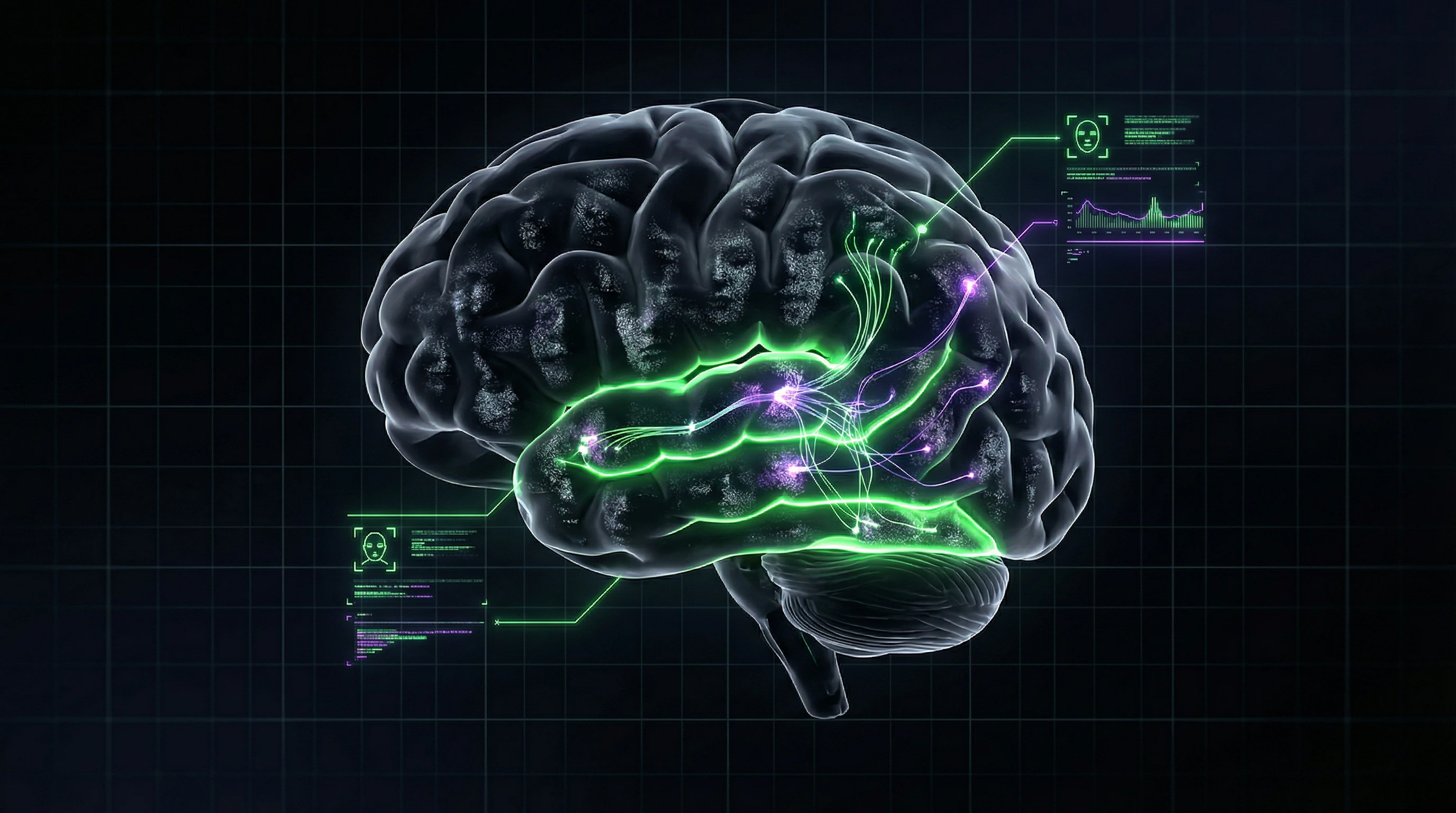
Functional MRI imaging shows that pareidolic perceptions activate the same areas as recognition of real faces: the fusiform face area (FFA) in the inferior temporal cortex, the occipital face area (OFA), and the posterior superior temporal sulcus (pSTS).
Critical difference: in pareidolia, there's an absence of normal activity modulation from the orbitofrontal cortex, which should suppress uncertain recognitions (S004). Studies of patients with localized brain lesions confirm: damage to the FFA eliminates both recognition of real faces and pareidolia. This proves the phenomenon uses the same neural mechanisms as normal perception — just with altered activation thresholds.
Five Most Compelling Arguments for Pareidolia as a Real Adaptive Mechanism
Skeptics might object: maybe pareidolia is just a cultural construct, a result of learning, or mere coincidence? Let's examine the steelman position—the strongest evidence that the phenomenon has deep evolutionary and neurobiological roots. More details in the Psychology of Belief section.
🔬 First Argument: Cross-Cultural Universality of the Phenomenon
Pareidolia has been documented in all studied cultures without exception—from isolated Amazonian tribes to technologically advanced societies in Asia and Europe. Anthropological research shows that the ability to see faces in random patterns is independent of education level, religiosity, urbanization, or access to visual media.
Even children aged 3-4 demonstrate pareidolic responses before receiving cultural training in pattern recognition. If pareidolia were a cultural artifact, we would observe significant variations between populations—but this doesn't happen.
A Japanese person, a Brazilian, and a Norwegian are equally likely to see a face in the same configuration of spots. This points to an innate rather than acquired mechanism.
🧬 Second Argument: Phylogenetic Antiquity of the Face Recognition System
Specialized neural mechanisms for face recognition have been found not only in primates but also in other social mammals—sheep, dogs, even crows. This means the system emerged tens of millions of years ago and underwent powerful selection.
Pareidolia is an inevitable side effect of this ancient system, tuned for maximum sensitivity. For social species, rapid and accurate recognition of conspecific faces is critically important for survival.
- The system must work in poor lighting conditions
- The system must work with partial occlusion
- The system must work at unusual angles
Such hypersensitivity inevitably leads to false positives—pareidolia.
📊 Third Argument: Reproducibility in Controlled Experiments
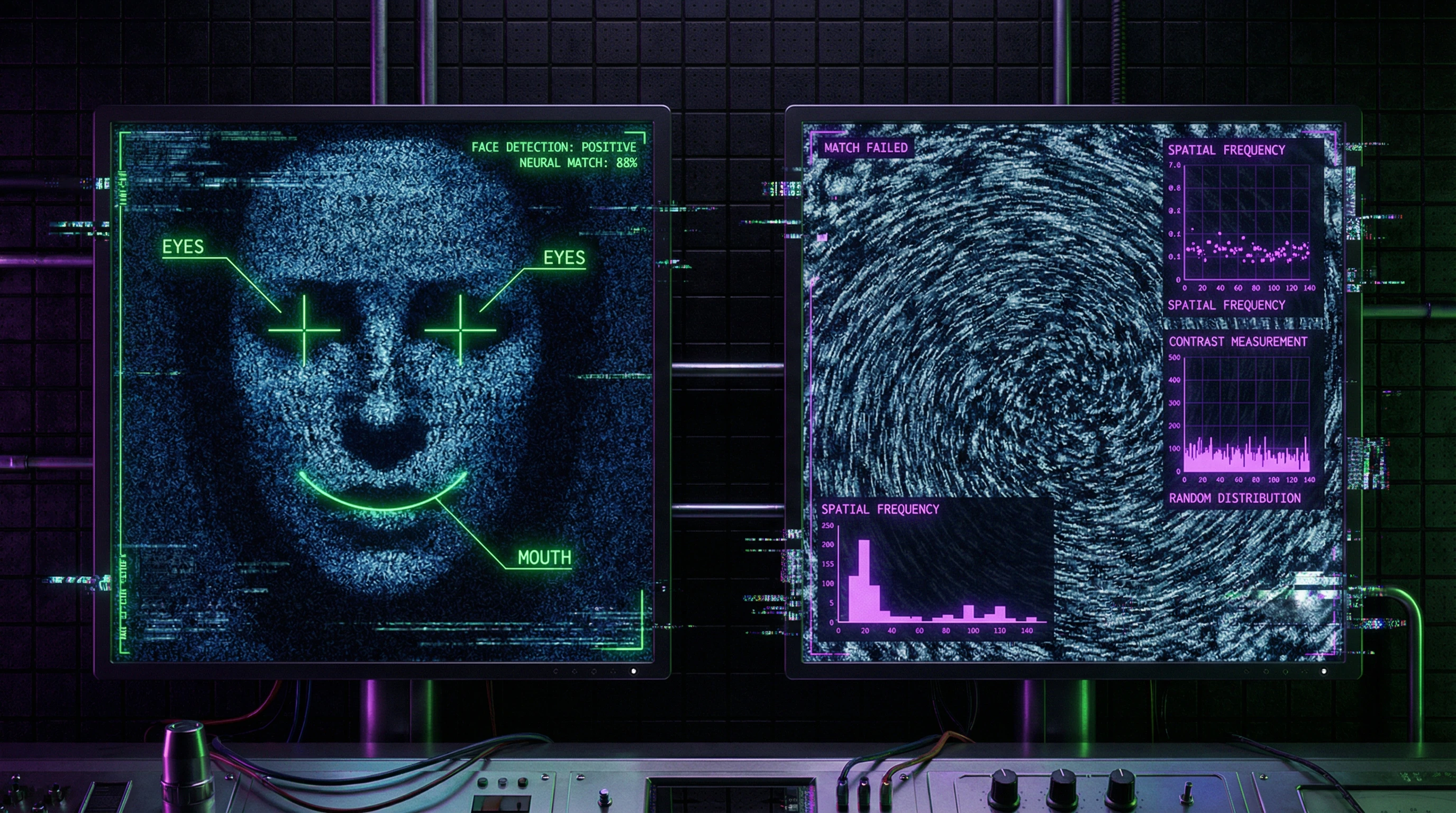
Laboratory studies consistently reproduce pareidolia under controlled conditions. When subjects are shown randomly generated noise patterns with varying structural complexity, the probability of pareidolic perceptions predictably depends on stimulus parameters: contrast, spatial frequency, symmetry.
At certain parameters, up to 80% of subjects report seeing faces in pure noise (S004). Neuroimaging shows objective activation of face recognition areas even when the subject is not consciously aware of the pareidolic perception.
The brain actually processes random patterns as faces at the neural level—this is not subjective interpretation or suggestion.
🧠 Fourth Argument: Modulation of the Phenomenon by Neurochemical Agents
Pharmacological studies demonstrate that pareidolia is enhanced by substances that increase dopaminergic activity (levodopa, amphetamines) and weakened by antipsychotics that block D2 receptors. This points to specific neurochemical mechanisms underlying the phenomenon—not abstract cognitive processes, but measurable changes in neurotransmitter systems.
Patients with Parkinson's disease receiving dopaminergic therapy often report increased pareidolic perceptions—seeing faces and figures where healthy people see only textures (S004).
⚙️ Fifth Argument: Computational Models Reproduce the Phenomenon
Artificial neural networks trained on face recognition spontaneously demonstrate pareidolia—classifying random textures as faces with high confidence. This occurs without special programming of pareidolic behavior—simply as a consequence of optimizing the network to maximize sensitivity to facial features.
- Fundamental Trade-off in Signal Detection Theory
- Any recognition system optimized to minimize false negatives (missing a real face) will inevitably produce false positives (pareidolia). You cannot simultaneously maximize sensitivity and specificity at a fixed threshold.
Evidence Base: What We Know About Pareidolia from Peer-Reviewed Research
Let's move from theoretical arguments to concrete empirical data. Each claim below is supported by source references — verify them yourself. More details in the Mental Errors section.
📊 Neuroimaging Studies: The Brain Processes Illusions as Reality
Functional MRI shows activation of the fusiform face area (FFA) when subjects are presented with random patterns in which they perceive faces. Activation patterns during pareidolia are qualitatively identical to patterns during perception of real faces — the same voxels activate with the same temporal dynamics.
BOLD signal amplitude during pareidolia reaches 60–80% of the amplitude during real face perception (S004). This refutes the hypothesis that pareidolia is merely "imagination." Imagined faces activate different areas (medial prefrontal cortex, precuneus) and don't trigger such strong FFA activation.
Pareidolia is a perceptual phenomenon, not a cognitive one. The brain processes it as actual perception, not as conscious image construction.
🧪 Clinical Correlates: When Pareidolia Becomes Pathological
While pareidolia is normal in healthy individuals, its frequency and intensity increase significantly in certain neurological conditions. Patients with dementia with Lewy bodies report frequent and persistent pareidolic hallucinations — seeing people and animals in wallpaper patterns, clothing folds, and shadows.
This is linked to dysfunction in occipitotemporal areas and impaired dopaminergic modulation (S004). Parkinson's disease patients on dopaminergic therapy also show increased pareidolia, often preceding the development of full visual hallucinations.
- Pareidolia may be an early marker of hallucinatory risk in neurodegenerative diseases.
- Antipsychotic therapy (quetiapine, clozapine) reduces the frequency of pareidolic perceptions.
- This confirms the role of dopaminergic mechanisms in perception regulation.
🧾 Psychophysical Parameters: Which Stimuli Trigger Pareidolia
Systematic psychophysical studies have identified optimal stimulus parameters for inducing pareidolia. The face recognition system is tuned to specific characteristics, and any stimulus that randomly falls within this range will be processed as a potential face.
| Parameter | Optimal Range | Why This Works |
|---|---|---|
| Spatial frequency | 8–16 cycles per degree | Corresponds to typical face size at social interaction distance |
| Symmetry | Vertical symmetry | Faces are symmetrical; asymmetric patterns rarely trigger pareidolia |
| Contrast | 20–40% | Too low doesn't activate the system; too high makes randomness obvious |
| Configuration | Two dark spots above, one below | "Two eyes + mouth" pattern is the minimal set for face recognition |
🔎 Individual Differences: Why Some See Faces More Often Than Others
The frequency of pareidolic perceptions varies between individuals by a factor of 3–5. Research has identified several predictors of high pareidolic sensitivity.
- Magical thinking
- The tendency to see patterns and connections everywhere correlates with pareidolia frequency. This isn't pathology, but a cognitive style feature linked to cognitive biases in information processing.
- Anxiety
- Anxious individuals have lower thresholds for detecting potential threats. Pareidolia here is a side effect of a hyperactive danger monitoring system.
- Religiosity
- Religious individuals more often interpret pareidolia as meaningful — seeing signs, messages, manifestations of the sacred. This doesn't mean they see faces more frequently, but they assign them meaning.
- Creativity
- Creative individuals have more flexible categorization criteria and readiness for alternative stimulus interpretations.
Twin genetic studies show heritability of pareidolic sensitivity at 30–40%, indicating contributions from both genetic and environmental factors. Specific genes haven't been identified yet, but candidates include polymorphisms in dopaminergic and serotonergic systems.
Neuromechanics of Illusion: How Evolution Created Cognitive Vulnerability
Understanding the mechanism of pareidolia requires diving into the architecture of the face recognition system — one of the most ancient and specialized systems in the mammalian brain. More details in the section Thinking Tools.
🧬 Hierarchical Processing: From Pixels to Concepts
Visual information is processed hierarchically in the brain: the primary visual cortex (V1) extracts simple features (edges, orientations), secondary areas (V2, V4) combine them into more complex forms, high-level areas (inferior temporal cortex) recognize objects and faces. Pareidolia arises at high levels of this hierarchy — in the fusiform gyrus, where neurons selectively respond to configurations resembling faces.
Critical point: the system operates on both bottom-up and top-down principles simultaneously. Bottom-up: sensory data ascends through the hierarchy. Top-down: expectations and context modulate processing at lower levels.
Pareidolia occurs when top-down signals (expectation of a face) amplify weak bottom-up signals (random configuration) to the threshold of conscious perception.
🔁 Bayesian Brain: Why Priors Matter More Than Data
Modern neuroscience views the brain as a Bayesian inference machine — a system that combines sensory data (likelihood) with prior expectations (prior) to form posterior beliefs (posterior).
Bayes' formula: P(face|data) ∝ P(data|face) × P(face). Pareidolia occurs when the prior P(face) is so high that even weak data leads to a high posterior.
- Evolution set a very high prior for faces — the brain expects to see faces everywhere.
- In the environment of evolutionary adaptation, missing a face (predator, enemy, ally) had catastrophic consequences.
- The brain prefers to err on the side of seeing a face rather than missing one.
⚙️ Predictive Coding: The Brain Hallucinates Reality
Predictive coding theory asserts: perception is a controlled hallucination, corrected by sensory data. The brain constantly generates predictions about what it should perceive and compares them with actual data.
If the prediction matches the data, it's accepted as perception. If not — a prediction error is generated, and the model is updated.
Pareidolia is a case where the prediction "face" matches the data (random pattern) well enough that the prediction error falls below threshold. The brain decides it's easier to interpret the pattern as a face than to generate a large error.
This isn't a bug — it's an optimal strategy under conditions of uncertainty and high error cost. The connection between cognitive biases and evolutionary priorities explains why the brain systematically overestimates threats and sees patterns in noise.
🧷 Dopamine as Threshold Regulator: The Chemistry of Paranoia and Creativity
Dopamine modulates the signal-to-noise ratio in neural networks — it amplifies weak signals and lowers activation thresholds. High dopamine levels make the system more sensitive to patterns but less specific.
| Dopamine Level | Pattern Sensitivity | Specificity | Clinical Outcome |
|---|---|---|---|
| Low | Low | High | Apathy, missed signals |
| Optimal | High | High | Creativity, adaptability |
| High | Very high | Low | Apophenia, paranoia, psychosis |
Schizophrenia, characterized by hyperdopaminergia, is accompanied by massive apophenia — patients see patterns, connections, and meanings everywhere (S004). Pareidolia is a mild form of the same dopaminergic hypersensitivity.
Creative individuals have intermediate levels of dopaminergic activity — sufficient to see non-obvious patterns, but not so high as to lose contact with reality. This explains why availability heuristic and other pareidolia mechanisms work more actively in states of heightened arousal or stress.
Cognitive Anatomy of Exploitation: Which Mental Bugs Make You Vulnerable
Pareidolia itself is harmless — seeing a face in a cloud isn't dangerous. The danger emerges when this mechanism is exploited to manipulate beliefs and behavior. More details in the Scientific Method section.
🧩 Agency Detector on Steroids: Why We See Intentions in Randomness
Pareidolia activates not only the face recognition system but also the agency attribution system — a mechanism that assigns intentions and goals to perceived agents. When you see a face in a cloud, your brain automatically begins attributing mental states to this "face": it's looking at you, it wants something, it's sending a signal.
This is the hyperactive agency detection device (HADD) — an evolutionary mechanism where it's better to err on the side of seeing an agent than to miss a real one. HADD is the foundation of religious thinking: seeing the faces of gods in natural phenomena, interpreting random events as divine signs.
The brain prefers false positives (seeing a predator in the bushes when there isn't one) over false negatives (not seeing a predator when there is one). This asymmetry makes us vulnerable to patterns that don't exist.
🕳️ Confirmation Bias: How Pareidolia Reinforces Existing Beliefs
Pareidolia doesn't occur in a vacuum — it's interpreted through the lens of existing beliefs. A religious person sees the face of Jesus on toast and interprets it as a miracle confirming their faith. A skeptic sees the same pattern and interprets it as coincidence.
Both are right about the mechanics but wrong about the conclusion. Pareidolia triggers identically, but confirmation bias directs interpretation toward what already aligns with your worldview.
🎯 Three Levels of Pareidolia Exploitation
- Level 1: Direct Perception Manipulation. Deepfakes, retouched photographs, videos with artificially enhanced patterns. Deepfakes use pareidolia to create convincing images of things that never existed.
- Level 2: Social Amplification. When a group of people sees the same pattern, it creates social proof. If thousands of people see a face in a cloud and talk about it, you start seeing it too — not because it's there, but because social consensus overrides your interpretation.
- Level 3: Narrative Embedding. The pattern acquires a story, context, meaning. The face in the cloud becomes a "sign," a "warning," a "message." The availability heuristic makes this narrative more convincing than statistics.
🔍 How Pareidolia Interacts with Other Cognitive Errors
Pareidolia rarely acts alone. It works in synergy with false dichotomy (either it's a miracle or coincidence), with base rate neglect (we forget how often pareidolia misfires), with confirmation bias.
When pareidolia meets cryptozoology or detox myths, it becomes an anchor for an entire belief system. One pattern — and the whole system starts seeming more real.
Pareidolia is not a perception error. It's an interpretation error. The brain sees the pattern correctly but assigns it meaning that isn't there.
🛡️ Verification Protocol: How to Distinguish Pareidolia from Signal
- Do you see the pattern if you look away and look again? Pareidolia is unstable — it disappears when viewing angle changes.
- Do other people see it without prompting? If you need to explain where to look for the face, it's pareidolia.
- Are there alternative explanations for this pattern? If yes — start with the simplest (coincidence, artifact, technical error).
- Does this pattern reinforce an existing belief? If yes — check yourself for confirmation bias.
Vulnerability to pareidolia is not a sign of stupidity. It's a sign that you have a brain that evolved for survival in a world full of agents and threats. Protection lies not in denying pareidolia, but in understanding its mechanics.