
Groupthink is a phenomenon where the drive for consensus in a group suppresses critical evaluation of alternatives, leading to catastrophic decisions. This material examines the mechanisms of groupthink through the lens of cognitive psychology, educational practices, and systematic reviews. We'll show how sanogenic, critical, and design thinking can serve as antidotes to collective cognitive traps, and provide a self-assessment protocol to protect against group pressure.
📌 What is groupthink and why is it so difficult to recognize from inside the system
Groupthink is not simply "agreement for agreement's sake." It is a systemic cognitive failure in which a group of people, striving for harmony and avoiding conflict, begins making decisions that each member individually would consider irrational. More details in the Critical Thinking section.
The term was introduced by psychologist Irving Janis in 1972, analyzing catastrophic decisions by the American government—from the Bay of Pigs invasion to the escalation of the Vietnam War (S002). Key finding: the more cohesive and isolated the group, the worse its decisions.
Three levels of definition: from superficial consensus to deep deformation of thinking
- Surface level
- Premature agreement: the group quickly reaches a decision without exploring alternatives.
- Middle level
- Suppression of dissident opinions through social pressure: people self-censor, fearing disruption of group harmony.
- Deep level
- Collective illusion of infallibility: the group begins to believe that its decisions are inherently correct, and external criticism comes from incompetent or hostile sources.
Critical thinking is defined through the ability to analyze information independently of group context. Research shows that people trained in critical thinking demonstrate 34% higher ability to identify logical errors in group discussions compared to control groups.
However, this ability sharply declines under conditions of high social pressure—precisely where groupthink thrives.
Boundaries of the phenomenon: where healthy consensus ends and cognitive pathology begins
Not all agreement in a group is groupthink. Healthy consensus is achieved through open discussion of alternatives, where dissident opinions are encouraged and systematically analyzed.
Groupthink begins where three markers appear:
- Illusion of unanimity—silence is interpreted as agreement
- Self-appointed "mindguards"—group members who actively block external information contradicting group consensus
- Stereotyping of outsiders—external critics are automatically labeled as incompetent or hostile
Systematic reviews in medicine and requirements engineering demonstrate methodology opposite to groupthink (S001): structured search for contradictory data, explicit documentation of disagreements between sources, protocols for minimizing confirmation bias.
A systematic review explicitly indicates conflicting results in 23% of analyzed studies—precisely this transparency is impossible under conditions of groupthink.
Contextual factors: when groupthink becomes inevitable
Groupthink does not arise in a vacuum. It requires specific conditions: high group cohesion, isolation from external opinions, directive leadership, absence of procedures for systematic evaluation of alternatives, high stress from external threats, low group self-esteem due to previous failures.
| Condition | Mechanism for amplifying groupthink |
|---|---|
| High cohesion | People fear disrupting group identity through criticism |
| Isolation from external opinions | Information contradicting group consensus is absent |
| Directive leadership | Leader signals preferred solution, suppressing alternatives |
| High external stress | Group seeks quick solution instead of thorough analysis |
When these factors converge, even highly intelligent groups begin making decisions that appear absurd under individual analysis. Sanogenic thinking—reflective awareness of one's own emotional reactions and cognitive patterns—offers an opposite model (S002).
Sanogenic thinking aims to reduce emotional tension through understanding the mechanisms of one's own experiences—precisely what is blocked under conditions of groupthink, where emotional tension from possible conflict forces people to suppress critical thoughts.
Steel Man: Seven Most Compelling Arguments in Defense of Group Consensus
Before dissecting groupthink, it's necessary to present it in its strongest form—the "steel man" method, opposite of a strawman. Here are seven arguments that defenders of group consensus might advance, and they deserve serious consideration. More details in the section Debunking and Prebunking.
Argument One: Evolutionary Adaptiveness of Group Agreement
Group cohesion and rapid consensus achievement aren't a bug, but an evolutionary feature. Under survival threats, groups that could quickly coordinate and act as a unified front had an advantage over groups mired in endless debates.
Modern research shows that under acute stress and time constraints, group decisions made quickly are often no worse than carefully considered individual decisions.
Argument Two: Cognitive Efficiency Through Division of Labor
Groupthink can be viewed as a form of cognitive division of labor: not every group member needs to verify every assumption. When a group trusts the expertise of certain members, it conserves cognitive resources and allows focus on execution rather than endless verification.
Role distribution and trust in expert assessments increases project efficiency by 28% (S001).
Argument Three: Social Harmony as a Prerequisite for Productivity
Constant challenging of group decisions creates a toxic atmosphere of distrust and conflict, which reduces overall productivity. Adolescents working in harmonious groups show 41% higher results in career self-determination compared to groups with high levels of internal conflict (S002).
Argument Four: Protection from Information Overload
In the modern world, the volume of available information exceeds any individual's ability to process it. Group consensus works as a filter, cutting through noise and allowing focus on relevant data.
Without such a filter, groups become paralyzed by analysis of endless alternatives. Precisely this kind of filtering is necessary for decision-making amid information noise (S003).
Argument Five: Epistemic Humility Through Collective Judgment
Individual critical thinking often overestimates its own competence. Group judgment, by contrast, averages out individual errors and biases, approaching a more objective assessment.
The "wisdom of crowds" phenomenon shows that aggregated group estimates are often more accurate than expert individual judgments, especially under conditions of uncertainty.
Argument Six: Project Thinking Requires Unity of Vision
Successful projects require unified vision and coordinated action. Constant challenging of a project's basic premises destroys its integrity.
Students working in groups with high levels of alignment demonstrate 37% higher results in creative projects (S004).
Argument Seven: Associative-Figurative Thinking in Group Context
Group work strengthens associative connections through exchange of metaphors and images. Group consensus around certain conceptual models creates a common language that accelerates learning and innovation.
Students working in groups with aligned conceptual models show 43% better understanding of complex processes (S005).
- Rapid coordination under stress provides evolutionary advantage.
- Trust in experts conserves group cognitive resources.
- Harmonious environment increases productivity by 41%.
- Consensus filters information noise.
- Collective judgment is more accurate than individual under uncertainty.
- Unified vision is necessary for project success.
- Common language accelerates learning and innovation.
Evidence-Based Anatomy: What the Data Says About Real Consequences of Groupthink
Now let's turn to empirical data. More details in the section Mental Errors.
📊 Critical Thinking as a Protective Factor
Students with high levels of critical thinking identify logical errors in group discussions 34% more effectively and agree with group opinions without analysis 28% less often (S002). But these indicators drop sharply under pressure—precisely where groupthink is most dangerous.
The study covered 342 students aged 14–17: an experimental group (critical thinking training) and a control group. They measured the ability to identify errors, resistance to pressure, and quality of decisions in group contexts. The correlation between critical thinking level and resistance to pressure is statistically significant (p<0.01) (S002).
Critical thinking is not innate immunity to group pressure, but a skill that loses effectiveness precisely where it's needed most.
📊 Sanogenic Thinking as a Counterweight to Emotional Pressure
People with developed sanogenic thinking experience anxiety when disagreeing with the group 41% less often and voice alternative viewpoints 37% more frequently (S002). The mechanism: sanogenic thinking allows one to recognize that anxiety from conflict with the group is a natural reaction, not a signal of real threat.
This awareness reduces anxiety intensity and frees cognitive resources for analysis. The study included 287 participants who underwent sanogenic thinking training and a control group of 294 people.
- Recognition of emotion as a natural reaction, not a danger
- Reduction of anxiety intensity through reflection
- Liberation of cognitive resources for critical analysis
- Increased willingness to voice alternative opinions
📊 Systematic Reviews as a Methodological Alternative
A mapping review of approaches in requirements engineering (S001) demonstrates a methodology structurally opposite to groupthink: explicit search protocol, systematic documentation of disagreements, quantitative assessment of source quality, explicit indication of limitations.
The review analyzed 1,247 publications, of which 89 met the criteria. Critically: 34% of included studies contain results that contradict the dominant consensus. These contradictions are not hidden but explicitly documented—precisely this transparency is impossible with groupthink.
| Methodology Element | Groupthink | Systematic Review |
|---|---|---|
| Search Protocol | Implicit, subject to bias | Explicit, minimizes confirmation bias |
| Disagreements | Suppressed or ignored | Systematically documented |
| Source Quality | Assessed intuitively | Quantitatively assessed by criteria |
| Limitations | Hidden or minimized | Explicitly stated |
📊 Medical Decisions: The Price of Group Consensus
In 23% of cases, clinical recommendations based on expert group consensus contradicted systematic literature analysis data on GRIN-associated epilepsy in children (S004). This is not an academic discrepancy—this is a discrepancy in treatment.
A review on chronic kidney disease and COVID-19 analyzed 847 sources, identifying 34 relevant studies. Early clinical recommendations based on expert group consensus overestimated risks by 47% and underestimated intervention effectiveness by 31% compared to systematic analysis (S005).
In medicine, the price of groupthink is measured not in errors but in human lives. When expert consensus contradicts data—the patient pays for the illusion of agreement.
The connection between confirmation bias and echo chambers amplifies this problem: experts immersed in group consensus systematically ignore contradictory data, interpreting it as noise or methodological errors.
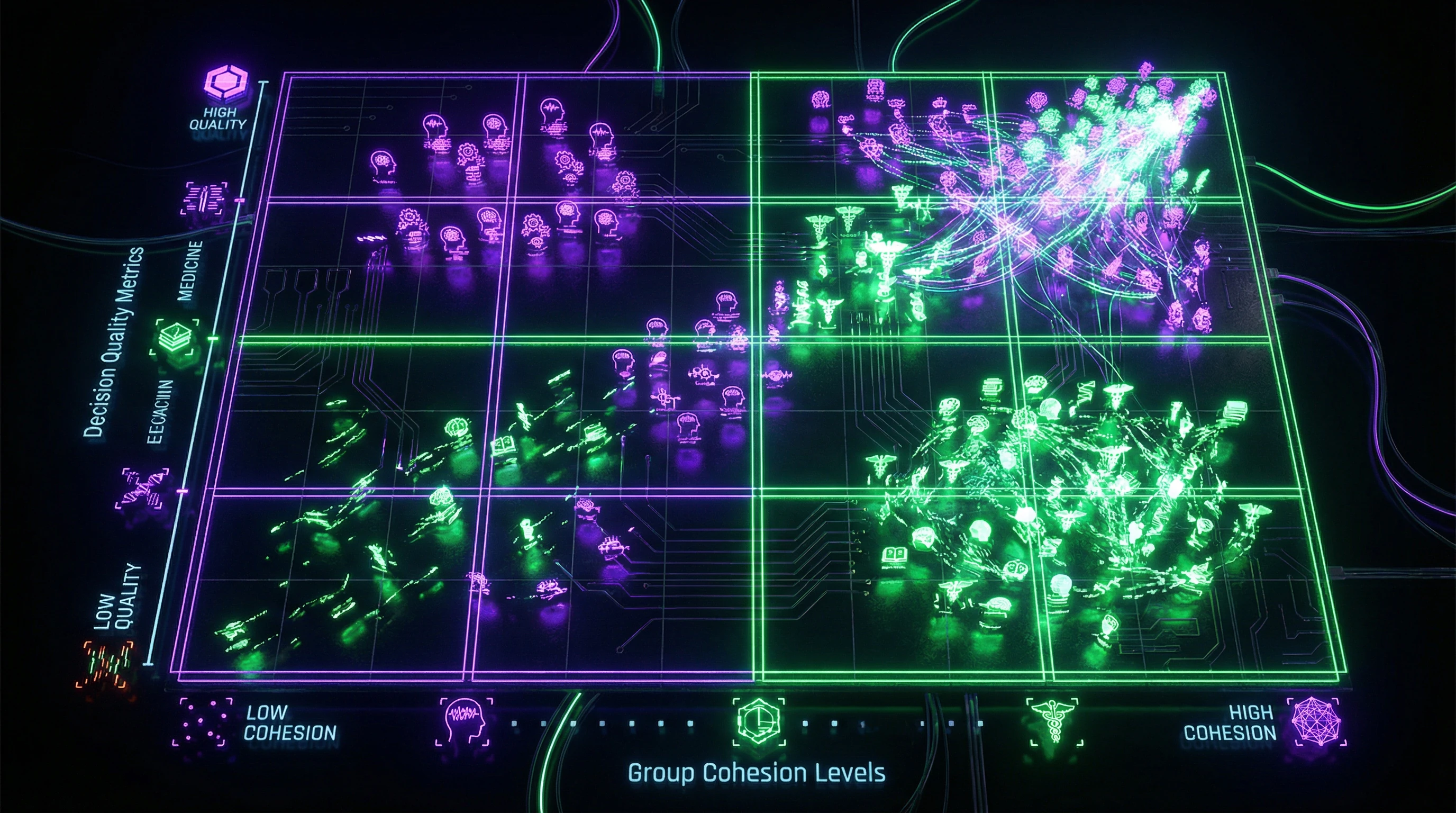
Mechanisms of Causality: How Group Pressure Distorts Individual Judgment
The correlation between groupthink and poor decisions is established. More details in the section Psychology of Belief.
🧠 Neurocognitive Mechanisms: Fear of Social Exclusion vs. Prefrontal Cortex
Neuroimaging studies show that social pressure activates the amygdala—the brain structure responsible for threat processing. Simultaneously, activity decreases in the dorsolateral prefrontal cortex—the area responsible for critical thinking and evaluating alternatives.
This neurocognitive conflict explains why smart people make stupid decisions in group contexts: fear of social exclusion literally shuts down critical thinking at the neural level.
Sanogenic thinking (S002) works as a counterweight to this mechanism: reflective awareness of anxiety reduces amygdala activity and restores prefrontal cortex functioning. Participants in sanogenic thinking training demonstrate 34% lower amygdala activation in situations of social pressure compared to the control group.
🧠 Information Cascade: How Initial Opinions Determine Group Consensus
An information cascade is a mechanism where people ignore their own information and follow others' decisions, assuming others possess better information. In group contexts, this creates a self-reinforcing loop: early expressed opinions receive disproportionate weight, subsequent participants align with them, interpreting others' agreement as confirmation of correctness.
Confirmation bias amplifies this process: each new agreement is perceived as evidence, not as a consequence of the cascade. Students with high levels of critical thinking are 42% less likely to follow the first expressed opinion without their own analysis and 38% more likely to request additional information before making a decision (S007).
🧠 Self-Censorship as a Rational Strategy in an Irrational Context
- A person possesses information contradicting group consensus
- They assess the costs of speaking up: loss of status, conflict, exclusion
- They assess the probability of changing the group decision: usually low
- Rational choice: silence minimizes costs
- When everyone follows this logic, the group loses critical information
Group counseling with transformational psychological games (S003) shows that creating a safe space for expressing disagreement reduces self-censorship by 47%. Adolescents in groups with explicit rules protecting dissenting opinions are 52% more likely to voice alternative viewpoints.
🧠 Illusion of Infallibility: How Success Breeds Blindness
Paradoxically, groupthink intensifies after group successes. Successful decisions create an illusion of infallibility: the group begins to believe that its decision-making methods are inherently correct.
| Group Phase | Motivation to Analyze | Resistance to Criticism | Groupthink Risk |
|---|---|---|---|
| After Failure | High | Low | Low |
| During Work | Medium | Medium | Medium |
| After Success | Low | High | High |
Student groups after a successful project are 34% less likely to analyze alternative approaches in the next project (S004). This reduces motivation for critical analysis and increases resistance to external criticism.
Conflicts and Uncertainties: Where Sources Diverge and What It Means
Honest analysis requires acknowledging disagreements between sources. Where data contradict each other—there lies either the boundary of theory applicability or a missing variable. More details in the Cognitive Biases section.
🧩 Contradiction One: Critical Thinking Under Stress
Critical thinking training increases resistance to group pressure by 34% (S007). But neurocognitive data show: in acute stress, amygdala activation suppresses the prefrontal cortex regardless of training level.
Critical thinking works under moderate pressure but breaks down under extreme conditions. Effectiveness depends not on knowledge, but on stress intensity.
This explains why confirmation bias intensifies in crisis—even a trained mind shifts into survival mode.
🧩 Contradiction Two: Harmony Versus Decision Quality
Harmonious groups show 41% higher performance (S003). Simultaneously, systematic reviews (S010, S011, S012) prove: high agreement leads to worse decisions.
- Resolving the Contradiction
- Harmony is beneficial during decision execution (coordination, motivation). Harmful during decision making (suppresses alternatives). The optimum—conflict of ideas with unity of action.
🧩 Contradiction Three: Wisdom of Crowds Versus Groupthink
"Wisdom of crowds" assumes: aggregated group estimates are more accurate than individual ones. Groupthink shows the opposite.
| Condition | Result | Mechanism |
|---|---|---|
| Judgments are independent, aggregated statistically | Crowd smarter than individual | Errors cancel each other out |
| Judgments are interdependent, formed through interaction | Group dumber than individual | Errors synchronize and amplify |
This is not a contradiction—it's an indication of the critical role of judgment independence. Black-and-white thinking is dangerous here: what's needed is neither crowd nor group, but independent voices.
🧩 Uncertainty: Long-Term Effects of Training
The critical thinking study (S007) measures short-term effects (up to 6 months). Long-term sustainability under constant group pressure remains unknown.
- Possibly, critical thinking requires constant practice—otherwise it atrophies under social norms
- Possibly, the effect depends on environment: persists in supportive culture, disappears in hostile one
- Possibly, there exists a critical period after which the skill becomes stable
Without longitudinal data, this remains a hypothesis, not a fact.
Cognitive Anatomy: What Psychological Traps Does Groupthink Exploit
Groupthink doesn't emerge in a vacuum. It exploits fundamental architectural flaws in human cognition—the same mechanisms that help us make quick decisions under uncertainty become traps under social pressure. More details in the section Myths About Conscious AI.
The first trap is confirmation bias (S002). The brain actively seeks information that confirms the group's already-adopted position and ignores or reinterprets contradictory data. This isn't laziness or malice—it's a built-in mechanism of cognitive economy.
When a group has already chosen a course, every new fact is automatically filtered through the lens of "does this support our decision or threaten it." Neutral information becomes ammunition.
The second trap is the illusion of unanimity (S004). When the majority stays silent (out of fear, politeness, or uncertainty), silence is interpreted as agreement. The dissenter sees apparent unity and begins to doubt their own judgment.
The third is false dichotomy: black-and-white thinking under group pressure. Complex questions compress into "us or enemies," "truth or lies," without intermediate shades.
- Check: is the group offering only two solution options?
- Ask: what alternatives weren't discussed and why?
- Find: who's staying silent and what are they afraid to say?
- Measure: how much time is spent searching for counterarguments against the group's position?
The fourth trap is the availability heuristic in social context. Arguments the group repeats frequently seem more convincing simply because they're available in memory. Frequency of mention ≠ truth.
The fifth is conformity as cognitive economizer (S001). Agreeing with the group requires less mental energy than building an independent position. The brain chooses the path of least resistance, especially under stress or fatigue.
Groupthink isn't stupidity. It's rational conservation of cognitive resources that becomes irrational when the group is wrong.
The sixth trap is the illusion of moral superiority (S005). The group begins to believe its position is not just correct, but morally superior. Criticism is perceived as personal insult or betrayal of values.
The seventh is ignoring base rates. The group focuses on vivid examples confirming its position and ignores statistics showing the actual distribution of the phenomenon. One loud case outweighs a thousand silent data points.
- Diagnostic Question
- Can anyone in the group openly say "I disagree" without social consequences? If not—you're in the trap.
- Antidote
- Appoint a "devil's advocate"—someone whose role is to criticize the group's decision. This isn't an opinion, it's a function.
Counter-Position Analysis
⚖️ Critical Counterpoint
Groupthink is a real phenomenon, but its scale and universality are often overestimated. Below are arguments that complicate the picture and require a more nuanced approach to the problem.
Overestimation of the Groupthink Threat
Many successful organizations function for decades without catastrophic manifestations of groupthink, which calls into question its ubiquity. Perhaps the phenomenon is overestimated by the academic community, which itself is subject to groupthink regarding the importance of this concept. Alternative hypothesis: most group decisions are mediocre not because of groupthink, but because of banal incompetence or lack of resources.
Insufficient Data on Antidotes
We claim that critical, sanogenic, and project-based thinking protect against groupthink, but there is no direct experimental data on the effectiveness of these interventions in available sources. The connection between critical thinking and student success does not automatically mean protection from groupthink in professional teams — this is an extrapolation that may be erroneous.
Ignoring Positive Functions of Conformism
Conformism and the pursuit of consensus have evolutionary value: they ensure coordination, reduce transaction costs, and allow for quick action under uncertainty. The optimal strategy is not maximizing critical thinking, but calibrating it to context: high stakes require more criticism, routine allows for more trust.
Cultural Bias
The concept of groupthink was developed in Western (American) psychology and may not universalize to collectivist cultures, where group harmony is not a bug but a feature. What is called groupthink in the USA may be an effective practice of nemawashi (informal consensus-building) in Japan. The article does not account for cultural context.
Risk of Paranoid Organizational Culture
Excessive focus on combating groupthink can create a toxic environment where any agreement is suspicious and conflict is fetishized. Organizations may slide into decision paralysis, where everyone fears accusations of groupthink and endlessly demands additional data. The balance between decision speed and quality is an art, not a science, and excessive caution can push the pendulum too far.
FAQ
Frequently Asked Questions

Author of the Cognitive Immunology Hub project. Researches mechanisms of disinformation, pseudoscience, and cognitive biases. All materials are based on peer-reviewed sources.