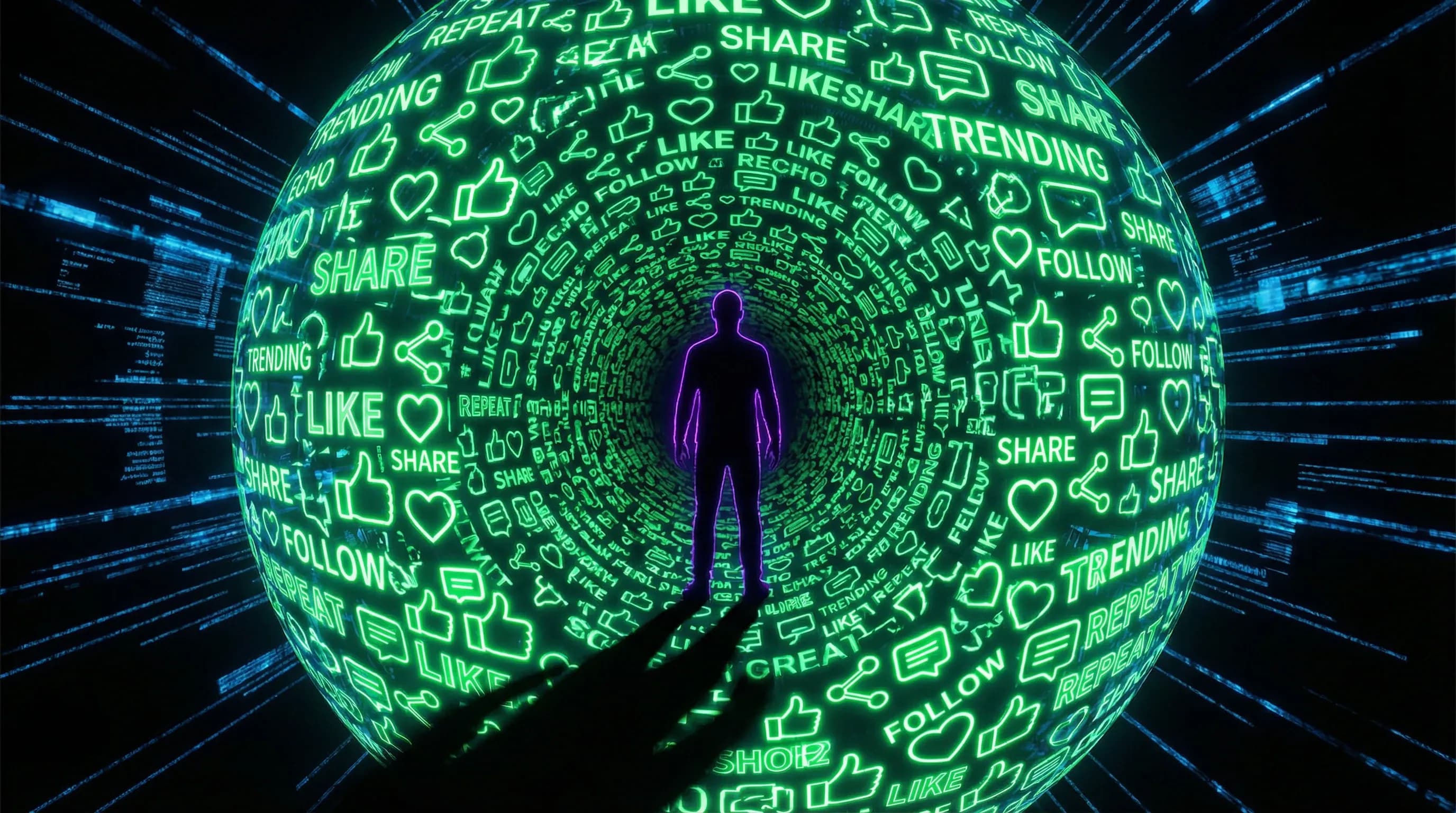
An echo chamber is not just a "bubble of like-minded people," but a mechanism of self-similarity in information flows that transforms social networks into amplifiers of cognitive biases. Research shows that algorithms and human psychology create closed loops where each confirmation of your position makes alternative views increasingly invisible. This is not a platform conspiracy—it's an architectural feature of networked communications that can be recognized and neutralized.
🖤 Have you ever noticed that your social media feed seems to read your mind? Every post confirms what you already think, every comment resonates with your beliefs, and opposing opinions appear increasingly absurd and rare. This isn't the magic of personalization—it's an architectural trap of modern communication systems that turns your consciousness into a closed loop of self-confirmation. 👁️ The echo chamber effect is not a metaphor, but a measurable phenomenon of information isolation that transforms how beliefs are formed in the digital age. Understanding its mechanics is not an academic exercise, but a necessary critical thinking skill for surviving in the information landscape of the 21st century.
What Is an Echo Chamber in Digital Space: From Metaphor to Structural Model of Information Isolation
The term "echo chamber" describes a configuration of information flows in which a user receives predominantly information that confirms their views. This is not simply a social group of like-minded individuals, but a structured content filtering system where algorithmic and behavioral mechanisms create a closed loop of informational reinforcement (S002).
🧱 Structural Components: Three Levels of Information Isolation
An echo chamber functions on three interconnected levels:
- Algorithmic Level
- Social media platforms use recommendation systems that maximize engagement by showing content with which the user is most likely to interact.
- Social Level
- Users independently form networks by subscribing to sources that share their views and unsubscribing from those that challenge them.
- Cognitive Level
- The brain tends toward selective perception of information, giving preference to data that aligns with existing beliefs (S002).
🔎 Echo Chamber versus Filter Bubble
These concepts are often confused, but they differ in mechanism. A filter bubble is primarily the result of algorithmic personalization, where the platform automatically limits diversity based on previous behavior.
An echo chamber includes active participation by the user themselves in creating information isolation through the choice of sources, communities, and interaction patterns. Technological and human factors reinforce each other (S002).
⚙️ The Principle of Self-Similarity as Mathematical Foundation
The echo chamber effect is described through the principle of self-similarity—a mathematical concept of structures that reproduce their patterns at different scales. In social networks, this means recursive reproduction: content with positive reactions generates more similar content, attracting audiences with similar preferences.
| Cycle Stage | Mechanism | Result |
|---|---|---|
| 1. Content receives reaction | Algorithm registers engagement | Content is amplified in feed |
| 2. Similar content multiplies | Creators see demand, produce more | Information flow homogeneity increases |
| 3. Audience consolidates | Like-minded individuals find each other | Self-reinforcing cycle closes (S003) |
This principle explains why echo chambers not only exist but exponentially intensify over time. The system becomes increasingly closed, and alternative viewpoints become less and less accessible.
The connection between this mechanism and broader cognitive processes is revealed in the analysis of confirmation bias, where the brain actively seeks information that supports existing beliefs.

Why Echo Chambers Feel Natural: Five Arguments in Defense of Information Homogeneity
Before analyzing the problems with echo chambers, it's necessary to understand why they are perceived by many users as a comfortable and even desirable environment. There are a number of compelling arguments that explain the appeal of informationally homogeneous spaces. More details in the Reality Check section.
🛡️ The Cognitive Efficiency Argument: Conserving Mental Resources in an Age of Information Overload
Daily, users encounter a volume of information that is physically impossible to process critically. Filtering content based on alignment with existing beliefs becomes an adaptive strategy for cognitive economy.
Echo chambers reduce cognitive load, allowing quick navigation through information streams without the need to constantly reevaluate basic assumptions (S002). This is especially relevant in the context of availability heuristics, when the brain automatically selects information that is easier to process.
- Reduced time spent critically evaluating each source
- Automatic filtering through trusted channels
- Decreased cognitive dissonance when encountering contradictory data
🧠 The Social Identity Argument: Strengthening Group Belonging Through Information Solidarity
Echo chambers function as spaces of social identification, where sharing common information sources becomes a marker of group membership. Research shows that information homogeneity strengthens in-group bonds and creates a sense of solidarity (S005).
In this context, the echo chamber is not a bug but a feature of social organization. The mechanism works through groupthink, which reinforces the sense of "us" versus "them."
📊 The Discussion Quality Argument: Depth Versus Breadth in Complex Topic Discussions
Informationally homogeneous groups are capable of achieving greater depth in discussing specialized topics. When participants share basic assumptions and terminology, discussion moves more quickly to nuances, bypassing the need to constantly explain fundamental concepts.
| Parameter | Homogeneous Group | Heterogeneous Group |
|---|---|---|
| Speed of moving to details | High | Low |
| Depth of analysis | Deep within paradigm | Superficial but broad |
| Risk of blind spots | High | Low |
This argument is especially strong in professional and scientific communities, where a certain degree of information homogeneity is necessary for productive exchange.
⚠️ The Manipulation Defense Argument: Echo Chamber as Immune System Against Disinformation
In conditions of active disinformation spread, echo chambers can function as a protective mechanism. Trusted sources within informationally homogeneous groups serve as filters, screening out demonstrably false information.
Research shows that in conditions of information chaos, people tend to rely on verified channels, even if this limits information diversity (S007). The paradox: limitation can protect against manipulation, but simultaneously creates vulnerability to coordinated disinformation within the echo chamber itself.
🔁 The Algorithmic Inevitability Argument: Technological Determinism of Personalization
Echo chambers are an inevitable consequence of the architecture of modern digital platforms. Recommendation algorithms are optimized to maximize engagement, which mathematically leads to content personalization.
- Personalization
- Adapting content to user preferences to increase time spent in the app.
- Engagement
- A metric that grows when users see content aligned with their beliefs (less cognitive dissonance = longer stay).
- Inevitability
- Attempts to avoid echo chambers require abandoning the very principles of how social networks operate, making them practically unfeasible for ordinary users (S003).
The connection to false dichotomy is obvious here: either personalization (and echo chambers), or complete abandonment of platforms—there is no third option.
Empirical Anatomy of Echo Chambers: What Research Shows About Information Isolation in Digital Networks
Moving from theoretical arguments to empirical data, it's necessary to examine what is actually known about the echo chamber effect from systematic research. The evidence base forms at the intersection of sociology, computer science, and cognitive psychology. More details in the Sources and Evidence section.
📊 Measuring Information Homogeneity: Methodological Approaches to Quantifying Echo Chambers
Research on the echo chamber effect uses several methodological approaches to measure the degree of information isolation. The first approach is network structure analysis, which assesses the density of connections within groups compared to connections between groups.
The second approach is content analysis, which measures the diversity of sources and topics in users' information streams. The third approach is experimental, where researchers create controlled conditions to observe the formation of information preferences (S002).
- Network structure analysis — density of intra-group connections vs. inter-group connections
- Content analysis — diversity of sources and topics in streams
- Experimental approach — controlled conditions for preference formation
- Longitudinal observations — tracking the dynamics of isolation over time
🧪 The Self-Similarity Principle in Action: Empirical Evidence of Fractal Structure in Information Flows
Research applying the mathematical apparatus of self-similarity theory to social network analysis finds that information flows demonstrate fractal properties. Content distribution patterns at the individual user level are reproduced at the community and platform-wide levels.
This self-similar structure is not random, but forms through the interaction of algorithmic recommendations and user choice. Mathematical modeling predicts the strengthening of such structures over time — and longitudinal observations confirm this (S003).
🔎 Content Verification in Echo Chambers: How Information Isolation Affects Credibility Assessment
A critically important aspect of the echo chamber effect is its impact on users' ability to verify information. Under conditions of information homogeneity, critical evaluation of sources decreases: if information comes from a trusted circle and aligns with group consensus, it is less likely to be verified.
| Scenario | Echo Chamber Effect | Verification Outcome |
|---|---|---|
| Information from trusted circle + group consensus | High | Low criticality, rare verification |
| Information from external sources + contradicts consensus | High | Increased criticality, active verification |
| Misinformation within group | High | Group filter can protect or amplify |
Echo chambers create a paradox: they simultaneously protect against some types of misinformation (through group filtering) and make users more vulnerable to others (through reduced individual criticality) (S002).
🧾 Body of Research: What Systematic Reviews Show
Applying systematic review methodology to the study of echo chambers allows assessment of the reliability of conclusions. The echo chamber effect is confirmed by multiple independent studies, though its magnitude varies depending on platform, topic, and user demographics (S001).
Systematic review methodology requires transparent criteria for study selection and quality assessment, which increases the reliability of conclusions compared to narrative reviews. This is especially important when analyzing phenomena related to confirmation bias and echo chambers, where subjective interpretation can distort results.
- Effect Validity
- Confirmed by multiple independent studies across different platforms and populations
- Magnitude Variability
- Depends on platform (Twitter vs. Facebook), topic (politics vs. health), and user demographics
- Methodological Reliability
- Systematic reviews provide a higher level of evidence than individual studies

Mechanisms of Echo Chamber Formation: From Algorithms to the Neurobiology of Confirmation Bias
Echo chambers form at three interconnected levels: technological, cognitive, and social. Each amplifies the others, creating a self-reinforcing system. More details in the section Debunking and Prebunking.
⚙️ Algorithmic Architecture: How Recommendation Systems Create Information Feedback Loops
Recommendation algorithms are optimized for a single metric: engagement (time on platform, clicks, interactions). Mathematically, this works through predictive models that estimate the probability of user interaction with content based on their history.
The result: positive feedback. Content you've interacted with increases the likelihood of similar content being shown, which increases the likelihood of new interaction (S003). The loop closes. Important: this isn't malicious design, but a natural consequence of the optimization problem.
The algorithm doesn't choose your ideology—it chooses your activity. But activity and beliefs in digital space become indistinguishable.
🧠 Cognitive Prerequisites: Confirmation Bias as Evolutionary Adaptation
At the psychological level, confirmation bias operates—the tendency to seek, interpret, and remember information in ways that confirm existing beliefs.
The neurobiology here is brutal: information that aligns with your beliefs activates reward systems in the brain. It's literally pleasurable. Information that contradicts beliefs activates threat systems, causing discomfort (S002).
- Confirmation Bias
- Not a logical error, but a mechanism for conserving cognitive resources. The brain filters noise, but in doing so also filters signals that contradict the current model of the world.
- Why This Is Dangerous in an Echo Chamber
- The algorithm starts showing only confirming content, while your brain starts ignoring contradictory content. Two filters working in the same direction.
🔁 Social Dynamics: Homophily and Group Pressure Mechanisms in Digital Communities
The third level is social. Homophily ("like attracts like") describes the tendency of people to form connections with those similar to them. In digital networks, this is amplified: you can instantly subscribe to sources you like and unsubscribe from uncomfortable ones.
Additionally, group pressure operates: in homogeneous communities, dissenting opinions meet negative reactions, creating incentives for conformity (S005). Groupthink becomes a self-reinforcing mechanism.
📊 Causality versus Correlation: Separating Causes and Effects in Information Isolation Formation
The key question: do algorithms create echo chambers, or do they reflect existing preferences? The answer: both simultaneously.
| Mechanism | What Happens | Evidence |
|---|---|---|
| Self-Selection | Users arrive with ready-made preferences | People choose sources they like |
| Algorithmic Amplification | The system personalizes content, deepening preferences | Experimental studies: random content weakens the effect |
| Bidirectional Causality | Both mechanisms work simultaneously | Effect observed only with combination of both |
Experimental studies where users were randomly shown diverse content demonstrate: algorithmic personalization has a causal effect on the formation of information preferences (S003). This isn't correlation—it's causation.
Data Conflicts and Zones of Uncertainty: Where Echo Chamber Research Diverges and What It Means
Despite general consensus on the existence of the echo chamber effect, significant disagreements exist in the scientific literature regarding its scale, universality, and consequences. More details in the Scientific Method section.
🧩 Debates About Scale: How Widespread Are Echo Chambers in Reality
One of the key conflicts concerns how widespread the echo chamber effect is among ordinary users. Some studies claim that most social media users exist in information bubbles, while others show that a significant portion of users regularly encounter diverse viewpoints.
This discrepancy may be explained by differences in measurement methodology, choice of platforms for analysis, and definitions of what constitutes "sufficient" informational diversity (S002).
- Methodology: how exactly "diversity" of content is measured (by number of sources, political spectrum, thematic coverage)
- Platform: one network may show the effect, another may not
- Thresholds: what counts as an echo chamber—60% homogeneous content or 80%
- Time horizon: short-term algorithmic impact or long-term user behavior
🔎 Platform Specificity: Do Echo Chambers Differ Between Social Networks
The architecture of different social networks varies substantially: some are based on friendship graphs (Facebook), others on interest graphs (Twitter), still others on algorithmic feeds without explicit subscriptions (TikTok). Research shows that these architectural differences affect echo chamber formation, but systematic comparative analysis is insufficient for definitive conclusions (S003).
Conclusion from the conflict: an echo chamber on Facebook (where you choose friends) is not the same as on TikTok (where the algorithm chooses content). Generalizing results from one platform to another is a common error in research popularization.
📌 Thematic Variability: Politics Versus Other Domains
Most echo chamber research focuses on political content, where the effect is most pronounced and socially significant. However, the question remains open as to how applicable findings from political material are to other domains—science, health, culture.
Some data suggest that in less polarized topics the echo chamber effect is weaker, but systematic research is insufficient (S007). This relates to the confirmation mechanism: in politics the stakes are higher (identity, values), so the motivation to filter information is stronger.
- Political Content
- High polarization, strong identification, echo chamber strongly pronounced
- Scientific Content
- Low polarization (expert consensus), but local bubbles possible (anti-vax, alternative medicine)
- Cultural Content
- Medium polarization, echo chamber depends on subculture rather than algorithm
- Financial Content
- High polarization (meme stocks), echo chamber amplifies herd behavior (S006)
Cognitive Anatomy of Susceptibility: What Psychological Mechanisms Make Echo Chambers Effective
The effectiveness of echo chambers in forming and reinforcing beliefs is based on exploiting several fundamental cognitive mechanisms. Learn more in the Mental Errors section.
⚠️ Confirmation Bias: Why We Seek What We Want to Find
Confirmation bias is the tendency to seek, interpret, and focus on information that confirms our existing beliefs, while ignoring or devaluing information that contradicts them.
In the context of echo chambers, this mechanism operates on several levels: users actively choose sources that align with their views (selective exposure), interpret ambiguous information in favor of their beliefs (selective interpretation), and better remember confirming facts (selective memory) (S002).
The brain doesn't seek truth—it seeks consistency. Contradictory information is perceived as a threat, not as an opportunity.
🧩 False Consensus Effect: When the Echo Chamber Creates an Illusion of Majority
The false consensus effect is a cognitive bias in which people overestimate the degree to which others share their beliefs and behaviors.
In an echo chamber, where users predominantly see opinions matching their own, this effect intensifies: it creates the illusion that "everyone thinks this way" or "this is obvious to any reasonable person." This distortion of perception can have serious consequences for assessing reality and making decisions (S003).
- You see an opinion similar to yours—you perceive it as confirmation
- You see it again in another source—it seems like the majority opinion
- You don't see opposing opinions—they simply don't exist in your information environment
- Conclusion: "I'm right, and almost everyone agrees with me"
🔁 Availability Cascades: How Repetition Transforms Into Conviction
An availability cascade is a self-reinforcing process in which a collective belief gains increasing plausibility through repetition in public discourse.
In echo chambers, this mechanism works particularly effectively: the same information or interpretation circulates through multiple sources within the community, creating the impression of independent confirmation, when in reality all sources may trace back to one original claim. Repetition increases the cognitive availability of information, which the brain mistakenly interprets as evidence of its truth (S002).
| Stage | What Happens | Cognitive Effect |
|---|---|---|
| 1. First mention | Idea appears in one source | Low availability, skepticism |
| 2. Reposts and retellings | Idea circulates in the community | Availability grows, seems popular |
| 3. Multiple repetitions | You see the idea everywhere in your feed | High availability = high plausibility |
| 4. Consolidation | Idea becomes "obvious truth" | Critical thinking shuts down |
🧷 Group Polarization: How Discussion in a Homogeneous Group Amplifies Extremes
Group polarization is a phenomenon in which discussion within a homogeneous group leads members to adopt more extreme positions than they held before the discussion.
In an echo chamber, this process is inevitable: when people with similar views discuss a topic, they hear arguments that confirm and strengthen their position, but don't hear counterarguments. The result is a gradual shift of the group's position toward extremity. What seemed like a moderate opinion becomes the norm, and then the minimum position (S001).
- Comparison mechanism
- People want to be perceived as reasonable and informed. When they see others in the group taking a stronger position, they shift in the same direction to keep up.
- Persuasive arguments mechanism
- In a homogeneous group, you only hear arguments supporting your position. New arguments seem convincing because opposing ones aren't presented.
- Social reinforcement
- Each new extreme post receives likes and comments from like-minded people. The brain interprets this as social approval of extremity.
💭 Illusion of Understanding: When Familiarity With Terms Replaces Understanding of Mechanisms
The illusion of understanding is a cognitive bias in which people overestimate the depth of their understanding of complex phenomena, especially when they're familiar with terminology or superficial explanations.
In an echo chamber, this effect intensifies: users see explanations that sound authoritative and confirm their beliefs, but often these are superficial or distorted versions of actual mechanisms. Familiarity with terms creates an illusion of deep understanding, which reduces motivation for further study (S004).
The connection between these mechanisms creates a self-reinforcing system: confirmation bias directs attention to confirming information, false consensus creates the impression that this is the majority opinion, availability cascades make it increasingly plausible, group polarization amplifies the extremity of the position, and the illusion of understanding blocks critical reconsideration. Each mechanism amplifies the action of others, creating a cognitive lock that's difficult to escape (S005).
An echo chamber isn't just an information filter. It's an architecture that puts natural cognitive mechanisms into maximum vulnerability mode.
Understanding these mechanisms is the first step toward recognizing them. When you know how confirmation bias works, you can notice when you're using it. When you see a false dichotomy in an argument, you can stop and ask: is there a third option? When you recognize groupthink, you can deliberately seek opposing opinions.
Counter-Position Analysis
⚖️ Critical Counterpoint
Echo chambers are a real phenomenon, but their scale and causes are often overestimated. Here's where the article's logic shows cracks.
Overestimation of Algorithms' Role
Algorithms amplify, but don't create echo chambers. Human homophily — the tendency to communicate with similar people — existed long before social media and may be an even more significant factor. Research shows that most users still encounter diverse content, they just ignore it.
Lack of Quantitative Data
The article relies on theoretical models and qualitative descriptions, but large-scale empirical studies with measurable isolation metrics are absent. Some research shows that the degree of polarization is exaggerated, and most users are in "weak" echo chambers with partial access to alternative opinions.
Ignoring the Benefits of Filtering
Content personalization saves time, reduces information overload, and allows finding relevant information in an ocean of data. Without filtering, social networks would be chaotic and barely usable. The question isn't whether echo chambers are bad, but where the balance lies between personalization and diversity.
Underestimation of User Agency
Many consciously choose a limited information space because they don't want to spend energy on arguments or find value in communicating with like-minded people. This isn't always irrational — sometimes it's a rational attention management strategy.
Obsolescence of Conclusions
Platforms are actively experimenting with algorithms. Facebook and YouTube have implemented mechanisms that show alternative viewpoints and deprioritize polarizing content. If these measures prove effective, conclusions about the inevitability of echo chambers may become outdated.
FAQ
Frequently Asked Questions

Author of the Cognitive Immunology Hub project. Researches mechanisms of disinformation, pseudoscience, and cognitive biases. All materials are based on peer-reviewed sources.