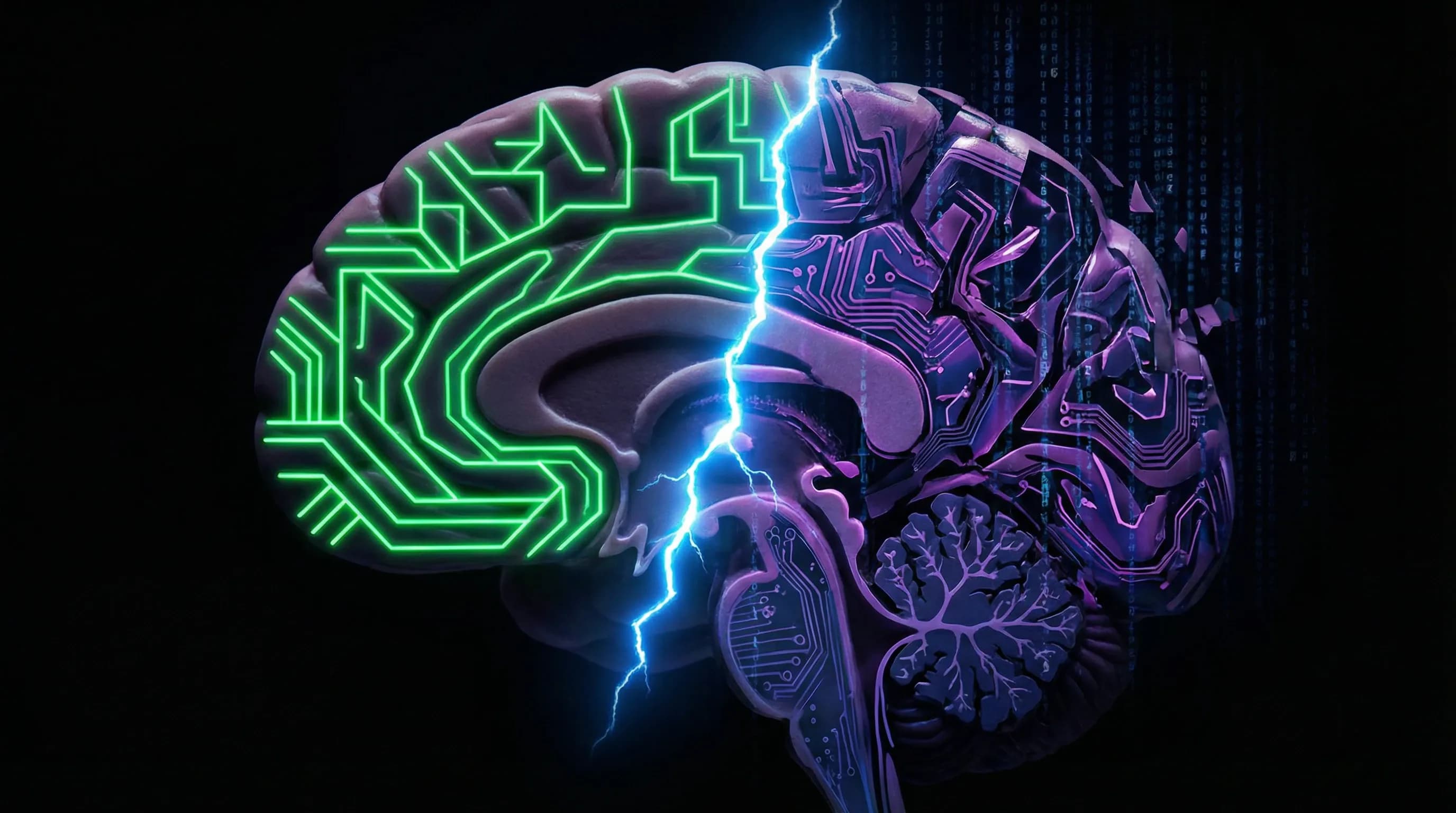
Cognitive distortions are systematic errors in thinking that cause us to perceive reality in a distorted way. They are universal, unconscious, and influence every decision—from choosing a partner to making investments. High intelligence offers no protection: smart people simply rationalize their biases more effectively. This article reveals the mechanism behind cognitive traps, dismantles myths about "rationality," and provides a self-audit protocol for daily use.
🖤 You consider yourself a rational person. You weigh arguments, analyze data, make informed decisions. But every day your brain systematically deceives you—and you don't notice it. What's more: the smarter you think you are, the more sophisticated your intellect becomes at disguising these deceptions as logic. Cognitive distortions aren't a bug in your consciousness—they're its basic operating system, and it's working against you right now, as you read these lines.
What Cognitive Biases Actually Are — And Why the Textbook Definition Won't Save You
Cognitive distortions (cognitive biases) are systematic patterns of deviation from rational thinking and objective information assessment. They're not random errors, not the result of lack of education, and not a sign of low intelligence. Learn more in the Critical Thinking section.
They're mechanisms built into the architecture of human thinking that force us to perceive, remember, and interpret information in predictably distorted ways.
🧩 Three Critical Properties That Make Cognitive Biases Dangerous
- Automaticity
- Cognitive biases occur without conscious intention, at the level of automatic thought processes (S005). You don't decide to distort reality — your brain does it before the information reaches the level of conscious analysis. By the time you start "thinking" about a problem, the data has already passed through several layers of distortion.
- Systematicity
- Biases follow predictable patterns that reproduce across different people in similar situations (S002). These aren't chaotic errors — they're structured failures that can be catalogued and exploited. Marketers, political strategists, and manipulators know these patterns and use them professionally.
- Universality
- Cognitive biases affect all people regardless of intelligence level, education, or cultural context. Nobel laureates are subject to the same basic biases as people without college degrees. The only difference is that high intelligence allows for creating more sophisticated rationalizations to justify biased conclusions.
⚠️ Why Your Brain Evolved to Lie to You
Cognitive biases aren't an evolutionary defect — they're a feature. Under conditions of limited computational resources and the need to make quick decisions in a dangerous environment, our ancestors survived not through accuracy, but through speed (S001).
Better to mistake a rustling in the bushes for a predator ten times than to miss a real threat once. Heuristics — mental shortcuts — allowed conserving cognitive energy and reacting instantly.
The problem is that the modern environment radically differs from the Pleistocene savanna. Decisions about loans, investments, choosing a partner, medical treatment, or political preferences require accuracy, not speed. But the brain continues using ancient algorithms optimized for survival in a world that no longer exists.
🔎 Boundaries of the Concept: What Is NOT a Cognitive Bias
| Phenomenon | Why It's Not a Bias | Where the Trap Is |
|---|---|---|
| Conscious Lying | Deliberate distortion of information, conscious choice | Easy to confuse with rationalization that follows the bias |
| Lack of Information | Gap in knowledge, not distortion of perception | The brain fills gaps with assumptions — that's already a bias |
| Emotional Reactions | Normal feelings (fear, anger, joy) | Emotion becomes a bias when it systematically deforms interpretation of reality |
For example, anxiety is an emotion, but catastrophizing (automatic assumption of the worst outcome) is a cognitive bias. Fear of flying is a normal reaction; believing that planes crash more often than cars is a distortion of risk perception.
The Steel Version of the Argument: Seven Reasons Why Cognitive Biases Are Inevitable and Even Useful
Before examining the problems of cognitive biases, it's necessary to present the strongest version of the opposing argument. This is called the "steel man" approach—as opposed to a "strawman," where you represent your opponent in the weakest possible light. For more details, see the section on Psychology of Belief.
Here are seven serious arguments in defense of cognitive biases:
🧠 Argument One: Computational Efficiency Under Resource Constraints
The human brain consumes about 20% of the body's energy while representing only 2% of body mass. Fully rational processing of every bit of information would require astronomical energy expenditure. Cognitive biases represent a tradeoff between accuracy and efficiency.
The availability heuristic (estimating probability by ease of recalling examples) works quickly and produces acceptable results in most cases. Yes, it sometimes errs, but the alternative is paralyzing slowness with every decision.
⚡ Argument Two: Speed of Response in Critical Situations
In situations of real danger, cognitive biases save lives. If you see a snake-like object on a path, it's better to jump back first and analyze later—even if 99% of the time it turns out to be a stick.
Type I error (false alarm) is less critical than Type II error (missing a real threat). Evolution optimized us for survival, not academic accuracy.
🎯 Argument Three: Social Cohesion and Group Survival
Many cognitive biases promote social cohesion. In-group favoritism (preferring members of one's own group) creates trust and cooperation within communities (S008).
Conformity (tendency to agree with the majority) reduces conflict and accelerates collective decision-making. Yes, these mechanisms can lead to discrimination and groupthink, but they also make stable social structures possible.
🔮 Argument Four: Adaptive Value of Optimism
Optimistic biases (overestimating the probability of positive outcomes) correlate with better mental health, greater persistence, and higher achievement (S007).
People with "depressive realism"—more accurate assessment of their capabilities and risks—are often less successful because realistic evaluation of odds can be demotivating. The illusion of control motivates people to take actions that sometimes genuinely improve situations.
💡 Argument Five: Creativity Through Illogical Associations
Apophenia (tendency to see patterns in random data) can lead to false conclusions, but it also underlies scientific discoveries and artistic insights.
Many breakthrough ideas began with intuitive hunches that were formally cognitive biases but proved productive.
🛡️ Argument Six: Protective Function of Self-Esteem
Self-serving biases protect the psyche from the destructive impact of constant self-criticism (S007). Attributing successes to oneself and failures to external circumstances maintains self-esteem at a level necessary to continue efforts.
Completely "objective" self-perception may be psychologically unbearable.
📊 Argument Seven: Statistical Adequacy in Natural Environments
Many cognitive biases that appear irrational in laboratory conditions are statistically justified in natural environments. The representativeness heuristic (estimating probability by similarity to a typical example) works well when base rates in the population match our intuitive expectations.
Problems arise in artificial situations with counterintuitive probability distributions.
- Computational efficiency: fast decisions with limited brain energy
- Response speed: survival in critical situations matters more than accuracy
- Social cohesion: trust and cooperation within groups
- Psychological resilience: optimism and self-esteem as resources for action
- Creative potential: intuitive insights often precede logic
- Psychic protection: self-perception adapted for survival, not objectivity
- Ecological validity: heuristics work in natural environments, break down in laboratories
These arguments are serious and deserve respect. Cognitive biases aren't simply "errors" that need to be "fixed." They represent a complex set of adaptations that made evolutionary sense.
The problem is that the modern environment creates contexts where these adaptations systematically malfunction—and these malfunctions have serious consequences.
Evidence Base: What Science Actually Knows About Cognitive Biases — With Numbers and Without Illusions
Cognitive biases have been studied within cognitive psychology, behavioral economics, and neuroscience for over half a century. There exists an extensive empirical foundation demonstrating their existence, mechanisms, and consequences. For more details, see the Scientific Method section.
🧪 Memory Biases: Why Your Memories Are Fanfiction Written by Your Brain
Memory doesn't work like video recording — it's a reconstructive process subject to systematic distortions (S009). Recency effect overvalues the importance of the latest information. Primacy effect gives disproportionate weight to first impressions. Selective memory retains information consistent with current beliefs and "forgets" contradictory evidence.
Hindsight bias is a particularly insidious distortion: after an event, people systematically overestimate how predictable it was beforehand (S009). This creates the illusion of "I knew it all along" and prevents learning from mistakes. Even experts are susceptible: physicians evaluating medical cases after knowing the outcome "remember" considering that outcome more likely than they actually did.
Hindsight bias turns failures into inevitabilities and successes into predictabilities — both variants block learning.
👥 Social Biases: How the Brain Turns People Into Stereotypes
Fundamental attribution error is one of the most persistent social biases: we explain others' behavior through personal characteristics while ignoring situation, but explain our own behavior through circumstances (S005). A colleague is late — they're irresponsible; you're late — there was traffic. This underlies interpersonal conflicts and unfair evaluations.
Halo effect colors the perception of all a person's qualities based on one positive characteristic (S009). Physically attractive people are systematically rated as more intelligent and competent — without objective connection. This effect even influences judicial decisions: attractive defendants receive lighter sentences.
In-group favoritism and out-group homogenization work in tandem: we prefer members of "our" group and perceive the "other" as homogeneous (S005). These biases activate even with arbitrary division of people in laboratory conditions — a random t-shirt color is sufficient.
- Fundamental attribution error: internal causes for others, external for ourselves
- Halo effect: one trait colors entire perception
- In-group favoritism: preference for "our own" and homogenization of "others"
💰 Decision-Making Biases: Why You Systematically Choose Suboptimally
Anchoring effect — the first number disproportionately influences decisions, even when chosen arbitrarily (S009). Real estate appraisers, knowing about this effect, cannot fully protect themselves from it. Initial price in negotiations, first offer in bargaining, starting bid at auction — all are anchors distorting valuations.
Sunk cost fallacy compels continued resource investment in failing projects simply because much has already been invested (S010). Rational decisions should be based only on future costs and benefits, but it's psychologically difficult to "write off" past investments. This destroys businesses, marriages, and careers.
Availability heuristic assesses event probability by ease of recall (S009). After a plane crash, people overestimate aviation risk and underestimate automobile risk, though statistically cars are orders of magnitude more dangerous. Media coverage creates availability, availability creates illusion of frequency, illusion of frequency distorts risk assessment. See availability heuristic and risk perception for more details.
🪞 Self-Perception Biases: Why You Don't Know Yourself as Well as You Think
Dunning-Kruger effect — people with low competence overestimate their abilities, while highly competent individuals underestimate their uniqueness (S010). This isn't simply "stupid people don't know they're stupid" — lack of competence prevents assessing one's own incompetence, because evaluating quality requires the same skills as the work itself.
Self-serving bias attributes successes to internal factors and failures to external circumstances (S007). This protects self-esteem but prevents learning. In depression, this bias weakens — "depressive realism" means more accurate but psychologically painful attribution.
Illusion of control overestimates influence over events, especially in situations involving chance (S009). People throw dice harder for high numbers, softer for low ones. Investors believe they "feel the market." Gamblers develop "systems" for roulette. The illusion can motivate but leads to unjustified risks.
📰 Information Processing Biases: How Media and Algorithms Exploit Brain Vulnerabilities
Confirmation bias — possibly the most dangerous: the tendency to seek, interpret, and remember information to confirm existing beliefs (S009). This isn't merely preference for agreeable information — it's active distortion of contradictory data. People reading a single article with opposing views find confirmation of their own positions in it.
Modern algorithmic social media feeds turn confirmation bias into a weapon of mass destruction (S004). Algorithms are optimized for engagement, and engagement is maximal when content confirms beliefs and triggers emotion. The result — "filter bubbles" where people see only reinforcing information and never encounter alternatives. The mechanism also operates in groupthink.
Algorithms didn't create confirmation bias — they simply scaled it to a level where it becomes an instrument of social fragmentation.
Framing effect demonstrates that the manner of presenting information radically changes decisions, even when content is identical (S004). "90% survival rate" sounds better than "10% mortality rate," though they're the same. Media systematically use framing to manipulate perception — choice of headline, order of facts, emotionally charged words create a distorted picture.
Availability cascade — a self-reinforcing cycle where media coverage of an event increases its perceived importance, leading to even more coverage (S004). This explains moral panics and media hysteria. Terrorist attacks receive disproportionate coverage compared to car accidents, though the latter kill orders of magnitude more people — because terrorism is more dramatic and generates more clicks.
| Bias | Mechanism | Consequence |
|---|---|---|
| Anchoring effect | First number disproportionately influences valuation | Negotiations, bargaining, auctions distorted by initial price |
| Sunk cost fallacy | Past investments influence future decisions | Continuation of failing projects, marriages, careers |
| Availability heuristic | Ease of recall determines probability | Overestimation of rare but media-covered risks |
| Confirmation bias | Seeking information confirming beliefs | Filter bubbles, social fragmentation |
| Framing effect | Presentation method changes decision | Perception manipulation through language and structure |
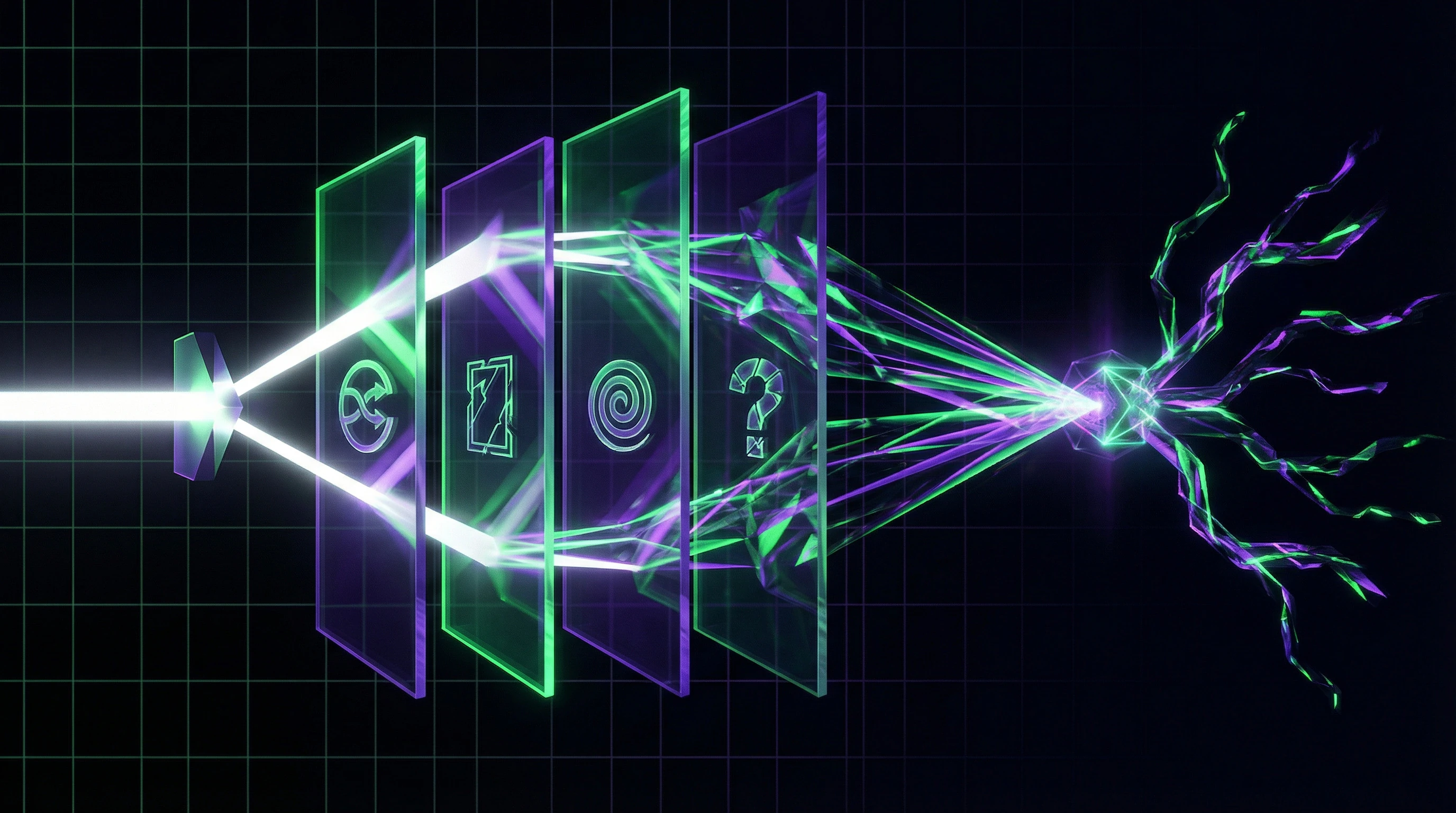
Mechanisms and Causality: What Happens in Your Brain When It Lies to You — And Why It's Not Your Fault (But It Is Your Responsibility)
Cognitive biases are not moral failings or signs of weak character. They are the result of how evolution assembled the human brain from available components to solve survival problems in an environment radically different from today's. More details in the Statistics and Probability Theory section.
Understanding the neurobiological mechanisms is critically important for separating causality from correlation.
🧠 Dual-System Architecture: Why You Have Two Brains, and They Don't Get Along
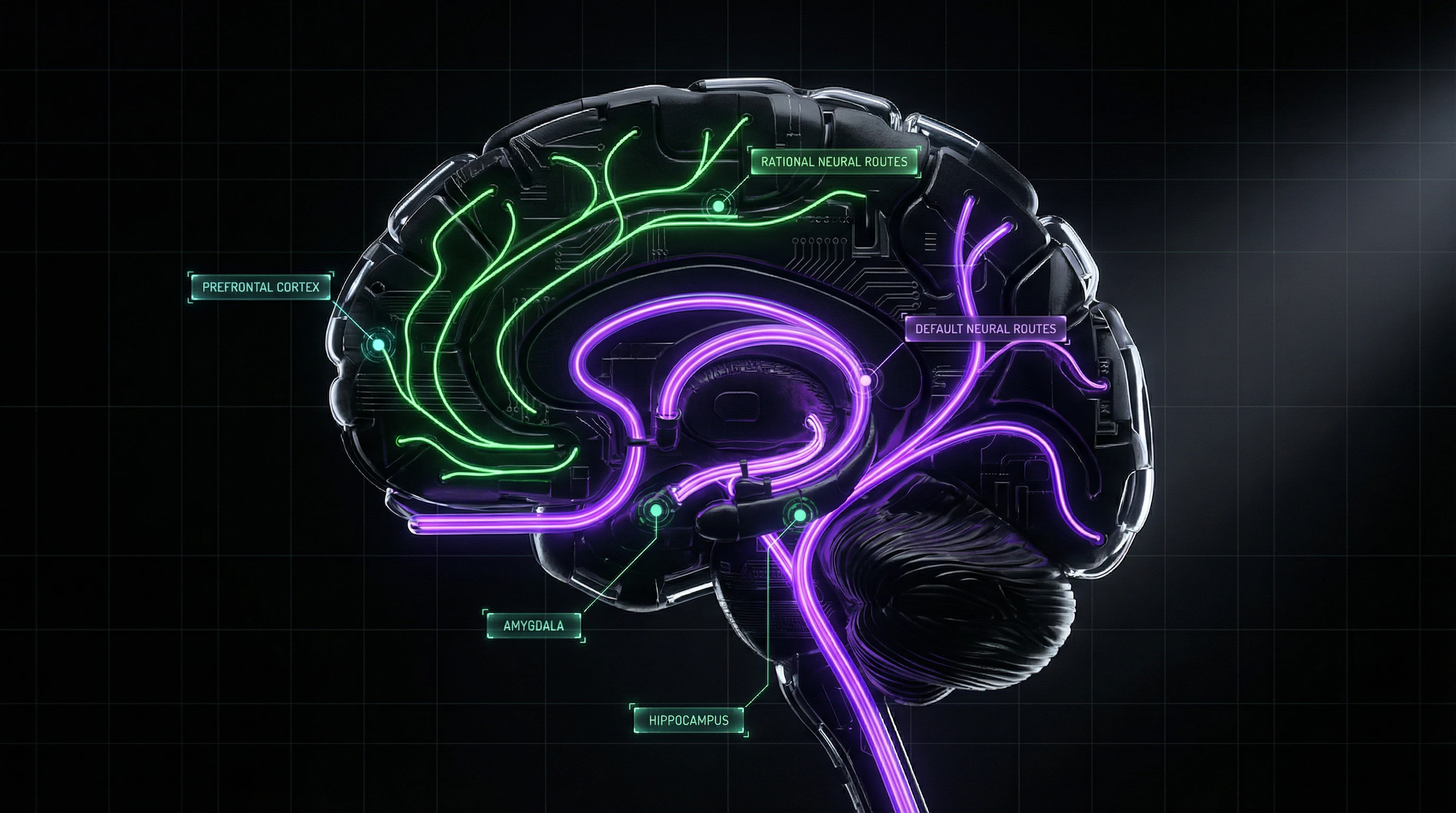
Daniel Kahneman popularized the model of two thinking systems. System 1 is fast, automatic, intuitive, emotional. It operates effortlessly and cannot be controlled by willpower.
System 2 is slow, analytical, rational, and requires effort. It can check and correct System 1's conclusions, but this requires energy and motivation.
| Parameter | System 1 | System 2 |
|---|---|---|
| Speed | Instant | Slow |
| Effort | Minimal | Maximum |
| Source of Errors | Heuristics, patterns, emotions | Lack of information, fatigue |
| Control | Automatic | Volitional |
Most cognitive biases are products of System 1. It makes quick judgments based on heuristics, patterns, and emotional reactions (S001). System 2 can correct them, but only if you have the time, motivation, and cognitive resources.
The Predictive Brain: Why Error Is Better Than Uncertainty
The brain is not a recorder of reality, but a generator of predictions (S001). It constantly builds models of what will happen next and compares them with incoming information.
When data is insufficient, the brain fills in the gaps. Error in this case is not a bug, but a feature: an incorrect prediction is better than paralysis from uncertainty. In survival environments, speed is often more important than accuracy.
The brain prefers a fast error to a slow truth. This strategy saved our ancestors, but in today's world of information overload, it becomes a trap.
Emotions are not obstacles to rationality, but its foundation (S004). They encode past experience and direct attention to relevant signals. Without them, System 2 would be paralyzed by choice.
Energy Budget: Why Your Brain Is Lazy
The brain consumes 20% of the body's energy while comprising only 2% of its mass. Cognitive biases are a way to conserve this energy.
- Representativeness Heuristic
- The brain judges probability by similarity to a prototype, not by statistics. It saves computation but ignores base rates.
- Anchoring
- The first number you hear becomes the reference point for all subsequent estimates. The brain doesn't recalculate from scratch — it adjusts the anchor.
- Confirmation
- The brain seeks information that confirms an already-formed hypothesis. This reduces cognitive load but blinds you to contradictions.
These mechanisms are not design flaws — they are optimal for a world with limited information and high cost of error. The problem is that the modern world works differently.
From Causality to Responsibility
Knowing that biases are the result of neurobiology, not moral choice, frees you from shame. But it doesn't free you from responsibility.
You're not to blame for how your brain works. You are to blame if you know about it and do nothing. Responsibility begins with understanding the mechanism — and with choosing to slow down when the stakes are high.
Causality explains why you make mistakes. Responsibility requires that you make mistakes more slowly and more consciously.
Counter-Position Analysis
⚖️ Critical Counterpoint
The article offers tools for combating cognitive biases, but fails to account for the limitations of these methods in real-world conditions, the adaptive value of certain biases, and cultural differences in their manifestation. Here's where the article's logic shows cracks.
Overestimating the Controllability of Biases
The article claims that systematic practice and self-checking protocols reduce the influence of cognitive biases. However, research shows that even trained professionals (doctors, judges, analysts) make the same mistakes in real-world conditions when stress, time constraints, and emotional involvement are high. The effectiveness of protocols may be overestimated, working only in laboratory or low-stress conditions.
Underestimating the Adaptive Value of Biases
The article focuses on negative consequences but insufficiently covers the adaptive function of biases. For example, optimistic bias correlates with better mental health and motivation. Complete "cognitive hygiene" can lead to depressive realism—a more accurate but psychologically destructive perception of reality, so some biases are worth preserving.
Cultural Bias in Sources
Most cognitive bias research is conducted on Western, Educated, Industrialized, Rich, and Democratic (WEIRD) populations. The universality of many biases may be an artifact of the cultural homogeneity of samples. The article is insufficiently critical of generalizations to all humanity.
The Problem of Measurement in Real-World Conditions
The article references experimental data, but most studies are conducted in artificial conditions with hypothetical scenarios. The ecological validity of these experiments is questionable—it's unclear how well the results transfer to real decisions with real stakes.
Risk of Metacognitive Paranoia
Excessive focus on biases can lead to decision paralysis and constant doubt in one's own judgments. This is dysfunctional in situations requiring quick decisions or intuitive expert judgment. The article doesn't discuss when to trust intuition versus when to apply analytical protocols.
FAQ
Frequently Asked Questions

Author of the Cognitive Immunology Hub project. Researches mechanisms of disinformation, pseudoscience, and cognitive biases. All materials are based on peer-reviewed sources.