 🔄 Cognitive Biases
Cognitive Biasesλ
Everything About Cognitive Biases: Complete Guide, Facts and Myth-Busting.
Overview
Cognitive biases are systematic thinking errors that arise from how our brains are wired 🧠: evolution optimized them for speed, not accuracy. We've compiled the mechanisms, classification, and protection methods — without myths about "rationality" or illusions of control.
Reference Protocol
Scientific Foundation
Evidence-based framework for critical analysis
Protocol: Evaluation
Test Yourself
Quizzes on this topic coming soon
Fact Checks
View All Claims →Claims & Analysis
Sector L1
Articles
Research materials, essays, and deep dives into critical thinking mechanisms.
🔄 Cognitive Biases 🔄 Cognitive Biases
 🔄 Cognitive Biases
 🔄 Cognitive Biases
 🔄 Cognitive Biases
 🔄 Cognitive Biases
 🔄 Cognitive Biases
 🔄 Cognitive Biases
 🔄 Cognitive Biases
 🔄 Cognitive Biases
 🔄 Cognitive Biases
 🔄 Cognitive Biases
⚡
Deep Dive
Cognitive Biases
Cognitive biases are systematic errors in thinking that arise from how the brain processes information. They're not the result of stupidity or carelessness, but consequences of heuristics — quick "mental shortcuts" that conserve energy but often lead to mistakes.
The brain prefers speed over accuracy. When a quick decision is needed, it uses ready-made templates instead of complete analysis — and this is where biases are born.
The history of their study traces back to the work of Daniel Kahneman and Amos Tversky in the 1970s. They demonstrated that people systematically violate the laws of probability theory and rationality — not randomly, but in predictable patterns.
How They Emerge
Biases operate on three levels:
- Perception — the brain filters information, noticing only what's relevant and ignoring the rest
- Interpretation — new data is integrated into existing beliefs, often becoming distorted
- Memory — recollections are rewritten to fit current needs and emotions
This isn't a design flaw in the brain — it's a compromise. Complete analysis of every decision would require enormous resources. Heuristics allow us to act quickly under uncertainty.
Distinction: Bias vs. Deception
A cognitive bias is what happens to your thinking. Deception is what someone does to your thinking intentionally.
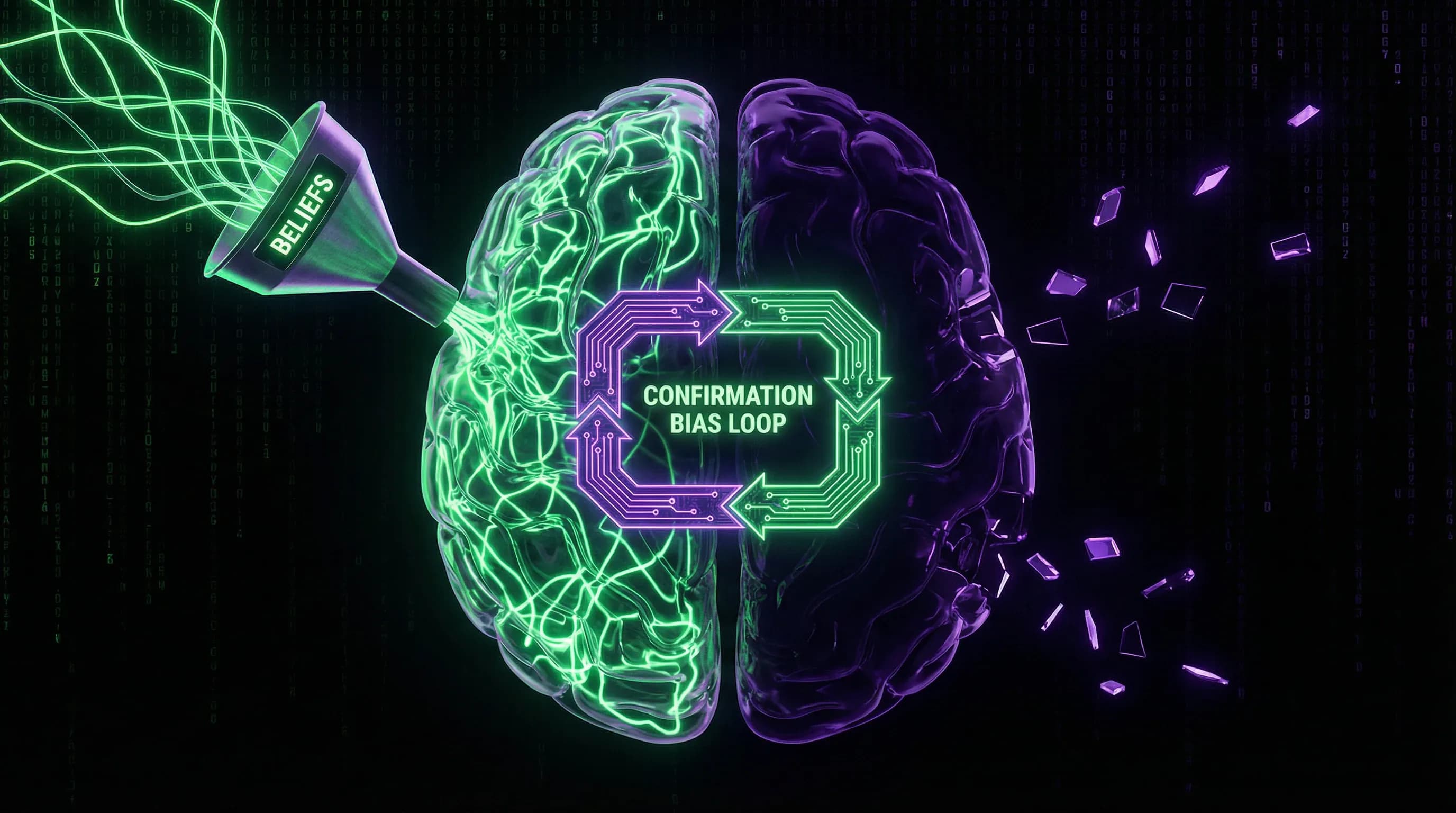
When you fall into confirmation bias (noticing only facts that support your position), that's a bias. When a manipulator deliberately selects facts so you'll notice only those — that's deception, using your biases as a tool.
Where Biases Are Dangerous
| Domain | Bias | Consequence |
|---|---|---|
| Medicine | Confirmation: doctor sees symptoms confirming the initial diagnosis | Incorrect treatment, missed diseases |
| Finance | Anchoring: the first price heard anchors all subsequent valuations | Overpaying, poor investments |
| Politics | Group bias: we see enemies as more hostile, allies as more noble | Polarization, conflicts |
| Science | P-hacking: researcher searches statistics until finding a "significant" result | False discoveries, replication crisis |
How Mental Defense Works
Awareness of a bias doesn't guarantee overcoming it. Even experts who know about confirmation bias fall into its trap under pressure or stress.
- Verification Protocol
- Before an important decision: write down 3 facts that contradict your position. If you can't find any — you're caught in confirmation bias.
- Red Flag: Certainty Without Doubt
- If you can't name a condition under which you'd be wrong, you haven't tested your logic.
- Social Verification
- Someone not invested in your position sees biases you miss. This isn't weakness — it's a feature of perception.
Developing critical thinking isn't about eliminating biases, but mapping them. You learn to notice when the brain takes a shortcut, and decide: trust it or verify.
Biases in Belief Systems
Cults, pseudoscience, ideological movements don't work despite cognitive biases, but through them. They create environments where biases are amplified:
- Confirmation: the group shares only "correct" facts
- Social proof: everyone believes it, therefore it's true
- Sunk cost: the more invested (time, money, relationships), the stronger the justification of belief
- Hostility to criticism: questions are interpreted as attacks, which strengthens the group
The system doesn't need to deceive you. It simply creates conditions under which your brain deceives itself.
Understanding the psychology of belief reveals: people in cults or under the influence of pseudoscience aren't victims of stupidity, but people caught in traps of normal cognitive mechanisms, amplified by social environment.
Practical Takeaway
Cognitive biases are ineliminable, but manageable. The goal isn't their absence, but awareness: when you're relying on intuition (fast but risky) and when verification is needed (slow but reliable).
Knowledge Access Protocol
FAQ
Frequently Asked Questions
Cognitive biases are systematic patterns of deviation from norm or rationality in judgment, where individuals create their own subjective reality based on their perception of input. These mental shortcuts help us process information quickly but can lead to errors in thinking, decision-making, and behavior.
The primary purposes include understanding how we perceive the world, gaining self-awareness about our thinking patterns, and solving specific problems in decision-making. Recognizing cognitive biases helps improve judgment in business, investing, relationships, and personal development.
The history of this field traces back to the pioneering work of psychologists Daniel Kahneman and Amos Tversky in the 1970s, who demonstrated that human judgment systematically deviates from rational models. Their research laid the foundation for behavioral economics and modern understanding of decision-making.
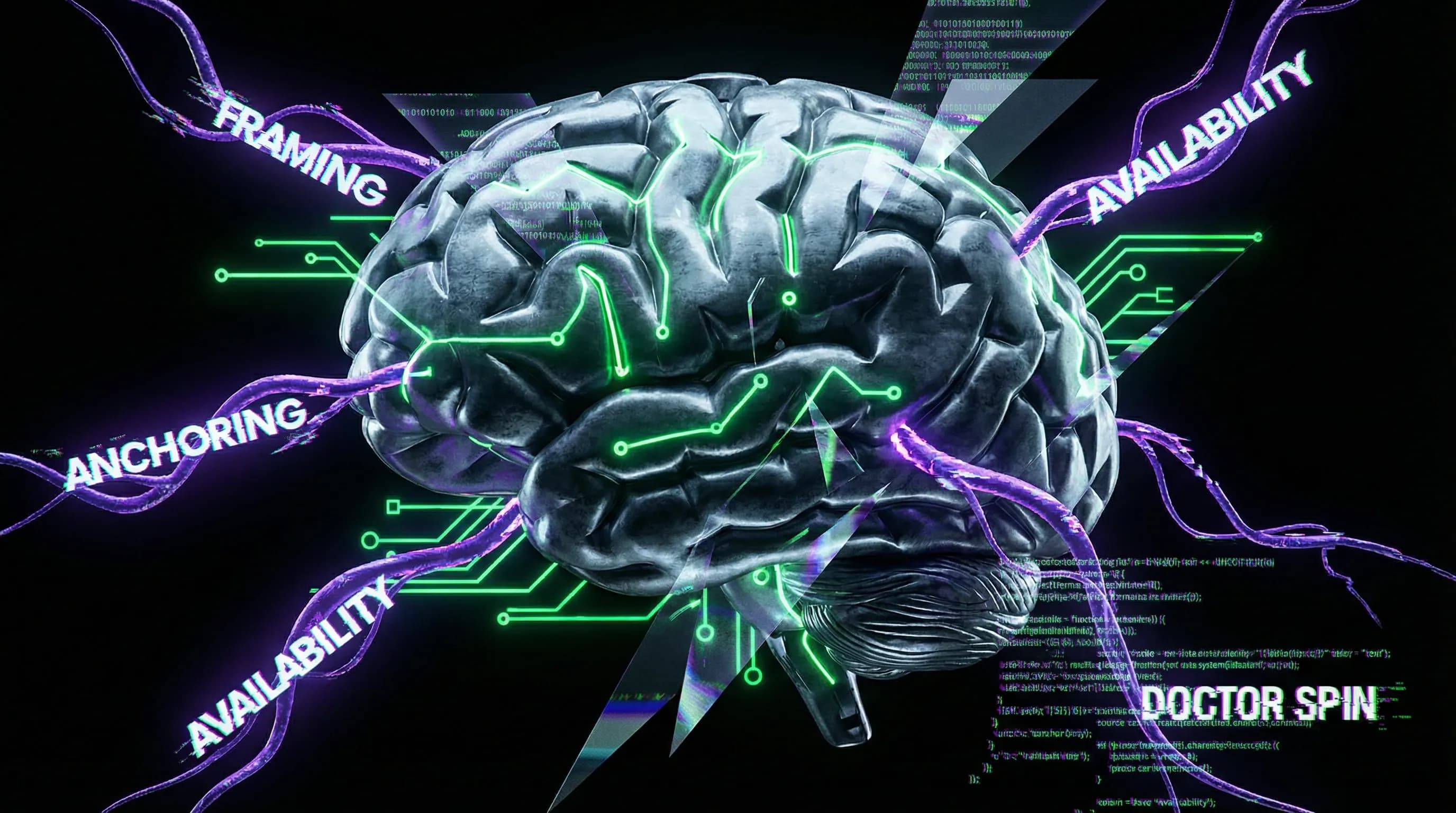
Key terms include: heuristics (mental shortcuts), confirmation bias (seeking information that confirms existing beliefs), anchoring (over-relying on initial information), availability heuristic (judging probability by ease of recall), loss aversion (preferring to avoid losses over acquiring gains), and framing effects (how presentation influences decisions).
The main distinction lies in methodology and subject matter. While traditional economics assumes rational actors, cognitive bias research demonstrates systematic irrationality. Unlike general psychology, it focuses specifically on predictable errors in judgment. It differs from logic by studying how people actually think rather than how they should think.
Begin with foundational literature and understanding core principles. Start with accessible books like "Thinking, Fast and Slow" by Daniel Kahneman, then explore specific biases relevant to your interests. Practice identifying biases in your own thinking and observe them in daily decisions.
It depends on the depth of engagement. The basics are accessible to everyone and can be understood with moderate effort. However, truly recognizing and counteracting biases in real-time requires ongoing practice and self-reflection, as our brains naturally resist acknowledging their own systematic errors.
You'll need access to research literature, case studies, and practical exercises. A journal for self-reflection helps track personal bias patterns. Decision-making frameworks and checklists can systematize bias recognition. Online resources, academic papers, and communities focused on rationality provide ongoing learning opportunities.
The mechanism is based on our brain's tendency to use mental shortcuts for efficiency. When faced with complex decisions, we unconsciously apply heuristics that worked in ancestral environments but may fail in modern contexts. For example, investors often hold losing stocks too long (loss aversion) or overweight recent market movements (recency bias) when making portfolio decisions.
From several weeks to a lifetime. Basic familiarity with major biases can be achieved in weeks of focused study. However, developing the ability to recognize and mitigate biases in real-time is an ongoing process. Even experts continue discovering new biases in their thinking, making this a continuous journey of self-improvement.
There are many myths surrounding cognitive biases. It's important to separate facts from fiction. Cognitive biases are well-documented psychological phenomena, not deception—they're systematic patterns in how our brains process information that can lead to judgment errors.
The main risks are associated with unrecognized biases influencing critical decisions—financial choices, medical judgments, hiring practices, and personal relationships. When left unchecked, biases like confirmation bias or anchoring can lead to poor investment decisions (costing thousands of dollars), flawed business strategies, and impaired personal judgment.
The scientific community has extensively validated cognitive biases through decades of rigorous research. Pioneering work by Kahneman and Tversky established the foundation, with thousands of peer-reviewed studies since confirming these patterns across cultures and contexts. The evidence base is robust and continues to grow.
Yes, if their influence goes unrecognized or if awareness techniques are misapplied. Overconfidence in one's ability to overcome biases can paradoxically increase vulnerability. The key is systematic awareness and structured decision-making processes, not simply knowing biases exist.
Individuals with certain psychological conditions that might be exacerbated by excessive self-analysis, or those prone to analysis paralysis. However, basic awareness benefits most people—the caution is against obsessive focus that impairs rather than improves decision-making.
Seek peer-reviewed sources and expert opinions. Academic journals in psychology and behavioral economics, books by established researchers like Kahneman, Ariely, and Thaler, and reputable institutions' publications provide evidence-based information rather than pop psychology oversimplifications.
Among the leading authorities are Daniel Kahneman (Nobel laureate), Amos Tversky (posthumously recognized), Richard Thaler (Nobel laureate in behavioral economics), Dan Ariely, and Gerd Gigerenzer. Their research has fundamentally shaped our understanding of human judgment and decision-making.
We recommend starting with 'Thinking, Fast and Slow' by Kahneman for comprehensive coverage, 'Predictably Irrational' by Ariely for accessible examples, and 'Nudge' by Thaler and Sunstein for practical applications. These provide evidence-based insights grounded in decades of research.
Yes, interest in the topic is growing in connection with the information age's challenges—social media echo chambers, misinformation spread, algorithmic decision-making, and complex financial markets. Understanding biases has become essential for navigating modern life's cognitive demands.
Understanding biases can fundamentally change perception and decision-making quality. Awareness helps people make better financial choices (potentially saving thousands annually), improve professional judgment, enhance relationships through reduced reactive thinking, and develop more accurate self-assessment—leading to measurably better life outcomes.