
What is Wikipedia's "List of Fallacies" — and why it became a cultural phenomenon of the digital age
Wikipedia's List of Fallacies is a structured catalog of cognitive and argumentative errors that people make in reasoning. Each fallacy is accompanied by a definition, examples, and source references. More details in the section Sources and Evidence.
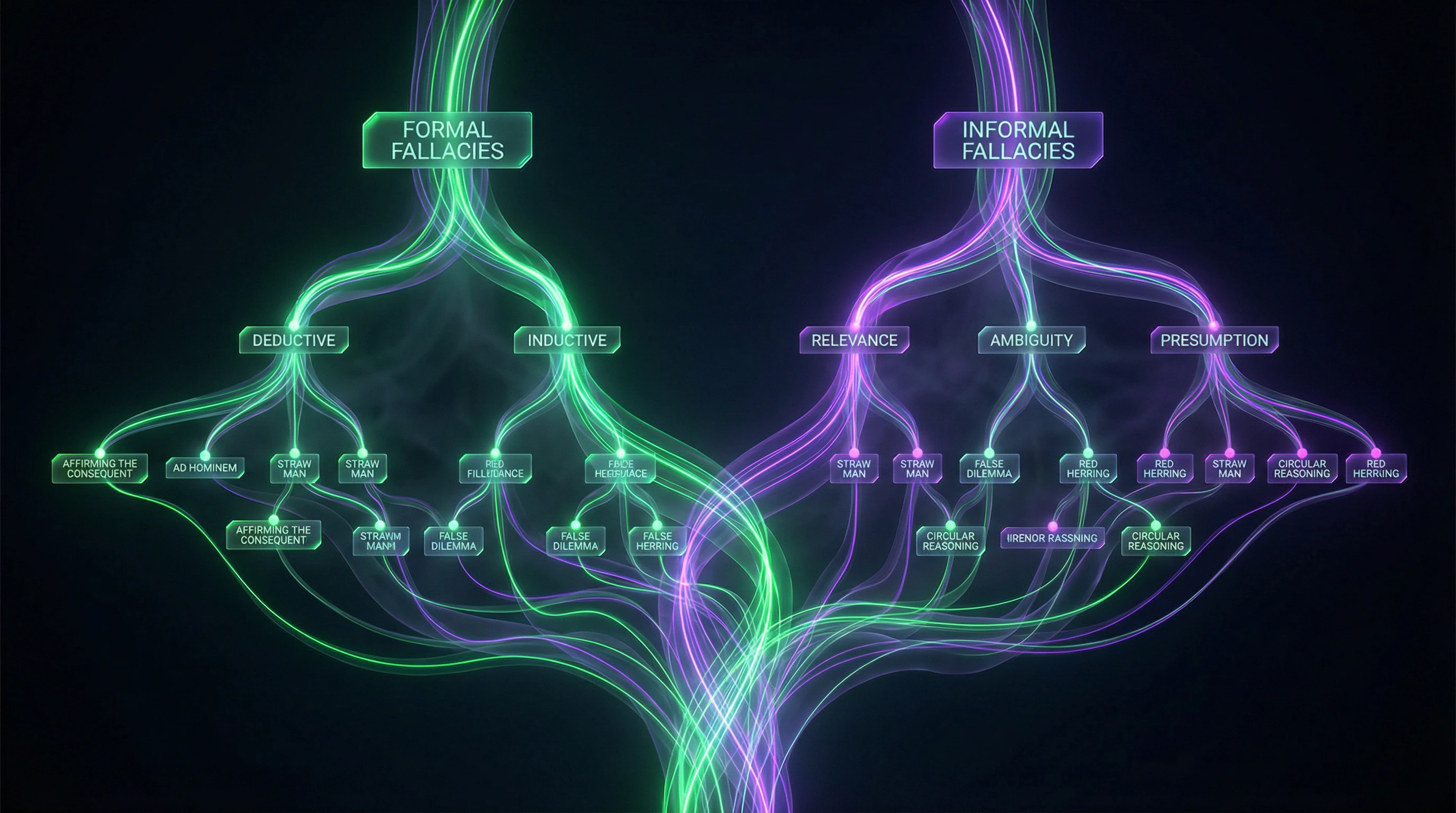
The page contains dozens of categories: from formal logical fallacies (affirming the consequent) to informal ones (ad hominem, straw man, false dilemma). This division reflects the fundamental distinction between violations of logical rules and manipulative techniques.
Why this list became a reference for millions
Its popularity is explained by three factors: free access and availability in dozens of languages, intuitive search structure, and Wikipedia's cultural authority as the first source of information (S008).
Research shows that Wikipedia represents "a huge, constantly evolving fabric of concepts and relationships" applied to multiple tasks (S008). For audiences without philosophical education, this means: logical fallacies have become accessible as a critical thinking tool.
- Formal fallacies
- Violations of logical inference rules (denying the antecedent, affirming the consequent). The error remains an error regardless of content.
- Informal fallacies
- Manipulative techniques dependent on content (appeal to emotion, authority, popularity). The same structure can be a fallacy in one context and acceptable reasoning in another.
- Causal fallacies
- Confusion between correlation and causation (post hoc ergo propter hoc, false cause). Especially dangerous in medicine, sociology, and politics.
Boundaries of applicability: what's included in the list and what remains beyond its scope
The list focuses on classical logical fallacies from philosophical literature but doesn't always cover modern cognitive biases studied in behavioral economics or neuroscience.
The same argumentative structure can be a fallacy in one context and acceptable reasoning in another. The list often ignores this contextual dependency.
This means Wikipedia provides a reference, not an application guide. The reader must independently assess whether the fallacy applies to their situation. For critical thinking, this is insufficient.
Seven Arguments for Wikipedia's Reliability as a Source on Logical Fallacies
Before criticizing Wikipedia, it's necessary to acknowledge its strengths. There are several mechanisms that make this platform surprisingly resistant to errors and manipulation. More details in the Scientific Method section.
✅ First Argument: Collective Review and System Self-Correction
Wikipedia functions as a self-managing team, where users distribute roles through self-selection (S006). A study of the Dutch version showed that "this bottom-up approach, in the absence of top-down organizational control, does not lead to chaos" (S006).
An "integrated and coherent data structure" is created (S006). Errors introduced by one editor are often quickly corrected by others.
✅ Second Argument: Transparency of Edit History and Rollback Capability
Every edit on Wikipedia is preserved in the page history. Any user can see who changed what and when—this creates an accountability mechanism.
Vandalism or unfounded edits are easily detected and rolled back. For pages about logical fallacies, this is especially important, as they often become subjects of ideological disputes.
✅ Third Argument: Requirement to Cite Reliable Sources
Wikipedia requires that claims be supported by references to verifiable sources. For philosophical and logical topics, this typically means academic publications, textbooks, or authoritative reference works.
Pages without sufficient citations are marked with special tags, signaling the need for improvement.
| Control Mechanism | How It Works | Effect on Logical Fallacies |
|---|---|---|
| Source Requirements | Every claim must have a citation | Definitions are anchored to authoritative texts |
| Insufficiency Tags | Pages without citations are flagged | Signal for verification needed |
| Edit History | All changes are visible and reversible | Vandalism is quickly detected |
✅ Fourth Argument: Multilingualism and Cross-Cultural Validation
The list of logical fallacies exists in dozens of languages. This creates an additional layer of verification: if the definition of a fallacy in one language version diverges from others, this may indicate a problem.
Cross-cultural validation is especially important for universal logical principles, which should not depend on language or region.
✅ Fifth Argument: Active Community of Expert Volunteers
Many Wikipedia pages, including the list of logical fallacies, are edited by people with relevant education. Philosophers, logicians, and critical thinking instructors contribute voluntarily.
This creates a pool of expertise that in some cases can compete with traditional encyclopedias.
✅ Sixth Argument: Speed of Updates and Adaptation to New Research
Unlike printed encyclopedias, Wikipedia can be updated in real time. When new research on cognitive biases or logical fallacies is published, information can be added within days or hours.
This makes Wikipedia more current than many traditional reference works.
✅ Seventh Argument: Scale as a Stability Factor
Wikipedia is a "gold mine of information," representing "a huge investment of manual labor and judgment" (S008). The platform's scale means that even if individual pages contain errors, the overall system remains statistically reliable.
The more editors working on a page, the higher the probability that serious errors will be detected and corrected.
- Collective review reduces the likelihood of systematic errors
- History transparency creates editor accountability
- Source requirements anchor information to authorities
- Multilingualism enables cross-cultural validation
- Expert volunteers enhance content quality
- Real-time updates maintain currency
- Scale ensures statistical reliability of the system
Evidence Base: What Research Says About Wikipedia's Accuracy and Reliability in Logic and Philosophy
Scientific research specifically dedicated to the accuracy of Wikipedia pages on logical fallacies is virtually nonexistent. However, studies on the platform's structure and mechanisms provide indirect answers to questions about reliability. For more details, see the Reality Validation section.
Self-Governance as a Stability Factor
Research on Dutch Wikipedia demonstrated that the platform functions as a successful self-governing system (S006). The absence of centralized control does not lead to chaos thanks to built-in self-organization mechanisms.
Effective self-governance does not guarantee accuracy, but it creates conditions for error correction through distributed verification.
Scale and Application in Science
Wikipedia is recognized as "a resource of exceptional scale and utility" for scientific purposes (S008). The platform is applied to numerous tasks and represents a "constantly evolving fabric of concepts and relationships" (S008).
The scientific community uses Wikipedia as a source of structured information, but this does not mean that every article is equally reliable.
Critical Gap: What Remains Unstudied
- General Wikipedia Research
- Analyzes organization, vandalism, educational applications—but not the accuracy of logical fallacy definitions.
- Comparative Studies
- Show that Wikipedia is comparable to traditional encyclopedias on many topics, but writing style is less consistent.
- Specific Analysis of Logic and Philosophy
- Absent in available literature. This creates a gap between Wikipedia's popularity as a reference and the volume of evidence for its reliability in this domain.
Paradox: the more widely a source is used, the less specialists verify it. Critical thinking requires acknowledging this asymmetry.
What Research Says About Distortion Mechanisms
While direct research on logical fallacy accuracy is absent, studies on logical fallacies in discourse show how even well-intentioned authors reproduce systematic errors. This applies to Wikipedia as well: collective knowledge can be distorted not through malice, but through common cognitive traps.
| Source Type | Advantage | Risk |
|---|---|---|
| Traditional Encyclopedia | Editorial review, unified style | Obsolescence, limited updates |
| Wikipedia | Currency, distributed verification | Inconsistency, lack of specialists |
| Specialized Journal | Expert peer review, depth | Accessibility, narrow audience |
Research confirms: Wikipedia is a useful tool, but not a final source of truth. Especially in domains where definitions are contested or require philosophical precision.

Mechanisms of Vulnerability: Why Collective Knowledge Can Be Systematically Distorted Even with Good-Faith Participation
Even when all Wikipedia editors act in good faith, systemic mechanisms exist that lead to distortions in information about logical fallacies. More details in the section Debunking and Prebunking.
🧬 Self-Selection Effect: Who Becomes an Editor of Logic Pages
Editors independently choose the topics they work on (S006). Pages about logical fallacies are edited by those already interested in the topic—and interest often correlates with certain ideological positions.
Skeptics and rationalists may be overrepresented among editors, which skews interpretations in their direction. This isn't vandalism—it's a natural result of who has the time and motivation to edit an encyclopedia.
Collective knowledge reflects not objective reality, but the demographics of those who create that knowledge.
🧬 The Consensus Problem: When the Majority Is Uniformly Wrong
Wikipedia strives for consensus among editors. But consensus is not a guarantee of truth.
If the majority of active editors share the same misconception about the nature of a particular logical fallacy, that misconception becomes entrenched in the article. Wikipedia's verification mechanisms are effective against vandalism, but less effective against systematic errors shared by the community.
| Type of Error | Detection Mechanism | Effectiveness |
|---|---|---|
| Vandalism (text deletion, spam) | Rollback, IP blocking | High |
| Systematic distortion (incorrect definition shared by editors) | External review, peer review | Low |
🔁 Circularity of Sources: When Wikipedia Cites Those Who Cite Wikipedia
Many authors use Wikipedia as a starting point for their work. If they then publish material based on Wikipedia, and that material is cited back in Wikipedia, a closed loop emerges.
- Circularity of Sources
- A process whereby information from Wikipedia enters academic or popular publications, and then these publications are used as "reliable sources" to confirm the same information in Wikipedia.
- Why This Is Dangerous
- An error, once caught in this cycle, can become entrenched and spread, creating the illusion of independent confirmation.
🔁 Anchoring Effect: The First Version Determines Subsequent Edits
Initial information creates an "anchor" that influences all subsequent judgments and decisions. In the Wikipedia context, the first version of a logical fallacy definition disproportionately influences all subsequent edits.
Editors tend to make small changes rather than completely rewrite an article, even if the original definition was inaccurate. This saves time but preserves errors.
- The first editor publishes a definition (often based on personal understanding)
- Subsequent editors make refinements, but within the framework of the original logic
- After several years, the inaccurate definition becomes the "canonical" version
- New editors perceive it as established fact
Cognitive Anatomy of Trust: What Psychological Mechanisms Make Us Trust Wikipedia More Than We Should
Understanding why we trust Wikipedia requires analyzing the cognitive biases that influence our perception of information. These mechanisms operate independently of the source's actual reliability. Learn more in the Cognitive Biases section.
🧩 Availability Heuristic: "If It's Easy to Find, It Must Be True"
Wikipedia typically appears at the top of Google search results. The availability heuristic causes us to overestimate the reliability of easily accessible information.
We subconsciously reason: "If millions of people use this source, it's probably reliable." This is a classic example of substituting the question of accuracy with the question of popularity — see more in logical fallacies of discourse.
🧩 Halo Effect: Wikipedia's Authority Extends to All Its Pages
Wikipedia has earned a reputation as a reliable source on many topics. The halo effect causes us to transfer this trust to all pages indiscriminately.
We assume that if Wikipedia is accurate in describing historical events or scientific facts, it's equally accurate in defining logical fallacies. However, article quality in Wikipedia varies significantly depending on the topic and editor activity.
🧩 Illusion of Understanding: Structure Creates a Sense of Clarity
Wikipedia's list of logical fallacies is well-structured: categories, subcategories, examples. This structure creates an illusion of completeness and clarity.
We feel we "understand" the topic because the information is presented in an organized manner. However, structure doesn't guarantee content accuracy — this is especially dangerous when analyzing cognitive traps in quick decisions.
🧩 Confirmation Bias: We Find in Wikipedia What We Want to Find
When we consult a list of logical fallacies, we often already have an idea of what fallacy our opponent committed. We seek confirmation of our interpretation, not an objective assessment.
- Confirmation Bias Mechanism
- Wikipedia provides enough material for everyone to find support for their position. This reinforces confirmation bias and creates the illusion that the source confirms your specific viewpoint.
- Why This Is Dangerous
- We begin to believe our interpretation of a logical fallacy is the only correct one because "Wikipedia confirms it." In reality, we simply found in Wikipedia what we were looking for.
Developing critical thinking requires awareness of these mechanisms. Trust in a source should be differentiated: high for factual data, low for interpretations and classifications where expert opinion varies.
Conflicts and Uncertainties: Where Sources Diverge and Why This Matters for Understanding Logical Fallacies
Philosophical literature disagrees on definitions and classifications of logical fallacies. Wikipedia reflects these disagreements but doesn't always resolve them. For more details, see the Scientific Databases section.
⚠️ Terminological Disagreements: One Fallacy, Multiple Names
"False dilemma" is simultaneously called "black-and-white thinking" or "false dichotomy"—depending on the school and author. Wikipedia lists synonyms, but this creates confusion for readers seeking a specific definition.
The problem is compounded by different authors choosing different names as "primary," with others treated as variations. There is no unified standard.
- Verify which name the fallacy is known by in your discipline or context
- Don't assume Wikipedia uses the same name
- Search for the definition using multiple synonyms if the first search yields no results
⚠️ Boundaries Between Fallacies: When One Fallacy Transitions Into Another
"Appeal to emotion" and "appeal to pity" are closely related but not identical. Where the boundary lies—philosophical literature doesn't define unambiguously.
When boundaries are blurred, classification becomes arbitrary. Wikipedia chooses one variant, but this doesn't mean it's the only correct one.
This is especially important when analyzing logical fallacies in discourse, where context often determines which category to apply.
⚠️ Cultural Differences in Understanding Logical Fallacies
Appeal to authority in Western logic is a classic fallacy. In Eastern traditions, respect for authority is a legitimate part of argumentation (S006). Wikipedia, as a global platform, should account for these differences but often applies Western standards as universal.
| Context | Appeal to Authority | Status in Logic |
|---|---|---|
| Western academic tradition | "Professor X said it, therefore it's true" | Fallacy (ad verecundiam) |
| Eastern cultures (Confucianism, Hinduism) | Reference to sage or sacred text | Acceptable argument |
| Scientific consensus | "Most scientists agree" | Heuristic, not fallacy |
This means Wikipedia reflects not universal logic, but the logic of a specific cultural tradition. Readers must account for this, especially when working with critical thinking in multicultural contexts.
Verification Protocol: Seven Steps for Critical Evaluation of Information About Logical Fallacies from Any Source, Including Wikipedia
A systematic approach to verifying information is the only way to use Wikipedia responsibly. The seven steps below work for any source.
✅ Step One: Check Edit History and Editor Activity
The "History" tab shows how frequently a page is edited, who edits it, and whether there are edit wars (reversions of the same edits back and forth). An active and diverse editorial base is a sign of greater reliability.
✅ Step Two: Check the Quality and Currency of Cited Sources
The "Notes" or "References" section reveals the source base. Academic publications and textbooks represent one level of reliability; blogs, popular articles, and outdated sources are quite another.
✅ Step Three: Compare the Definition with Independent Sources
Find the same definition in a logic textbook, philosophical encyclopedia, or academic article. Substantial discrepancies are a signal of a problem. This is especially important when working with logical fallacies, where terminology often varies.
- Open at least two independent sources
- Write out the key elements of the definition
- Note agreements and discrepancies
- If discrepancies are substantial, delve into the history of the term
✅ Step Four: Pay Attention to Warning Tags
Tags like "Additional citations needed," "Neutrality disputed," or "May contain original research" are clear signals that additional verification is necessary.
⛔ Step Five: Beware of Circular References
Open the cited source and check its bibliography. If the source itself is based on Wikipedia, that's a red flag. Circular references create an illusion of reliability but actually amplify errors.
| Indicator | Interpretation |
|---|---|
| Source references Wikipedia | Circularity—verify original source |
| Source published in peer-reviewed journal | Higher probability of reliability |
| Source is popular article without references | Requires additional verification |
| Source is more than 10 years old | Check whether understanding of the issue has changed |
⛔ Step Six: Evaluate Context and Examples
The definition is only the beginning. Examples should be clear and unambiguous. If examples themselves allow multiple interpretations, this weakens the definition. Check whether examples apply to real situations or are too artificial.
This is especially important when analyzing cognitive traps in fast decisions—there, context often determines whether reasoning is fallacious or not.
🧭 Step Seven: Consider the Limitations of the Formal Approach
Logical fallacies are abstractions. In real argumentation, context matters. What formally looks like a fallacy may be acceptable reasoning in a particular context.
Don't use a list of logical fallacies as a weapon in an argument. Use it as a tool for improving your own thinking and understanding the mechanisms of persuasion.
For a deeper understanding of the mechanisms underlying logical fallacies, see logical fallacies in discourse and critical thinking.
Boundaries of Knowledge: Six Areas Where Data on Wikipedia Reliability Remains Incomplete or Contradictory
Despite extensive research on Wikipedia, significant gaps remain in our understanding of its reliability as a source of information about logical fallacies.
🔎 Gap One: Absence of Systematic Studies on Definition Accuracy
No large-scale studies exist that systematically compare definitions of logical fallacies in Wikipedia with definitions in academic sources. We don't know how frequently discrepancies occur or how substantial they are.
The absence of data about discrepancies is not the absence of discrepancies. It's the absence of knowledge about their scale.
🔎 Gap Two: Unknown Quality Dynamics Over Time
The quality of Wikipedia articles can change over time. A page may be accurate today and contain errors tomorrow (or vice versa). No longitudinal studies have been conducted tracking the quality of pages about logical fallacies over extended periods.
🔎 Gap Three: Impact of Language Versions on Quality
Article quality varies across different language versions of Wikipedia (S008). Russian, English, and German versions may contain different definitions and examples of logical fallacies. No systematic analysis of these differences exists for the field of logic and philosophy.
🔎 Gap Four: Incomplete Data on Editorial Conflicts
Edit histories and discussion pages on Wikipedia contain information about disagreements between editors. However, no major study has analyzed which definitions of logical fallacies generate the most controversy and why.
🔎 Gap Five: Absence of Data on Reader Impact
It's unknown how definitions of logical fallacies from Wikipedia affect readers' understanding. Do people absorb these definitions accurately or distort them? Which errors in Wikipedia lead to the greatest cognitive harm?
🔎 Gap Six: Blind Spots in Coverage of Fallacies Themselves
Wikipedia's list of logical fallacies may be incomplete. Some fallacies may be underrepresented or entirely absent. No study has compared the completeness of this list with other classifications of logical fallacies in philosophical literature.
The boundaries of our knowledge about Wikipedia are the boundaries of our ability to improve it. Until we measure the problem, we cannot solve it.