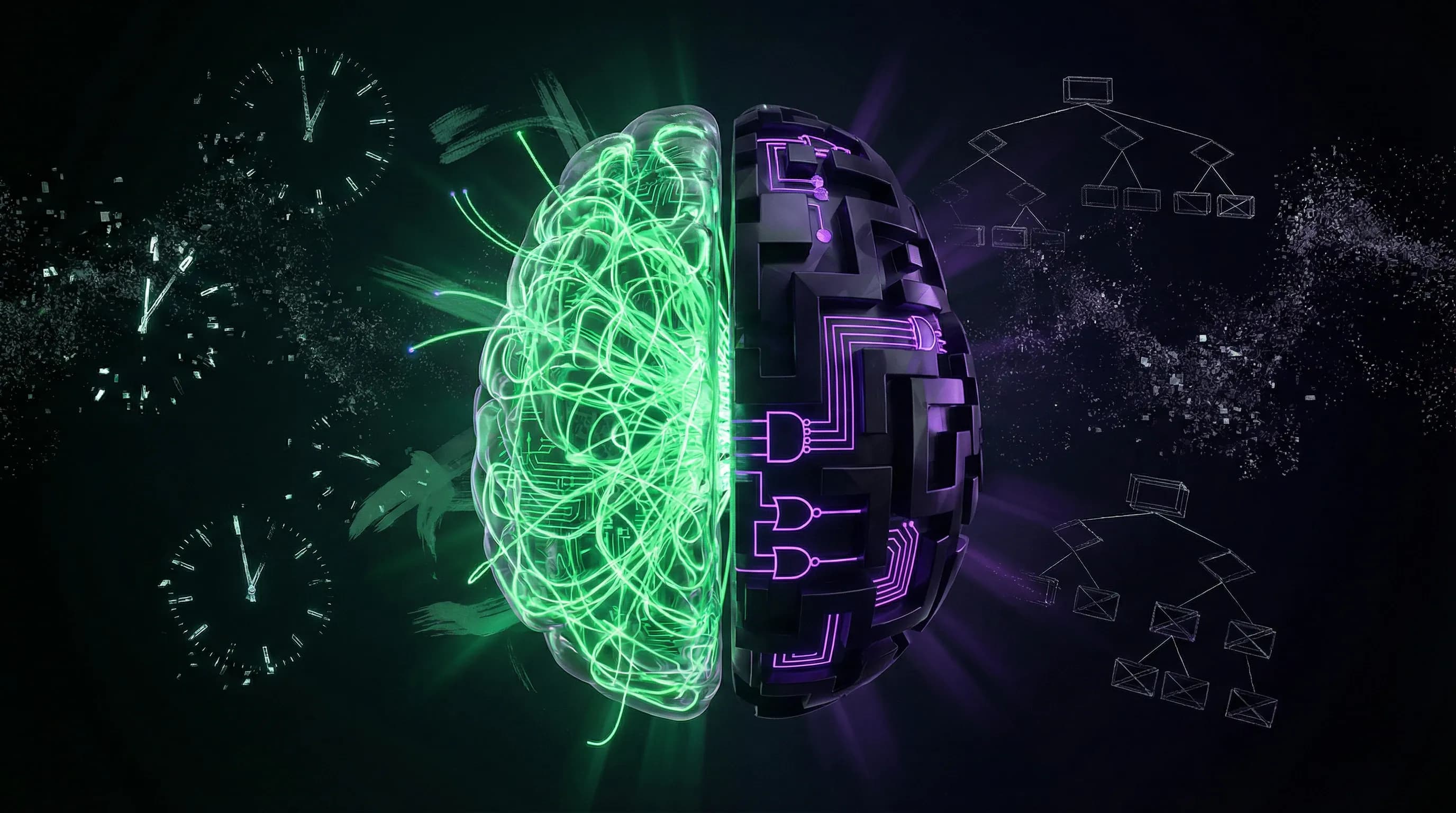
Cognitive Traps and Logical Fallacies: Where Heuristics End and Catastrophe Begins
The term "cognitive bias" describes systematic deviations in information processing arising from limitations in brain architecture. Logical fallacies are violations of formal rules of inference that render an argument invalid regardless of the truth of its premises. For more details, see the section Mental Errors.
The boundary between them is blurred: confirmation bias drives the search for only supporting data, and then the logical fallacy "post hoc ergo propter hoc" transforms correlation into causation.
🧩 Three Levels of Failure: Perception, Inference, Action
Cognitive traps operate on three floors of decision-making.
- Perception Level
- The availability heuristic causes overestimation of the probability of events that are easy to recall—plane crashes seem frequent because they're media-prominent, though statistically rare.
- Inference Level
- The base rate fallacy ignores prior probabilities—a doctor sees a positive test for a rare disease and makes a diagnosis, forgetting that with low prevalence, most positives are false (S005).
- Action Level
- Escalation of commitment (sunk cost fallacy) compels continuation of a failing project because "so much has already been invested."
🔎 Why Quick Decisions Are a Battlefield Between System 1 and System 2
Daniel Kahneman divided thinking into two systems: System 1 (fast, automatic, emotional) and System 2 (slow, analytical, energy-intensive). Under time pressure, System 2 shuts down—the brain conserves glucose.
Diplomatic negotiations, where every second of silence is interpreted as a signal, become a proving ground for traps: the anchoring effect determines the entire bargaining range, and the fundamental attribution error attributes an opponent's rigidity to their character rather than situational pressure (S001).
⚙️ Heuristics as Weapons: When Simplification Becomes Manipulation
The representativeness heuristic causes judgment of probability based on similarity to a prototype: "He looks like a programmer, so he's probably a programmer"—ignoring that there are more librarians in the population.
| Heuristic | Mechanism | Field of Manipulation |
|---|---|---|
| Representativeness | Judge by similarity to prototype | Stereotyping in advertising and hiring |
| Affect | Link risk assessment to emotional coloring | Positive image bypasses analysis (green energy, new technologies) |
In marketing, the representativeness heuristic transforms into stereotyping: advertising images exploit prototypes to bypass analytical thinking. The affect heuristic links risk assessment to emotional coloring: technologies with a positive image are perceived as safe, even when data is ambiguous.
For more on identifying such errors, see the logical fallacies reference guide.

The Steel-Man Version: Why Cognitive Traps Are Features, Not Bugs
Before dissecting errors, we must acknowledge: heuristics exist because they work. Under conditions of uncertainty and limited resources (time, information, computational brain power), they deliver "good enough" solutions at minimal cost. More details in the Debunking and Prebunking section.
Criticism must account for ecological rationality—the fit between strategy and environment. This isn't an excuse; it's context.
- Heuristics win under high uncertainty and noise
- Social heuristics coordinate collective action
- Cognitive economy is an evolutionary advantage
- Logical fallacies can be rhetorically effective
- Context-specificity makes universal criticism meaningless
- Quantum decision models explain "irrationality" as higher-order rationality
- Consultation reduces errors by increasing mutual information
Heuristics Win Under High Uncertainty and Noise
Simple heuristics (like "choose the recognizable option") often outperform complex statistical models in real-world tasks with noisy data. Complex models overfit to noise; heuristics ignore it.
In medicine, rapid pattern-based diagnosis saves lives when there's no time for complete analysis—an experienced physician "sees" a heart attack through a constellation of subtle signs faster than an algorithm can process an EKG (S005).
Social Heuristics Coordinate Collective Action
The "do what the majority does" heuristic seems like conformism, but it solves coordination problems without centralized control. In panic situations (fire, attack), following the crowd can be the optimal strategy—you don't have time to analyze evacuation plans.
Collective behavior aggregates distributed information. Problems arise when the environment changes faster than the heuristic adapts: the crowd runs toward a blocked exit because "everyone's running there."
Cognitive Economy Is an Evolutionary Advantage
The brain consumes 20% of the body's energy at 2% of its mass. Analytical thinking is energetically expensive—it can't stay on constantly.
Heuristics are cache that enables thousands of micro-decisions daily (what to wear, which route to take, whom to trust) without burning glucose. Criticizing heuristics without accounting for this constraint is like criticizing a processor cache for not storing the entire database.
Logical Fallacies Can Be Rhetorically Effective
Argumentum ad populum is formally fallacious but socially persuasive—it appeals to the need for belonging. In diplomacy and politics, rhetorical force matters more than logical validity (S001).
The "slippery slope" fallacy can be justified when escalation mechanisms exist—the first compromise genuinely creates precedent for subsequent ones. Rhetoric's goal isn't proving truth but moving audiences to action.
Context-Specificity Makes Universal Criticism Meaningless
What's an error in one domain may be standard practice in another. In science, post hoc ergo propter hoc is a gross error, but in medical diagnosis, temporal symptom sequences are key diagnostic indicators.
- Dunning-Kruger Effect
- Novice overconfidence is criticized in science, but in startup culture, "naive self-assurance" can be an advantage—it enables launching projects that experts would dismiss as unrealistic.
- Logical Fallacies in Discourse
- Smart people believe foolish things not because they're stupid, but because context and rhetoric redefine logic. See more on logical fallacies in discourse.
Quantum Decision Models Explain "Irrationality" as Higher-Order Rationality
Classical decision theory predicts people maximize expected utility. But experiments show systematic violations: order effects, where question sequence changes answers, and disjunction effects, where knowing outcomes shifts preferences illogically.
The quantum model of social agents explains this through superposition of states and probability interference (S003). Decisions aren't determined until the moment of "measurement" (questioning), and context collapses the wave function of preferences. This isn't error—it's different mathematics.
Consultation Reduces Errors by Increasing Mutual Information
Paradoxes in classical decision theory (like the Ellsberg paradox, where people prefer known to unknown probabilities) weaken when agents consult each other. Information exchange increases mutual information between agents, reducing decision entropy and diminishing cognitive bias influence (S003).
Collective decisions are often more accurate than individual ones—not because of "wisdom of crowds," but because informational interference cancels random fluctuations.
This explains why logical errors are less dangerous in open systems where dialogue and verification are possible. Isolation amplifies distortions; connectivity neutralizes them.
Evidence Base: What 2025 Research Says About Cognitive Trap Mechanisms
Empirical data on cognitive biases has been accumulating since the 1970s, but only in recent years have models emerged that explain why classical rationality theory systematically fails. The key shift is moving from describing errors to understanding their mechanisms. More details in the Critical Thinking section.
Quantum Decision Theory: Why the Classical Model Is Paradoxical
Classical expected utility theory assumes preferences are stable and independent of question order. Experiments show the opposite: if you first ask "Are you happy in your marriage?" then "How happy are you overall?", the correlation between answers is high. Reverse the order—correlation drops.
This is the order effect, unexplainable in the classical model (S003). Quantum decision theory introduces non-commutativity: measuring one parameter changes the system's state, affecting measurement of another. Mathematically, this is described through projection operators in Hilbert space—the same equations as in quantum mechanics (S003).
Question order isn't just a survey artifact. It's a fundamental property: measuring one aspect reconfigures the mental state for the next.
Ellsberg Paradox and Uncertainty: Why People Avoid Unknown Probabilities
In the Ellsberg paradox, participants are offered two urns: the first contains 50 red and 50 black balls (known distribution), the second contains 100 balls in an unknown ratio. Most prefer betting on the first urn, even if the payoff is identical—this violates the independence axiom of classical theory.
The quantum model explains this through entropy: the uncertainty of the second urn increases decision entropy, which is perceived as risk. When agents consult each other, information exchange reduces entropy—and preference for the first urn weakens (S003). Group decisions show less sensitivity to the Ellsberg paradox.
Context Specificity in Medical Diagnosis: When Heuristics Kill
Research on clinical reasoning shows that contextual factors—time of day, physician fatigue, patient arrival order—systematically affect diagnostic accuracy (S005). The availability heuristic causes physicians to diagnose what they've recently seen.
If there were three pneumonia cases in the morning, the fourth patient with a cough gets the same diagnosis, even if symptoms differ. Base rate neglect is especially dangerous with rare diseases: a test with 99% sensitivity and 99% specificity for a disease with 0.1% prevalence yields 90% false positives—but physicians ignore this, focusing on "99% accuracy" (S005).
- Availability Heuristic
- A recently seen case becomes an anchor for interpreting new data. Mechanism: activated neural networks remain excited, lowering the threshold for similar pattern recognition.
- Base Rate Neglect
- Ignoring the prior probability of an event in favor of test specificity. Dangerous in medicine: rare disease + high-accuracy test = most positive results are false.
Diplomatic Failures: How Cognitive Traps Destroy Negotiations
Analysis of diplomatic cases reveals typical traps: anchoring effect (first offer defines bargaining range), attribution error (opponent's rigidity attributed to character rather than situation), escalation of commitment (S001). The 1962 Cuban Missile Crisis—both sides interpreted each other's actions through the lens of hostile intentions, ignoring situational pressure.
Only direct communication (Kennedy-Khrushchev hotline) reduced information entropy and allowed de-escalation.
Evidence-Based Management: Why Hyperrationality Is Also a Trap
Criticism of evidence-based management reveals a paradox: requiring rigorous proof for every decision can paralyze action (S002). Under uncertainty (startup in a new niche), data simply doesn't exist—waiting for it means missing the window of opportunity.
EBM works in stable environments (medicine, engineering), but in rapidly changing contexts (tech business, geopolitics), heuristics and expert intuition may be more effective. The error isn't using heuristics, but inability to switch between thinking modes depending on context (S002).
Hyperrationality under uncertainty isn't a virtue—it's paralysis. Heuristics exist because they work in real time.
Automated Decision Systems: New Traps for Old Errors
Automated decision systems inherit cognitive biases from their creators through data and algorithms. If training data contains historical prejudices (e.g., a hiring algorithm trained on data where 90% of successful candidates are men), the system will reproduce discrimination.
Confirmation bias is encoded in metric selection: if optimizing for accuracy while ignoring false negatives, the system will miss rare but critical cases. Ethics-based auditing proposes structured verification against ethical norms, but it's a "soft" mechanism—auditors' main task isn't punishment, but stimulating ethical reflection at key development stages.
More on logical errors encoded in algorithms: see logical fallacies: learning to identify sophisms and correlation does not equal causation.

Sabotage Mechanisms: How Heuristics Turn Speed into Vulnerability
Understanding the mechanism is the key to protection. Cognitive traps don't work randomly: they exploit the brain's architectural features, evolutionary priorities, and social instincts. More details in the section Statistics and Probability Theory.
Analysis of cause-and-effect chains reveals exactly where rationality breaks down.
🔁 Availability Effect: Why Media Events Distort Risk Assessment
The availability heuristic estimates the probability of an event by how easily examples come to mind. Vivid, emotionally charged events (terrorist attacks, plane crashes, shark attacks) are remembered better and activated faster than statistically frequent but mundane ones (cardiovascular disease, car accidents).
Media amplifies the effect: coverage of rare but dramatic events creates an illusion of frequency. People fear flying but don't fear driving, even though the risk of dying in a car accident is orders of magnitude higher.
In business, this leads to overestimating "black swans" and underestimating routine risks—strategy focuses on visible threats while ignoring systemic ones.
🧷 Anchoring Effect: How the First Number Captures the Entire Negotiation Range
Anchoring effect works through priming: the first number you hear (even if it's random) becomes the reference point for all subsequent estimates.
Classic experiment: participants spun a wheel (random number from 0 to 100), then were asked to estimate the proportion of African countries in the UN. Those who got 10 gave estimates of ~25%, those who got 65—~45%. The wheel had nothing to do with the question, but the anchor worked.
- In negotiations
- The first offer determines the bargaining range. If a seller names a price of $100k, the final deal will be closer to that figure than if they started at $50k.
- Defense
- Make the first offer yourself or explicitly reject the anchor: "That figure isn't relevant, let's start with market analysis."
🧩 Base Rate Fallacy: Why Doctors Make Wrong Diagnoses with Accurate Tests
Base rate fallacy ignores prior probability (base rate) and focuses on specific information. A test for a rare disease (prevalence 0.1%) with 99% sensitivity and 99% specificity returns positive.
Intuitive answer: probability of disease ~99%. Correct answer (Bayes' theorem): ~9% (S005).
| Group | Size | Test Result | Count |
|---|---|---|---|
| Sick (0.1%) | 10 out of 10,000 | Positive (99%) | ~10 |
| Healthy (99.9%) | 9,990 out of 10,000 | False positive (1%) | ~100 |
| Probability of disease given positive test | 10 / (10+100) ≈ 9% | ||
Doctors systematically ignore the base rate, focusing on "99% test accuracy." This leads to overdiagnosis and unnecessary treatment.
🔁 Escalation of Commitment: Why Sunk Costs Kill Projects
Sunk cost fallacy makes us continue a failing project because "we've already invested so much." The brain perceives abandonment as admitting error, which activates pain centers (anterior cingulate cortex).
Rationally: sunk costs shouldn't influence decisions—only future benefits and costs matter. But emotionally: abandonment = loss of face, admission of incompetence.
In corporations, this is amplified by groupthink: a team that has invested years in a project cannot admit failure without destroying its identity.
Example: Concorde—British and French governments continued funding the unprofitable project because stopping meant admitting error at a national level.
🧬 Fundamental Attribution Error: Why We See Character, Not Situation
Fundamental attribution error overestimates the role of personal factors and underestimates situational ones. If someone is rude, we think "they're a rude person," not "maybe they're having a tough day."
Mechanism: assessing situational factors requires additional information and cognitive effort, while attributing to character is fast and automatic.
- Observe behavior (opponent's tough stance)
- Quickly attribute to character (hostility, aggression)
- Ignore situational factors (domestic political pressure, constraints)
- Make decisions based on incomplete model (negotiations collapse) (S001)
Defense: explicitly model situational constraints. Ask yourself: "What factors might force them to act this way?"—this switches attention from System 1 to System 2.
More about logical fallacies and their mechanisms—and how they embed in discourse.
Conflicts and Uncertainties: Where Sources Diverge and Why It Matters
Scientific integrity requires acknowledging: not all questions are settled. Sources diverge on how universal cognitive biases are, how correctable they are, and in which contexts heuristics are justified. More details in the Epistemology section.
Three points of disagreement that will determine how you proceed.
- Universality vs. context-dependence. (S003) argues that heuristics are adaptive tools that work in most scenarios. But (S001) shows: motivated reasoning and ideological filters are so powerful that "universal" rules break down under the pressure of beliefs. Conclusion: heuristics work until identity defense kicks in.
- Correction through training vs. structural inevitability. (S002) proposes alternative forms of testing, hinting at the plasticity of cognitive processes. However, (S004) points to rigid working memory constraints—the resource is finite, and no amount of training will physically expand it.
- Associative vs. propositional learning. (S005) redefines the mechanism: human learning is not merely associative, it's propositional (logically structured). This means traps aren't just automatic triggers, but the result of incorrectly constructed judgments.
Disagreements between sources aren't a weakness of science, but a map of reality. Each conflict points to an edge case where your model of the world may fail.
Practical takeaway: don't look for a universal life hack. Instead, identify logical errors in your own judgments and distinguish correlation from causation in each specific decision.