 🔄 Cognitive Biases
Critical Thinking: The Essential 21st Century Skillλ
A system of judgment for analyzing phenomena, the ability to examine information from multiple perspectives and make well-founded decisions in an age of information abundance
Overview
Critical thinking is a meta-competency that enables information analysis and informed decision-making in conditions of data overload. Research confirms: 🧠 the skill develops systematically through education — senior students demonstrate significantly higher results than freshmen. It is based on structured memory, language mastery as a thinking tool, meaning extraction from information flow, logic, and cognitive flexibility.
🛡️
Laplace Protocol: Critical thinking is not an innate ability nor a synonym for negativity, but a developable skill of analytical information investigation from multiple perspectives, grounded in scientific evidence of progressive development through education and practice.
Reference Protocol
Scientific Foundation
Evidence-based framework for critical analysis
Navigation Matrix
Subsections
[epistemology]
Epistemology
A philosophical discipline that investigates the nature, sources, and structure of knowledge, methods of acquiring it, and criteria for reliability in science and everyday life.
Explore
[logic-probability]
Logic and Probability
Exploring the fundamental unity of logic and probability theory for analyzing reliability, safety, and decision-making under uncertainty
Explore
[mind-bugs]
Mental Errors
How students develop predictable patterns of flawed reasoning when learning step-by-step procedures, and why these errors aren't random but arise from incomplete mental models
Explore
[validation-stack]
Reality Check
A multifaceted concept spanning psychology, cognitive science, and lucid dreaming research, aimed at distinguishing external objects from mental representations and evaluating the nature of one's current state of consciousness.
Explore
Protocol: Evaluation
Test Yourself
Sector L1
Articles
Research materials, essays, and deep dives into critical thinking mechanisms.
🔄 Cognitive Biases 📺 Media Literacy
 🔄 Cognitive Biases
 📺 Media Literacy
 🔄 Cognitive Biases
 📺 Media Literacy
 🔄 Cognitive Biases
 📺 Media Literacy
 🔄 Cognitive Biases
 🔄 Cognitive Biases
 🔄 Cognitive Biases
 🔄 Cognitive Biases
⚡
Deep Dive
The Architecture of Critical Thinking: From Components to Theoretical Models
Critical thinking is a system of judgments for analyzing phenomena from multiple perspectives, examining information, and reaching well-founded conclusions.
In the information age, this becomes the foundation for decisions in professional and personal life. The academic community recognizes it as a key competency of the 21st century, reflected in educational programs at leading institutions.
Component Skills and Abilities
Critical thinking is built on six foundational components that function as an integrated system, not a collection of isolated skills.
- Well-Organized Memory
- Structured storage and retrieval of information, enabling connections between new data and existing knowledge.
- Mastery of Language as a Thinking Tool
- The ability to formulate questions precisely, distinguish nuances of meaning, and identify manipulative linguistic constructions.
- Extracting Meaning from Information
- Recognition of explicit content, hidden assumptions, logical connections, and potential distortions.
- Logical Abilities
- Construction of valid chains of reasoning and verification of their consistency.
- Cognitive Flexibility
- Switching between different analytical perspectives, avoiding rigid thinking and premature conclusions.
- Analytical Skills
- Breaking down complex phenomena into components and identifying cause-and-effect relationships.
Developing one component strengthens the effectiveness of the others—this is synergy, not a sum of parts.
Theoretical Approaches: Cognitive and Embodied
The traditional cognitive approach views critical thinking as primarily abstract intellectual activity, focusing on logical reasoning and analytical processes.
The embodied cognition hypothesis offers an alternative: physical and sensory experience plays a significant role in analytical processes. Bodily experience is integrated into critical thinking, not separated from it.
| Approach | Focus | Role of Bodily Experience |
|---|---|---|
| Cognitive | Logic, abstract reasoning | Minimal or absent |
| Embodied | Integration of physical and mental | Central to analytical processes |
Integration of physical experience opens new directions for educational practices and methods of developing analytical abilities.
However, this theoretical framework requires further empirical validation to establish specific mechanisms of interaction between bodily and cognitive components.

Scientific Evidence on Critical Thinking Development
Critical thinking is not innate. Empirical research demonstrates that it develops systematically through structured education and practice.
Quantitative measurements document progressive improvement in analytical skills throughout educational trajectories—refuting the myth of fixed ability.
Progressive Development Through Education
Research by Kokina (2019) identified a statistically significant correlation: senior students demonstrate substantially higher critical thinking scores than freshmen.
This isn't merely maturation or experience accumulation—improvement occurs specifically within the context of intentional instruction, confirming the effectiveness of pedagogical approaches.
- Structured courses built on principles of progressive complexity in analytical tasks show measurable results in developing component abilities.
- Educational programs at leading institutions (Harvard Kennedy School, Stanford Graduate School of Business) integrate critical thinking development as a core competency.
- Long-term trajectories require longitudinal studies to understand skill persistence after formal education completion.
Measurability and Standardized Assessment
Standardized tests provide an objective foundation for measuring progress. They assess logical abilities, cognitive flexibility, and analytical skills through specialized methodologies.
The ability to measure baseline levels and subsequently monitor changes creates a scientific foundation for optimizing educational strategies.
Quantifiable progress confirms that critical thinking is amenable to intentional development with predictable outcomes.
Standardized assessment enables comparison of different pedagogical approaches' effectiveness, identification of the most productive methods, and provision of feedback to learners, making the development process more conscious and purposeful.
Common Myths and Misconceptions About Critical Thinking
Critical thinking is surrounded by numerous misconceptions that impede its development and application. Understanding these myths is necessary for constructing adequate educational strategies and developing analytical capabilities.
The Innate Ability Myth
The widespread misconception about critical thinking being innate contradicts empirical data. Research shows measurable improvement in critical thinking scores among senior students compared to freshmen—a difference impossible to explain by innate variations within a single cohort.
This myth is particularly dangerous: it creates a false sense of impossibility for development among those who consider themselves "not analytically inclined." Recognizing trainability opens the path to intentional development through structured programs and practice.
Critical thinking is not a talent but a competency accessible to everyone through systematic application of analytical methods, solving complex problems, and reflection on one's own processes.
Critical Thinking as Negativism
The erroneous identification of critical thinking with automatic rejection or cynicism distorts its essence. The analytical approach involves balanced evaluation from multiple perspectives, not systematic rejection of everything.
Critical thinking includes the ability to accept well-founded conclusions. Excessive skepticism—when analytical approach transforms into inability to accept any conclusions—becomes an obstacle rather than a tool.
- Justified doubt: distinguishing between weaknesses in argumentation and sufficiency of evidence for accepting a conclusion.
- Destructive negativism: rejection for rejection's sake, which blocks formation of any beliefs and impedes cognition.
Mature critical thinking requires balance: recognizing mental errors and manipulative techniques, but also accepting well-founded conclusions. This makes it a constructive tool for cognition rather than an obstacle to belief formation.
The Connection Between Critical Thinking and Well-being and Quality of Life
Contemporary research reveals a direct correlation between the level of critical thinking development and indicators of everyday well-being. The HT-Lab project, supported by the NSF (grant 24-28-00809), examines the relationship between critical analysis ability and quality of life, mood, and satisfaction with daily decisions.
Critical thinking serves as a protective factor for psychological well-being, not a source of cynicism and unhappiness—this refutes the common misconception about the cost of clarity.
Quality of Daily Life and Decision Satisfaction
People with developed critical thinking demonstrate higher satisfaction with decisions made in professional and personal spheres. The ability to analyze information from different perspectives, identify logical errors, and evaluate source credibility reduces cognitive load in decision-making and decreases subsequent regret about choices made.
| Life Domain | Effect of Critical Thinking |
|---|---|
| Financial Decisions | Conscious choice, protection from impulse purchases |
| Interpersonal Relationships | Recognition of manipulation, strengthening trust |
| Career | Informed choice of profession and development |
| Information Environment | Filtering misinformation, autonomy of judgment |
Decision-Making and Protection from Manipulation in the Information Age
In conditions of exponential growth in information flows, critical thinking becomes an essential tool for protection against cognitive manipulation and misinformation. The ability to recognize logical fallacies, rhetorical tricks, and manipulative argumentation techniques allows maintaining autonomy of judgment under informational pressure.
People with developed critical analysis skills are less susceptible to emotional manipulation in advertising, political propaganda, and social media, which protects them from irrational financial decisions and ideological indoctrination.
Critical thinking functions as a dual protective mechanism: external (against manipulation) and internal (against self-deception). This dual protection is especially critical in the era of personalized algorithms, where manipulative techniques become increasingly sophisticated and individualized.

Practical Development of Critical Thinking Skills Through Education
Educational Strategies and Progressive Competency Development
Research by Kokina (2019) demonstrates that senior students exhibit significantly higher levels of critical thinking than freshmen. This confirms that critical thinking develops through targeted educational interventions rather than being an innate ability.
Leading institutions—including Harvard Kennedy School and Stanford Graduate School of Business—integrate critical thinking development as a key 21st-century competency into their programs.
- Progressive complexity of analytical tasks
- Creating situations of cognitive dissonance requiring belief revision
- Systematic practice of multi-perspective analysis
- Standardized testing to measure progress
Standardized tests assess logical abilities, cognitive flexibility, and analytical skills, enabling evidence-based design of educational programs with proven effectiveness.
Individual Development Techniques and Component Skills
Critical thinking consists of interconnected components: properly organized memory, mastery of language as a thinking tool, ability to extract meaning from information, logical abilities, and cognitive flexibility.
Each component can be deliberately developed through specific practices: information structuring for memory, precision in formulation for language mastery, active reading techniques for meaning extraction, study of formal logic.
Contemporary approaches, including the embodied cognition perspective, suggest that critical thinking develops not only through abstract intellectual exercises but also through integration of physical and sensory experience.
| Technique | Development Mechanism | Outcome |
|---|---|---|
| Analytical journals | Structuring thoughts in written form | Awareness of one's own cognitive processes |
| Fact-checking before judgment | Gap between impulse and action | Reduction of mental errors |
| Considering alternative interpretations | Training cognitive flexibility | Resistance to bias |
| Regular reflection | Feedback on thinking quality | Automation of critical analysis |
Daily practice of these techniques gradually transforms critical thinking from conscious effort into an automated cognitive habit.
Pitfalls and Limitations of Critical Thinking in Practical Application
Excessive Skepticism as a Destructive Extreme
Excessive critical thinking transforms into a cognitive trap: over-skepticism blocks acceptance of well-founded conclusions even when evidence is sufficient. Analysis becomes an end in itself rather than a means of understanding.
Cognitive paralysis — when constant doubt and refusal to draw conclusions transform a constructive tool into an obstacle to forming beliefs.
Managing Cognitive Biases and Recognizing Limitations
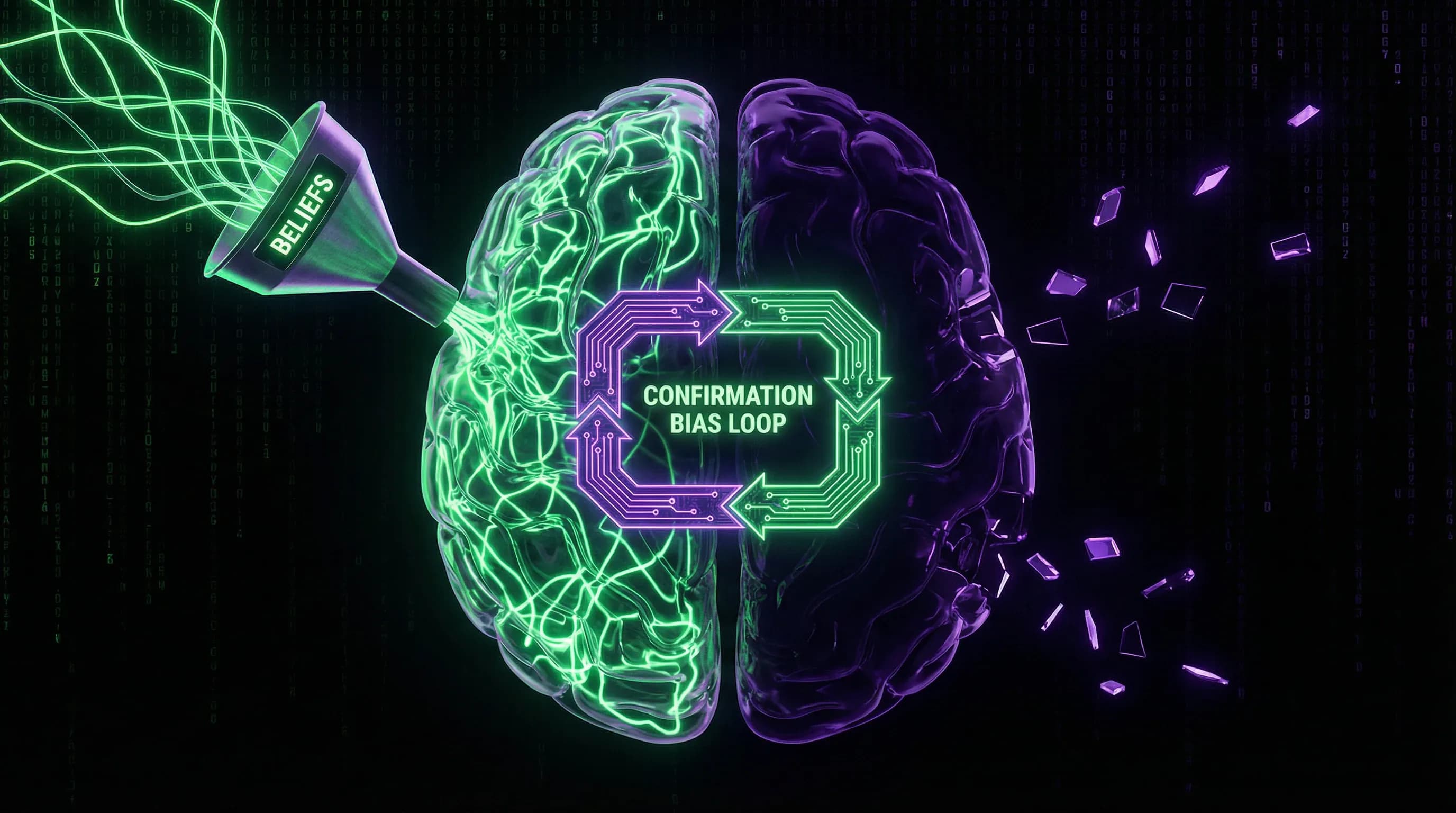
Critical thinking does not eliminate mental errors completely, but provides tools for recognizing them. Even well-developed critical thinking is subject to confirmation bias, anchoring effect, and survivorship bias.
The distinction between critical thinkers and non-critical individuals lies not in the absence of biases, but in metacognitive awareness of them and active compensation strategies.
- Acknowledging Limitations
- Critical thinking does not guarantee absolute objectivity — it is a tool for reducing errors, not eliminating them entirely.
- Separation of Competencies
- Analysis does not replace specialized expertise in technical domains where deep subject-matter knowledge is required.
- Pragmatism Under Time Pressure
- With limited resources, it is reasonable to trust verified sources instead of independently analyzing every issue.
- Adaptive Choice
- Mature thinking distinguishes situations requiring deep analysis from situations where expert opinion is the optimal solution.
The balance between critical analysis and pragmatic decision-making distinguishes functional application of critical thinking from its dysfunctional forms. Mature critical thinking is an adaptive tool of cognition under conditions of bounded rationality, not an absolute arbiter of truth.

Knowledge Access Protocol
FAQ
Frequently Asked Questions
Critical thinking is the ability to analyze information from different perspectives and draw well-founded conclusions. It includes logical abilities, cognitive flexibility, and the skill to extract meaning from data. It's not an innate talent, but a skill that develops through education and practice.
Critical thinking consists of six key components: properly organized memory, mastery of language as a thinking tool, ability to extract meaning from information, logical abilities, cognitive flexibility, and analytical skills. All these elements work together for effective information analysis.
Critical thinking is an acquired skill, not an innate ability. Research shows that senior students demonstrate significantly higher levels of critical thinking than freshmen. Systematic education and practice allow for measurable improvement of this skill.
No, this is a common misconception. Critical thinking is a balanced analytical approach, not automatic rejection or cynicism. It involves examining phenomena from multiple perspectives for objective assessment, not a negative attitude toward everything.
Research reveals connections between critical thinking levels and quality of daily life, mood, and overall well-being. Developed critical analysis skills help make more informed decisions in professional and personal spheres. This protects against manipulation and improves quality of life.
There are two main approaches: the traditional cognitive approach and the embodied cognition concept. The cognitive approach focuses on logical reasoning and analytical processes. The embodied cognition approach explores critical thinking through integration of physical and sensory experience.
Standardized tests exist for assessing critical thinking that measure logical abilities, cognitive flexibility, and analytical skills. These instruments allow quantitative evaluation of progress through educational interventions. Measurability confirms that the skill can be systematically developed.
Critical thinking develops progressively through structured university education. Effective strategies include case analysis, discussions from different positions, problem-solving tasks, and reflective practices. A systematic approach yields measurable results throughout the learning process.
Exponential information growth requires analytical data processing skills. Critical thinking protects against misinformation, manipulation, and helps separate facts from opinions. It's a recognized key competency of the 21st century for professional and personal success.
Effective techniques include practicing examination of issues from multiple perspectives, verifying information sources, and analyzing one's own cognitive biases. Regular reflection on decisions made and their consequences strengthens the skill. It's important to consciously reject illusions that support habitual worldviews.
Yes, excessive skepticism is one of the pitfalls of critical thinking. Over-analysis can lead to decision paralysis and an inability to trust verified information. The key is balance between healthy skepticism and the practical ability to make decisions based on available data.
Critical thinking is positioned as a fundamental meta-competency for informed decision-making. It enables systematic analysis of facts, examination of information, and achievement of well-reasoned conclusions. This applies in both professional and everyday contexts.
Critical thinking doesn't increase IQ, but it improves the quality of how intellectual resources are used. It develops the ability to process information effectively, identify logical errors, and make informed decisions. It's a practical skill for applying intelligence, not increasing it.
Major biases include confirmation bias (seeking only confirming information), anchoring effect, and illusions that support existing worldviews. Critical thinking requires awareness of these patterns and active work to overcome them. Managing biases is a key element in developing the skill.
Mastery of language as a thinking tool is one of the six key components of critical thinking. Language structures thoughts and enables precise formulation of questions and arguments. A rich vocabulary and understanding of nuanced meanings expand the possibilities of analytical thinking.
Critical thinking has boundaries of applicability: it's less effective in situations requiring quick intuitive decisions or creative insight. Excessive analyticity can block emotional intelligence and spontaneity. It's important to understand contexts where other types of thinking are more appropriate.