What HAARP actually is—and why technical specifications don't stop conspiracy theorists
HAARP (High-Frequency Active Auroral Research Program) is a research facility in Gakona, Alaska, consisting of 180 antennas that transmit high-frequency radio waves into the ionosphere at altitudes of 80–500 km. Total transmitter power: 3.6 megawatts. More details in the section Sovereign Citizens Movement.
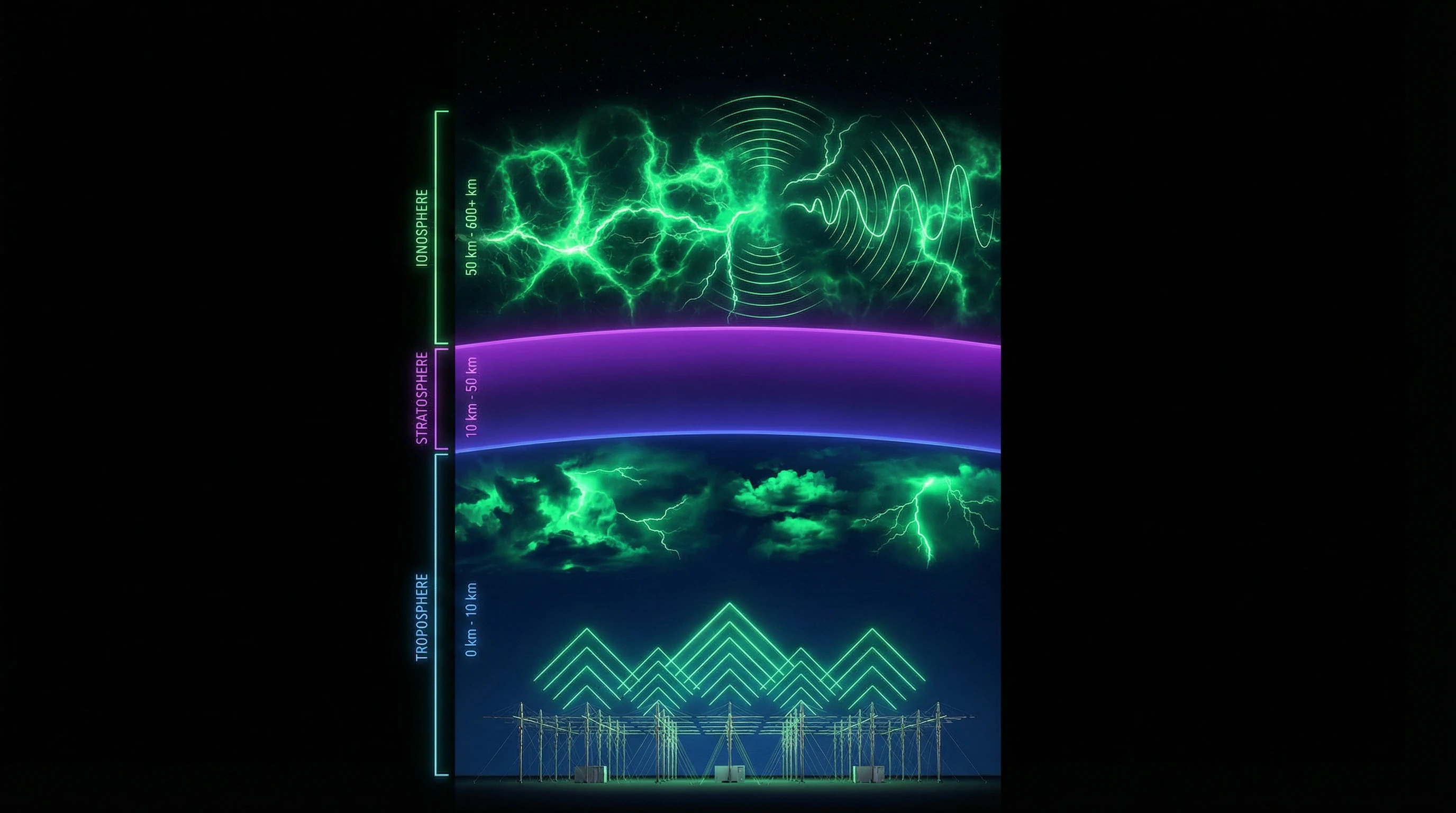
For comparison: this is less than many commercial radio stations. The energy required to affect weather processes in the troposphere (0–12 km, where clouds and cyclones form) exceeds HAARP's capabilities by millions of times.
| Parameter | HAARP | Minimum for weather modification |
|---|---|---|
| Power | 3.6 MW | 10¹⁴–10¹⁵ W (hurricane energy) |
| Altitude of effect | 80–500 km (ionosphere) | 0–12 km (troposphere) |
| Energy transfer mechanism | None | Requires direct contact or convection |
🔎 The physical chasm between ionosphere and troposphere
The ionosphere and troposphere are separated by the stratosphere—an atmospheric layer with minimal vertical mixing. HAARP's energy dissipates at altitudes above 100 km and physically cannot descend to Earth's surface.
This is analogous to trying to heat water in a glass by pointing a hairdryer at the ceiling: there's no mechanism to transfer the effect between the energy source and the target.
🧾 Open data that gets ignored
Since 2015, HAARP has been operated by the University of Alaska Fairbanks and is open to researchers worldwide. All technical parameters, experiment schedules, and scientific publications are publicly available.
Any physicist can calculate the energy balance: the facility's power is insufficient even to locally change ionospheric temperature by more than fractions of a degree.
- Why data transparency doesn't convince conspiracy theorists
- Open sources are often interpreted as "cover" or "disinformation." The more details an official source provides, the more material for alternative explanations (S002). This cognitive distortion is called the "illusion of explanatory depth": people believe they understand a mechanism even when their explanation contradicts physics.
⚙️ Actual purpose: studying the ionosphere for communications and navigation
HAARP was created to research ionospheric processes affecting radio communications, GPS navigation, and radio wave propagation. The ionosphere is a layer of charged particles that reflects radio waves and enables long-distance communication.
Understanding its dynamics is critical for military and civilian communications, especially at high latitudes where the ionosphere is most active due to solar wind and magnetic storms. This explains the funding and military interest—not because HAARP controls weather, but because the ionosphere controls radio communications.
- Research on ionospheric disturbances to predict communication interference
- Testing methods for active probing of the upper atmosphere
- Studying solar wind interaction with the magnetosphere
- Developing technologies to improve GPS reliability in polar regions
Steelman Arguments: Seven Strongest Claims from Climate Weapon Theory Proponents
To understand the persistence of the HAARP myth, we must examine the most compelling arguments of its proponents in their strongest formulation — without straw men and caricatures. Only then can we identify the real cognitive mechanisms that make this theory attractive. More details in the section Mind Control.
⚠️ Argument 1: Correlation Between HAARP Activity and Natural Disasters
Theory proponents point to temporal correlations between periods of HAARP operation and major earthquakes, hurricanes, or floods. Indeed, in some cases the facility was operating several days before disasters occurred.
This argument exploits a fundamental cognitive error — conflating correlation with causation. It ignores that HAARP operates regularly (hundreds of hours per year), while natural disasters occur constantly — statistically, coincidences are inevitable.
⚠️ Argument 2: Secrecy of Military Research
HAARP was initially funded by the U.S. Air Force and Navy, which raises suspicions about military applications. This argument relies on real historical context: the military was indeed interested in weather modification (Project Popeye in Vietnam, 1967-1972), and many dual-use technologies were first developed in classified programs.
However, after HAARP was transferred to the university in 2015, all documentation became public, and no evidence of "climate weapons" was found.
⚠️ Argument 3: Patents on Weather Modification Technologies
Real patents exist (for example, Bernard Eastlund's patent US4686605A, 1987) describing theoretical methods of ionospheric manipulation for weather modification. Theory proponents claim HAARP was built based on these patents.
- Critical Distinction
- The existence of a patent does not imply technical feasibility. Eastlund's patent requires gigawatts of power (thousands of times more than HAARP has) and describes processes that contradict current understanding of atmospheric physics.
⚠️ Argument 4: Anomalous Cloud Formations and "Chemtrails"
Photographs of unusual clouds (lenticular, nacreous, wave-like structures) are often linked to HAARP's influence. This argument exploits the natural human tendency to find patterns and explanations for unusual phenomena.
In reality, all these cloud formations are well-studied by meteorology and explained by natural processes: orographic waves, temperature inversions, ice crystallization at specific altitudes. For more on the mechanisms of these phenomena, see the article "Chemtrails and Contrails: How Pseudoscience Exploits Ignorance of Atmospheric Physics."
⚠️ Argument 5: "Witness" Testimonies and Local Anomalies
Residents of areas near HAARP report strange sounds, unusual animal behavior, and electronic malfunctions. These subjective testimonies create an illusion of mass confirmation.
However, none of these phenomena have been instrumentally recorded, and psychological research shows that expecting anomalies (priming) dramatically increases the frequency of their "detection" — an effect known as confirmation bias (S006).
⚠️ Argument 6: Geopolitical Logic of "Climate Weapons"
From a geopolitical perspective, climate weapons would be an ideal tool: invisible, leaving no traces, allowing attacks to be disguised as natural disasters. This argument appeals to rationality: if such a weapon were possible, it would certainly be created.
However, this logic ignores physical limitations: the impossibility of creating a technology doesn't depend on its desirability. Moreover, conspiracy narratives often rely on group dynamics and social incentives rather than logic (S001).
⚠️ Argument 7: International Treaties Banning Climate Weapons
The UN Convention on the Prohibition of Military or Any Other Hostile Use of Environmental Modification Techniques (ENMOD, 1977) is real. Theory proponents argue: why ban something that doesn't exist?
| Proponents' Interpretation | Historical Context |
|---|---|
| The convention proves climate weapons exist | ENMOD was adopted after real but primitive weather modification attempts in Vietnam (cloud seeding to enhance rainfall), not in response to fantastical climate control technologies |
The Conspiracy Theories category contains additional materials on the structure of conspiracy narratives and their social functions.
Evidence Base: What Atmospheric Physics Says About Weather Control Through the Ionosphere
To assess the plausibility of climate weapon theory based on HAARP, we need to examine fundamental energy and physical constraints. These make such influence impossible with current technology levels. More details in the Viral Fakes section.
🧪 Energy Barrier: Power Comparisons
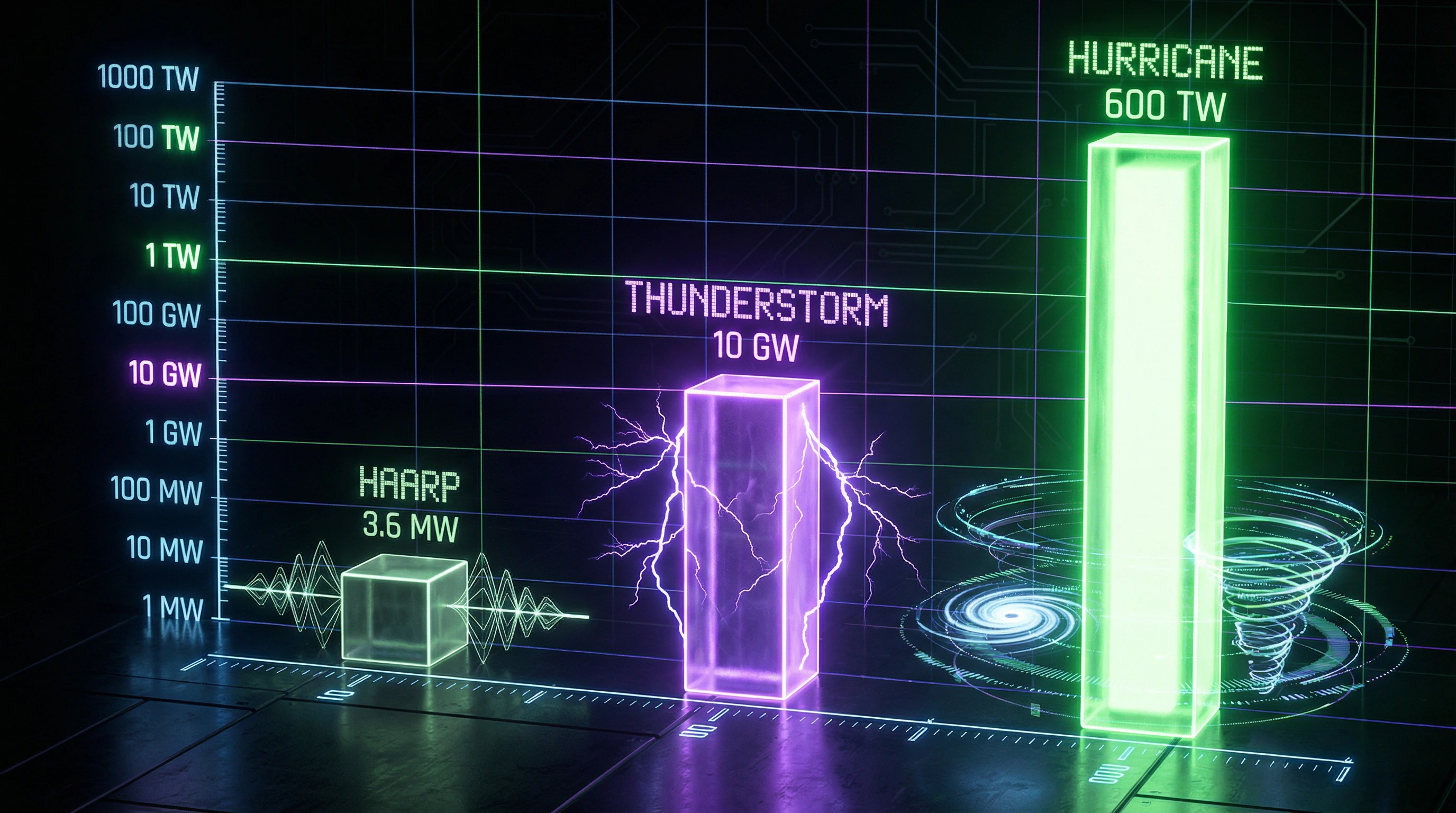
HAARP's power output is 3.6 MW. The energy of an average hurricane is approximately 6×10¹⁴ watts—170 million times greater.
A local thunderstorm cell releases energy on the order of 10¹⁰ watts—thousands of times more than HAARP. To "create" a hurricane would require not just directing energy, but orchestrating highly complex thermodynamic processes in the atmosphere—controlling massive volumes of air and moisture.
| Energy Source | Power / Energy | Ratio to HAARP |
|---|---|---|
| HAARP | 3.6 MW | 1× |
| Thunderstorm Cell | 10¹⁰ watts | ~2.8 million × |
| Average Hurricane | 6×10¹⁴ watts | ~170 million × |
🔬 Energy Transfer Mechanism: Why the Ionosphere Doesn't Affect the Troposphere
HAARP radio waves are absorbed in the ionosphere at altitudes of 100–300 km, causing local electron heating by fractions of a degree. This heating doesn't transfer downward for three reasons.
- Air Density
- In the ionosphere it's billions of times lower than in the troposphere—there's virtually no mass to transfer heat.
- Stratosphere as Barrier
- At altitudes of 15–50 km, temperature inversion blocks convection.
- Tropopause
- At approximately 12 km altitude, vertical air mixing ceases. Energy deposited in the ionosphere remains there and dissipates into space.
📊 Seismic Activity: Absence of Physical Mechanism
The theory about HAARP's impact on earthquakes assumes radio waves can influence tectonic plates or magma. But radio waves at 2.8–10 MHz frequencies are absorbed in the upper atmospheric layers and don't penetrate the ground deeper than a few meters.
Earthquakes occur at depths from 10 to 700 km, where forces on the order of 10²⁴ joules operate. All energy emitted by HAARP during a year of continuous operation would amount to ~10¹⁴ joules—10 billion times less.
HAARP radio waves physically cannot reach the depths where earthquakes occur. The energy gap is not an engineering question, but a matter of fundamental physics.
🧾 Statistical Analysis: Correlation Between HAARP Activity and Natural Disasters
Independent researchers analyzed databases of earthquakes (USGS), hurricanes (NOAA), and HAARP's operational schedule from 1997–2014. Result: no statistically significant correlation was found.
Earthquakes with magnitude >6.0 occur on average 150 times per year worldwide, HAARP operates ~500 hours per year—random coincidences are inevitable. Most major disasters (for example, the 2011 Japan earthquake) occurred during periods when HAARP was not operating.
🔎 Real Weather Modification Technologies: What Works and Why It's Not HAARP
Real, scientifically validated methods of local weather modification exist: cloud seeding with silver iodide to stimulate precipitation (used in China, UAE, USA), fog dispersal at airports, hail suppression.
- All these technologies work in the troposphere, requiring direct contact with clouds (aircraft, rockets).
- They can only slightly accelerate or redirect processes that have already begun naturally.
- You cannot "create" rain from dry air or "cancel" a hurricane—atmospheric energetics exceed human capabilities by orders of magnitude.
The connection between real weather modification and the myth of HAARP as a climate weapon is a classic example of how conspiracy narratives exploit the existence of legitimate technologies, transfer their capabilities to completely different systems, and ignore physical constraints.
The Mechanism of Delusion: Why the Question "Can X Be Controlled?" Becomes a Cognitive Trap
The central problem in the HAARP debate isn't technical details—it's the question itself. Asking "can weather be controlled?" activates a specific mode of thinking that makes people vulnerable to conspiracy narratives. More details in the section Debunking and Prebunking.
The Binary Thinking Trap: "Yes" or "No" Instead of "To What Degree and Under What Conditions"
A "can it?" question demands a "yes" or "no" answer, reducing complex reality to binary opposition. In reality, the correct answer is: some local weather processes can be influenced to a very limited degree under certain conditions, but climate cannot be controlled or catastrophes created.
However, such a nuanced answer is psychologically unsatisfying—the brain prefers clear categories. This creates cognitive dissonance, resolved by adopting an extreme position: either "anything is possible" (conspiracy thinking) or "nothing is possible" (naive skepticism).
Binary thinking isn't a perceptual error—it's cognitive resource conservation. The brain chooses simplicity over accuracy when information load is high. Conspiracy narratives win because they offer ready answers instead of uncomfortable uncertainty.
The "Proof of Possibility" Effect: From Theoretical Possibility to Actual Implementation
If you demonstrate something is theoretically possible (for example, a patent exists for a method of ionospheric modification), the brain automatically lowers the evidentiary threshold for claims of actual implementation. This cognitive bias is called "availability cascade": an idea becomes more plausible simply because it's discussed frequently.
In HAARP's case: facility exists + patents exist + military funding = "therefore, it works." The missing step—verification of technical feasibility and energy constraints.
| Level of Claim | Required Evidence | What's Often Substituted |
|---|---|---|
| Theoretical possibility | Mathematical model, physical principles | Existence of idea or patent |
| Technical feasibility | Prototype, energy calculations, scalability | Presence of equipment and funding |
| Actual application | Direct measurements, elimination of alternatives, reproducibility | Temporal coincidence, indirect indicators |
Illusion of Control and Agency: Why Chaos Is More Frightening Than Conspiracy
Psychological research shows people prefer believing in malevolent conspiracy over randomness or natural processes (S002). The reason: conspiracy implies an agent (someone in control), meaning the world is predictable and potentially manageable.
A natural disaster without cause represents existential horror before chaos. The HAARP theory transforms an earthquake from meaningless tragedy into an "attack," which paradoxically provides comfort: if there's an enemy, you can fight; if there's technology, you can understand or destroy it.
Conspiracy thinking isn't just misinformation. It's a method of restoring psychological control over a world that seems unpredictable and hostile. Debunking the theory means returning someone to a state of helplessness.
Evidentiary Asymmetry: Why Debunking Doesn't Work
For the claim "HAARP controls weather," one "suspicious" coincidence suffices. For refutation, you must explain every case, provide alternative mechanisms, prove absence of connection—a task requiring expertise and time.
This creates asymmetry: conspiracy theory is "cheap" (easy to create and spread), scientific refutation is "expensive" (requires resources). In the information environment, truth doesn't win—what's easier to reproduce and emotionally compelling does (S006).
- Conspiracy narrative requires minimal facts and maximum interpretation
- Scientific refutation requires data completeness and elimination of alternatives
- Audiences judge not logic, but emotional persuasiveness
- Each new refutation is perceived as "another attempt to hide the truth"
- Asymmetry amplifies on social media, where simplicity spreads faster than complexity
The connection of these mechanisms to the broader problem of conspiracy thinking is examined in the conspiracy section. Similar cognitive traps operate in theories about chemtrails and contrails, where ignorance of atmospheric physics becomes the foundation for conspiracy narratives.
Conflicting Data and Zones of Uncertainty: Where Science Doesn't Provide Definitive Answers
Honest analysis requires acknowledging: not all aspects of atmospheric impact have been fully studied, and there are areas where scientific consensus is still forming or data is contradictory. More details in the Sources and Evidence section.
🧪 Nonlinear Atmospheric Effects: The Theoretical Possibility of a "Butterfly Effect"
The atmosphere is a chaotic system where small perturbations could theoretically lead to large consequences (the concept of deterministic chaos). Some researchers suggest that even weak ionospheric impact could trigger a cascade of events in the troposphere.
However, this hypothesis has not been experimentally confirmed: the "butterfly effect" requires not just introducing a perturbation, but hitting a critical point in the system at a critical moment—the probability of this is astronomically small, and predicting such points is impossible.
📊 Limited Long-Term Observations: HAARP Has Operated Since 1993
A full cycle of climate oscillations (e.g., El Niño/La Niña) spans decades. HAARP has operated for ~30 years—a period insufficient to detect subtle long-term effects, if they exist.
The absence of evidence of effects over 30 years with thousands of hours of operation is a strong argument against the hypothesis of significant impact.
🧾 Classified Experiments: What We Don't Know for Certain
Until 2015, some HAARP experiments were classified. It's impossible to completely rule out that tests were conducted whose data has not been published.
However, after declassification and transfer of the facility to the university, no evidence of "climate weapons" has been found. Moreover, physical limitations (energy, mechanism of impact transmission) don't depend on secrecy—the laws of physics are the same for open and closed programs.
Why Uncertainty Fuels Conspiracy Theories
Zones of scientific uncertainty are a natural part of knowledge acquisition. But conspiracy narratives exploit this uncertainty, transforming "we don't know everything" into "therefore, they're hiding the truth" (S002).
- The unknown is reinterpreted as the hidden.
- Absence of evidence is read as evidence of absence of transparency.
- Each new fact is incorporated into the existing framework rather than revising it.
This isn't critical thinking—it's conspiratorial thinking that uses the language of science but ignores its logic.
Anatomy of a Conspiracy Narrative: Which Cognitive Biases the HAARP Myth Exploits
The climate weapon theory is a textbook example of how conspiracy narratives exploit vulnerabilities in human thinking to create self-sustaining belief systems (S002).
🧠 Confirmation Bias: Selective Attention to Confirming Data
Theory supporters notice every coincidence between HAARP operations and disasters, but ignore thousands of instances when HAARP operated without consequences, and hundreds of disasters that occurred when the facility was offline. More details in the Fake Diagnostics section.
Hindsight bias amplifies the effect: after a disaster, people "remember" strange phenomena that didn't seem significant before the event.
🕳️ Pattern Recognition Overdrive: Finding Patterns in Noise
The human brain is evolutionarily wired to find patterns—this aided survival. But this ability produces false positives: we see patterns where none exist.
Unusually shaped clouds, date coincidences, "strange" sounds—all interpreted as "evidence," though statistically inevitable with large data volumes.
🧬 Dunning-Kruger Effect: Underestimating the Complexity of Atmospheric Physics
People without specialized education tend to underestimate the complexity of scientific problems. The logic "there's a transmitter → there's energy → therefore, influence is possible" seems convincing.
But it ignores dozens of intermediate links: energy transmission mechanisms, energy balance, nonlinear effects, thermodynamic constraints. The less someone knows about atmospheric physics, the simpler weather control seems.
⚠️ Motivated Reasoning: Protecting Worldview Over Truth
For many supporters, the HAARP theory is part of a broader worldview where "elites" control everything (S006). Abandoning the climate weapon theory would mean revising an entire belief system, which is psychologically painful.
- The brain actively seeks ways to preserve the belief
- Reinterprets facts in favor of the theory
- Rejects sources that contradict the narrative
- Finds alternative explanations for refutations ("scientists are bought off," "data is fabricated")
🔁 Information Cascades: Social Reinforcement of False Beliefs
When millions believe in a theory, that itself becomes "proof": "they can't all be wrong" (S001). Social networks create echo chambers where conspiracy ideas circulate without critical examination.
Recommendation algorithms amplify the effect, showing users content that confirms their beliefs. The result—a closed loop where each new user enters an environment where the theory already seems mainstream.
The mechanism works regardless of the claim's truth: conspiracy narratives exploit the same cognitive vulnerabilities, whether HAARP, chemtrails, or other theories (S005).
Verification Protocol: Seven Questions That Dismantle Any Climate Weapon Theory in Two Minutes
To quickly assess the plausibility of a climate weapon claim, you don't need a physics degree. Just ask yourself seven questions — and the theory's logic will collapse on its own.
- Energy balance: how many megawatts does it take to shift the atmosphere by 1 degree? Compare that to HAARP's power (3.6 MW). Answer: a difference of millions of times.
- Effect visibility: if this is a weapon, why is its action only visible in conspiracy forums, but not in satellite data from meteorological services?
- Controlling chaos: the atmosphere is a chaotic system. Can you predict the weather a month ahead? If not — how can you control it?
- Traces and witnesses: such a project requires thousands of people. Where are the leaks, exposés, insider testimonies with documents?
- Alternative explanations: climate is changing due to CO₂. Why would you need a weapon if the result is achieved cheaper and simpler?
- Blowback: if HAARP controls weather, why doesn't the U.S. use it against enemies and protect its cities from hurricanes?
- Scientific replication: why hasn't a single independent scientist reproduced the effect of weather control through the ionosphere?
Each answer is a logical dead end for the theory. The conspiracy narrative survives not because it answers these questions, but because they aren't asked (S002, S006).
Verification works both ways: if you can't formulate how to test a hypothesis, then it's not a hypothesis — it's a belief.
When a climate weapon theory supporter can't answer these seven questions, it doesn't mean they're stupid. It means the conspiracy narrative is built to avoid verification, not withstand it (S001, S005).