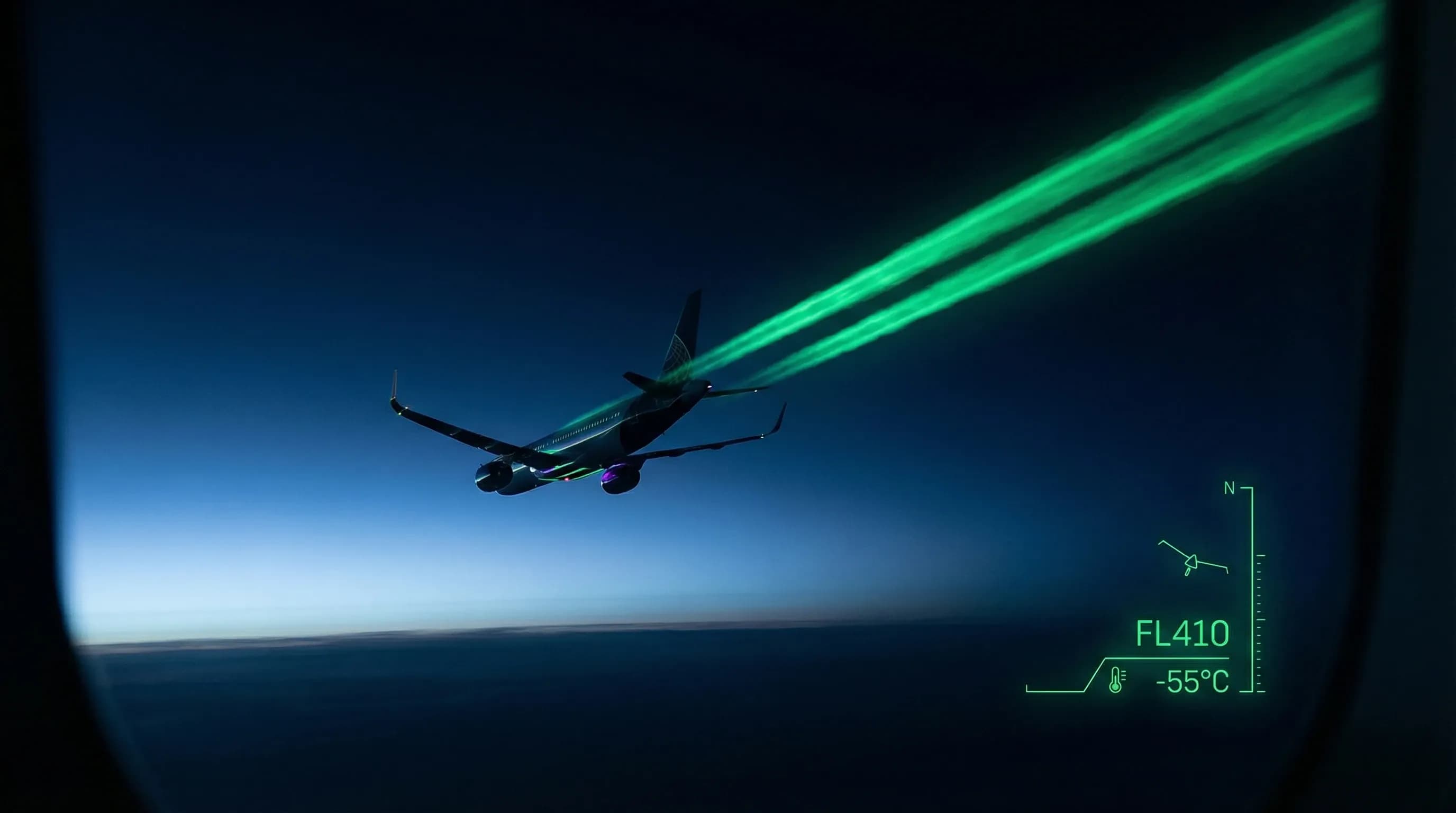
What the chemtrail theory claims—and where the line between observation and interpretation lies
The chemtrail theory asserts that white trails behind aircraft aren't water vapor, but deliberate spraying of chemical or biological agents (S001). Alleged purposes vary: weather control, population reduction, mind control, disease spread, or weapons testing.
The key difference from scientific explanation: proponents believe trails result from special onboard equipment, not atmospheric physics. More details in the section Microchipping and World Government.
Core claims: what counts as "evidence"
Proponents identify four "anomalies":
- Trails persist for hours and spread into cloud cover, whereas "normal" ones should dissipate quickly
- Some aircraft leave trails while others at the same altitude don't
- "Grid" patterns in the sky when multiple trails intersect at angles
- Water and soil analyses allegedly show elevated concentrations of aluminum, barium, and strontium
The boundary between observation and interpretation runs here: the phenomenon is visible, but its cause is reinterpreted through a lens of institutional distrust.
Historical evolution: from real programs to global myth
The theory in its modern form emerged in the mid-1990s in the United States (S003). Early mentions trace to conspiracy theorist William Thomas's radio broadcast in 1999.
However, the roots lie in real programs: in the 1970s, experiments were conducted seeding clouds with silver iodide to stimulate precipitation, and in the 1950s-60s, secret tests sprayed harmless bacteria over U.S. cities (Operation LAC, Operation Sea-Spray). These programs, declassified decades later, created fertile ground for distrust and became "proof" that the government is capable of such actions.
Three categories of phenomena: what's conflated into one theory
- Condensation trails (contrails)
- A scientifically documented phenomenon occurring under specific temperature and humidity conditions at altitude. Fully explained by atmospheric physics (S002).
- Cloud seeding
- A real weather modification technology, applied locally and openly (UAE, China, some U.S. states) to stimulate precipitation or suppress hail.
- Stratospheric aerosol injection (SAI)
- A hypothetical geoengineering technology discussed in scientific literature as a possible approach to combating global warming. NOT implemented at scale and NOT related to routine commercial flights.
The chemtrail theory conflates all three categories into one "conspiracy," ignoring differences in scale, purpose, and physical mechanisms. This allows real historical programs to be used as "proof" of a current fictional phenomenon.

Steel Version of Arguments: Seven Most Convincing Claims by Chemtrail Proponents
To honestly examine any theory, you must first present it in its strongest form — this is called "steelmanning" as opposed to "strawmanning." Below are seven arguments that chemtrail supporters consider most convincing. More details in the Disinformation section.
⚠️ Argument 1: Trails Only Became Widespread in the 1990s
Proponents claim: in the 1970s–80s, skies were "clear," and persistent trails only appeared in the mid-1990s. Personal memories, old photographs, and videos allegedly confirm this.
The logic is simple: if condensation physics hasn't changed, but trails have increased — something else must have changed. Either fuel composition, or additional dispersal equipment was introduced.
⚠️ Argument 2: Trails Behave "Unnaturally" — Persisting for Hours and Turning into Clouds
The central argument: condensation trails should dissipate quickly, like breath on a cold day. If a trail persists for an hour or several hours, spreads into cirrus haze and covers the entire sky — this "can't be just water."
Videos showing trails transforming into cloud cover are presented as proof. The question: how can water vapor create such a mass of clouds?
⚠️ Argument 3: Different Aircraft at the Same Altitude Leave Different Trails
Two aircraft fly at roughly the same altitude — one leaves a long trail, the other a short one or none at all. If atmospheric conditions are identical, why the different results?
Chemtrail theory explains this simply: not all aircraft participate in the dispersal program, only specially equipped ones.
| Observation | Proponents' Interpretation | Cognitive Trap |
|---|---|---|
| Trails of varying duration | Different aircraft — different equipment | Ignoring atmospheric variables (humidity, temperature, pressure) |
| Grid patterns in the sky | Systematic territory coverage | Apophenia — seeing patterns in random route intersections |
| High aluminum levels in soil | Proof of dispersal | Confusing correlation with causation; aluminum is the third most abundant element in Earth's crust |
⚠️ Argument 4: Grid Patterns and Parallel Lines Look Like Intentional Territory Coverage
Photos of skies with intersecting trails forming grids or parallel stripes are interpreted as evidence of systematic dispersal. Civilian flight routes shouldn't create such patterns — therefore, it's either military operations or special flights.
Visually, this does resemble methodical area coverage, like crop dusting.
⚠️ Argument 5: Soil and Water Tests Show Elevated Levels of Aluminum, Barium, and Strontium
Numerous amateur and commercial laboratory analyses allegedly show abnormally high concentrations of aluminum, barium, and strontium in rainwater, snow, and soil. These elements are mentioned in geoengineering scientific literature as possible aerosols for reflecting sunlight (S001).
The logic: if these substances are found in the environment, and they're also proposed for climate modification — the program must already be implemented.
⚠️ Argument 6: Patents Exist for Aircraft Dispersal Systems
Actually existing U.S. patents (for example, Chang's 1991 patent for a system to disperse aluminum oxide in the stratosphere to reduce global warming, or patents for fire suppression dispersal systems) are interpreted as proof that the technology exists and may be in use.
Patent existence = proof of implementation. This is a logical fallacy: a patent is a right to an invention, not evidence of its deployment.
⚠️ Argument 7: Official Denials and Lack of Open Data Strengthen Suspicions
When government agencies and scientific organizations categorically deny the existence of chemtrail programs, this is perceived not as refutation, but as confirmation of conspiracy. If the program is secret, exactly this response should be expected.
The absence of open data on aviation fuel composition, all military flight routes, and complete transparency in atmospheric research is interpreted as "they're hiding something" (S003). This creates a closed loop: any denial becomes "proof" (S007).
The mechanism is simple: absence of evidence is interpreted as evidence of dishonesty, not absence of the phenomenon. Learn more about how pseudoscience exploits ignorance of atmospheric physics.
Evidence Base: What Science Says About Contrails and Why the Chemtrail Theory Doesn't Hold Up
Let's examine each argument from proponents through the lens of meteorology, atmospheric chemistry, and available research. More details in the Cults and Control section.
Physics of Contrails: How and Why They Form
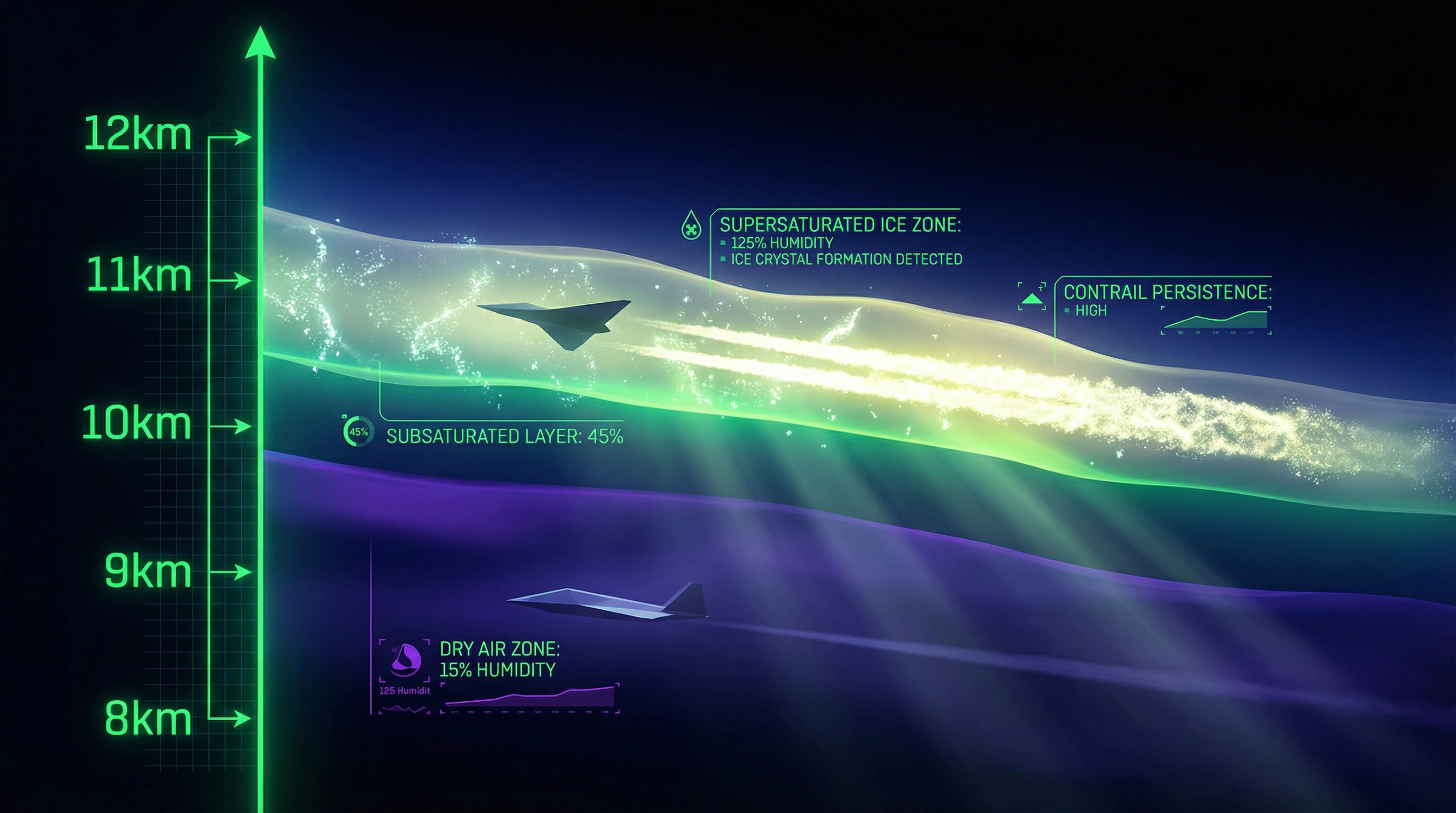
Contrails form when hot exhaust gases from jet engines meet cold air at altitudes of 8–12 km, where temperatures drop below −40°C. Water vapor instantly condenses on soot particles and freezes, creating millions of ice crystals—the same process as visible breath on a cold day, just in incomparably colder conditions.
The critical condition is high relative humidity with respect to ice. If the air is saturated, the trail persists and grows. If dry, crystals sublimate within seconds. This mechanism is described in meteorology textbooks and confirmed by thousands of observations (S002).
Why Trails Became More Noticeable Since the 1990s: Growth in Air Traffic and Engine Technology
Contrails have been photographed since the 1920s, when aviation reached the necessary altitude. Their numbers surged from the 1990s for three reasons: global air traffic increased more than threefold, modern turbofan engines produce more water vapor than older turbojets, and climate changes have increased upper tropospheric humidity in some regions.
The increase in trails is explained by rising air traffic and changing engine technology, not the emergence of a new spraying program.
Why Trails Persist for Hours: Atmospheric Humidity and Ice Supersaturation
Long-lived trails form in layers with relative humidity with respect to ice above 100%—a state called ice supersaturation. Ice crystals not only don't evaporate but actually grow, drawing in additional moisture. The trail expands to several kilometers and persists for hours, transforming into cirrus clouds.
Meteorological models predict where and when persistent trails will form, and these predictions match observations. If trails resulted from chemical spraying, their behavior wouldn't depend on air humidity—but it does (S002).
Why Different Aircraft Leave Different Trails
This observation is explained by three factors:
- Visual altitude estimation from the ground is imprecise: a difference of 300–500 meters is invisible to the eye but critical for condensation.
- The atmosphere is heterogeneous—layers with different humidity alternate at small altitude differences. An aircraft through a dry layer leaves no trail; through a moist layer 200 meters higher—leaves a long one.
- Different engines produce different amounts of water vapor and soot particles.
These factors fully explain the variability without the spraying hypothesis.
Grid Patterns: Air Routes and Wind Drift
Commercial air routes are organized into corridors that often intersect over major cities. When multiple aircraft fly through the same zone within an hour, their trails overlap, creating a grid.
Additionally, trails drift with the wind: at 10 km altitude, speeds can reach 200–300 km/h, and a trail left an hour ago shifts tens of kilometers. Route data is available in open tracking systems (Flightradar24, FlightAware)—anyone can verify that observed trails correspond to actual flights (S001).
Aluminum, Barium, Strontium: Natural Sources and Methodological Errors
Analyses showing elevated levels of these elements suffer from methodological problems:
- Aluminum
- The third most abundant element in Earth's crust (8% by mass). Its presence in soil and water is completely normal.
- Lack of Controls
- Many analyses don't compare results with background levels for the region. A "high" value may be typical for local geology.
- Natural Sources
- Barium and strontium weather from rocks, are released by industry, and are contained in automotive brake pads.
- Professionalism
- Some analyses were conducted without following sampling protocols and contamination controls.
Large-scale scientific studies comparing precipitation composition across different regions and periods have found no anomalies linked to aviation (S003). If spraying occurred at the claimed scale, the signal would be obvious and reproducible.
Spraying Patents: Technology Existence Doesn't Prove Application
Patents for spraying systems exist, but their existence doesn't prove application. The patent system protects ideas, many of which are never implemented.
Chang's 1991 patent describes a hypothetical system for stratospheric aerosol injection—a technology discussed in the context of geoengineering but not applied. There isn't a single documented case of such systems being used on commercial or military aircraft at the scale necessary to explain mass trails (S004).
Scientific Consensus: Systematic Survey Against the Theory
In 2016, researchers from Carnegie Mellon University and the University of California, Irvine surveyed 77 leading experts in atmospheric chemistry and geochemistry. 76 out of 77 (98.7%) stated they saw no evidence of a chemical spraying program.
| Survey Result | Number of Scientists | Position |
|---|---|---|
| No Evidence | 76 | No spraying program |
| Possible Anomaly | 1 | Not related to chemtrails |
Researchers also analyzed atmospheric and precipitation composition data and found no signs that couldn't be explained by natural processes and known pollution sources (S005). This isn't "official denial," but scientific consensus based on data.
The chemtrail theory requires simultaneous silence from tens of thousands of scientists, engineers, pilots, and technicians worldwide—people working in competing countries, different organizations, with opposing interests. The history of science shows: large-scale conspiracies of this magnitude are unstable against exposure (S006).
The Mechanism of Delusion: Why the Chemtrail Theory Is So Convincing to Millions
The chemtrail theory is not simply an error in interpreting facts. It's a cognitive trap that exploits fundamental features of human thinking (S003), (S006). Understanding these mechanisms helps develop immunity to similar delusions.
Pattern Illusion: How the Brain Sees Design Where None Exists
The human brain evolved in an environment where the ability to quickly recognize patterns was critical for survival. A rustle in the bushes could be wind or a predator—those who erred on the side of caution survived more often. For more detail, see the section on Statistics and Probability Theory.
This tendency toward hyperactive agency detection makes us see intentionality in random events (S008). Intersecting trails in the sky look like a "plan," though they're the result of crossing flight paths and wind drift. The brain automatically constructs a narrative: "Someone planned this."
The mechanism that saved our ancestors from predators now makes us vulnerable to conspiratorial narratives.
Confirmation Bias: How We Select Only Convenient Facts
Confirmation bias is the tendency to seek, interpret, and remember information in ways that confirm pre-existing beliefs (S005). A person who believes in chemtrails begins noticing trails in the sky (which were always there but previously ignored).
They find "confirming" articles and videos, ignore contradictory facts, and each new observation strengthens the belief. This isn't lazy thinking—it's the brain's normal operating mode, conserving cognitive resources.
- See a trail in the sky → interpret it as a chemtrail
- Search for confirmation → find a community of believers
- Receive social reinforcement → belief strengthens
- Contradictory facts → rejected as "disinformation"
Social Reinforcement: Why Groups Amplify Belief
Humans are social creatures. Belonging to a group that "knows the truth" activates the same reward centers in the brain as food or sex (S001). Chemtrail believer communities provide identity, an explanation for chaos, and a sense of participation in something important.
Criticism of the theory is perceived not as refutation of an idea, but as an attack on the group and personal identity. This shifts the discussion from the cognitive plane to the emotional—and emotions always defeat facts.
| Factor | Effect on Belief |
|---|---|
| Group belonging | Strengthens (social reward) |
| External criticism | Strengthens (group defense) |
| New facts | Rarely weakens (if contradicting group) |
Illusion of Competence: Why Amateurs See Themselves as Experts
The Dunning-Kruger effect: people with low levels of knowledge overestimate their competence. A person who has watched a few videos about chemtrails begins to consider themselves an expert in meteorology, chemistry, and aviation (S007).
The internet amplifies this effect: it's easy to find sources that confirm any idea, and difficult to assess their reliability without specialized training. The illusion of competence protects belief from criticism—the person is confident they've figured it out better than scientists.
The internet gave everyone access to information, but didn't give them the ability to verify it. This created a generation of people who know enough to be dangerous, but not enough to understand that.
Apophenia and Narrative Coherence: How the Brain Creates Meaning from Noise
Apophenia is seeing meaningful connections between unrelated events. If someone believes in chemtrails, they begin linking them to allergies, depression, diseases—everything that's increasing in modern society. Every coincidence becomes "proof" (S004).
The brain seeks narrative coherence—a unified story that explains the world. The chemtrail theory provides this story: there are enemies, there's a plan, there's an explanation for suffering. This is psychologically more comfortable than admitting the world is complex and often randomly unfair.
For comparison, see how pseudoscience exploits ignorance of atmospheric physics and why the climate weapon myth persists despite physics.