
�� Thousands of people worldwide report headaches, insomnia, tachycardia, and burning skin sensations when near cell towers, Wi-Fi routers, or 5G antennas. Their symptoms are real, sometimes debilitating. But systematic reviews of provocation studies show: under blind conditions, these individuals cannot distinguish an active electromagnetic field source from an inactive one, and their symptoms appear regardless of actual radiation exposure (S010, S011). This doesn't mean the suffering is fabricated—it means the mechanism behind it lies not in the biophysics of radio waves, but in the psychophysiology of the nocebo effect and anxiety disorders.
�� Electromagnetic Hypersensitivity: What Sufferers Actually Claim and Where the Line Between Symptom and Diagnosis Lies
Electromagnetic hypersensitivity (EHS) is a term people use to describe a condition in which they attribute the onset of various symptoms to exposure to electromagnetic fields (EMF) from household and industrial sources (S002).
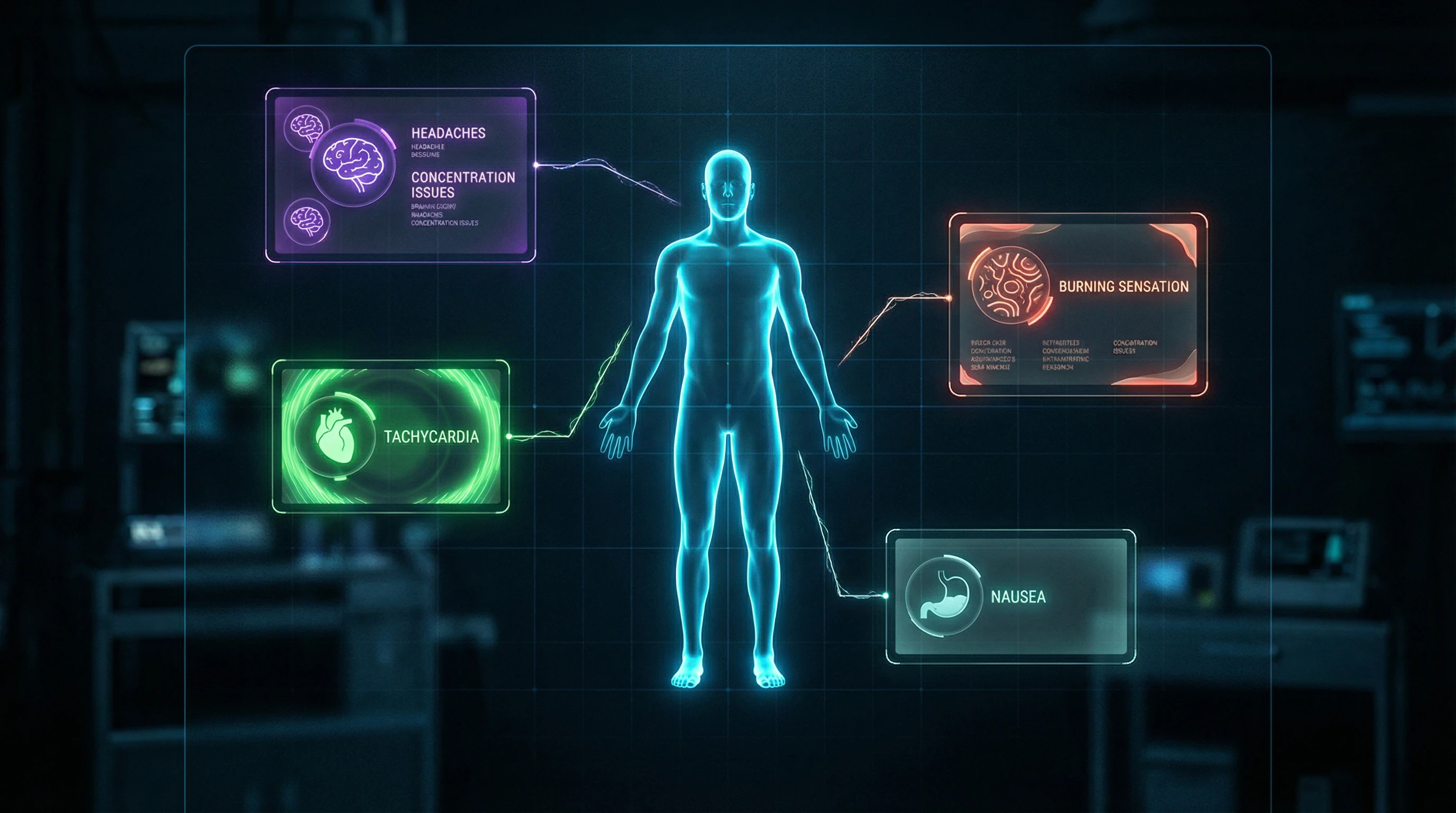
Symptoms include headaches, fatigue, concentration difficulties, dizziness, nausea, heart palpitations, tingling and burning skin sensations (S005). Critically: EHS is not a recognized medical diagnosis in ICD-10 or ICD-11, and the World Health Organization does not recognize it as an independent disease with established etiology.
- Non-ionizing Radiation
- The electromagnetic fields referenced by people with EHS: mobile phones, base stations (including 5G), Wi-Fi routers, Bluetooth, microwave ovens, power lines, transformer substations (S002). The frequency range varies from extremely low frequencies (50–60 Hz from electrical grids) to radiofrequencies (hundreds of MHz to several GHz). Key distinction: non-ionizing radiation lacks the energy to break chemical bonds in DNA, unlike ionizing radiation (X-rays, gamma rays).
Symptom Spectrum: From Discomfort to Disability
Symptoms are extremely diverse and non-specific. People report dermatological manifestations (redness, tingling, burning), neurological (headache, dizziness, memory impairment), cardiological (tachycardia, arrhythmia), gastroenterological (nausea), and psychiatric (anxiety, depression, insomnia) (S004).
Some patients report symptoms so severe they're forced to change their lifestyle: relocate to rural areas, shield their homes, avoid public places with Wi-Fi (S001).
The absence of objective biomarkers, reproducible laboratory tests, and consistent clinical presentation makes it impossible to establish EHS as a nosological entity.
Why EHS Is Not an Official Diagnosis
WHO states that EHS is characterized by diverse non-specific symptoms that vary between individuals, and that "there is no scientific basis to link EHS symptoms with EMF exposure" (S003).
Instead of establishing EHS as a diagnosis, WHO recommends focusing on treating symptoms and improving patients' quality of life, regardless of the presumed cause. This means the pain and discomfort are real, but their connection to EMF remains unproven. More details in the Conspiracy Theories section.
- No unified diagnostic criteria exist for EHS
- Symptoms overlap with anxiety disorders, somatization, and other conditions
- Objective markers are absent (blood tests, imaging, electrophysiology)
- Clinical presentation varies between patients
The boundary between symptom and diagnosis lies precisely here: people experience real discomfort, but the mechanism of its occurrence remains unclear. This doesn't mean symptoms are fabricated—it means their cause requires further investigation rather than automatic attribution to EMF.
�� The Steel-Man Version: Seven Most Compelling Arguments for the Reality of Biophysical EMF Effects on Hypersensitive Individuals
Before examining the evidence base, we need to present the strongest arguments from proponents of the biophysical nature of EHS. This is not a straw man, but a steel-man version—the most convincing formulation of the position, which we will then test. For more details, see the section on Sovereign Citizens Movement.
Argument 1: Reproducibility of Subjective Experience in the Same Individuals
People with EHS report a stable pattern of symptoms: they appear in the presence of certain EMF sources and disappear when those sources are removed. Many patients keep diaries documenting the correlation between proximity to cell towers, mobile phone use, and the onset of headaches or tachycardia.
This reproducibility at the individual level, according to EHS proponents, indicates a real causal relationship rather than random coincidence.
Argument 2: Biological Plausibility—Known Mechanisms of EMF Interaction with Tissues
Electromagnetic fields do indeed interact with biological tissues. The primary mechanism for radiofrequency radiation is tissue heating through energy absorption and increased oscillation of water molecules (the microwave oven principle). For extremely low frequencies (ELF), effects of inducing weak electrical currents in tissues have been described.
EHS proponents argue that some people may have individual characteristics (genetic, metabolic, structural) that make their tissues more sensitive to these effects, even at exposure levels below established safety limits (S002).
Argument 3: Existence of Analogous Chemical Hypersensitivity Syndromes
Multiple Chemical Sensitivity (MCS) is a recognized condition in which people react to low concentrations of chemical substances (perfumes, cleaning products, exhaust fumes) with symptoms that don't manifest in the general population.
If hypersensitivity to chemical agents exists, it's logical to assume that hypersensitivity to physical agents like EMF could also exist. Both syndromes share similar clinical presentations: nonspecific symptoms, absence of objective biomarkers, significant impact on quality of life (S004).
| Parameter | Multiple Chemical Sensitivity (MCS) | Electromagnetic Hypersensitivity (EHS) |
|---|---|---|
| Triggers | Low concentrations of chemical substances | Electromagnetic fields |
| Symptoms | Nonspecific (headache, fatigue, irritation) | Nonspecific (headache, tachycardia, fatigue) |
| Objective markers | Absent or disputed | Absent or disputed |
| Recognition status | Recognized in some countries | Recognized in some countries |
Argument 4: Rising EHS Cases Correlate with Wireless Technology Proliferation
The first reports of EMF-related symptoms appeared in the 1970s–1980s, when radar installations and high-voltage power lines began widespread deployment. A sharp increase in EHS cases occurred in the 1990s–2000s—the period of mass adoption of mobile phones and Wi-Fi.
A new wave of concern has been linked to 5G network deployment since 2019. This temporal correlation, according to hypothesis proponents, indicates a causal relationship: more EMF sources—more people with symptoms.
Argument 5: Some Animal and Cell Culture Studies Show Biological EMF Effects
Laboratory studies exist demonstrating changes in cell cultures or animal behavior under EMF exposure: changes in gene expression, oxidative stress, disruptions in blood-brain barrier permeability, alterations in rodent behavior (S003).
While these studies are often criticized for methodological flaws and lack of reproducibility, their existence is used as an argument that biological EMF effects are possible in principle, and in some people they may manifest clinically.
Argument 6: Official Safety Standards Are Based Only on Thermal Effects and May Not Account for Non-Thermal Mechanisms
International EMF safety standards (such as ICNIRP—International Commission on Non-Ionizing Radiation Protection recommendations) are based on preventing thermal effects: exposure levels are set so that tissue heating doesn't exceed 1°C.
EHS proponents argue that these standards ignore possible non-thermal biological effects: influence on ion channels in cell membranes, neurotransmitter modulation, changes in circadian rhythms. If such effects exist, current safety standards may be insufficient to protect hypersensitive individuals.
Paradox: safety standards based on heat transfer physics may miss biochemical mechanisms that trigger at much lower exposure levels.
Argument 7: EHS Recognition in Some Countries and Compensation Payments
In several countries (Sweden, France), EHS is recognized as a functional impairment entitling individuals to social support and workplace accommodations. In France in 2015, a court recognized a woman with EHS's right to disability benefits (S001).
These legal precedents are used as arguments for the reality of the condition: if government and judicial bodies recognize EHS, there must be grounds to consider it a legitimate medical phenomenon.
- Legitimacy through recognition
- Legal recognition of EHS in some countries creates an impression of scientific consensus, though it actually reflects social and political positions rather than an evidence base.
- Attribution trap
- People with EHS often seek explanations for their symptoms. If symptoms coincide temporally with turning on Wi-Fi or approaching a tower, the brain automatically links events into a causal chain—even if the connection is coincidental.
�� Evidence Base: What Provocation Studies Show in Blind and Double-Blind Conditions
The gold standard for testing the causal relationship between EMF and EHS symptoms is provocation studies. Participants with self-reported EHS are exposed to real or sham exposure under controlled conditions, and researchers assess: can they detect EMF better than random guessing, and do they experience symptoms more frequently during real exposure? Learn more in the Coaching Cults section.
Systematic Review by Rubin et al. (2005): 31 Studies, 24 Negative Results
Analysis of 31 provocation studies prior to 2005 showed: 24 found no evidence of biophysical hypersensitivity (S010). Seven studies reported confirmatory data, but with methodological limitations—small sample sizes, inadequate blinding, multiple comparisons without correction.
Meta-analysis of EMF detection ability yielded unambiguous results: people with self-reported EHS cannot distinguish real exposure from its absence better than random guessing (S010). If biophysical hypersensitivity existed, this group would show significant advantage.
The absence of a dose-response effect is a key marker. If symptoms are caused by EMF, stronger exposure should produce more pronounced symptoms. Provocation studies do not find this.
Updated Review by Rubin et al. (2010): Confirmation of No Association
In 2010, an updated systematic review included studies after 2005 (S011). The conclusion remained unchanged: under blind and double-blind conditions, no evidence was found that people with EHS detect EMF or that their symptoms are associated with actual radiation.
| Parameter | Expectation (if EHS is biophysical) | Provocation Study Results |
|---|---|---|
| EMF Detection | Better than random guessing | No different from random |
| Dose-Response | Stronger exposure → stronger symptoms | Symptoms at low levels, don't intensify with increasing intensity |
| Real vs. Sham Exposure | Symptoms only during real exposure | Symptoms equally frequent in both |
Design of a Quality Provocation Study
The participant is placed in a shielded room where an EMF source is turned on/off without their knowledge. Neither the participant nor the experimenter knows when real exposure occurs (double-blinding). The sequence is determined randomly.

The participant is asked to press a button when sensing EMF or rate symptoms after each session. Responses are compared with the actual protocol. If correlation doesn't exceed chance—there's no causal relationship.
Why Early Positive Results Are Unreliable
- Small Sample Sizes
- Fewer than 10 participants increase the probability of false-positive results due to random fluctuations.
- Inadequate Blinding
- Participants received indirect cues—sound of equipment fans, vibration, changes in room temperature.
- Multiple Comparisons Without Correction
- Testing different frequencies, symptoms, time points increases the probability of finding at least one random correlation.
- Publication Bias
- Studies with positive results are published more often than those with negative results, creating an illusion of evidence.
Absence of Dose-Response Effect as a Diagnostic Sign
People with EHS report symptoms at very low EMF levels—significantly below established safety limits. But when exposure intensity increases, symptoms don't intensify. Moreover, they often report symptoms during sham exposure (when the source is off), indicating the role of expectation rather than physical factors.
This contradicts a basic principle of toxicology and biophysics: biological effects should depend on dose. The absence of such dependence is a strong indicator that the mechanism is not biophysical.
Provocation studies aren't a perfect tool, but they remain the most objective way to separate real exposure from expectation. Their consistent negative results indicate not the absence of people's suffering, but the absence of a causal relationship with EMF.
�� Mechanism of Symptom Development: Nocebo Effect, Anxiety Disorder, and Attribution
If EHS symptoms are not caused by actual EMF exposure, what causes them? The current model explains the phenomenon through three psychophysiological mechanisms: nocebo effect, anxiety disorder, and attribution bias. More details in the Logical Fallacies section.
�� Nocebo Effect: When Expectation of Harm Creates Real Symptoms
The nocebo effect is the negative counterpart of placebo: expectation of harm triggers real physiological symptoms, even without actual exposure. The mechanism activates the stress axis hypothalamus-pituitary-adrenal, releases cortisol, and alters the autonomic nervous system (increased sympathetic tone).
Result: tachycardia, sweating, muscle tension, headache. Research shows that informing participants about "potential dangers" of EMF before an experiment increases the likelihood of symptoms even with sham exposure (S002).
�� Anxiety Disorder and Somatization
Many people with EHS have comorbid anxiety disorders, depression, or somatoform disorders (S004). Somatization is a process where psychological distress manifests as physical symptoms without organic pathology.
A person with chronic anxiety focuses attention on bodily sensations (interoceptive hypersensitivity), interprets normal fluctuations (increased heart rate after climbing stairs) as pathological, and seeks an external cause. EMF becomes a convenient attribution: invisible, ubiquitous, frequently mentioned in media.
- Interoceptive Hypersensitivity
- Heightened attention to internal bodily signals; in anxiety, leads to misinterpretation of normal sensations as dangerous.
- Somatization
- Transformation of psychological distress into physical symptoms; a mechanism that doesn't require organic pathology.
�� Attribution Bias and Confirmation Bias
Attribution bias is the tendency to attribute symptoms to a specific cause based on preexisting beliefs rather than objective data. A person convinced of EMF danger notices and remembers instances when symptoms coincided with EMF sources (confirmation bias), and ignores contrary cases.
The cycle intensifies through avoidance behavior: the person avoids places with Wi-Fi, which temporarily reduces anxiety (negative reinforcement), but strengthens the belief in EMF danger (S007).
| Cycle Stage | Mechanism | Outcome |
|---|---|---|
| Belief | EMF is dangerous | Selective attention to coincidences |
| Observation | Confirmation bias | Remembering only confirming cases |
| Action | Avoidance of EMF sources | Short-term anxiety reduction |
| Reinforcement | Negative reinforcement | Belief becomes stronger |
�� Role of Media and Online Communities
Information about "EMF harm" is widespread online, often in sensationalized form. Online communities of people with EHS provide social support, but simultaneously reinforce beliefs through sharing personal stories and recommendations for "protection" (shielding fabrics, EMF "neutralization" devices).
This creates a closed information ecosystem where alternative explanations (such as anxiety disorder) are perceived as invalidating the reality of symptoms. This strengthens social identity around the diagnosis and makes belief reassessment more difficult (S006).
Key paradox: the symptoms are absolutely real and cause suffering, but their cause is not the biophysical impact of EMF, but rather a psychophysiological process in which expectation, anxiety, and attribution create a closed loop. This doesn't mean the symptoms are "imaginary" or that the person is "faking" — it means the mechanism requires a different treatment approach.
Data Conflicts and Areas of Uncertainty: Where the Scientific Community Has Not Reached Consensus
Despite compelling data from provocation studies, there are areas where the scientific community continues to debate and where data remains ambiguous. For more details, see the Epistemology Basics section.
�� Long-Term Effects of Low-Intensity Exposure: A Data Gap
Most provocation studies assess acute effects of short-term EMF exposure (from several minutes to hours). There is significantly less data on long-term effects of chronic exposure to low levels of EMF — such as living near a cell tower for decades.
Epidemiological studies face challenges: accurate assessment of cumulative exposure, multiple confounders (socioeconomic status, lifestyle, other environmental factors), lengthy observation periods. The absence of convincing data means neither proof of safety nor proof of harm — this is an area of uncertainty.
- Acute effects: studied under controlled conditions
- Chronic effects: insufficient data, high complexity in controlling variables
- Cumulative exposure: methodologically difficult to track and measure
�� Non-Thermal Biological Effects: Conflicting Data from Laboratory Studies
Some studies (S002, S003) report non-thermal biological effects of EMF at the cellular level: changes in gene expression, oxidative stress, disruptions in mitochondrial function. However, reproducibility of these results remains problematic.
Different laboratories obtain contradictory results when attempting to replicate experiments. Reasons include: differences in exposure parameters (frequency, modulation, duration), cell types, culture conditions, measurement methods. This doesn't mean the effects don't exist, but it points to the need for protocol standardization.
Reproducibility is a criterion of scientific validity. If a result cannot be reproduced in different laboratories under identical conditions, this signals the need to revise methodology, not proof of the effect's absence.
�� Symptom Attribution Mechanism: Where the Boundary Between Physiology and Psychology Lies
Research shows that people with EHS often demonstrate heightened sensitivity to multiple stimuli — not just EMF, but also odors, sounds, light (S004). This may indicate a general mechanism of sensory hyperreactivity rather than one specific to EMF.
The question remains open: is this a consequence of primary biophysical EMF impact on the nervous system, or the result of psychological attribution and conditioned reflex? (S007) Both mechanisms may operate simultaneously, reinforcing each other.
- Hyperreactivity to Multiple Stimuli
- May be a marker of general sensory sensitivity rather than EMF-specific. Requires differential diagnosis.
- Symptom Attribution
- A psychological process where a person links symptoms to a specific source. Can be either rational inference or cognitive error.
- Synergy of Mechanisms
- Biophysical impact + psychological attribution can create a closed loop that amplifies symptoms.
�� Risk Perception and Communication: Why Fear Spreads Faster Than Data
Risk perception research (S006) shows that people assess the danger of 5G not based on physical radiation parameters, but on social signals: media coverage, authority opinions, others' personal experiences. This isn't irrationality — it's a normal cognitive strategy under conditions of uncertainty.
When the scientific community doesn't provide a clear answer (area of uncertainty), people fill the gap with social narratives. This creates a paradox: the more scientific debate, the more public uncertainty, the higher the perceived risk.
The solution isn't suppressing discussion, but transparent communication about the boundaries of knowledge: what we know, what we don't know, why it matters, what research is needed next. Sources and Evidence should be accessible, not hidden behind professional jargon.
�� Protective Measures: Effectiveness and Risks
People with EHS often use shielding materials, Faraday cages, specialized clothing (S008). The question: do they help, and are there side effects?
Data is contradictory. Some people report improvement, others report no effect. Possible explanations: placebo effect, actual reduction in exposure (if material is properly installed), or psychological comfort from a sense of control. Risk: excessive shielding can lead to social isolation and increased anxiety.
Protective measures are not just a physical problem, but a psychological one. They can help or harm depending on how a person interprets and uses them.
�� Consensus and Its Boundaries
Scientific consensus on EHS and 5G has not been reached. This doesn't mean both sides are equal in evidence — provocation studies show that EMF doesn't cause symptoms under blind conditions. But it does mean open questions remain about long-term effects, mechanisms, individual variability.
The area of uncertainty isn't a failure of science, but its normal state. Science moves toward where data is contradictory, not where everything is already known. Fears Around 5G are often fueled precisely by this uncertainty, but the solution isn't suppressing discussion — it's deepening it.