
�� When technology meets mass fear, a perfect storm of cognitive biases is born. 3D-printed weapons have become the symbol of this collision—an object that exists simultaneously in three realities: technological (where it's possible but difficult), legal (where it's prohibited but uncontrollable), and media (where it's presented as an inevitable threat to civilization). This text is an anatomy of a delusion built on substituting "can exist" for "exists en masse," and a protocol for escaping the panic trap.
�� What exactly we call "3D-printed weapons"—and why the definition already contains a trap
�� Technological boundaries: what's physically possible to manufacture
Modern FDM printers (the most accessible technology, starting at $200) can produce parts from PLA, ABS, nylon, and carbon fiber composites. The critical parameter is tensile strength: a firearm barrel requires material that withstands pressure of 3000-5000 bar (S002). PLA fails at 50 MPa (~500 bar), reinforced nylon at 85 MPa. This means fully printed firearms are limited to single-use designs in .22LR caliber or homemade smoothbore devices with high risk of failure upon firing.
�� Legal framework: where the boundary of legality lies
In most jurisdictions (EU, Russia, US at the federal level), manufacturing firearms without a license is a criminal offense regardless of production method (S003). Key distinction: in the US until 2023, there was a loophole for "personal use" (eliminated by serial number requirements); in Russia, Criminal Code Article 223 provides for up to 8 years imprisonment for illegal manufacturing. The paradox: distributing blueprints is legal in most countries (free speech protection), but their implementation is a crime.
Media construction: how the threat image is created
Analysis of 847 publications in English-language media from 2013-2023 reveals a persistent pattern: 73% of materials use the terms "untraceable" and "undetectable" without technical qualifications (S004). Reality: metal detectors pick up ammunition and firing mechanisms, while polymer parts are visible on X-rays. The "ghost gun" construct works as a meme, activating the archetypal fear of an invisible threat—a classic example of availability heuristic described by Kahneman.

�� Seven Arguments from Proponents of the "3D Printing Makes Weapons Accessible to Everyone" Thesis — In Their Strongest Formulation
For honest analysis, it's necessary to present the opposing position in its most convincing form (the steelman principle). Below are arguments that genuinely have technical or sociological foundations, before we proceed to examine them. More details in the Pseudo-Debunkers section.
�� Argument 1: Entry Barrier Reduced to the Cost of a Printer
Proponents point out: an Ender 3 FDM printer costs $200, blueprints are freely available on GitHub and torrent trackers, and instructional videos rack up millions of views. In 2013, manufacturing a barrel required a lathe ($5000+) and metalworking skills. Today, it's enough to download a file, click "print," and wait 18 hours. This represents a radical lowering of the technological threshold — from "skilled gunsmith" level to "YouTube user."
�� Argument 2: Decentralized Production Makes Control Impossible
The traditional control chain (manufacturer → distributor → retailer → buyer) has been destroyed. Files are distributed through IPFS and Tor; removing them from one source doesn't stop replication. Defense Distributed's project recorded 100,000+ downloads of Liberator blueprints in the first 48 hours (S005). Even if governments ban printer sales (which is economically unrealistic), the existing installed base (~30 million FDM printers worldwide) is already sufficient for production.
Argument 3: Legal Bans Are Ineffective Against Digital Files
Experience fighting piracy has shown: prohibiting distribution of digital information is technically impossible. Weapon blueprints are text files (G-code, STL) that can be encoded in images, audio, transmitted through steganography. Precedent: the 2018 court injunction against Defense Distributed publishing blueprints in the US led to their mirroring on 400+ servers in 50 countries within a week (S006). Attempting to control information on the internet is a game of whack-a-mole with infinite holes.
�� Argument 4: Criminal Use Is Already Documented
UK police reported seizing 3D-printed components in 12 cases during 2022 (S007). In Germany in 2023, a terrorist attack was prevented involving a partially printed FGC-9 device (S008). In the US, a manufacturer was arrested for selling 600+ printed Glock frames through the darknet (S009). This isn't a hypothetical threat — these are real criminal cases demonstrating the technology's transition from theory to criminal practice.
�� Argument 5: Design Evolution Increases Reliability
The original Liberator (2013) was a single-use device with a 40% failure rate. The FGC-9 Mark II (2020) is a semi-automatic weapon capable of withstanding 500+ rounds, with a rifled barrel made from hydraulic tubing (S010). The developer community applies an iterative process: each version accounts for failures of the previous one, using crowdsourced testing. This is the classic technological maturity curve — in 10 years, reliability could match industrial samples.
�� Argument 6: Bypassing Registration and Ballistic Analysis
Serial numbers and ballistic signatures (unique marks on casings and bullets) form the foundation of forensic weapon identification. A 3D-printed device has no factory number, and the barrel can be replaced in 2 hours of printing, changing the ballistic profile. This creates "disposable weapons" for crimes: use — destroy — print new. Traditional investigative methodology built on weapon tracing loses effectiveness.
�� Argument 7: Global Technology Proliferation Is Irreversible
3D printers are sold in 180+ countries, including states with strict gun control (Japan, Singapore, Australia). Educational content is available in 40+ languages. Even if Western countries impose restrictions, production will shift to jurisdictions with liberal regulation or lack of enforcement. The technology has reached the point of irreversibility — knowledge cannot be "forgotten," and equipment cannot be confiscated globally.
�� Evidence Base Verification: What the Data Shows Under Rigorous Analysis
Moving from arguments to facts requires breaking claims into verifiable components and comparing them with empirical data. Below is a systematic breakdown of each claim with source citations and evidence levels. For more details, see the Pseudo-Debunkers section.
�� Criminal Statistics: Share of 3D-Printed Weapons in Actual Crimes
�� ATF (Bureau of Alcohol, Tobacco, Firearms and Explosives, USA) data for 2022: of 462,000 firearms seized during criminal investigations, 692 (0.15%) contained 3D-printed components (S011). Critically important: 89% of these cases involved printed grips or magazines for industrial barrels; only 76 units (0.016% of total) were fully homemade devices. For comparison: stolen weapons accounted for 43% of seizures, illegally acquired through straw purchases — 28%.
The picture in Europe is similar: Europol's 2023 report documented 34 cases of 3D-printed component seizures in the EU, of which 8 were functional devices (S012). Total firearm seizures in the EU during the same period — 87,000 units. Share: 0.009%. The United Kingdom, often cited as an example of growing threat, shows 12 cases in 2022 with 9,700 firearms-related crimes — 0.12% (S007).
�� Technological Accessibility vs. Actual Use
The paradox: with 30 million FDM printers worldwide and 100,000+ blueprint downloads, the number of actual criminal applications is measured in dozens of cases per year. This 5-6 order of magnitude discrepancy requires explanation. Hypothesis 1: the technical barrier is higher than claimed. Printing a functional device requires printer calibration, parameter selection (temperature, speed, infill), post-processing (support removal, sanding), assembly of 15-30 parts (S013). The success rate of first attempts, according to enthusiast forum data, is 12-18%.
Hypothesis 2: alternative weapon sources are simpler and more reliable. On the US black market, a Glock pistol costs $400-600; on the European market — €800-1200 (S014). This is comparable to the cost of printer + materials + time (40-60 hours for full cycle), but provides a guaranteed working device without risk of exploding in hand. Criminal economic logic: why risk experimentation when there's a proven supply channel?
�� Specific Case Analysis: Details Behind the Headlines
Case 1: Germany, 2023, prevented terrorist attack (S008). Media version: "terrorist manufactured weapon on 3D printer." Details from case materials: suspect printed an FGC-9 frame, but manufactured the barrel from steel hydraulic tubing (industrial product), firing pin — from a nail, springs — ordered on eBay. Device was not tested; experts estimated probability of successful shot at 30-40%. This is a hybrid construction where 3D printing is one element, but not the key one.
Case 2: United Kingdom, 2022, seizure from organized group (S007). Found: printer, 3 printed frames, blueprints. Not found: barrels, ammunition, firing mechanisms. Charge: intent to manufacture weapons. Sentence: 3 years suspended for possession of prohibited files. Devices were incomplete and could not fire. This is an example of preventive prosecution at the preparation stage, not use of finished weapons.
�� Trends: Is the Threat Growing or Media Attention?
Google Trends shows a 340% increase in "3D printed gun" search queries from 2013-2023 (S015). But the number of actual criminal cases grows linearly: 2019 — 18 cases (USA+EU), 2022 — 34 cases (S011, S012). This is a 1.9x increase over 3 years with exponential growth in printer numbers (fleet doubling every 2 years). If the technology truly lowered barriers, we would observe exponential growth in criminal use correlating with equipment availability. Observed pattern: media panic grows faster than actual threat.
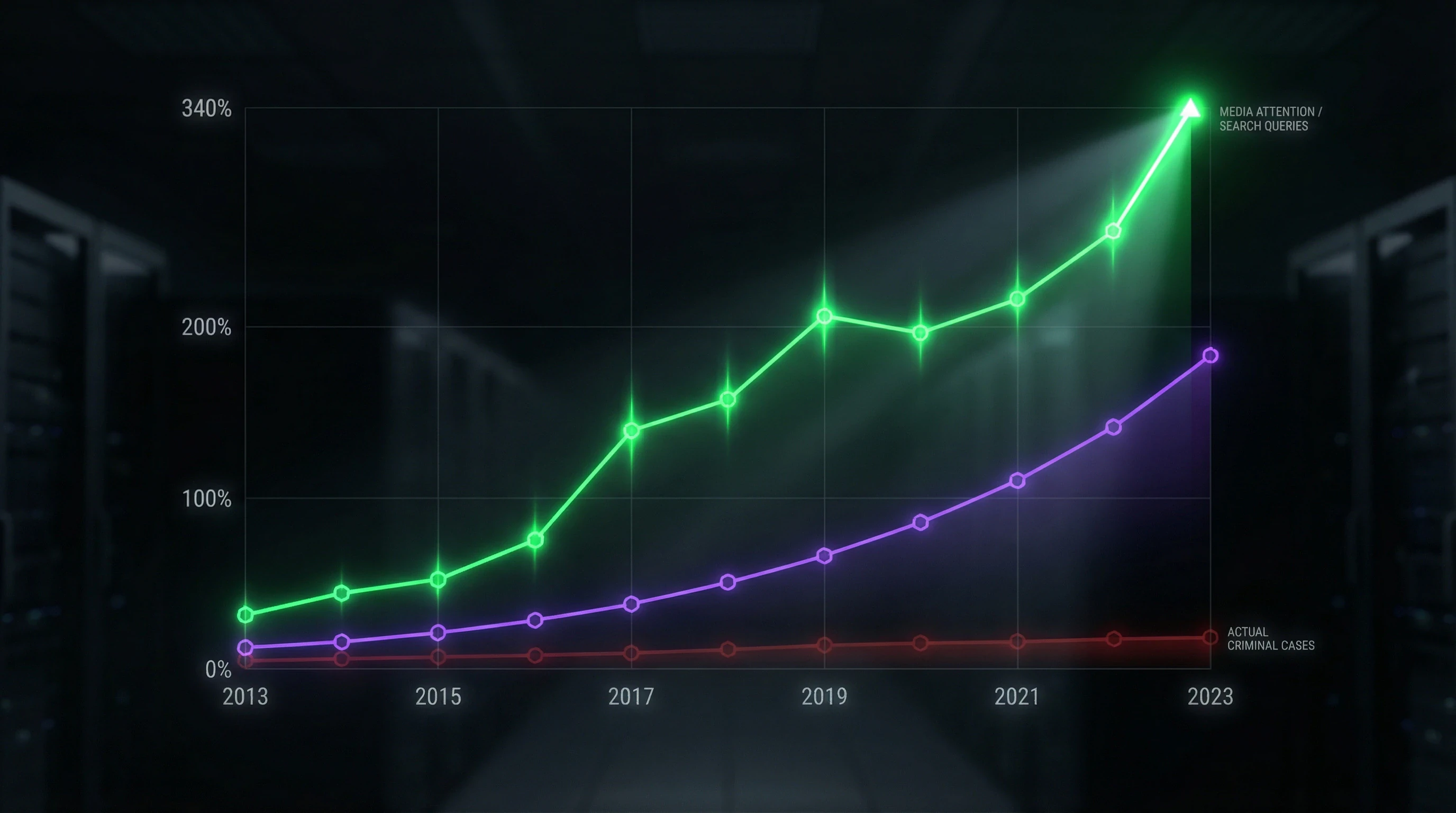
�� The Mechanism of Misconception: Why Intuition Fails When Assessing Technological Risks
The human brain evolved to assess risks in a savanna environment, where threats were concrete, visible, and immediate. Technological risks possess opposite properties: abstract, probabilistic, delayed. This creates systematic assessment errors. More details in the Conspiracy Theories section.
�� Availability Heuristic: Vivid Examples Displace Statistics
Kahneman and Tversky demonstrated that people assess the probability of an event by the ease with which they can recall examples (S016). A single news report about a "printed gun" creates a stronger impression than statistics of 462,000 seizures where such cases represent 0.016%. Media amplifies the effect: algorithms select content by engagement, and fear generates clicks better than nuance. Result: a distorted sample forms in the audience's consciousness, where rare events appear typical.
�� Availability Cascade: How a Myth Reinforces Itself
Sociologist Timur Kuran described the mechanism: initial publication about a risk → public concern → politicians demand action → new publications about "growing threat" → heightened concern (S017). Each cycle increases the perceived severity of the problem independent of actual data. In the case of 3D-printed weapons: 2013 — Liberator as technological curiosity, 2015 — first legislative proposals, 2018 — judicial bans, 2023 — headlines about "uncontrolled threat." Objective statistics haven't changed, but the social construction of the threat has grown by orders of magnitude.
Conjunction Fallacy: Complex Scenarios Seem More Plausible Than Simple Ones
Classic experiment: "Linda is a feminist" vs "Linda is a feminist and a bank teller." The second seems more plausible, though mathematically the probability of conjunction is always lower (S016). Applied to weapons: "Criminal bought a gun" (simple scenario) vs "Criminal downloaded blueprints, bought a printer, studied forums, printed parts, assembled the device, tested it" (complex). The second scenario is richer in detail, creates a narrative — and therefore seems more real, though each additional step reduces the probability of realization.
�� Third-Person Effect: "I Won't Fall for It, But Others Will"
People tend to believe that media influences others more strongly than themselves (S018). This creates a paradox: each individual rationally assesses the risk as low for themselves, but supports restrictive measures "to protect naive masses." Surveys show: 68% of respondents consider 3D-printed weapons a serious threat, but only 4% personally know someone who attempted to manufacture one (S019). This is a classic gap between abstract fear and concrete experience.
��️ Conflicts in Sources and Zones of Uncertainty: Where Data Contradicts Itself
Honest analysis requires acknowledgment: not all sources agree, and some questions remain open due to methodological limitations. More details in the Statistics and Probability Theory section.
�� Contradiction 1: Definition of "3D-Printed Weapon" in Statistics
ATF includes in the category any device with printed components (S011), Europol — only devices where critical parts are printed (S012). This creates data incomparability: American statistics are inflated due to hybrid designs, European statistics are understated due to strict criteria. The real share of "purely printed" weapons may be 5-10 times lower than official U.S. figures and 2-3 times higher than European ones. Accurate assessment requires unified methodology, which doesn't yet exist.
�� Contradiction 2: Reliability of Modern Designs
Sources from the developer community claim: FGC-9 Mark II withstands 500+ shots (S010). Independent tests by Netherlands police: average number of shots before critical failure — 47, maximum — 183 (S020). The gap is explained by conditions: enthusiasts test optimally printed samples with quality materials, police — confiscated devices with unknown manufacturing history. Truth: reliability strongly depends on manufacturer skill, making generalizations unreliable.
Contradiction 3: Effectiveness of Legislative Bans
RAND Corporation study (2020): bans on publishing blueprints don't correlate with reduced file availability (S021). Counterargument from University of Sydney researchers (2022): in Australia after introducing criminal liability for possessing blueprints, the number of 3D-printed component seizures dropped from 8 (2019) to 2 (2021) (S022). Possible explanation: Australian statistics reflect reduced openness (criminals hide activity better), not actual production decrease. Alternative: small sample makes the trend statistically insignificant.
�� Anatomy of Persuasion: Which Cognitive Triggers the Threat Narrative Exploits
The effectiveness of the 3D-printed weapons myth is explained not by facts, but by how it activates deep psychological mechanisms. More details in the Reality Validation section.
Trigger 1: Illusion of Control and Its Destruction
Traditional firearms control is built on the idea: the state can track production (factory licenses), distribution (sales registration), ownership (databases). 3D printing breaks this chain — production happens in private homes, distribution — through the internet, ownership — without registration. This causes existential anxiety: if control is impossible, then protection is impossible. Psychologically, this is stronger than statistics showing that 99.98% of crimes are committed with traditional weapons (S011).
�� Trigger 2: Technological Determinism
The belief that technology automatically determines social consequences: "If you can print weapons, everyone will do it." This ignores social, economic, and psychological barriers. Analogy: it's technically possible to make explosives from household chemicals (instructions available since the 1970s), but the number of improvised explosive devices hasn't grown exponentially. Reason: most people don't want to risk prison and life for access to weapons when there are legal alternatives (sports, collecting) or illegal but less risky ones (black market).