 🔍 Pseudo-Debunkers
Pseudo-Debunkers: When Criticism Becomes Manipulationλ
A study of the false debunker phenomenon, where individuals spread disinformation and conspiracy narratives under the guise of critical thinking
Overview
Pseudo-debunkers mimic critical thinkers, but instead of fact-checking, they construct conspiratorial narratives — often accusing scientists of "hidden agendas" while ignoring the scientific method themselves. This is particularly evident in English-speaking spaces: 🧩 under the guise of "alternative history," they promote revisionism, science denial, and ideological propaganda. The mechanics are the same as those they claim to "expose" — substituting evidence with emotions and selective data cherry-picking.
🛡️
Laplace Protocol: Critical thinking requires source verification, evidence quality assessment, and understanding of the scientific method. Real debunking is based on facts and logic, not emotions and ideology.
Reference Protocol
Scientific Foundation
Evidence-based framework for critical analysis
Protocol: Evaluation
Test Yourself
Quizzes on this topic coming soon
Sector L1
Articles
Research materials, essays, and deep dives into critical thinking mechanisms.
🔍 Pseudo-Debunkers⚡
Deep Dive
What Hides Behind the Debunker's Mask: Anatomy of Pseudo-Criticism
Pseudo-debunkers position themselves as truth-seekers, but spread disinformation, manipulate evidence, or serve hidden ideological agendas. Unlike legitimate skeptics who apply scientific methodology, they create counter-narratives that distort historical or scientific facts for sensationalism or political purposes.
This is a meta-level of conspiratorial thinking: accusing those who debunk conspiracies of conspiracy.
Terminology and Origins
"Pseudo-debunker" designates people who present themselves as experts in myth-busting, but demonstrate the same methodological flaws they criticize.
Key characteristic: accusations of evidence manipulation, lack of proper credentials, and serving hidden agendas while maintaining the appearance of objective analysis.
- Origin of the term
- Connected to growing distrust of official narratives in the post-Soviet information space, where multiple versions of historical events compete. Pseudo-debunkers create false dichotomies between "official lies" and "alternative truth," ignoring gradations of evidence and scientific consensus.
Primary Domains of Application
| Domain | Characteristics |
|---|---|
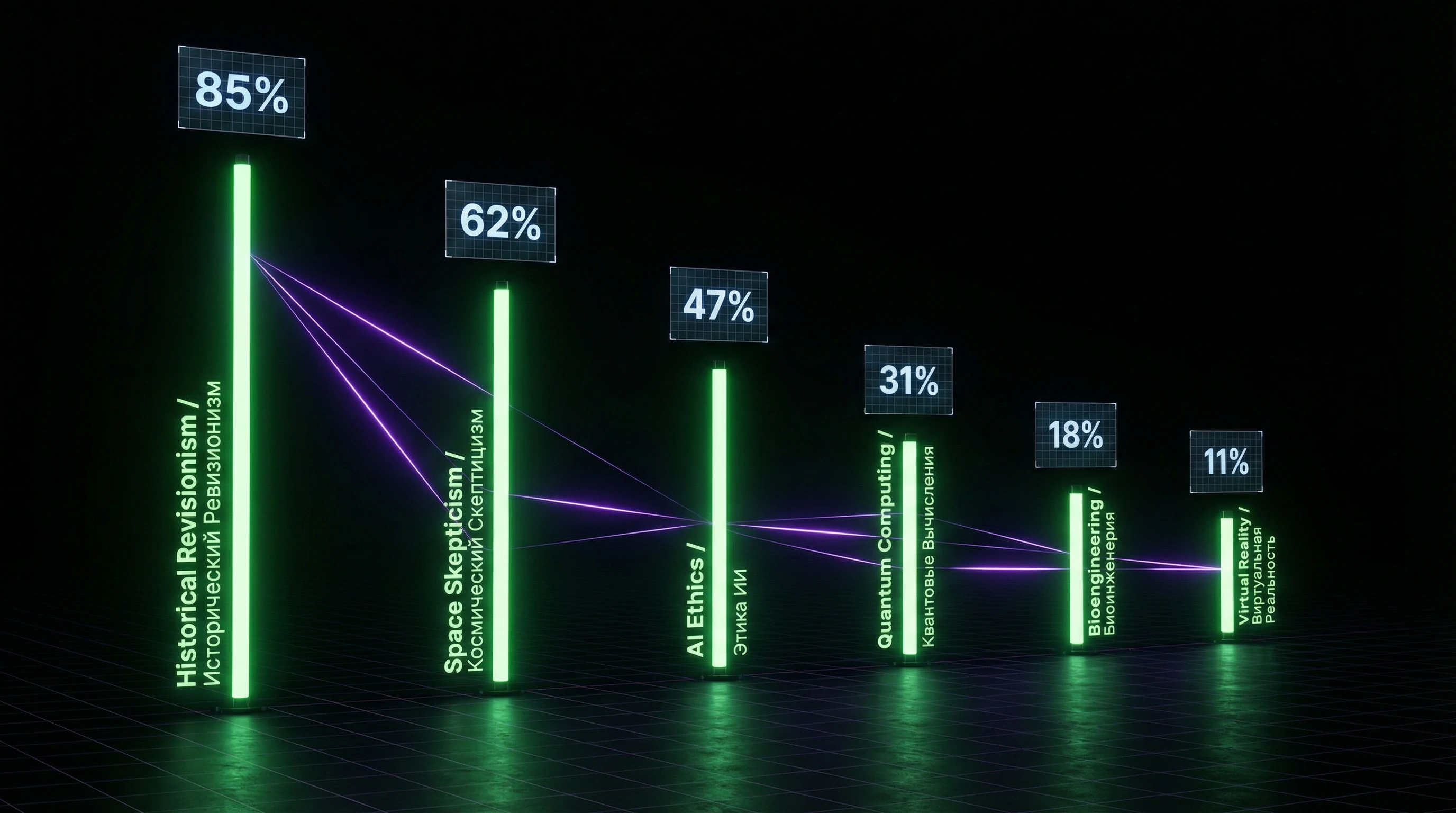
| Historical Revisionism | WWII and Soviet history; politicized by nationalist and anti-Western sentiments |
| Space Exploration | Theories about Moon landing hoaxes, NASA concealing evidence of life on Mars |
| Archaeology | Claims about mainstream suppression of evidence for prehistoric advanced civilizations |
| UFOs and Paranormal | Debates about discrediting evidence of extraterrestrial contact |
| Technological Paranoia | Surveillance through messaging apps, covert monitoring |
| Religious Debates | Discrediting religious figures and teachings |
A common thread across all contexts — positioning sources as debunkers of those who debunk conspiracy theories, creating a recursive structure of mutual accusations.
- The term is actively used in historical, scientific, and religious-political debates
- Pseudo-debunkers demonstrate the same methodological flaws they criticize
- Recursive logic: accusing those who debunk conspiracies of conspiracy
Manipulation Signatures: How to Recognize a Pseudo-Debunker
Pseudo-debunkers demonstrate a consistent set of methodological flaws that distinguish them from legitimate skeptics and researchers. Selective cherry-picking of facts while ignoring contradictory evidence constitutes a fundamental characteristic of pseudo-debunking practice.
Evidence Manipulation and Cherry-Picking
Evidence manipulation techniques include quote mining, presenting correlation as causation, and using unauthenticated images or documents. Appeals to "hidden documents" or "classified materials" create unfalsifiable claims that cannot be independently verified.
| Manipulation Technique | Mechanism | Why It Works |
|---|---|---|
| Burden of Proof Reversal | Demanding opponents prove a negative claim instead of providing positive evidence | Shifts responsibility to the skeptic, creates illusion of logical strength |
| Statistical Manipulation | Ignoring sample size, confounding variables, and base rate probabilities | Random correlations appear as patterns to unprepared audiences |
| Visual Evidence Without Context | Images and videos without metadata, shooting conditions, or expert authentication | Excludes critical evaluation, appeals to emotional perception |
Pseudo-debunkers systematically avoid providing primary sources, limiting themselves to secondary interpretations or anonymous testimonies.
Lack of Expertise and Scientific Methodology
A critical deficit is the absence of relevant expertise in fields about which categorical claims are made. Amateur speculation is presented as equivalent to or superior to analysis by qualified specialists.
- Unfalsifiable hypotheses. Claims are formulated so they cannot be empirically refuted—any outcome is interpreted as confirmation.
- Absence of control groups and alternative explanations. A single explanation is presented as obvious, though competing hypotheses are not considered.
- Rejection of entire fields of expertise. Qualified specialists are declared "corrupted" without examining specific evidence—this shifts the burden to opponents.
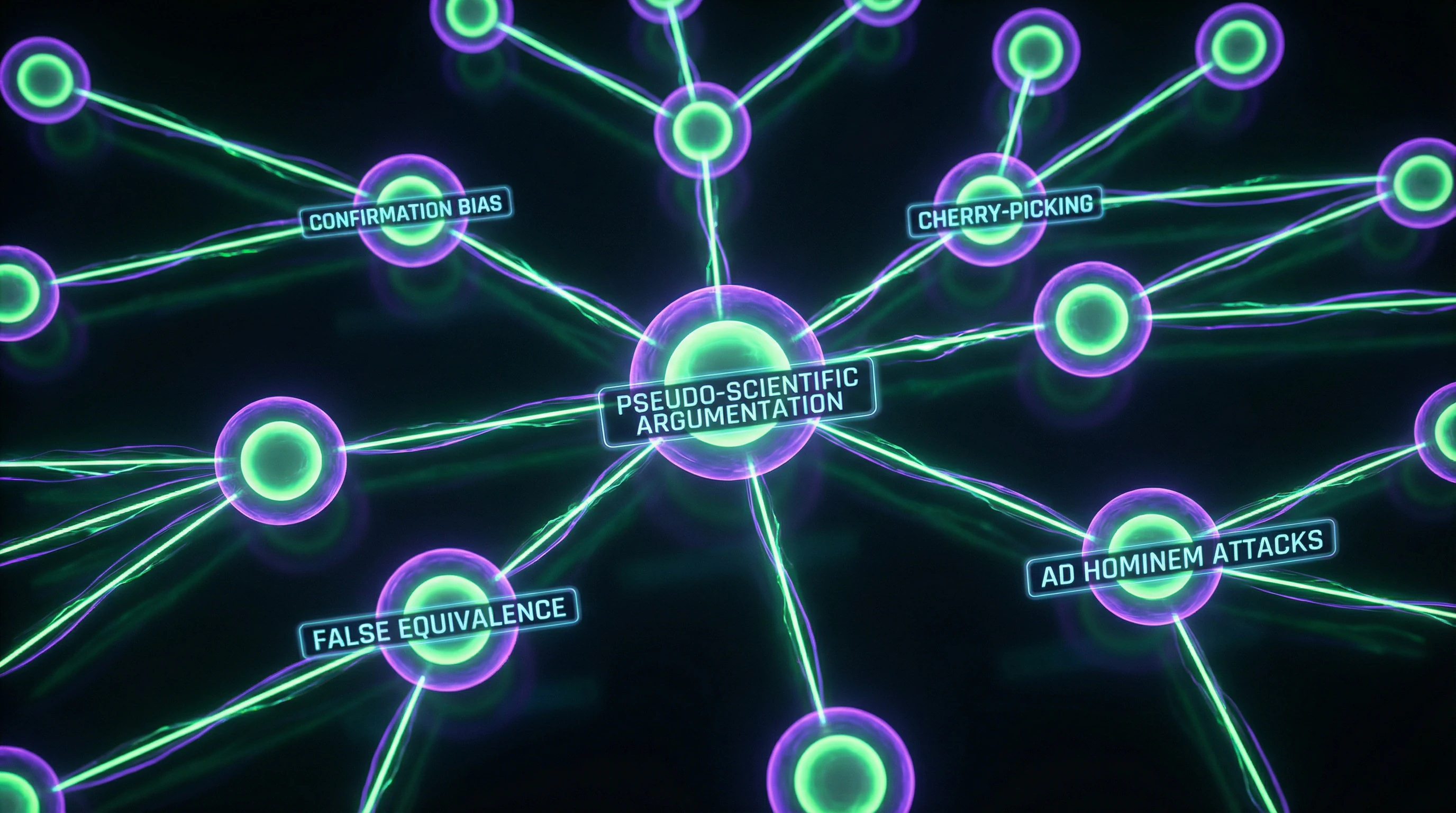
- Logical fallacies instead of analysis. Ad hominem attacks, false dilemmas, and straw man arguments replace actual refutation.
The absence of peer review and publication in academic journals is compensated by appeals to "folk wisdom" or "common sense."
Ideological Motivation and Hidden Agendas
Source analysis reveals strong correlation between pseudo-debunking rhetoric and specific ideological positions: nationalist, anti-establishment, or revisionist sentiments in historical discussions. Financial incentives play a significant role: sensational content generates traffic and monetization through advertising, book sales, or donations.
Emotionally charged language, appeals to fear and outrage replace the neutral analytical discourse characteristic of scientific inquiry.
Opposing viewpoints are systematically distorted, creating an echo chamber of confirming information. Pseudo-debunkers often position themselves as victims of persecution by "official science" or "power structures," creating a martyrdom narrative that strengthens group identity among followers.
Conspiracy Kaleidoscope: From the Moon to Major Battles
Pseudo-debunking discourse revolves around several persistent conspiracy narratives: distrust of official sources and the search for alternative explanations of historical and scientific facts. Theories about falsified moon landings, concealed life on Mars, revisionist World War II history, denial of scientific consensus—all are united by one logic: if an official source says X, then the truth must be the opposite.
The problem isn't skepticism itself. The problem is that skepticism becomes a tool rather than a method: instead of testing evidence, facts are selected to fit a predetermined conclusion.
Conspiracy Theories About NASA Space Programs
Conspiracy claims about NASA rely on several recurring myths: the alleged impossibility of crossing the Van Allen radiation belts, the absence of stars in lunar photographs, a "waving" flag in a vacuum. Each of these claims has been refuted multiple times with detailed technical explanations.
But pseudo-debunkers don't simply ignore refutations—they declare them part of the conspiracy. This is circular logic: any evidence against the theory becomes proof of its truth.
The scale of the alleged conspiracy is logically untenable: thousands of engineers, scientists, astronauts, and international observers would have had to maintain silence for decades without a single credible leak. The USSR, the main geopolitical competitor to the US in the space race, acknowledged American achievements and presented no evidence of deception, despite having all the technical means to detect it.
| Verification Aspect | Reality | Conspiracy Narrative |
|---|---|---|
| Data Accessibility | Mars rovers transmit data in real time, images are open for independent analysis | Data is falsified, true information is hidden |
| Independent Verification | International scientific community verifies results in parallel | All scientists are coordinated in a single conspiracy |
| Geopolitical Control | Competitor (USSR) had motive and means to expose deception | Even enemies remain silent about the conspiracy |
| Motivation | Scientific research, prestige, technological progress | Remains unclear and contradictory |
World War II Historical Revisionism
Historical revisionism in pseudo-debunking discourse focuses on reevaluating key battles (especially the Battle of Kursk) with accusations against "history falsifiers." These narratives often minimize war crimes, overestimate the effectiveness of one side, or create alternative explanations that contradict documentary archives.
Selective use of sources is characteristic: memoirs of individual participants are elevated to absolute truth, while systematic archival research is rejected as "ideologically motivated."
- Source Triangulation: military archives from all sides, diplomatic correspondence, archaeology, demography—the professional standard. Individual contradictions or inaccuracies, inevitable in any research, are declared to discredit the entire body of evidence.
- Critical Document Analysis: accounting for context and authorship—the foundation of historical method. Ignoring the principle of triangulation and replacing historical research with ideological polemic—a hallmark of pseudo-debunking.
Denial of Scientific Consensus
Systematic denial of scientific consensus is a fundamental characteristic of pseudo-debunking practice. The mechanism of consensus formation (repeated independent replication, peer review, public criticism, convergence toward evidence-based conclusions) is declared "groupthink" or "ideological pressure."
Marginal hypotheses rejected by the scientific community for lack of evidence are positioned as "suppressed truths." The reasons for rejection are ignored.
Denial of consensus is especially dangerous in fields with direct practical consequences: medicine, climatology, engineering. It creates a false impression of scientific controversy where none actually exists.
The opinions of individual dissenters are presented as equivalent to the positions of the overwhelming majority of experts. This distortion of epistemological reality undermines public trust in scientific institutions and expertise in general.
Logical Fallacies and Cognitive Biases of Pseudo-Debunkers
Ad Hominem Arguments and Straw Man Fallacies
Pseudo-debunkers systematically attack the person rather than analyzing their arguments. Scientists are accused of working for "hidden forces," labeled as "servants of Satan" or "falsifiers of history"—all instead of examining the actual evidence.
In discussions about World War II, historians are accused of ideological bias without any counterarguments to documentary evidence being provided. Straw man fallacies occur when an opponent's position is reformulated in simplified form to make it easier to refute.
Scientific skepticism regarding specific claims is transformed into "denial of all alternative theories." Pseudo-debunkers create caricatured versions of scientific positions, attributing absolute statements to scientists that they never made.
False Equivalence and Burden of Proof Shifting
False equivalence equates scientific consensus with marginal hypotheses. Speculations about "ancient civilizations" or "moon landing hoaxes" are presented as equivalent alternatives to academic research, despite the colossal difference in volume and quality of evidence.
In discussions about space programs, they demand that NASA "prove the absence" of hidden data about life on Mars. The burden of proof is shifted to those who reject extraordinary claims, instead of resting on those who make them.
- "Both sides" principle: exploited in public debates, creating the illusion of scientific controversy when overwhelming consensus exists.
- Demand for "absolute proof": double standards applied to science versus their own speculations, with no critical examination of alternative hypotheses.
The Dunning-Kruger Effect in Pseudo-Debunking
People with low competence overestimate their knowledge. Authors without relevant education confidently refute conclusions of specialists who have spent decades studying the subject.
In archaeological discussions, amateurs claim "suppressed evidence" of ancient technologies without understanding basic principles of stratigraphy and dating. Lack of expertise is not recognized as a limitation but interpreted as "freedom from academic dogma."
Selective application of skepticism: critical attitude toward accepted scientific theories while uncritically accepting alternative hypotheses that align with their beliefs.
Pseudo-debunkers fail to acknowledge the complexity of scientific methodologies, believing that "common sense" is sufficient to evaluate specialized research. This leads to oversimplified interpretations of complex phenomena and rejection of expert knowledge as an "elitist conspiracy."
Knowledge Access Protocol
FAQ
Frequently Asked Questions
Pseudo-debunkers are individuals who position themselves as myth-busters but employ manipulative methods and ignore scientific methodology. Unlike genuine skeptics, they selectively cherry-pick facts, apply logical fallacies, and often pursue ideological agendas. True skeptics rely on verifiable evidence and are willing to revise their conclusions when new data emerges.
Key indicators include: lack of relevant credentials, manipulation of evidence, use of ad hominem arguments instead of addressing facts. Also characteristic are categorical statements without references to peer-reviewed sources, ignoring inconvenient data, and appealing to audience emotions. Pseudo-debunkers often monetize sensationalist content.
Most prevalent in historical topics (World War II revisionism), space programs (theories about NASA), archaeology (ancient civilizations), and paranormal phenomena. They're also active in political discussions, religious debates, and technological conspiracies. These fields attract them due to audience emotional investment and the difficulty of fact-checking.
Check for references to primary sources and peer-reviewed research, assess the author's qualifications in the field being discussed. Use fact-checking services, compare information with scientific consensus, and verify whether the author employs logical fallacies. Pay attention to their willingness to acknowledge the limitations of their knowledge.
Pseudo-debunkers exploit cognitive biases: distrust of official sources, confirmation bias, and the desire to feel like insiders. They offer simple explanations for complex phenomena and create the illusion of fighting against "the system." Emotional presentation and sensationalist content amplify audience engagement.
Most commonly used are ad hominem arguments (attacking the person instead of addressing arguments), false equivalence (equating scientific data with speculation), and straw man fallacies. Also characteristic are shifting the burden of proof onto opponents, appeals to ignorance, and selective quoting. These tactics mask the absence of real evidence.
Scientific skepticism requires verifiable evidence, relies on methodology, and is open to hypothesis falsification. Conspiracy thinking is built on unprovable assumptions, ignores contradictory facts, and explains the absence of evidence through "cover-ups." Skeptics publish in peer-reviewed journals, conspiracists on unverified platforms.
This is a cognitive bias where people with low competence overestimate their knowledge and abilities. Pseudo-debunkers often demonstrate this effect, confidently speaking on topics where they lack expertise. They don't recognize the boundaries of their incompetence and ignore the opinions of qualified specialists.
Study the fundamentals of logic and the scientific method, practice source verification through fact-checking services (Factcheck.org, Snopes). Develop media literacy, learn to recognize cognitive biases and logical fallacies. Read peer-reviewed research, compare different perspectives, and ask questions about research methodology.
Even a broken clock is right twice a day—sometimes pseudo-debunkers accidentally hit the mark. However, the correctness of individual claims doesn't compensate for systematic methodological errors. What matters isn't accidental accuracy, but the reliability of the knowledge-acquisition method and willingness to correct conclusions when new data emerges.
No, this is a widespread conspiracy theory without evidence. NASA publishes all data from Mars missions in open access, and thousands of scientists worldwide analyze this information. Concealing such a discovery would be impossible due to the international nature of research and independent data verification.
No, all "evidence" of the Moon landing hoax has been repeatedly debunked by the scientific community. Independent confirmations exist: laser reflectors on the Moon, lunar samples studied by scientists from different countries, and photographs of landing sites from other space agencies. Technically, faking the missions would have been more difficult than actually carrying them out.
They rewrite history by ignoring archival documents and scientific consensus to promote ideological narratives. Typical tactics include: selective quoting, distorting the context of events, and denying documented facts. They are particularly active in revising World War II history, where they exploit patriotic sentiments and lack of historical education.
Avoid direct confrontation—it reinforces beliefs through the backfire effect. Ask Socratic questions that help them independently discover contradictions, offer verified sources without pressure. Focus on methodology rather than specific claims, and show empathy for the emotional needs that conspiracy theories fulfill.
Yes, no source is immune to errors or bias, including government and scientific institutions. However, official sources are subject to verification through peer review mechanisms, public oversight, and competition of ideas. Critical thinking requires evaluating all sources, but considering their methodology, transparency, and willingness to correct errors.
Pseudo-debunkers often become tools of information operations, undermining trust in legitimate sources and creating chaos in the information space. They spread disinformation under the guise of "alternative truth," polarize society, and hinder public dialogue. This is especially effective in the social media era, where emotional content spreads faster than facts.