
What exactly is being claimed: from Chinese villages to Western water systems — the story of one extrapolation
The central claim: fluoride in drinking water causes neurotoxicity and reduces IQ in children. A 2012 systematic review analyzed 27 epidemiological studies and found a statistically significant association between elevated fluoride content and reduced intelligence scores (S010).
The devil is in the details — and these details radically change the interpretation.
🔎 Geographic and dose parameters of the studies
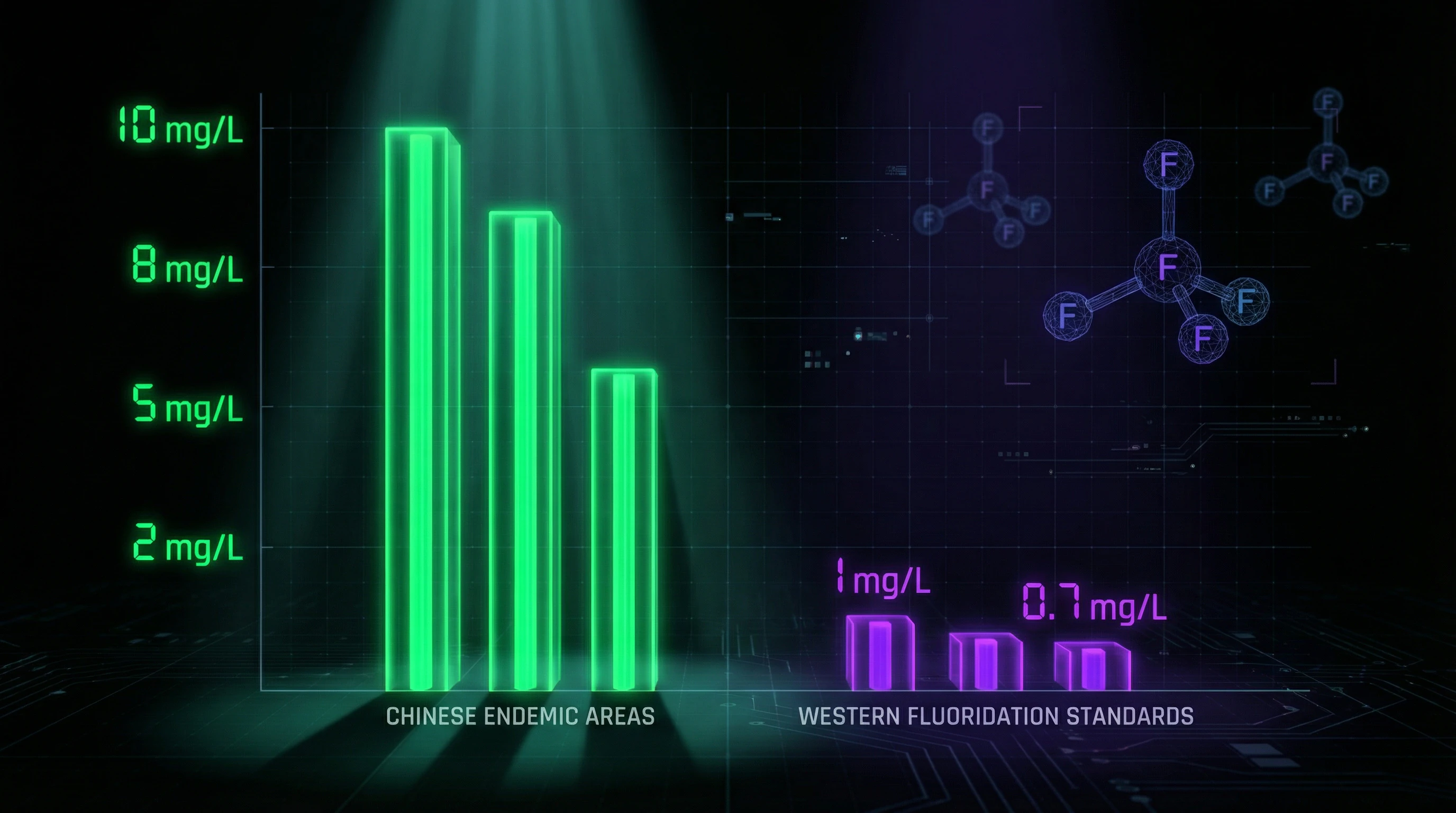
The overwhelming majority of studies were conducted in rural areas of China, where fluoride occurs as a natural contaminant. Concentrations ranged from 2 to 10 mg/L and higher — 3–15 times higher than levels used in Western fluoridation (S010).
In industrialized countries, fluoride concentration typically does not exceed 1 mg/L. In 2015, the U.S. DHHS changed the recommended level from a range of 0.7–1.2 mg/L to a single value of 0.7 mg/L (S010).
| Parameter | Chinese studies | Western fluoridation |
|---|---|---|
| Fluoride concentration (mg/L) | 2–10+ | 0.7–1.0 |
| Source | Natural contaminant | Added fluoride |
| Magnitude of difference | 3–15 times | |
⚠️ Methodological boundaries: what was measured and how
The systematic review used standard meta-analysis methods: Cochran's test for heterogeneity, Begg's funnel plot and Egger's test for publication bias, meta-regressions for sources of variation (S010).
The authors applied a fixed-effects model (Mantel-Haenszel method) and a random-effects model (DerSimonian and Laird method) (S010).
- I² statistic
- The percentage of total variation across studies due to between-study heterogeneity. Results showed substantial heterogeneity that did not decrease even with subgroup analysis and sensitivity analysis (S010).
- Critical signal
- Studies differed so much in design, populations, and conditions that pooling their results requires extreme caution.
🧩 Publication context: why this data wasn't widely known
While acute fluoride poisoning can be neurotoxic to adults, most epidemiological information on associations with child neurodevelopment comes from China (S010). The findings were not widely disseminated outside specialized scientific literature.
The information vacuum was filled with simplified interpretations and activist campaigns.
Steel Man Version of the Argument: Five Strongest Cases for Fluoride Neurotoxicity
Before examining weaknesses, we must honestly present the most compelling arguments from proponents of the fluoride neurotoxicity hypothesis. This is not a straw man, but a steel man version of the position — the strongest possible case. More details in the section Financial Pyramids and Scams.
🔬 Argument 1: Systematic Review Shows Consistent Association
A systematic review and meta-analysis of 27 studies identified a statistically significant inverse association between fluoride exposure and IQ scores in children (S003). This is not a single study, but a synthesis of data from multiple independent works.
Even with heterogeneity between studies, the direction of effect remained consistent: higher fluoride concentrations were associated with lower intelligence scores.
🧪 Argument 2: Biological Plausibility Based on Animal Models
Fluoride can cause neurotoxicity in animal models, which supports the biological plausibility of the effect (S002). If the mechanism of neurotoxicity is demonstrated in controlled animal experiments, this strengthens the likelihood that a similar effect could be observed in humans at sufficiently high doses.
- Animal models show impairments in nervous tissue development at high concentrations
- Mechanisms of action (oxidative stress, mitochondrial dysfunction) have been identified (S001)
- Dose ranges in experiments allow extrapolation to human scenarios
📊 Argument 3: Updated 2019 Review Confirms Findings
An updated systematic review published in 2019 included additional studies and confirmed the main conclusions of the previous analysis (S004). This indicates that the association is not an artifact of a single dataset, but is reproduced when the evidence base is expanded.
Reproducibility of results when adding new studies is one of the key markers of systematic review reliability. If the effect disappears when the sample is expanded, this indicates publication bias or methodological artifacts.
⚠️ Argument 4: Recognition of the Issue by the U.S. National Research Council
The U.S. National Research Council (NRC) concluded in 2006 that adverse effects of high fluoride concentrations in drinking water may be of concern and that additional research is needed. This official recognition by an authoritative scientific body lends legitimacy to concerns about neurotoxicity.
🧾 Argument 5: Dose-Response Analysis Shows Effect Gradient
Dose-response analysis of 27 studies revealed a gradient: higher fluoride doses were associated with more pronounced IQ reduction (S003). The presence of dose-dependence is one of the Bradford Hill criteria for causation, which strengthens the argument for causality.
| Bradford Hill Criterion | Status in This Case | Interpretation |
|---|---|---|
| Consistency | Present | Multiple independent studies show the same direction of effect |
| Dose-response | Present | Effect gradient correlates with fluoride concentration |
| Biological plausibility | Present | Neurotoxicity mechanisms are demonstrated in animal models |
| Temporal sequence | Requires clarification | Exposure precedes outcome, but most studies use cross-sectional design |
Evidence Base Under the Microscope: What the Data Show Upon Detailed Analysis of Concentrations, Confounders, and Study Quality
Critical analysis of the evidence base requires examining three layers: dose ranges, study methodology, and systematic biases in publications. More details in the Financial Scams section.
📊 The Dose Gap Problem: Extrapolation Across an Order of Magnitude
Fluoride concentrations in Chinese studies differ radically from Western standards. With water fluoridation in the West, concentration does not exceed 1 mg/L (S010), whereas in endemic regions of China it reaches 2–10 mg/L and higher.
Extrapolating toxicological effects from high doses to low doses is not linear scaling. Toxicokinetics and toxicodynamics change depending on dose: at high concentrations, mechanisms activate that don't operate at low levels. The absence of data in the 0.7–1 mg/L range means that effects at 2–10 mg/L cannot be extrapolated to Western doses with confidence.
A dose gap of 10–20 times is not merely a quantitative difference, but a qualitative change in toxicological profile. Mechanisms operating at 5 mg/L may be inactive at 0.7 mg/L.
🧩 Study Heterogeneity: When Pooling Data Becomes Problematic
Meta-analysis revealed substantial heterogeneity between studies that did not decrease with subgroup analysis and sensitivity analysis (S010). I² statistics showed that a significant portion of variation was due to between-study differences rather than random error.
High heterogeneity means studies differed in design, IQ measurement methods, population characteristics, confounder control, fluoride sources (natural vs. industrial), co-exposures (arsenic, lead), socioeconomic status, nutrition, and access to education. Pooling such heterogeneous data into a single effect estimate can produce misleading results.
| Parameter | Variation Between Studies | Impact on Interpretation |
|---|---|---|
| Design | Cross-sectional, cohort, case-control | Different ability to establish causation |
| IQ Measurement | Different tests, different validation | Results not comparable |
| Confounder Control | From minimal to moderate | Unclear what is actually being measured |
| Sample Size | From 100 to 5000+ participants | Different statistical power |
🔎 Confounder Control: What Remained Off-Screen
Most studies were conducted in rural regions of China with limited resources. Control of potential confounders was often inadequate. Key factors that could have influenced results:
- Socioeconomic Status
- Poverty, parental education, access to educational resources — all correlate with cognitive development independent of fluoride.
- Nutritional Quality
- Deficiency of iodine, iron, other micronutrients directly affects neurodevelopment and is often found in the same regions.
- Co-exposures
- Arsenic, lead, and other toxicants are often present in endemic areas and may be the primary cause of cognitive deficits.
- Water Quality
- Microbiological contamination, other mineral components — not only fluoride affects health.
- Genetic Factors
- Population differences in fluoride metabolism and sensitivity to neurotoxins.
Lack of adequate control means the observed association between fluoride and IQ may be partially or entirely due to other variables. This doesn't disprove the hypothesis, but leaves it unproven.
🧪 Study Quality: Methodological Limitations of Primary Research
The U.S. National Toxicology Program conducted a systematic review of fluoride neurotoxicity study quality and ranked them by methodological rigor (S002). Many studies received low ratings due to methodological limitations:
- Cross-sectional design, which doesn't allow establishing temporal sequence between exposure and effect
- Absence of individual exposure measurements — use of group-level mean fluoride concentrations
- Inadequate confounder control or its absence
- Use of non-standardized or unvalidated IQ tests
- Small sample sizes and low statistical power
- Lack of information about other fluoride sources (toothpaste, food, supplements)
These limitations reduce confidence in causal interpretation of observed associations. Low methodological quality doesn't mean results are incorrect, but means they require independent verification under conditions with better control.
⚠️ Publication Bias: What Remained in Desk Drawers
Meta-analysis authors used Begg's funnel plot and Egger's test to assess publication bias (S003). Publication bias occurs when studies with positive results are more likely to be published than studies with negative or null results.
If studies that found no association between fluoride and IQ remained unpublished, meta-analysis overestimates the true effect. This is especially likely in a context where fluoride is already perceived as a problem.
Given that most studies were conducted in China and published in local journals, the risk of publication bias may be substantial. Studies that found no association may simply not have been published or published in less accessible sources.

Mechanisms and Causality: Correlation, Confounders, and Bradford Hill Criteria in Toxicological Context
The observed statistical association between fluoride and IQ does not prove a causal relationship. Bradford Hill criteria are used to assess causality in epidemiology. Let's examine how well the data on fluoride neurotoxicity meet these criteria. More details in the section Microchipping and World Government.
🔁 Strength of Association: How Large is the Effect
Meta-analysis showed a statistically significant IQ reduction in high fluoride exposure groups compared to low exposure groups (S003). However, the effect size was relatively small—on average, a few IQ points.
Given substantial heterogeneity and potential confounders, such a small effect size could easily be explained by systematic errors.
🧬 Consistency: Reproducibility of Results
The inverse relationship between fluoride and IQ has been observed in multiple studies, indicating consistency (S003, S004). However, nearly all these studies were conducted in one geographic region (China) with similar methodological limitations.
Consistency of results within a single population and study design is less convincing than replication across different populations using different methods.
📊 Specificity: Uniqueness of the Association
The association between fluoride and IQ reduction is not specific—many other factors (lead, arsenic, iodine deficiency, malnutrition) are also associated with reduced cognitive function in children (S005). Lack of specificity does not rule out causality, but it reduces confidence in it, especially with insufficient control of confounders.
🔎 Temporal Sequence: What Came First
Most studies included in the review had a cross-sectional design, which does not allow establishing temporal sequence between fluoride exposure and IQ reduction. While it's logical to assume exposure preceded IQ measurement, the absence of prospective cohort studies weakens the evidence base.
🧪 Biological Gradient: Dose-Response Relationship
Dose-response analysis showed that higher fluoride concentrations were associated with more pronounced IQ reduction (S001). This is one of the strongest arguments for causality.
However, it's critically important that this gradient was observed in the high-dose range (2–10 mg/L), and we don't know whether it persists at low doses (0.7–1 mg/L). A threshold may exist below which the effect is absent.
🧬 Biological Plausibility: Mechanisms at the Cellular Level
Fluoride can cause neurotoxicity in animal models at high doses (S002). Proposed mechanisms include oxidative stress, mitochondrial dysfunction, alterations in neurotransmitter systems, and effects on gene expression.
| Evidence Level | Observed Effect | Critical Note |
|---|---|---|
| Animal models | Neurotoxicity at 2–10 mg/L | Doses exceed human exposure from fluoridation |
| Cell systems | Oxidative stress, mitochondrial dysfunction | Requires extrapolation to whole organism |
| Epidemiology (China) | IQ reduction at high doses | Multiple confounders, cross-sectional design |
⚠️ Coherence: Consistency with Other Knowledge
The hypothesis of fluoride neurotoxicity at low doses is inconsistent with decades of epidemiological data from countries with water fluoridation (USA, Canada, Australia, United Kingdom), where no population-level IQ decline or increase in neurodevelopmental disorders has been observed.
This inconsistency weakens the argument for causality at low doses and suggests the possibility of a threshold effect or the role of uncontrolled confounders in Chinese studies.
Conflicts in the Evidence Base: Where Sources Diverge and Why Consensus Remains Elusive
The scientific community is divided in assessing fluoride neurotoxicity risks. Let's examine the main points of disagreement. More details in the Mental Errors section.
🔬 Public Health Position vs. Toxicological Precaution
Public health organizations (CDC, ADA, WHO) continue to support water fluoridation as a safe and effective measure for preventing dental caries. They point to the absence of convincing evidence of neurotoxicity at doses used in fluoridation programs (0.7–1 mg/L).
Toxicologists and some epidemiologists call for caution, citing data from China (S001, S002) and the precautionary principle. The difference in positions reflects different approaches to managing uncertainty: public health requires a high level of evidence of harm, while toxicology operates from a presumption of potential risk.
📊 Meta-Analysis Interpretation: Pooling vs. Separating
Proponents of the neurotoxicity hypothesis point to the statistically significant result of meta-analyses (S003, S004) as evidence of an effect. Critics emphasize high heterogeneity between studies and methodological limitations, arguing that pooling such disparate data is inappropriate and may produce false-positive results.
Here we see a clash of two logics: aggregating (if many weak signals point in one direction, that's a signal) and conservative (if studies are incomparable, pooling them creates an artifact). Both positions have methodological justification.
⚠️ Dose Extrapolation: Linear Model vs. Threshold Model
The key question: can effects observed at 2–10 mg/L be extrapolated to doses of 0.7–1 mg/L? This isn't merely a technical problem—it's a choice between two toxicological paradigms.
| Model | Assumption | Conclusion for Fluoride |
|---|---|---|
| Linear No-Threshold (LNT) | Any dose carries risk, proportional to dose | 0.7 mg/L is potentially hazardous |
| Threshold | A dose exists below which no effect manifests | Extrapolation across an order of magnitude without data is unfounded |
LNT proponents argue this is a conservative approach. Critics counter: extrapolation without low-dose data isn't conservatism—it's speculation.
🧾 Role of Confounders: Controlled vs. Uncontrolled Factors
- Position 1: Confounders explain everything
- The observed association between fluoride and IQ is fully explained by uncontrolled factors (poverty, malnutrition, co-occurring toxicants). Studies in China were conducted in settings where multiple variables vary simultaneously.
- Position 2: Association persists after control
- Even after controlling for available confounders, the association remains statistically significant (S002). However, it's acknowledged that control was incomplete—it's impossible to measure all relevant variables.
- The trap of both positions
- The first assumes unmeasured confounders are strong enough to explain the entire effect (requires proof). The second assumes measured variables are sufficient (requires proof). Both operate with incomplete information.
Consensus remains unattainable until data are obtained from populations with controlled fluoride doses and minimized confounders. The current evidence base allows both positions to be defended with justification.
Anatomy of Cognitive Biases: How Psychological Mechanisms Transform Uncertainty into Certainty and Correlation into Causation
The fluoride neurotoxicity story is a textbook example of how cognitive biases and heuristics influence the interpretation of scientific data. Let's examine the key mechanisms. More details in the Reality Check section.
🧩 Availability Heuristic: Vivid Stories vs. Statistics
The availability heuristic causes us to overestimate the probability of events that are easy to recall—usually because they're vivid, emotional, or recent. The story of "fluoride lowering children's IQ" is a vivid, frightening narrative that's easily remembered and shared.
Dry statistics about methodological limitations and dose gaps can't compete with the image of a harmed child. That's why studies from Chinese villages with fluoride concentrations 10+ times above normal seem more relevant than data from countries with fluoridation at 0.7–1 mg/L (S002).
The brain chooses story over numbers. When information competes with narrative, narrative almost always wins.
Confirmation Bias and Source Filtering
Confirmation bias is the tendency to seek, interpret, and remember information that confirms pre-existing beliefs. Someone convinced of fluoride's dangers will more actively search for studies that confirm this and ignore or reinterpret contradictory data.
Systematic reviews from China (S003, S004) are often cited as proof, but their methodological limitations (lack of confounder control, mixing different concentrations) remain on the periphery of attention. Western standards requiring stricter control are perceived as "conspiracy" or "financial pressure."
- Search: I look for studies confirming my position
- Interpretation: I favorably interpret methodological flaws
- Memory: I remember supporting facts, forget contradicting ones
- Socialization: I share only confirming data within my community
Illusion of Causality and the Correlation Temptation
When two variables correlate, the brain automatically searches for a causal relationship—even when none exists. Fluoride and IQ correlate in some studies, but both may be consequences of a third variable: poverty, malnutrition, lack of education, water contamination by other substances.
Bradford Hill criteria (S002) require checking dose-response relationships, biological plausibility, and exclusion of confounders. But these criteria require effort and skepticism—while the illusion of causality works instantly and intuitively.
| Mechanism | What Happens | Result |
|---|---|---|
| Correlation | Fluoride and low IQ correlate in data | Brain assumes causation |
| Confounder | Poverty → high fluoride AND low IQ | Cause is poverty, not fluoride |
| Dose-response | Effect should increase with dose | No effect at 0.7 mg/L; effect at 10+ mg/L |
Social Proof and Echo Chambers
Social proof is the tendency to believe information if many people repeat it. Online echo chambers amplify this effect: people with identical beliefs gather together, confirm each other, and create an illusion of consensus.
When everyone in an anti-fluoridation community agrees that fluoride is dangerous, it seems like scientific consensus. In reality, it's social consensus within a self-selected group. Real scientific consensus is agreement among experts who have passed through peer review and confounder checking (S001).
Echo chambers create the illusion of truth through repetition, not through proof. The more people repeat the same thing, the more true it seems—regardless of facts.
Uncertainty as Fuel for Certainty
Paradox: the more uncertainty in the data, the more certainty in interpretation. If everything were clear, there'd be nothing to argue about. But when data are contradictory, each side can choose its interpretation and defend it with complete confidence.
Uncertainty in fluoride research (different concentrations, different populations, different confounders) creates space for cognitive biases. Each bias fills the knowledge gap with its own version of truth. Result: two groups with opposite beliefs, both certain they're right.
- Cognitive Bias
- A systematic error in information processing that seems logical but deviates from facts.
- Why This Is Dangerous
- Biases operate unconsciously. We don't notice we're wrong because the error is built into the very logic of our thinking.
- How This Relates to Fluoride
- Each bias (availability, confirmation, social proof) pushes us in one direction—either toward complete denial of risk or toward panic-driven exaggeration.
The solution: don't trust your intuition, but verify dose-response relationships, confounders, and methodology. This requires effort, but it's the only way to distinguish signal from noise under conditions of uncertainty.