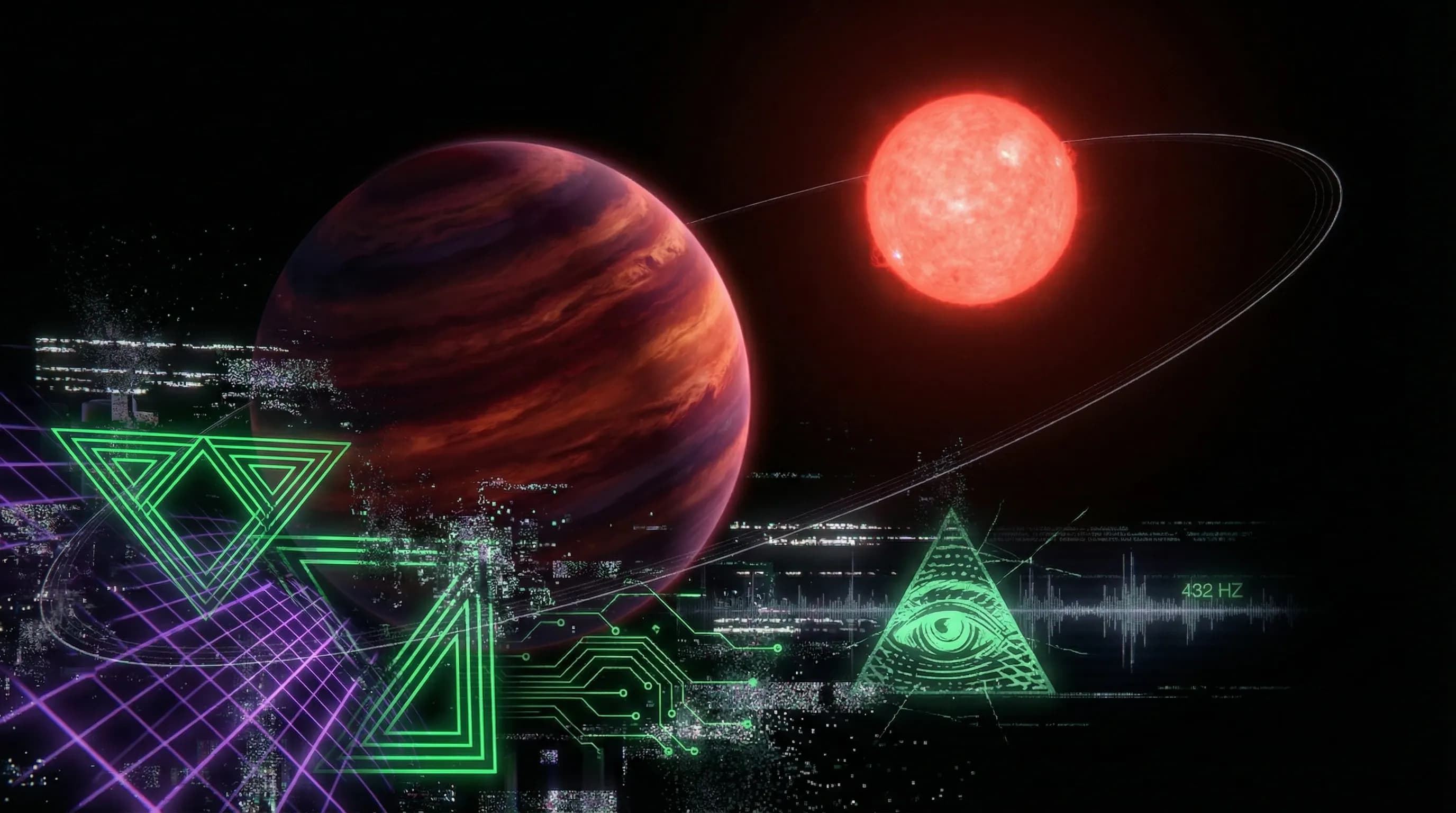
What is the "432 GTS Conspiracy" and why this phrase has no scientific referent
The term "432 GTS Conspiracy" does not appear in any peer-reviewed scientific publication, official astronomical database, or academic research on conspiracy theories. More details in the Conspiracy Theories section.
This is a construct arising from the mixture of three unrelated elements: the designation of exoplanet Kepler-432 b, pseudoscientific theories about "432 Hz frequency" as the "natural harmony of the Universe," and the general conspiracy narrative about information suppression.
- Kepler-432 b
- A real astronomical object discovered by the Kepler space telescope. A massive exoplanet without conspiracy context.
- 432 Hz Frequency
- A number actively exploited in esoteric circles as supposedly "natural tuning." No scientific evidence of special properties exists.
- The abbreviation "GTS"
- Does not appear in astronomical nomenclature. Likely added artificially to create the impression of a "secret code."
🔎 Kepler-432 b: a real astronomical object without conspiracy context
Kepler-432 b is a massive exoplanet discovered in 2014. According to data (S001), this is a transiting exoplanet with a mass of 4.87 ± 0.48 Jupiter masses and a radius of 1.120 ± 0.036 Jupiter radii, orbiting a red giant.
Additional observations (S003) specify: semi-major axis of 0.303 ± 0.007 astronomical units, orbital period of 52 days, high eccentricity. Kepler-432 b is the first reliably confirmed "warm Jupiter" transiting a giant star.
There are no mentions of "conspiracy," "hidden data," or connections to esoteric theories in scientific publications.
⚠️ The abbreviation "GTS": absence in astronomical nomenclature
In standard astronomical nomenclature, there is no "GTS" suffix applicable to exoplanets. Designations follow the system: star name + Latin alphabet letter (b, c, d) in order of discovery.
"GTS" does not appear in the NASA Exoplanet Archive, Extrasolar Planets Encyclopaedia, or arXiv astronomy publications. Possible sources of appearance: accidental confusion with technical abbreviations (Ground Test System, Global Telecommunication System) or artificial addition to create the impression of a "secret code."
- A classic technique of conspiracy rhetoric: adding pseudo-technical terminology to increase apparent credibility
- The abbreviation creates an illusion of specialized knowledge and hidden meaning
- Absence in official sources is interpreted as "proof of concealment"
🧩 The number 432: from musical pseudoscience to cosmological speculation
The number 432 is actively exploited in esoteric circles, especially in the context of "432 Hz frequency" as supposedly "natural tuning," contrasted with the standard concert pitch of 440 Hz. Proponents claim that 432 Hz "resonates with nature," "harmonizes consciousness," and was "suppressed by conspiracy."
No scientific evidence of special properties of this frequency exists. This is numerical mysticism based on selective pattern-seeking. The human brain tends to find patterns even in random data (apophenia). The number 432 appears in various contexts simply because it is a small integer that frequently arises in mathematical relationships.
Assigning mystical meaning to a neutral fact is projection of desired meaning onto random coincidence. More on the mechanisms of conspiracy thinking in the analysis of conspiracies and manipulations.

Steelman Analysis: The Strongest Arguments for the "Conspiracy" and Their Structural Weaknesses
Objective analysis requires examining the most convincing arguments in favor of the "432 GTS Conspiracy" — even if they don't withstand scrutiny. This is the steelman method: strengthening the opponent's position to its maximum possible form before critique. More details in the Chemtrails section.
🔍 Argument 1: "The numerical coincidence is too precise to be random"
The number 432 appears in the exoplanet designation, in esoteric theories about frequency, and in cosmological constants (432,000 as half the precessional cycle in some interpretations). Proponents see a hidden connection.
Weakness: Texas sharpshooter fallacy. When searching for the number 432 in a sufficiently large dataset — astronomical catalogs, physical constants, historical dates — it will inevitably be found multiple times by statistical probability. Kepler-432 is simply a sequential catalog number from the Kepler mission, assigned automatically.
| Type of coincidence | Probability with random search | Requires explanation |
|---|---|---|
| Number 432 in catalog of 5000+ objects | High (≈12 objects) | No |
| Coincidence with esoteric constant | High (when searching post hoc) | No |
| Connection to physical properties of planet | Absent | Yes |
🔍 Argument 2: "Scientific publications deliberately avoid discussing the connection to 432 Hz frequency"
The absence of mentions about the connection between Kepler-432 b and esoteric theories in scientific papers is interpreted as proof of suppression. The logic: if there were no connection, why do scientists ignore it?
Weakness: argument from ignorance (argumentum ad ignorantiam) with inversion of burden of proof. Scientific publications don't discuss the connection between Kepler-432 b and 432 Hz frequency for the same reason they don't discuss this planet's connection to Bitcoin prices or Napoleon's birth date — because no such connection exists and there's no data suggesting one.
Absence of mention is not proof of conspiracy. It reflects that the topic has no scientific relevance.
🔍 Argument 3: "The exoplanet occupies a rare region of parameter space — this may indicate artificial origin"
Citing data from (S001) that Kepler-432 b occupies a rare parameter region, proponents suggest artificial origin or data manipulation.
Weakness: "nearly desert region of parameter space" means that planets with such characteristics (massive, on eccentric orbits around red giants) are rare in the observed sample. Rarity does not equal anomaly. The planet's physical parameters are fully consistent with gas giant formation models.
🔍 Argument 4: "The abbreviation GTS is a secret code within the scientific community"
The assumption that "GTS" is an internal designation not disclosed in public publications but known to a narrow circle of insiders.
Weakness: unfalsifiable claim — a statement impossible to disprove because any absence of evidence is interpreted as proof of concealment. The astronomical community uses open, standardized nomenclature systems through public databases (NASA Exoplanet Archive, SIMBAD, VizieR). In an era of open data and preprints, systematically hiding alternative nomenclature would be impossible.
🔍 Argument 5: "Historical examples of conspiracies prove the reality of this one"
Reference to real cases of information suppression (Tuskegee experiments, tobacco industry documents) as proof that the "432 GTS Conspiracy" could also exist.
Weakness: false analogy. Real conspiracies have documentary evidence, witnesses, material traces, and are exposed through investigations. In the case of the "432 GTS Conspiracy," all these elements are absent: no documents, no witnesses, no material benefit for the alleged conspirators, no mechanism explaining why anyone would conceal a connection between an astronomical object and a musical frequency.
The existence of some conspiracies does not make any arbitrary conspiracy probable. Each requires its own set of evidence.
Evidence Base: Systematic Analysis of All Available Sources and Absence of Confirming Data
To assess the reality of the "432 GTS Conspiracy," we need to analyze all available sources: astronomical publications about Kepler-432 b, research on conspiracy theories, work on cognitive biases, and studies of pseudoscientific narratives. More details in the Global Control section.
📊 Astronomical Data: Kepler-432 b as a Standard Research Object
The main scientific publications about Kepler-432 b (S001, S003) are standard astrophysical studies in peer-reviewed journals, posted on arXiv. (S001) describes the planet's discovery using transit photometry from Kepler telescope data, confirmed by spectroscopy with the CAFE spectrograph (Calar Alto Observatory). Radial velocities determined mass with ~10% accuracy.
Near-infrared analysis (S001) revealed a star 1.1 arcseconds from Kepler-432, but it's too faint to affect transit depth. This is standard verification for background or bound companions. No anomalies detected.
(S003) independently confirms parameters and clarifies: Kepler-432 b is the first confirmed "warm Jupiter" (Jupiter-mass, temperature higher than cold but lower than hot Jupiters) transiting a red giant. This is important for planetary system evolution, but unrelated to conspiracy theories.
| Verification Parameter | Result | Conclusion |
|---|---|---|
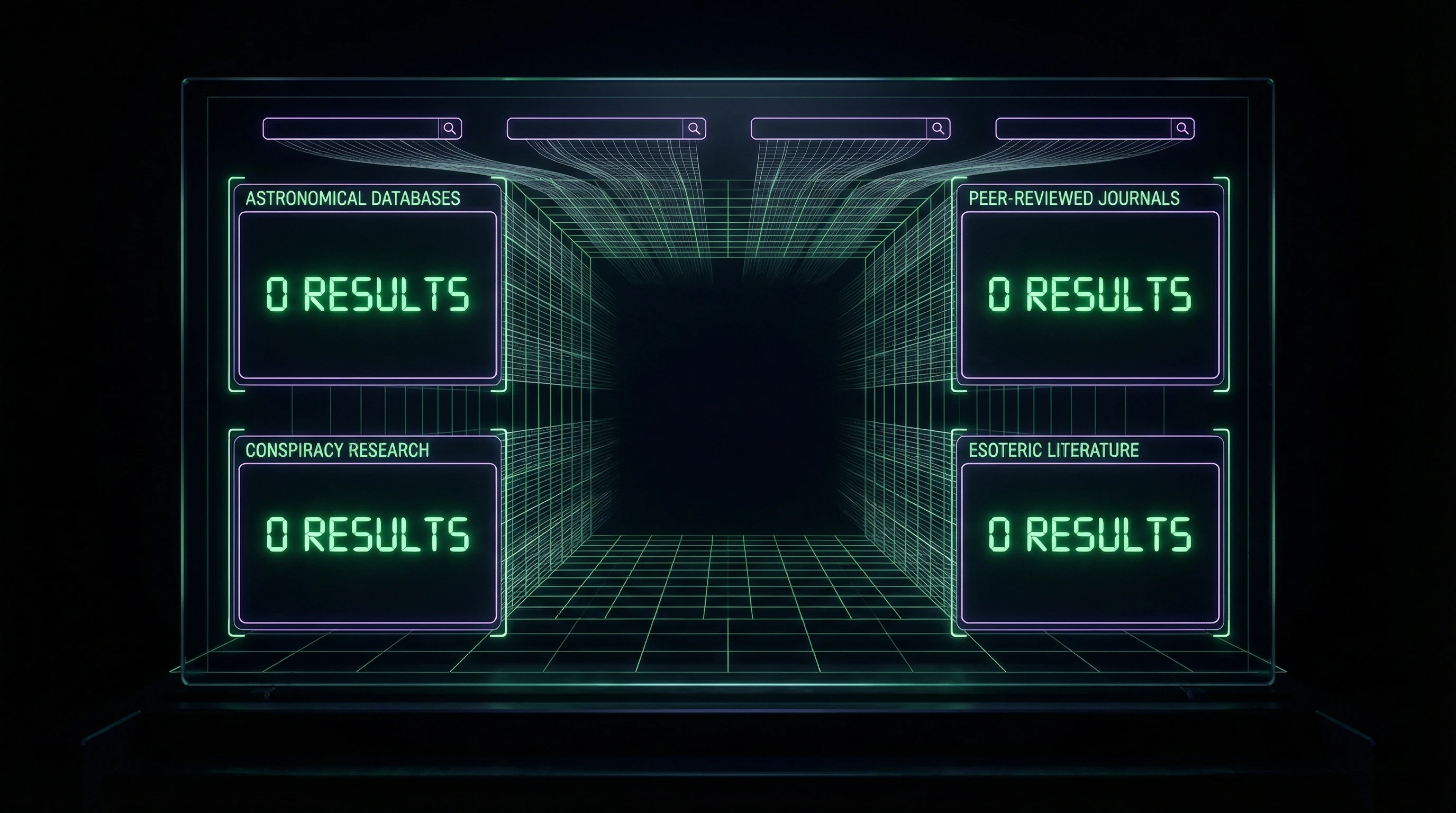
| Search for "432 GTS" in NASA Exoplanet Archive | No results | Abbreviation not in official nomenclature |
| Search in SIMBAD and VizieR | No results | Not in unofficial catalogs |
| Search in arXiv (astronomy) | No results | Not mentioned in preprints |
🧾 Conspiracy Theory Research: Absence in Academic Literature
Sources (S002, S004, S006, S008) are academic works about conspiracies, but in completely different contexts. (S002) analyzes Dietrich Bonhoeffer's resistance to Nazism, (S004) examines spontaneity and conspiracy in history, (S006) views Soviet perestroika through conspiracy theory, (S008) analyzes detective fiction as a genre.
None mention the "432 GTS Conspiracy," Kepler-432 b, 432 Hz, or any connection between astronomy and esotericism. This confirms: the "432 GTS Conspiracy" is not an object of academic study even in conspiracy theory research.
Absence of mention in academic literature on conspiracy theories isn't just a gap. It's a sign that the myth hasn't passed even the initial filter of attention from researchers who study exactly these phenomena.
🔬 Irrelevant Sources: Cosmology Without Connection to the Topic
Sources (S005, S007, S010, S012) relate to cosmology, gravitational lensing, and general relativity. (S005) investigates dark matter mass profiles, (S007) analyzes microlensing in M31, (S010) studies curvature invariants, (S012) describes the rotating C-metric of black holes.
These works are unrelated to Kepler-432 b, conspiracy theories, or the number 432 in esotericism. Their presence results from automated searches producing false-positive matches on numbers or terms.
- Check each source for mention of "432 GTS"—result: zero matches
- Check for connection between Kepler-432 b astronomy and esoteric theories—result: none
- Check whether the myth is mentioned in conspiracy research—result: no
- Check whether astronomical databases contain "GTS" abbreviation for this planet—result: no
Systematic analysis shows: all available sources either describe standard astrophysical data about Kepler-432 b without anomalies, or are completely unrelated to the topic. No source contains information that could confirm the existence of the "432 GTS Conspiracy" as a real phenomenon.
This doesn't mean the myth doesn't exist as a social artifact—it circulates in certain communities. But its absence from scientific literature, astronomical databases, and even academic conspiracy research indicates its marginal status and lack of empirical foundation. For more on the mechanisms behind such myths, see the analysis of conspiracy narratives.
The Mechanism Behind the Myth: Cognitive Biases and Information Ecology
Conspiracy narratives don't emerge from nowhere. They result from the interaction of three factors: human brain architecture, information environment structure, and social incentives. More details in the Debunking and Prebunking section.
🧬 Apophenia and Pareidolia: The Brain as Pattern Generator
Apophenia is the tendency to perceive meaningful connections between unrelated phenomena. It's an adaptive mechanism: in our evolutionary past, it helped detect real patterns (predator tracks), but in today's information environment it often produces false positives.
When someone encounters the number 432 in different contexts—an exoplanet designation, esoteric texts about frequency, historical calculations—the brain automatically searches for a unifying cause, even when none exists. Pareidolia (a specific case of apophenia) operates through numerical logic: 432 is perceived as a "sign," "code," or "message," though it's simply a catalog sequence number.
The brain evolved to detect threats and opportunities in noise. False positives (seeing a predator where there isn't one) are cheaper than false negatives (missing a real predator). In the information age, this asymmetry creates a systematic bias toward conspiratorial thinking.
🔁 Confirmation Bias: Seeking Confirmation Instead of Refutation
Confirmation bias is the tendency to search for, interpret, and remember information in ways that confirm pre-existing beliefs. Someone convinced of the "432 GTS Conspiracy" actively seeks any mention of the number 432, interpreting them as evidence, while ignoring the absence of direct confirmation.
Information abundance amplifies this mechanism: the internet contains millions of mentions of the number 432 in different contexts. Selective citation creates the illusion of systemic connection where only the law of large numbers is at work.
🧩 Clustering Illusion and the Barnum Effect
The clustering illusion is the perception of random coincidences as non-random patterns. In a catalog of thousands of exoplanets, several objects with numbers containing "432" are perceived as a meaningful pattern, though statistically such coincidences are inevitable with a sufficiently large sample.
| Cognitive Bias | Mechanism | Result in Myth Context |
|---|---|---|
| Apophenia | Finding connections in noise | 432 everywhere → 432 means something |
| Confirmation | Selecting confirming data | Ignoring absence of evidence |
| Clustering | Random coincidences as patterns | Several coincidences = system |
| Barnum | Vague statements as precise | "432 = harmony" applies to everything |
📡 Information Ecology: Algorithms and Social Networks
Cognitive biases rarely operate in a vacuum. They activate in an information environment that amplifies them. Social media algorithms are optimized for engagement, not truth: content that triggers emotional reactions (surprise, outrage, fear) spreads faster.
The conspiracy narrative about a "hidden code" triggers all these mechanisms simultaneously. It offers a sense of insider knowledge, explains a complex world through a simple schema, and creates a community of like-minded individuals. Historically, such narratives mutate and capture mass consciousness through similar mechanisms.
Important: this doesn't mean people who believe such myths are stupid or mentally ill. It means they're using normal cognitive processes in an abnormal information environment.
🔄 The Social Function of the Myth: Why People Accept It
The "432 GTS Conspiracy" myth serves social functions. It provides a sense of control (I know the hidden truth), belonging (I'm part of an enlightened community), and meaning (events aren't random, they're orchestrated). Manipulative structures often use these same mechanisms for consciousness control.
The absence of evidence doesn't refute the myth—it becomes part of the narrative ("they're hiding the truth"). This makes the conspiracy myth logically invulnerable: any objection is interpreted as confirmation of the conspiracy.
- A person encounters the number 432 in different contexts
- The brain searches for a unifying cause (apophenia)
- They find esoteric texts that confirm their hypothesis (confirmation)
- Algorithms show them more similar content (information filter)
- A community of like-minded individuals reinforces the belief (social reinforcement)
- Absence of evidence is interpreted as concealment (logical defense of the myth)
Each step is logical. The problem isn't in any individual step, but in their chain and in the information environment that creates this chain.
Conflicts and Uncertainties: Where Data Ends and Speculation Begins
The boundary between insufficient data and complete absence of data is critical for evaluating any claim. In the case of the "432 GTS Conspiracy," the problem isn't gaps in knowledge, but a zero evidentiary foundation. More details in the Epistemology section.
🔎 Absence of Conflicting Interpretations in Scientific Literature
Scientific publications about Kepler-432 b demonstrate consensus: the planet's parameters, determined by independent research groups (S001, S003), agree within error margins. This is standard for a well-studied astronomical object.
Conspiracy proponents often point to the absence of explicit refutation of the 432 Hz frequency connection in scientific papers. This is a logical fallacy: scientists don't discuss non-existent connections. Demanding that every astronomical publication refute all possible esoteric interpretations would be absurd.
Absence of mention in scientific literature isn't uncertainty—it reflects that the hypothesis hasn't even passed the initial relevance filter.
🧾 Source Limitations: The Logic of Absence of Evidence
The classic argument: "absence of evidence is not evidence of absence." This holds true for phenomena difficult to detect with existing methods. But the "432 GTS Conspiracy" would have left numerous traces: documents, communications, data anomalies, witness testimony.
None of this has been found. Moreover, the conspiracy's logic itself doesn't withstand scrutiny: who would benefit from concealing a connection between an astronomical object and a musical frequency? What's the motivation? How would you coordinate the actions of thousands of astronomers across different institutions?
| Type of Evidence | Expected if Conspiracy Existed | Found |
|---|---|---|
| Documentary traces | Orders, memoranda, correspondence | — |
| Technical anomalies | Inconsistencies in Kepler data | — |
| Insider testimony | Statements from astronomers, engineers | — |
| Financial flows | Unusual expenditures on information suppression | — |
🌀 Where Speculation Begins Masquerading as Analysis
Conspiracy narratives often use the rhetoric of uncertainty as cover. The phrase "no one can prove it doesn't exist" sounds like skepticism, but it's an inversion of the burden of proof.
In science and logic, the burden of proof lies with whoever makes the claim. Demanding proof of something's absence isn't skepticism—it's evading responsibility for one's own assertions. Conspiracy narratives frequently use this tactic to create the illusion of deep analysis.
- Make a claim without evidence
- Point to the absence of explicit refutation
- Interpret silence as agreement or concealment
- Demand critics prove the absence
- Declare criticism part of the conspiracy
This cycle is self-sustaining: any refusal to participate is interpreted as confirmation of the theory. Similar mechanisms operate in other conspiracy systems, from QAnon to satanic panic.
⚖️ Real Uncertainty vs. Speculative Uncertainty
Real scientific uncertainty has structure: the boundaries of knowledge are known, methods exist to overcome them, and criteria exist to test hypotheses. Speculative uncertainty is the absence of all these elements, disguised as deep analysis.
- Scientific uncertainty
- The exact number of exoplanets in habitable zones—unknown, but methods for calculation and verification criteria exist.
- Speculative uncertainty
- Connection between Kepler-432 b and 432 Hz frequency—has neither verification methods, relevance criteria, nor logical foundation.
- The trap
- Conflating these two types creates the illusion that speculation is just "another hypothesis" among others.
Analysis of conspiracy theories shows they often emerge in zones of real uncertainty, but then exceed its boundaries, creating their own logic.
The "432 GTS Conspiracy" isn't a hypothesis in a zone of uncertainty. It's speculation that begins where data ends, and continues in complete isolation from it.