
QAnon is a conspiracy movement that emerged in 2017 on imageboards, claiming the existence of a secret war between Donald Trump and a global pedophilic elite. Despite complete absence of evidence and multiple failed predictions, the movement has captured millions of people worldwide. Analysis of the phenomenon reveals classic mechanisms of cognitive biases, social reinforcement, and exploitation of epistemic uncertainty. This article examines the structure of the myth, psychological triggers of engagement, and provides a protocol for cognitive self-defense.
🖤 In October 2017, an anonymous user on the imageboard 4chan, calling themselves "Q," began posting cryptic messages about an alleged secret operation to overthrow the "deep state." Over six years, this evolved into a global movement whose participants stormed the Capitol, committed acts of violence, and destroyed families. QAnon became not just a conspiracy theory—it's a textbook on cognitive contagion in the digital age. Every element of this construct exploits fundamental vulnerabilities in human thinking with surgical precision. Understanding the mechanics of QAnon is not an academic exercise, but a necessary survival skill in the information environment of the 21st century.
Anatomy of a Deception: What Exactly QAnon Claims and Why It Matters for Understanding Mass Delusions
QAnon — a multi-layered conspiratorial system whose central claim is: a global cabal of satanic pedophiles controls governments, media, and finance. According to the narrative, Donald Trump was recruited by military intelligence to fight this conspiracy, and an anonymous insider "Q" publishes coded messages for the initiated. More details in the Financial Scams section.
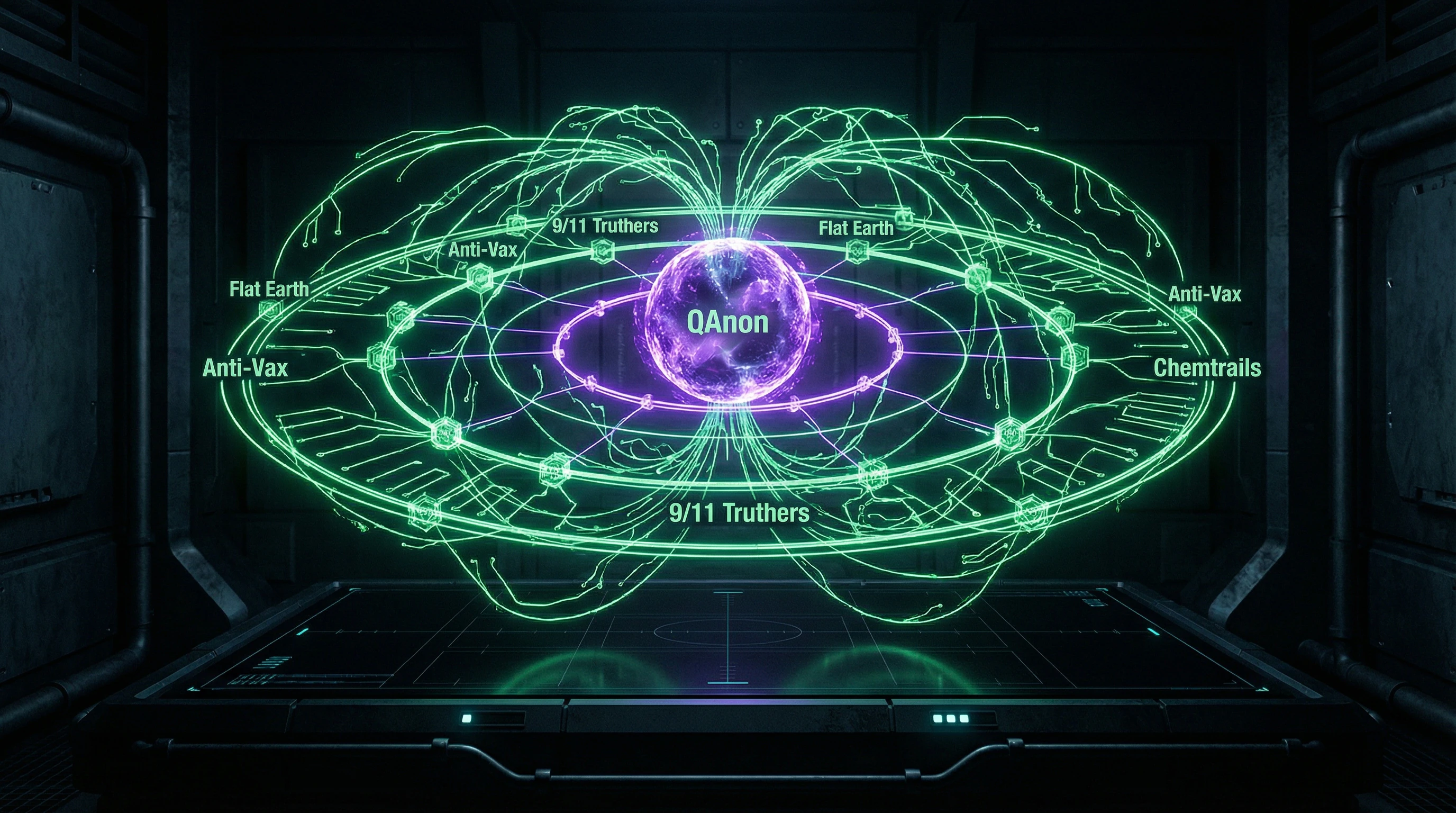
Key feature: QAnon functions as a "meta-conspiracy" — a system that integrates virtually any existing conspiracy theories into a unified narrative.
🧩 Structural Components of the Mythology
"Q drops" or "breadcrumbs" — short, deliberately ambiguous messages from imageboards 4chan, then 8chan/8kun. They employ "cold reading" techniques: vague formulations allow followers to find "confirmations" in any events.
- "The Great Awakening"
- The promise of a moment of mass revelation when citizens will learn the truth and conspiracy members will be arrested. A central element of belief, constantly postponed but never disappearing.
- "The Storm"
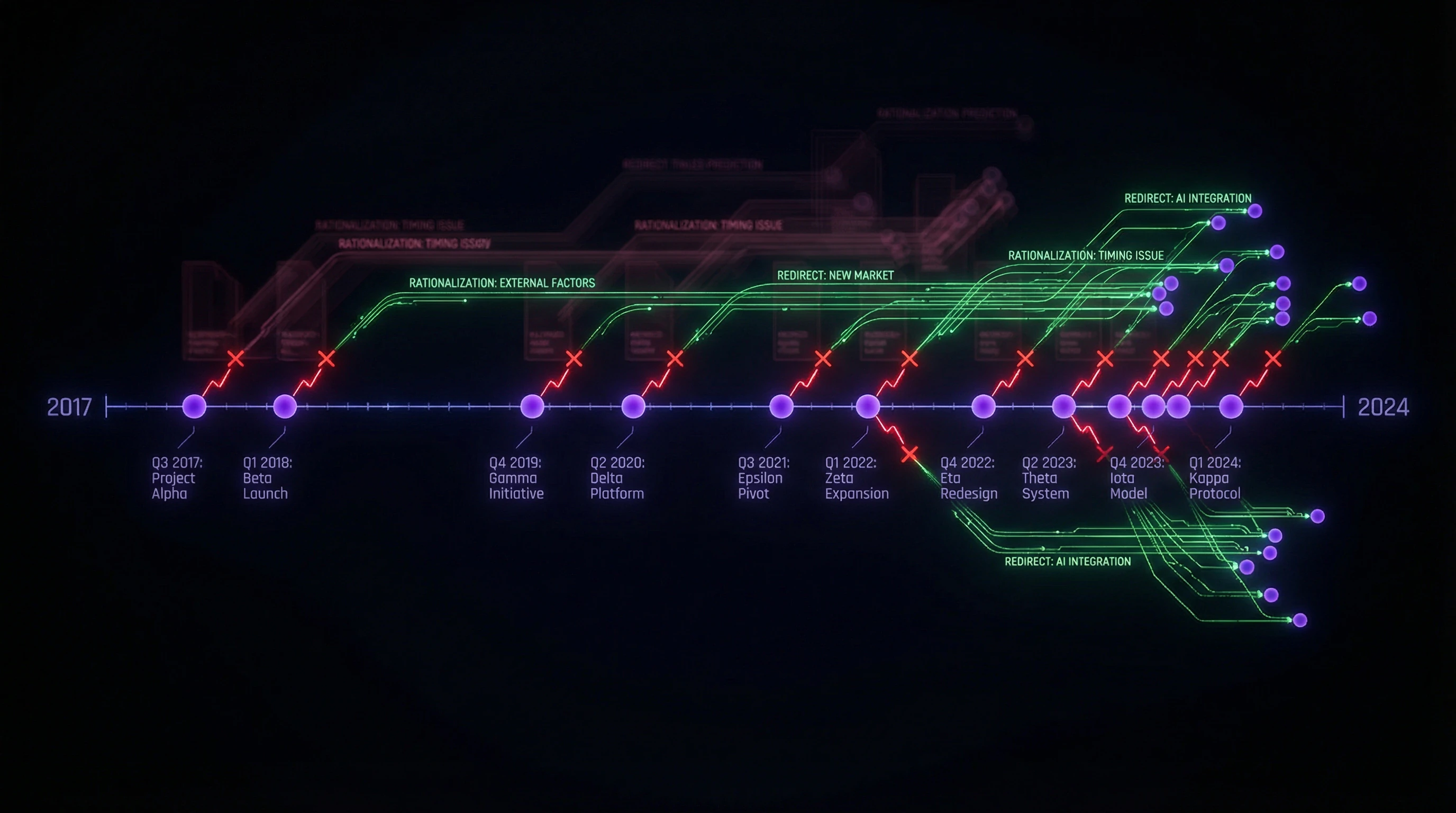
- The predicted event of mass arrests of elites. Each non-occurrence is interpreted as part of the plan rather than as refutation.
🔎 QAnon as an Umbrella Conspiracy
The movement integrates anti-vaccination, "chemtrail" theories, climate change denial, 9/11 conspiracies, flat Earth theories — all as parts of a unified conspiracy (S002). This structure makes the system exceptionally resistant to refutation: any contradiction is explained as disinformation or a more complex plan.
| Phase | Period | Characteristics |
|---|---|---|
| Initial | October 2017 — mid-2018 | Limited spread on imageboards and Reddit |
| Expansion | 2018–2019 | Migration to YouTube, Facebook, Twitter; acceleration through algorithms |
| Politicization | 2019–2020 | Congressional candidates, symbolism at Trump rallies |
| Culmination | 2020–2021 | Capitol riot January 6, 2021; QAnon symbolism widely represented |
| Current | 2021–present | Fragmentation, integration into right-populist and anti-vaccination movements |
Understanding this architecture is critical: QAnon demonstrates how conspiratorial systems exploit cognitive traps (apophenia, confirmation bias, social identity) to create self-sustaining ecosystems of belief independent of empirical data.
Steel-manning the argument: why millions find QAnon convincing and what real problems the narrative exploits
Understanding QAnon's resilience requires honestly examining the strongest versions of arguments its followers present. The "steel man" principle demands representing an opposing position in its most convincing form, rather than attacking simplified caricatures. More details in the section Pharmaceutical company data concealment.
This doesn't mean agreeing with the claims, but acknowledging the psychological and social logic that makes them attractive to a significant portion of the population.
🧩 The argument from real abuses: exploiting documented scandals
QAnon's strongest appeal element is its foundation on real, documented cases of elite power abuse and sexual violence. The Jeffrey Epstein case, Catholic Church scandals, the Jimmy Savile case in the UK, Operation Midland—all these events create a factual basis on which the hyperbolized narrative is built.
Followers rightly point out: many of these cases were initially dismissed as "conspiracy theories" before being confirmed. This historical validation creates epistemic uncertainty—if some "incredible" claims turned out to be true, why couldn't others be true as well?
🔎 The argument from institutional distrust: crisis of expert structure legitimacy
QAnon exploits a real and measurable crisis of trust in institutions. Trust in governments, media, and corporations is at historically low levels in most Western democracies.
Followers point to documented cases: government lies (weapons of mass destruction in Iraq, COINTELPRO program, Tuskegee experiments), corporate crimes (opioid crisis, tobacco company data concealment), media bias. In this context, skepticism toward official narratives isn't irrational—it's an adaptive response to an environment where institutions have repeatedly deceived the public.
The problem isn't skepticism itself, but the asymmetry in standards of evidence: some sources require absolute verification, others are accepted based on coincidences and interpretations.
⚠️ The argument from pattern recognition: cognitive reward for "connecting the dots"
The structure of "Q drops" creates a powerful sense of insight through the interpretation process. When followers "decode" cryptic messages and find "confirmations" in the news, they experience neurochemical rewards analogous to solving a puzzle.
This isn't mere delusion—it's exploitation of a real cognitive mechanism that's adaptive in other contexts. The ability to recognize patterns and draw conclusions from incomplete information is a fundamental human capability (S005). QAnon turns this ability into a trap, creating the illusion of patterns where none exist.
- Cryptic message is interpreted in multiple ways
- Coincidence with news is perceived as confirmation
- Non-matches are ignored or reinterpreted
- Neurochemical reward reinforces the search pattern
🧠 The argument from social belonging: movement as source of identity and meaning
For many followers, QAnon provides not just an explanatory model of the world, but social identity, sense of belonging, and feeling of significance. In an era of atomization, destruction of traditional communities, and epidemic loneliness, the movement offers a ready-made social structure.
Followers describe feelings of "awakening," finding purpose, becoming part of a historical mission. This is especially attractive to people experiencing social isolation, economic instability, or identity crisis (more on mechanisms of social control).
| Psychological need | What QAnon offers | Why rejection is painful |
|---|---|---|
| Belonging | Global community of like-minded people | Social isolation, loss of contacts |
| Meaning | Participation in historic struggle of good vs. evil | Return to feeling of meaninglessness |
| Competence | Status as "awakened" researcher | Status degradation within the group |
| Control | Illusion of understanding a chaotic world | Return to uncertainty and helplessness |
🔬 The argument from epistemic humility: acknowledging limits of knowledge
QAnon followers often appeal to the principle of epistemic humility: no one can know everything happening in secret power structures. This is a philosophically sound position—citizens have limited access to information about intelligence agency activities, closed elite negotiations, covert operations.
History is full of examples where "impossible" conspiracies turned out to be real: Watergate, Iran-Contra, MKUltra. In this context, absolute certainty in the absence of conspiracy can seem as dogmatic as belief in its existence.
⚙️ The argument from child protection: exploiting universal moral intuition
QAnon's central focus on protecting children from sexual abuse exploits one of the most powerful and universal moral intuitions. Care for children's wellbeing is a cross-cultural value, and child sexual abuse triggers an intense moral disgust reaction.
Framing the movement as a fight to save children makes criticism psychologically difficult—who can be against protecting children? This moral framework creates a Manichean picture: those with us protect children; those against us either participate in abuse or cover it up (see analysis of satanic panic and its evolution).
🧬 The argument from cognitive autonomy: resisting the "official" version as an act of independence
For many followers, embracing QAnon represents an act of cognitive autonomy—refusing to passively accept what authorities say and conducting independent "research." The call to "do your own research" appeals to the value of intellectual independence and critical thinking.
In a culture that values individualism and skepticism toward authorities, this is a powerful frame. The problem is that "own research" often means watching YouTube videos and reading blogs in an echo chamber, rather than applying systematic methods of evidence evaluation, but the psychological appeal of the independent thinker narrative remains strong.
- Cognitive autonomy (as followers understand it)
- Rejecting authorities and independently seeking truth through interpretation of open sources.
- Cognitive autonomy (as it works in practice)
- Replacing one set of authorities (mainstream media) with another (YouTube bloggers, anonymous posts), often with lower verification standards.
- Why the distinction matters
- True independence requires methodological rigor, not simply rejecting one source in favor of another. Echo chambers create the illusion of independent thinking while maintaining conformity.
Evidence Base: What We Actually Know About QAnon, Its Origins, Spread, and Impact Based on Empirical Data
Moving from understanding the narrative's appeal to assessing its factual basis requires systematic analysis of evidence. The critical question is not why people believe in QAnon, but what empirical data supports or refutes the movement's central claims. More details in the Conspiracy Theories section.
🧪 Origins of "Q": Linguistic Analysis and Author Identification
Analysis of "Q" posts using stylometry and machine learning methods revealed significant changes in writing style, vocabulary, and syntactic patterns. This indicates multiple authorship.
Digital forensics and journalistic investigations point to Paul Furber and Ron Watkins (administrators of 8chan/8kun) as probable authors of later posts. Early posts may have been created by other 4chan users as a form of trolling.
Critically important: there is no evidence that the author(s) had access to classified government information. All "predictions" were either vague enough for retrospective interpretation or concerned publicly available information.
📊 Scale of Spread: Quantitative Data on Engagement and Demographics
By the end of 2020, QAnon content reached hundreds of millions of views on major platforms (S002). Facebook removed over 1,500 groups with a combined subscriber count exceeding 4 million. Twitter suspended over 70,000 accounts.
Surveys show that 15–20% of Americans express agreement with core QAnon claims, though only a minority identify as active followers.
| Demographic Characteristic | Description |
|---|---|
| Ethnic Composition | Predominantly white Americans |
| Age | Middle-aged |
| Gender | Slight female predominance (unusual for conspiracy movements) |
| Religious Background | Often evangelical Christian |
🧾 Verification of Specific Claims: Systematic Analysis of "Predictions" and "Evidence"
QAnon's central predictions have systematically failed. The "Storm" of mass arrests of elites did not occur on any of the multiple predicted dates (S005).
- Hillary Clinton was not arrested (despite a specific prediction in the first post of October 2017)
- John Podesta was not detained
- There was no public disclosure of a global pedophile network among elites
- Biden's inauguration took place, despite predictions that Trump would remain president
Each failure was rationalized as "disinformation necessary to deceive enemies" or as part of a more complex plan. "Evidence" of the conspiracy consists exclusively of misinterpretations of public information, photos taken out of context, and logical fallacies like "post hoc ergo propter hoc."
🔎 Real Consequences: Documented Cases of Violence and Social Harm
The FBI classified the movement as a potential terrorist threat in 2019. Documented incidents include the murder of mob boss Frank Cali in 2019 (the killer was motivated by QAnon theories), the armed blockade of Hoover Dam by a follower in 2018, and child abductions by parents convinced they were saving them from pedophiles.
The January 6, 2021 Capitol attack included widespread representation of QAnon symbolism. Beyond direct violence, the movement has caused family destruction, job loss, psychological distress, and refusal of medical care, especially in the context of COVID-19.
🧬 Algorithmic Amplification: The Role of Platforms in Content Distribution
Recommendation algorithms on YouTube, Facebook, and other platforms significantly accelerated the spread of QAnon content (S003). Systems optimized to maximize engagement systematically promoted sensational and emotionally charged content.
- Distribution Mechanism
- Users who viewed videos on political topics quickly received recommendations for increasingly extreme content, including QAnon.
- Nature of the Problem
- This was not the result of a conscious decision by platforms to promote conspiracy theories, but an unintended consequence of system design where engagement is the primary success metric.
- Platform Response
- After public pressure, platforms began actively removing QAnon content from 2020, leading to migration to alternative platforms (Telegram, Gab, Truth Social).
⚙️ International Spread: Narrative Adaptation in Different Cultural Contexts
QAnon spread far beyond the US, adapting to local contexts (S003). In Germany, the movement integrated with the Reichsbürger movement and anti-COVID protests. In Japan, it merged with nationalist movements. In the UK, it combined with 5G conspiracy theories and anti-vaccination movements.
This adaptability demonstrates that QAnon functions as a modular system: the core structure (secret war of good versus evil, hidden information, coming revelation) is filled with locally relevant elements. This makes the movement exceptionally resilient and difficult to counter through simple fact-checking.
The connection to conspiracy narratives about satanic panic shows how historical patterns of mass delusion reproduce in the digital age. Understanding the cognitive errors underlying these beliefs is critical for developing effective counter-strategies.
The Mechanics of Cognitive Contagion: Why QAnon Exploits Fundamental Features of Human Cognition and How the Psychological Trap Works
QAnon exploits not sociology, but the architecture of thought. It works with how the brain processes information, forms beliefs, and constructs identity — with fundamental cognitive vulnerabilities that everyone has. More details in the Media Literacy section.
🧩 Apophenia and Hyperactive Pattern Detection
Apophenia — perceiving meaningful patterns in random data — is not a thinking error, but an evolutionary strategy. A brain that sees a predator in every rustle survives. A brain that misses a real threat doesn't.
QAnon creates an environment saturated with potential patterns: numerical coincidences, temporal correlations, symbolic connections. When a follower "finds" a connection between a Q post and a news event, they receive a neurochemical reward — a dopamine release (S001). The behavior is reinforced. Pattern-seeking becomes addictive.
The pattern detection system operates on a "better safe than sorry" principle: a false positive is less dangerous than missing a real signal. QAnon exploits this asymmetry.
🔁 Confirmation Bias and Motivated Reasoning
Confirmation bias — seeking information that confirms existing beliefs — turns QAnon into a closed system. Confirming information is accepted uncritically. Contradicting information is rejected as disinformation or part of the conspiracy.
Motivated reasoning amplifies the effect: when beliefs are tied to identity, social belonging, or emotional investment, the cognitive system actively defends them (S002). Disconfirming evidence isn't ignored — it's reinterpreted as confirming.
| Event | Interpretation Within QAnon Framework | Cognitive Mechanism |
|---|---|---|
| Failed prediction | Proof of plan's complexity | Motivated reframing |
| Criticism of movement | Proof of its importance | Confirmation bias |
| Lack of evidence | Proof of conspiracy's secrecy | Belief protection from falsification |
⚠️ Backfire Effect and Belief Strengthening Through Refutation
Attempting to refute a QAnon belief often leads to the opposite result — the belief strengthens. This isn't a paradox, but a predictable cognitive process.
When someone is presented with disconfirming evidence, their brain first activates defensive mechanisms: denial, reinterpretation, searching for counterarguments. If the refutation is perceived as a threat to identity or group belonging, the effect intensifies. The person doesn't just reject the evidence — they become more convinced of the original belief to restore cognitive balance (S001).
Refutation only works if it's not perceived as an attack on identity. If it is — the belief strengthens.
🎭 Narrative Identity and Social Belonging
QAnon offers not just an explanation of events, but a role in history. The follower becomes "awakened," a "researcher," a "defender of truth." This identity is socially reinforced: community, recognition, a sense of belonging to a group that "knows more."
Abandoning QAnon means not simply admitting error — it's losing identity, social network, meaning. The cognitive system resists this with full force. A person may recognize logical contradictions, but social and emotional investment outweighs logic (S004).
- Narrative trap
- Belief becomes part of self-definition. Abandoning belief = abandoning self.
- Social trap
- Community provides belonging. Leaving community = social death.
- Emotional trap
- Belief is tied to feelings of control, meaning, justice. Abandoning = losing these feelings.
🌐 Algorithmic Amplification and Information Ecosystem
QAnon doesn't exist in a vacuum. Social media algorithms, Telegram, and YouTube actively amplify its spread (S003). Algorithms are optimized for engagement — time spent on platform, clicks, comments. Content that triggers strong emotions (outrage, fear, triumph of discovery) gets more distribution.
QAnon is ideal for algorithms: it triggers intense emotions, requires constant searching for new patterns (high engagement), creates communities (social connections). Platforms don't need to believe in QAnon — they need people to stay active.
Algorithms don't filter truth. They filter attention. QAnon is ideal content for capturing attention.
🔐 Exit Protocol: Why Knowing the Mechanism Doesn't Guarantee Protection
Understanding these mechanisms doesn't automatically make someone protected. Apophenia, confirmation bias, motivated reasoning — these aren't errors of foolish people. They're fundamental features of human cognition that work in everyone.
Protection requires not knowledge of mechanisms, but structural changes: awareness of one's own cognitive errors, diversification of information sources, critical attitude toward one's own beliefs, especially if they're tied to identity. And — most importantly — understanding that exiting a conspiratorial narrative requires not logic, but offering an alternative identity and social belonging (see mind control mechanics).
- Track when belief becomes part of identity
- Seek information that contradicts current beliefs, not confirms them
- Check sources not for truth, but for motives and funding
- Recognize that algorithms show not reality, but what holds attention
- Maintain social connections outside ideological communities
Counter-Position Analysis
⚖️ Critical Counterpoint
The analysis of QAnon as a cognitive phenomenon relies on general psychological mechanisms but faces a number of methodological and empirical limitations. Below are the main objections that should be considered when evaluating the argumentation.
Lack of Direct Empirical Data on QAnon
The article extrapolates general principles of conspiratorial thinking to a specific movement, but there remains little research specifically on the QAnon phenomenon. A critic could fairly point out that applying universal models of cognitive biases requires more direct evidence rather than merely theoretical correspondence.
Risk of Pathologization Instead of Analyzing Motivations
The focus on cognitive errors may obscure legitimate socioeconomic causes of discontent that make conspiracy theories attractive. Some researchers argue that analyzing psychological mechanisms ignores structural problems in society that drive people to seek alternative explanations of reality.
Blurred Boundary Between Conspiracy Theories and Documented Conspiracies
The article draws a clear distinction between QAnon and confirmed conspiracies, but history shows that this boundary is fluid. NSA mass surveillance, initially considered a conspiracy theory, was later confirmed, which complicates the categorical separation of fiction from reality.
Unconfirmed Effectiveness of Deconversion Methods
Recommendations for persuading adherents are based on general principles, but their specific effectiveness in relation to QAnon has not been verified by controlled studies. The movement may possess unique characteristics that make standard approaches less effective than assumed.
Temporal Limitations of the Analysis
QAnon is an evolving phenomenon, and what is true at the time of writing may change. The movement may transform, integrate into other ideologies, or fade away, which would make categorical statements about its nature and trajectory obsolete faster than expected.
FAQ
Frequently Asked Questions

Author of the Cognitive Immunology Hub project. Researches mechanisms of disinformation, pseudoscience, and cognitive biases. All materials are based on peer-reviewed sources.