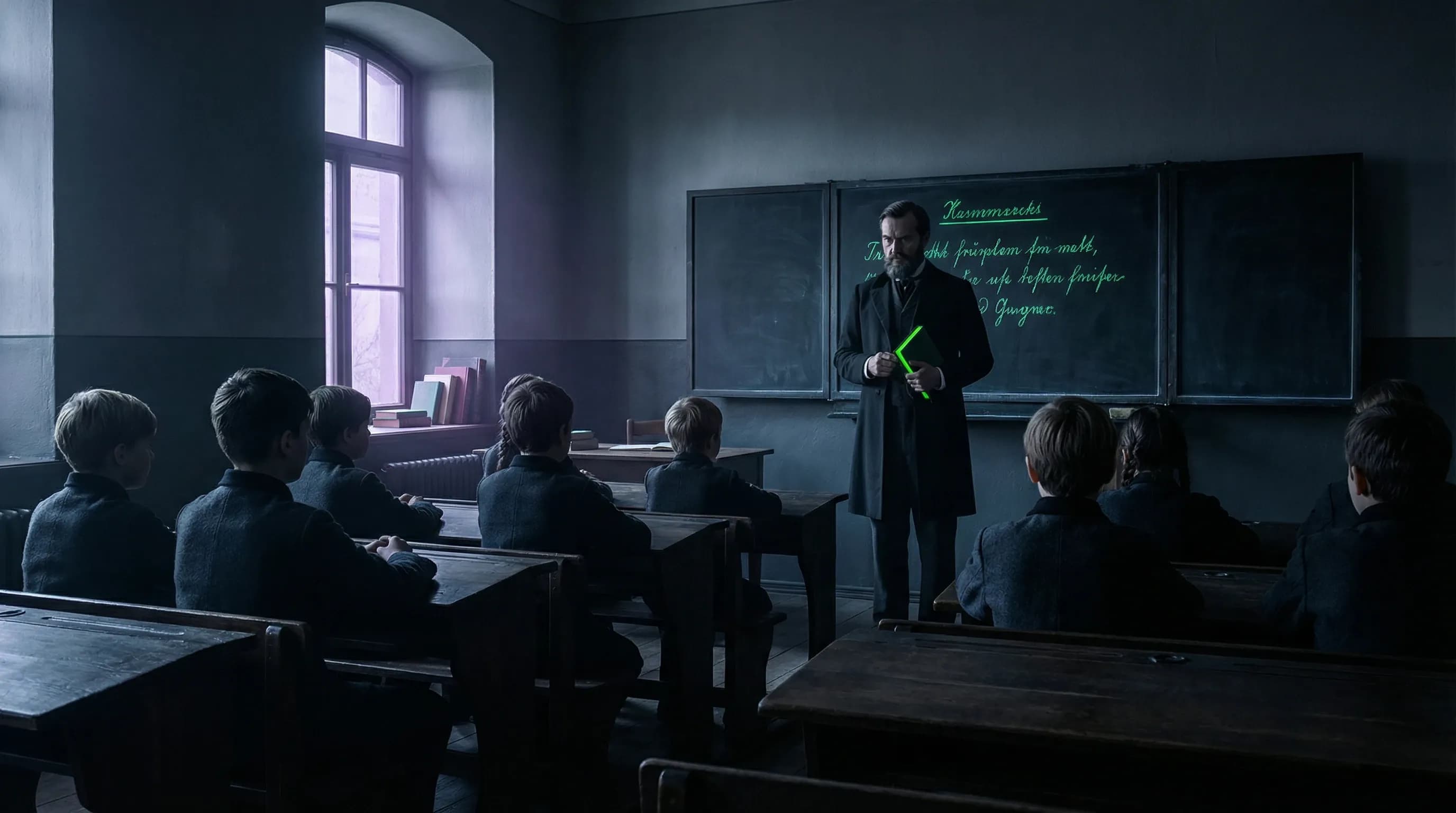
What exactly the Prussian education machine myth claims — and why it fits so perfectly into modern school criticism
The myth goes: 19th-century Prussia created an education system designed to produce obedient soldiers and compliant workers. The state supposedly implemented standardization, hierarchy, and discipline not for knowledge, but for control. More details in the section Pharmaceutical Company Data Concealment.
This narrative captures modern school criticism because it explains its pain with a single cause — conspiracy. If school stifles creativity and critical thinking, then it's not a side effect of bureaucracy or economic constraints, but the original design.
The myth works as a cognitive anchor: it links visible education problems (standardization, grades, obedience) to a single source — Prussia's military machine. This removes uncertainty and provides an enemy.
School critics reference this myth to legitimize radical demands: abolish grades, dismantle the classroom system, return to "natural learning." If the root of evil is Prussian military logic, then salvation means complete rejection of its legacy.
- Why the myth is so sticky
- It offers simple causality where none exists. It allows school critics to claim moral high ground: they're not just fighting for reform, but against historical evil. And it's confirmed by superficial coincidences — yes, Prussia had discipline, yes, schools have discipline.
The problem is that this myth is conspiratorial in structure: it requires us to believe in a long-term design that survived centuries and two world wars, without direct evidence of intent. Like other conspiratorial narratives, it works through confirmation: any fact about school discipline becomes "proof" of Prussian origins.
It also ignores that education systems changed, that different countries developed them differently, and that modern school problems have multiple sources.
| What the myth says | What requires verification |
|---|---|
| Prussia designed the system for control | What documents confirm this? Who made the decision? |
| This system spread worldwide | How exactly? Through whom? Why did other countries copy it? |
| Modern school is a direct heir to the Prussian machine | Which elements remained unchanged? Which disappeared? |
The next section will examine the seven most convincing arguments for this myth — not to refute them, but to understand why they work and where they start to crack.
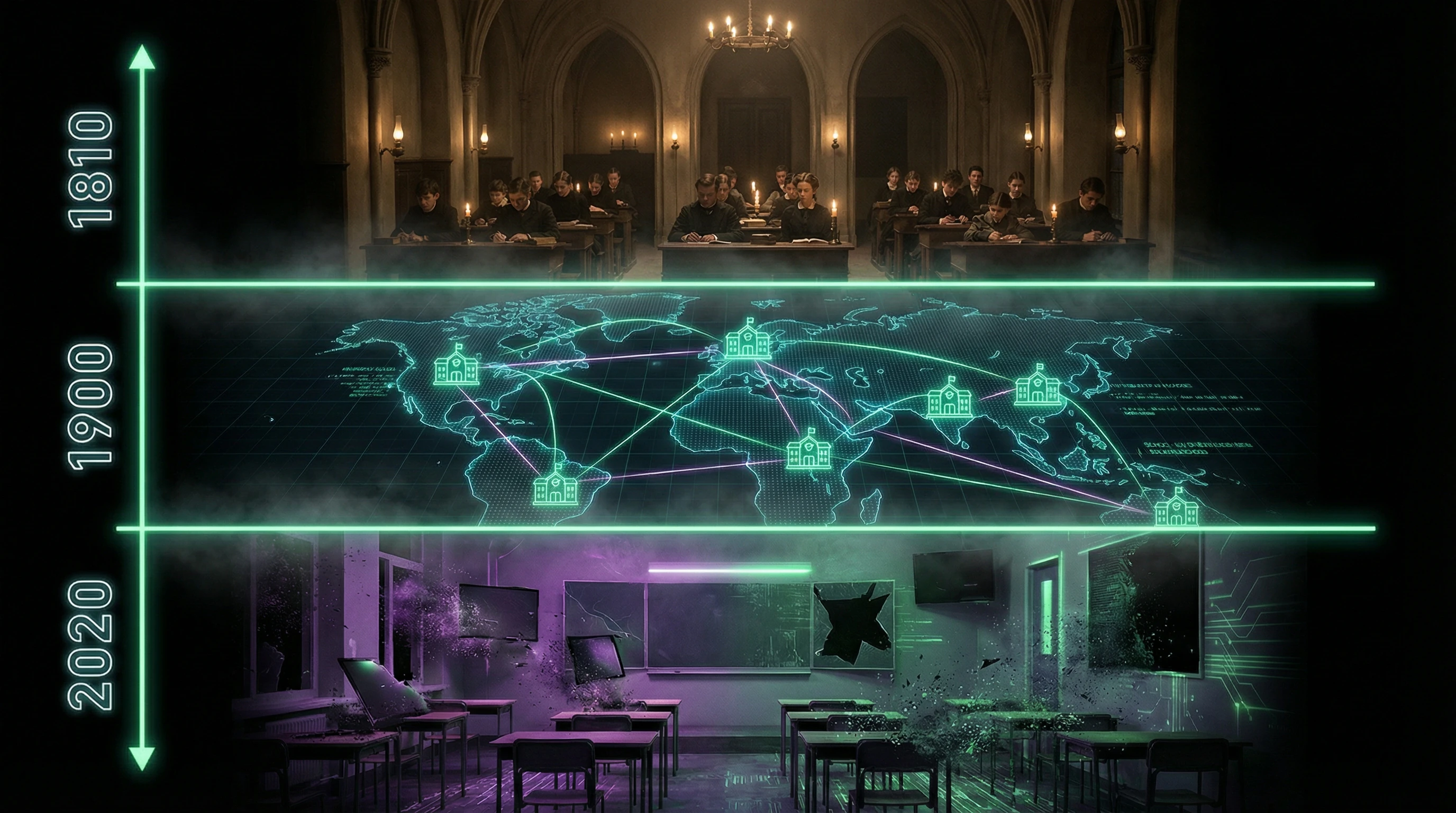
Steelmanning: Seven Most Compelling Arguments for the Prussian Educational Control Machine Theory
Intellectually honest analysis requires constructing a "steelman" — the most convincing version of the opposing position. Proponents of the theory about the Prussian model as an instrument of control rely on several genuinely weighty observations. More details in the section Coaching Cults.
🧾 Argument One: Chronological Coincidence of Military Reforms and Educational System
Prussian educational reforms occurred in the context of massive military reorganization after 1806. Military thinkers, including Carl von Clausewitz, actively participated in discussions about national reorganization. Strategic planning from the 1820s shows that Prussian leadership was thinking about long-term development of state capacity, including human resources (S001).
🧾 Argument Two: Standardization and Hierarchical Structure as Reflection of Military Organization
The Prussian educational system implemented elements reminiscent of military organization: clear division into grades, uniform curricula, systems of examinations and certification, hierarchy of teachers and administrators. Such structure was revolutionary for its time and allowed efficient management of mass education.
- Optimization for Control
- Hierarchical organization is indeed predictable and manageable, but this doesn't prove ideological intent — it's a consequence of scale.
- Alternative to Chaos
- Without standardization, mass education would have been impossible; the question is what goals this standardization pursued.
🧾 Argument Three: Emphasis on Discipline and Obedience in Pedagogical Practice
Historical documents show that Prussian pedagogy placed great importance on discipline, order, and respect for authority. Teachers were expected to shape students' character according to specific social norms.
This was not unique to Prussia — most educational systems of the 19th century shared these values. The question is whether this was an ideological program or a reflection of the era's general notions about upbringing.
🧾 Argument Four: Influence of the Prussian Model on Other Countries, Especially the USA
In the 19th century, American educators and reformers visited Prussia, studied its educational system, and adapted some elements. Horace Mann, one of the founders of the American public education system, openly admired Prussian schools. This historical influence is documented and indisputable.
🧾 Argument Five: Functional Correspondence Between Industrialization Needs and School Structure
The structural similarity between factory labor organization and the school day is obvious: bells, division of time into standard blocks, simultaneous performance of identical tasks by large groups, hierarchical supervision. Both systems developed in the context of industrialization and reflected the logic of mass production.
| Element | Factory | 19th Century School | Interpretation |
|---|---|---|---|
| Time Organization | Shifts, assembly line | Bells, lessons | Mass synchronization |
| Division of Labor | Specialized operations | Subjects, grades | Knowledge fragmentation |
| Supervision | Foreman, inspector | Teacher, principal | Behavior control |
🧾 Argument Six: Suppression of Regional Languages and Cultures in Favor of National Unity
The Prussian educational system was used as an instrument of national integration. Instruction was conducted in standard German, which contributed to the displacement of regional dialects and minority languages. This process of linguistic and cultural homogenization was a conscious policy aimed at creating a unified national identity.
Language is not merely a means of communication, but a carrier of cultural identity. Displacing local languages in favor of a national standard creates psychological attachment to the state as a source of legitimacy and meaning. Similar mechanisms operate in other contexts — from conspiracy narratives to ideological systems, where language becomes an instrument of thought control.
- Unification of symbols limits alternative ways of interpreting reality.
- Monopoly on narrative creates dependence on official sources of meaning.
- The mechanism works regardless of whether control is a conscious conspiracy or a side effect of centralization.
🧾 Argument Seven: Long-Term Effects on Formation of Political Culture of Obedience
Some historians and sociologists link peculiarities of German political culture, including the relative ease of establishing authoritarian regimes in the 20th century, with long-term effects of an educational system that cultivated respect for authority and discipline. While this connection is mediated by many other factors, completely denying the influence of educational socialization on political culture would be naive.
- Education shapes behavioral norms and expectations of authority.
- Long-term effects of socialization manifest in political preferences of generations.
- But correlation between school discipline and political authoritarianism requires proof of causality, not just coincidence.
These seven arguments form a compelling narrative: the military machine needed obedient citizen-soldiers, created an educational system that cultivated obedience through standardization and discipline, exported this model to other countries, and its long-term effects are visible in political culture. The logic is closed, facts are selected, causality seems obvious. This is precisely why this myth is so persistent — it explains too much too simply.
What the Data Says: Detailed Analysis of Historical Evidence and Modern Research on Educational Systems
Moving from arguments to evidence, we need to examine what we actually know about the effectiveness, goals, and consequences of different educational systems. Modern research provides analytical tools unavailable to historians of the past, allowing us to separate correlations from causal relationships. More details in the Financial Scams section.
🧪 Protestant Education and Economic Development: Rethinking Weber's Thesis
The study "Was Weber Wrong?" (S005) shows that the economic success of Protestant regions is explained not by "Protestant ethics" per se, but by investments in human capital through education. Protestantism stimulated literacy because it required personal Bible reading, which created demand for schools.
Critically important: the effect was linked specifically to cognitive skills and knowledge, not to ideological submission or discipline (S005). Regions with higher literacy rates demonstrated higher rates of economic growth regardless of the degree of political centralization or military organization.
Economic efficiency was linked to actual human capital development, not to mechanisms of submission.
🔬 Modern Educational Reforms: Lessons from India on What Actually Works
Research on model schools in India (S004) provides a natural experiment for understanding which elements of educational systems actually improve outcomes. The program included infrastructure improvements, teacher training, changes in teaching methods, and strengthened administrative oversight.
Key finding: effectiveness depended on institutional accountability mechanisms and quality of pedagogical practices, not on the degree of standardization or control as such (S004). Schools that simply increased discipline without improving teaching quality showed no significant improvements.
| Reform Component | Result When Isolated | Conclusion |
|---|---|---|
| Discipline strengthening only | Minimal improvements | Authoritarianism alone is ineffective |
| Infrastructure improvement only | Moderate improvements | Resources matter but are insufficient |
| Comprehensive approach + accountability | Significant improvements | Pedagogical quality and oversight mechanisms are critical |
📊 Methodological Problems in Education Research: Why Simple Comparisons Mislead
Educational data has nested structure: students within classes, classes within schools, schools within regions. Ignoring this structure leads to systematic errors in conclusions (S005). Simple comparisons of average indicators between countries or systems can be deeply deceptive.
Applied to debates about the Prussian model: historical comparisons of educational system effectiveness that don't account for multiple levels of variation and contextual factors are methodologically unsound. Claims about the superiority or deficiencies of the "Prussian model" based on simple outcome comparisons ignore the complex causal structure of educational processes.
🧬 Culture and Institutions: How They Interact in Shaping Educational Outcomes
Cultural norms and institutional rules are not independent—they coevolve and mutually reinforce each other (S006). This means that "exporting" an educational model from one context to another is never simple copying.
- Coevolution of Culture and Institutions
- Formal structures transform under the influence of local norms, political conditions, and economic realities. Even if American reformers consciously copied Prussian institutional forms, the resulting system inevitably transformed.
- Myth of Direct Continuity
- The claim that the modern American school "is the Prussian model" ignores these transformations and exaggerates the degree of institutional continuity.
🧾 Strategic Thinking in Prussia 1815–1830: What Military Leaders Actually Planned
Detailed analysis of Prussian strategic planning shows that military leadership did think about long-term development of national capacity, but their conception was significantly more complex than simply "producing obedient soldiers" (S001). Defense planning documents show concern for officer corps quality, technological development, economic base, and administrative efficiency.
Strategic documents contain no evidence of intentional "dumbing down" of the population or suppression of critical thinking (S001). On the contrary, Prussian military reformers understood that modern warfare requires initiative-taking, educated soldiers and officers capable of making decisions under uncertainty.
Prussian military strategists sought human capital development, not production of mindless obedience. This directly contradicts the popular narrative.
🔎 Educational Communication and Long-Term Engagement: Lessons from Science
Twelve years of educational work demonstrates that effective educational communication requires a long-term, systematic approach adapted to different audiences (S002). Successful programs combine formal instruction with informal engagement, use multiple communication channels, and constantly adapt based on feedback.
This is relevant for understanding the Prussian system: any large-scale educational system inevitably develops complex mechanisms of adaptation and communication that cannot be reduced to simple top-down ideology transmission (S002). Reducing the Prussian system to an "obedience factory" ignores this organizational complexity and diversity of local practices.
- Large-scale systems require multiple communication channels and adaptation
- Local practices always differ from central directives
- Long-term engagement involves dialogue, not one-way transmission
- Organizational complexity is incompatible with simple control models
⚙️ Feedback Mechanisms in Educational Systems: Why Control Doesn't Mean Obedience
Systems with centralized standards and monitoring often develop unforeseen mechanisms of adaptation and resistance. Teachers, administrators, and students find ways to work within formal rules while reinterpreting their meaning and application.
Historical evidence from Prussian archives shows that regional and local education authorities often ignored or modified central directives depending on local conditions (S001). This doesn't mean the system was ineffective—on the contrary, this flexibility allowed it to adapt and survive.
Centralized system does not equal monolithic control. Real organizations always contain zones of autonomy and negotiation.
📈 Personalization and Cognitive Development: Modern Data on What Works
Research on personalized learning (S007) shows that adapting teaching methods to individual needs and learning styles significantly improves outcomes. However, personalization requires not less but more data, monitoring, and coordination than standardized approaches.
Applied to the Prussian model: if the system was truly oriented toward producing obedience, it would have been less, not more, effective at developing cognitive skills. Data shows the opposite—Prussian graduates demonstrated high levels of literacy and numeracy skills, which is incompatible with the "dumbing down" hypothesis.
- High literacy rates in 19th-century Prussia—a fact confirmed by censuses
- Economic growth correlated with educational investments, not political control
- Technological development requires critical thinking, which the system had to develop
- The obedience myth is incompatible with empirical data on educational outcomes
🎯 Conspiracy Narratives and Educational Systems
Conspiracy narratives about "hidden goals" of educational systems often ignore a simple fact: systems that actually suppress critical thinking inevitably fall behind in economic and technological development. History shows the opposite.
The mechanisms through which such narratives form and spread are linked to cognitive biases, pattern-seeking, and the need to explain complex social phenomena. Cognitive biases make us vulnerable to reductionist explanations that ignore organizational complexity and multiple causes. For a deeper understanding of how conspiracy narratives form and spread, see the analysis of conspiracy thinking mechanisms.

Mechanisms and Causality: Why Correlation Between Prussian Education and Discipline Doesn't Prove Ideological Conspiracy
The central problem with the popular Prussian model narrative is the logical leap from observing correlations to making claims about causality and intentions. Yes, the Prussian system was disciplined. Yes, it spread to other countries. More details in the Epistemology Basics section.
But these observations don't prove the system was designed as a tool of suppression or that all problems in modern education are its legacy.
Similarities in educational structures across countries may reflect universal constraints and opportunities, not historical continuity or conspiracy.
🔁 Alternative Explanations: Why Mass Education Looks Similar Everywhere
There's a simpler explanation for structural similarities in educational systems: convergent evolution in response to similar problems. Any system teaching large numbers of children with limited resources inevitably arrives at certain organizational solutions.
- Age grouping simplifies curriculum planning
- Standardization enables system scaling
- Hierarchical structure ensures coordination
- Assessment creates feedback loops
These forms emerged independently in different countries because they're functionally efficient for solving the mass education problem, not because everyone copied Prussia (S006).
🧷 The Reverse Causality Problem: Maybe Disciplined Society Created Disciplined Schools?
The popular narrative assumes Prussian schools created a disciplined, obedient society. But reverse causality is possible: perhaps Prussian society already had certain cultural characteristics (valuing order, respecting authority, Protestant work ethic), and the educational system simply reflected these existing values?
| Direction of Causality | Mechanism | Methodological Problem |
|---|---|---|
| School → Society | Education shapes culture and behavior | Requires isolating school effects from other factors |
| Society → School | Cultural values shape educational institutions | Requires proving culture's temporal priority |
| Bidirectional | Institutions and culture mutually reinforce each other | Separating effects historically is extremely difficult |
Research on culture-institution interactions (S006) shows causality is usually bidirectional. Separating these effects historically is extremely difficult, and confident claims that schools "created" a certain type of society are methodologically questionable.
🧬 Confounders: Industrialization, Urbanization, and Other Factors
The Prussian educational system developed alongside massive social transformations: industrialization, urbanization, growth of bureaucratic states, development of capitalist labor markets, changing family structures. All these processes independently influenced both education and society.
- Discipline and Punctuality
- Became important not because schools imposed them, but because industrial production required these qualities. Schools adapted to demands but didn't create them (S004).
- Knowledge Standardization
- Emerged as a response to bureaucratic state needs for uniform personnel, not as a tool of ideological control.
- Hierarchical Organization
- Reflected the general organizational logic of the 19th century, applied simultaneously to armies, factories, and state apparatus.
Attributing observed social changes exclusively to the educational system is a classic error of ignoring confounders. Separating school effects from broader socioeconomic transformation effects requires complex causal analysis, which is rarely present in popular critiques.
🔬 The Measurement Problem: How to Assess "Obedience" Historically?
Claims that the Prussian system suppressed critical thinking or produced obedient citizens face a fundamental methodological problem: how do you measure these qualities historically? We don't have standardized critical thinking tests for 19th-century Prussian schoolchildren.
Modern education research (S005) shows how difficult it is to measure even relatively simple educational outcomes under controlled conditions. Retrospective claims about psychological effects of historical educational systems are inevitably speculative.
- Define operational definitions of "obedience" or "critical thinking" in the 19th century
- Find representative sources documenting these qualities in graduates
- Exclude alternative explanations (family, social class, culture, economic conditions)
- Establish temporal sequence: education → behavior change
- Demonstrate the effect is specific to the Prussian system, not universal
None of these steps are completed in popular versions of the Prussian suppression machine narrative. This doesn't mean the system was beneficial—it means claims about its psychological effects exceed what can be reasonably asserted based on available evidence.
Conspiracy narratives often rely on a methodological gap: they fill evidence holes with a compelling story that seems logical but doesn't require empirical verification. The mechanisms of such narratives are examined in the analysis of conspiracy patterns.
Conflicts in Sources and Zones of Uncertainty: Where Historians and Researchers Disagree
Academic literature on Prussian education is far from consensus. Researchers from different disciplines reach contradictory conclusions — and this is normal for history. More details in the section Statistics and Probability Theory.
🔎 Debates About Intentions: Instrument of Control or Investment in Human Capital?
One group of historians sees Prussian education reform as an instrument of state control. Another emphasizes economic rationality: education as an investment in human capital for industrialization.
The difference is not in facts, but in interpretation of causality. Both sides agree that education was centralized and standardized. The dispute is about whether this was a side effect or the primary goal.
(S005) shows that Protestant regions of Prussia demonstrated higher literacy rates and economic growth. But this doesn't resolve the dispute: did education contribute to growth through discipline, or through skills and mobility?
🔀 The Counterfactual Problem: What Would Have Happened Without the Prussian Model?
| Question | Position A | Position B | Status |
|---|---|---|---|
| Was the system uniquely repressive? | Rigid hierarchy — a distinctive feature of the Prussian approach | Standard 19th-century pedagogy, nothing exceptional | No consensus |
| How would education have developed without centralization? | More flexible local models with greater variability | Fragmentation and inequality in access to education | Speculative |
| Are systems from different countries comparable? | By unified metrics (literacy, social mobility) | Different contexts require different evaluation criteria | Methodological disagreements |
This creates a methodological trap: any historical narrative about Prussian education remains partially speculative. As in the analysis of conspiracy narratives, it's important here to distinguish what is confirmed by sources from what is logical extrapolation.
📊 Disagreements About the Scale of Influence
- Position 1: Global Template. The Prussian model was copied in many countries, including the USA and Russia, spreading the logic of subordination on a global level.
- Position 2: Local Adaptations. Each country reworked the Prussian model according to its own conditions, often weakening centralized control.
(S002) demonstrates that historical upheavals (for example, the partitions of Poland) influenced educational outcomes independently of system structure. This complicates isolating the specific contribution of the Prussian model.
🎯 Zone of Uncertainty: Where the Data Is Silent
There is no direct historical evidence about how effectively Prussian education achieved goals of subordination (if that was the goal). There is no data on what percentage of graduates internalized authoritarian values versus simply adapting to external requirements.
Absence of evidence is not evidence of absence. But it means that the popular narrative about the Prussian educational machine is built on logical extrapolation, not on direct data.
This uncertainty is not a flaw in historical science, but its honesty. It indicates where caution is needed in conclusions and where popular versions of history go beyond what sources actually say. As in evaluating manipulation mechanisms in debunking and prebunking, it's critically important here to distinguish established facts from interpretations.