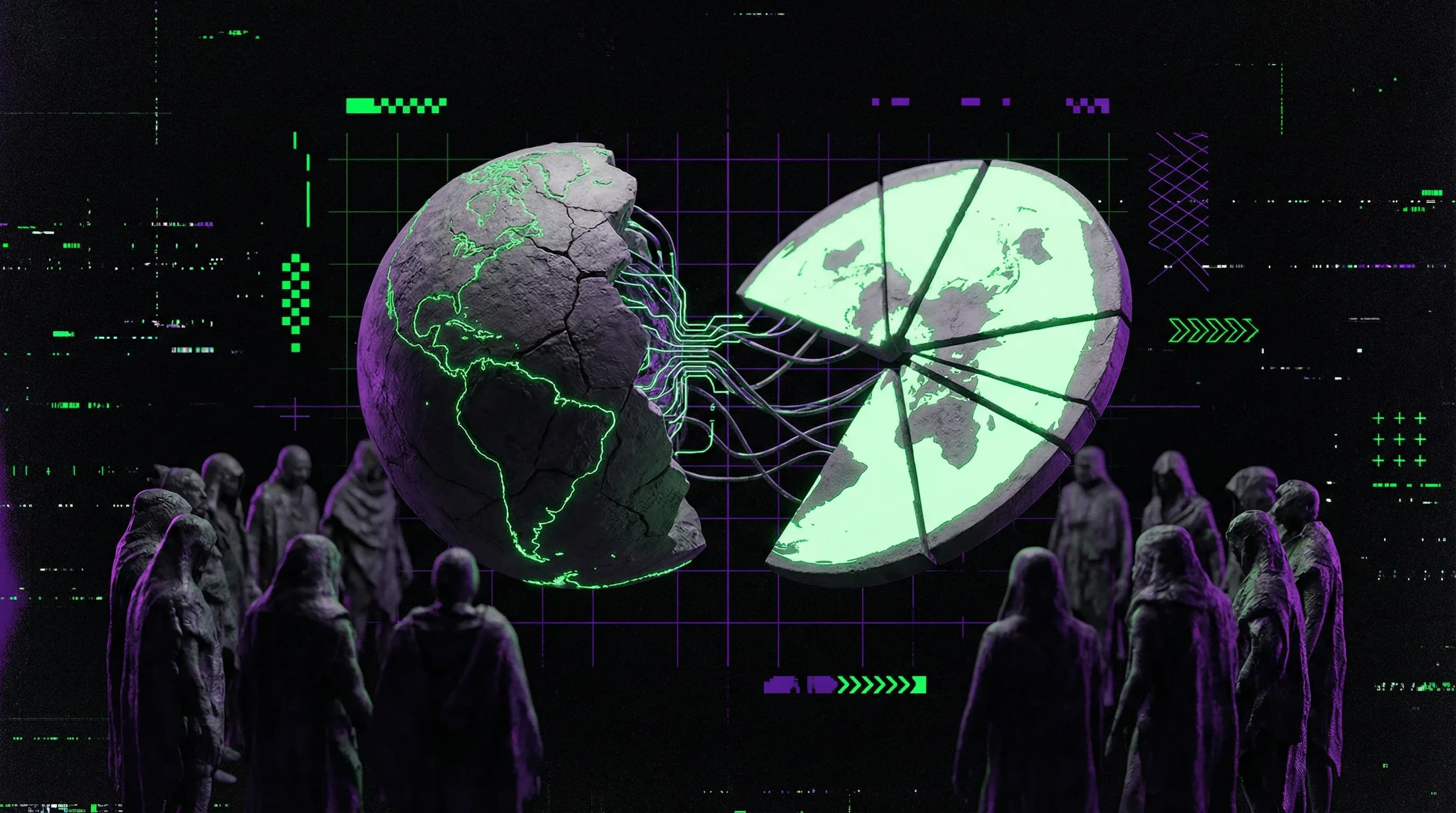
What flat Earth theory actually is—and why it's not a question of geography
Flat Earth theory isn't a unified doctrine, but a spectrum of beliefs united by rejection of the planet's sphericity and global scientific consensus. Proponents claim Earth is a disk surrounded by an ice wall (Antarctica), beneath a dome, while space agencies, governments, and scientists participate in a global conspiracy. More details in the Tech Fears section.
This isn't just a mistaken notion about geometry—it's a complex conspiratorial system incorporating institutional distrust, alternative epistemology, and social identity.
⚠️ Three levels of delusion: from naive skepticism to total conspiracism
- First level—naive skepticism
- The person doesn't understand how evidence for sphericity works (horizon, time zones, shadows) and genuinely asks questions. Here it's lack of information, not dysfunctional thinking.
- Second level—active denial
- The person is familiar with counterarguments but rejects them through selective perception and confirmation bias. Evidence filtering begins.
- Third level—total conspiracism
- Belief in flat Earth becomes part of a broader system: denial of space travel, NASA conspiracy theory, anti-vaccination, distrust of all official sources. Here we're dealing with systemic dysfunction of epistemic processes, not lack of information.
🧩 Why physical evidence doesn't work: the problem of epistemic foundation
When you show a flat Earther a photograph of the planet from space, they don't see proof—they see a product of conspiracy. When you explain gravity, they hear an "official version" that can't be trusted.
The problem isn't that the person doesn't understand physics. The problem is they reject the entire system of knowledge validation on which science is based. This is an epistemic crisis: the collapse of trust in methods of obtaining and verifying information.
In this state, any evidence coming from "the system" (universities, NASA, governments) is automatically disqualified as part of the deception. Arguing about physics is pointless—we need to analyze how and why this epistemic rupture occurred.
🔎 Boundaries of analysis: what we're investigating and what we're leaving aside
This analysis focuses on the cognitive, social, and psychological mechanisms sustaining belief in flat Earth, not on refuting the theory through physics. Earth is round—this is an established fact confirmed by thousands of independent observations.
Instead, we investigate:
- What cognitive biases make a person vulnerable to conspiratorial thinking
- How social reinforcement mechanisms work within flat Earth communities
- What psychological needs are satisfied by belonging to this group
- Why rational arguments not only don't work, but often strengthen conviction
This is a question of cognitive immunology, not astronomy.

Steel Version of Arguments: Why People Believe in Flat Earth — Seven Strongest Claims from Inside the System
To understand the phenomenon, we need to honestly present the most convincing arguments of proponents — not caricatures, but those that actually work within their coordinate system. This is called the principle of steelmanning: strengthening the opponent's position to its most logical form before analysis. More details in the section Chipization and World Government.
Below are seven arguments that flat-earthers consider most compelling, presented in their own logic.
| Argument | Why It Works | Cognitive Trap |
|---|---|---|
| "I don't see curvature" | The horizon really does look flat at low altitudes; photos from stratospheric balloons are often distorted by lenses | Scale is not considered: local curvature of a sphere with radius 3,959 miles is imperceptible without precise measurements |
| "Water finds its level" | Water in a glass is horizontal — this is intuitive experience that seems irrefutable | "Level" is defined by gravitational field directed toward center of mass; the concept of geoid sounds like "magic" |
| "NASA photos are fake" | Images of Earth differ; NASA uses composite images; NASA is a government organization | Technical aspects are not understood: lens correction, different satellites, different lighting, projections |
| "Planes fly straight" | Pilots don't tilt the nose down; the plane doesn't fly off into space | "Straight" means geodesic line on a sphere; gravity maintains constant altitude — without knowledge of geometry this seems evasive |
| "Antarctica is closed" | Antarctic Treaty restricts access; it's expensive for tourists to get there | Any restriction is interpreted as intentional concealment; difficulty of access = conspiracy |
| "Gravity is a theory" | The word "theory" sounds like "guess"; no one has seen gravity | Mass of experimental data is ignored; GPS satellites work thanks to relativistic gravity corrections |
| "Too many staying silent" | Conspiracy allegedly controls education, media, censorship; any whistleblower is discredited | Unfalsifiable claim: absence of evidence = proof of effective concealment |
🕳️ First Argument: Visibility of Curvature
Proponents claim: if you stand on a seashore or in a field, the horizon looks absolutely flat. With Earth's radius of 3,959 miles, curvature should be noticeable at a distance, but it's not visible to the naked eye.
Moreover, there are photographs taken from altitudes of 18–25 miles (amateur stratospheric balloons), where the horizon still looks flat or even concave due to lens distortions. For a person without physics education, this seems like direct proof: "I see flatness — therefore, it's flat."
The problem is not in observation (the horizon really does look flat at low altitudes), but in interpretation: a person doesn't account for scale and geometry of a sphere, where local curvature is imperceptible without precise measurements.
🧩 Second Argument: Water Finds Its Level
This is one of the most popular arguments: water in a glass, pool, or lake is always horizontal. How then can oceans "curve" around a ball?
Flat Earth proponents claim this contradicts basic properties of liquids. They don't understand (or reject) that water's "level" is determined by gravitational field, which on a spherical planet is directed toward the center of mass, creating an equipotential surface — the geoid.
For someone unfamiliar with the concept of gravitational potential, this explanation sounds like "magic." That's why the argument works: it appeals to intuitive experience that seems irrefutable.
⚠️ Third Argument: NASA Photographs
Proponents point to differences in images of Earth taken in different years: continents appear different sizes, clouds repeat, colors differ. They claim this proves use of CGI (computer graphics) instead of real photographs.
Moreover, NASA really does use composite images (assembled from multiple shots), which gives grounds for suspicion. For someone who doesn't understand technical aspects of space photography (lens correction, different satellites, different lighting, projections), this looks like evidence of conspiracy.
The argument is strengthened by the fact that NASA is a government organization, and therefore "part of the system" that can't be trusted. This connects to a broader pattern of distrust in institutions, described in the context of conspiratorial thinking.
🔁 Fourth Argument: Aircraft Course
Flat-earthers ask: if Earth is a sphere, pilots must constantly tilt the plane's nose down to follow the curvature, otherwise they'd fly off into space. But this doesn't happen — planes fly "straight."
For them, this is proof of flatness. The problem is misunderstanding that "straight" in the context of flight means movement along a geodesic line (shortest path on a sphere's surface), not along a straight line in Euclidean space.
Atmospheric pressure and gravity automatically maintain the aircraft at constant altitude relative to the surface. But without knowledge of geometry and physics, this explanation seems evasive, while the intuitive argument seems convincing.
🧠 Fifth Argument: Antarctica
Proponents point to the Antarctic Treaty (1959), which regulates activity on the continent and prohibits military use. They interpret this as proof that Antarctica is not a continent but an ice wall surrounding flat Earth, and governments are hiding this by restricting access.
In reality, tourists can visit Antarctica (tens of thousands annually), but it's expensive and logistically complex. However, for a conspiracist, any restriction is suspicious, and difficulty of access is interpreted as intentional concealment of "truth."
🕳️ Sixth Argument: Gravity as Theory
Flat-earthers often claim that gravity is just a theory invented to explain spherical Earth, but no one has seen gravity and can't explain "what it really is." They propose an alternative: things fall not due to attraction, but due to density (dense objects sink, light ones rise).
This is crude oversimplification, ignoring masses of experimental data — from Cavendish experiments to GPS satellites, whose operation depends on relativistic gravity corrections. But for someone unfamiliar with physics, the word "theory" sounds like "guess" rather than "tested model," creating an illusion of equivalence between alternative explanations.
⚠️ Seventh Argument: Scale of Conspiracy
This is a paradoxical argument that flat-earthers use in their favor: they claim the conspiracy is so massive (millions of scientists, engineers, pilots, sailors) that it's impossible to hide — therefore, "the system" controls information through education, media, and censorship.
Anyone who tries to reveal the truth is subjected to discreditation or silencing. This is a classic example of unfalsifiable claim: absence of evidence of conspiracy is interpreted as proof of its effectiveness.
Such logic makes the belief system immune to criticism. The mechanism works identically for other conspiratorial narratives, from QAnon to satanic panic: the more facts against the theory, the more this "proves" its truth.
All seven arguments share one thing: they appeal to intuition, experience, and distrust of institutions, not to logic and data. This is not a thinking error — it's a feature of cognitive architecture that makes conspiratorial beliefs resistant to refutation.
Evidence Base: What the Data Actually Says About Earth's Shape — And Why It Doesn't Matter to Conspiracy Theorists
Earth's sphericity is one of the most reliably established facts in the history of science, confirmed by thousands of independent observations, experiments, and technologies that only work under spherical geometry. But for flat Earth proponents, this evidence doesn't exist in an epistemic sense — it's rejected a priori as products of conspiracy. More details in the Conspiracy Theories section.
📊 Direct Observations: From Ancient Greeks to Modern Satellites
Eratosthenes in the 3rd century BCE calculated Earth's circumference with ~15% accuracy by measuring shadow angles in different cities at the same moment — a method anyone can replicate today. Ships disappear over the horizon bottom-up (hull first, then masts), which is impossible on a flat surface.
Different constellations are visible in the Northern and Southern hemispheres, and Polaris changes its height above the horizon depending on latitude — this only works on a sphere. Lunar eclipses always show Earth's round shadow.
- Circumnavigation (from Magellan to modern sailors) is only possible on a closed surface
- Satellite navigation (GPS, GLONASS) works based on calculations accounting for Earth's curvature and relativistic gravitational effects — without these corrections, error would accumulate at 10 km per day
- Thousands of photographs from space from dozens of independent space agencies (NASA, ESA, Roscosmos, CNSA, ISRO, private companies SpaceX, Blue Origin) and weather satellites
All this data is consistent with itself and with the spherical Earth model.
🧪 Technologies That Only Work on a Spherical Earth
Aviation: long-haul flight routes (e.g., Santiago to Sydney) pass through or near Antarctica, which makes sense on a globe but is absurd on a flat map where Antarctica is the outer edge. Maritime navigation: course calculations account for curvature, otherwise ships would systematically miss ports.
| Technology | Dependence on Spherical Earth | Consequence of Rejecting the Model |
|---|---|---|
| Geostationary satellites | Altitude 35,786 km above equator, "hang" over one point | Telecommunications, broadcasting, meteorology would stop working |
| Seismology | Wave analysis through the planet builds internal structure model | Impossible to predict earthquakes, study geology |
| GPS/GLONASS | Relativistic corrections for curvature and gravity | 10 km per day error — navigation becomes useless |
All these technologies are used daily by millions of people and work flawlessly — but for a flat Earther this isn't an argument, because they don't trust the system that created these technologies.
🧾 Why Evidence Doesn't Work: The Problem of Motivated Reasoning
Motivated reasoning is a cognitive process where a person unconsciously selects and interprets information to confirm pre-existing beliefs. Research shows that when people are presented with facts contradicting their identity or worldview, brain areas associated with threat and defense activate, rather than rational analysis.
In the case of flat Earth, belief has become part of social identity: abandoning it means losing community, "awakened" status, the sense of superiority over "sleeping sheep." Therefore, any proof of sphericity is perceived not as information, but as a personal attack.
This explains the backfire effect phenomenon: attempts to persuade someone with facts often strengthen their conviction, because they interpret the pressure as confirmation that "the system" is trying to silence them. The mechanism is identical to what's described in mind control research and analysis of conspiracy narratives.
🔎 Meta-Analysis: Not a Single Peer-Reviewed Study Supporting Flat Earth
In scientific literature, there isn't a single article in a peer-reviewed journal that presents evidence for flat Earth or refutes sphericity. All attempts by flat Earthers to conduct "independent experiments" either confirm curvature (as in the documentary "Behind the Curve," where their own laser experiment showed 8 inches per mile curvature — exactly as the sphere model predicts), or contain methodological errors making the results invalid.
The absence of scientific support isn't accidental: the flat Earth model cannot explain basic observable phenomena (day/night cycle, seasons, time zones, star movement) without introducing ad hoc hypotheses that contradict each other and known laws of physics. This is a typical pattern of pseudoscientific systems, described in the analysis of alternative histories and critique of perpetual motion machines.

The Mechanism of Belief Formation: How Someone Becomes a Flat-Earther — A Step-by-Step Cognitive Trajectory
No one is born a flat-earther. This belief forms through a series of cognitive and social steps, each reinforcing the next. Understanding this trajectory is critically important because it shows: the problem isn't lack of education (many flat-earthers have college degrees), but rather a specific sequence of cognitive events that creates an alternative epistemic system. More details in the section Debunking and Prebunking.
🧠 Step One: Epistemic Distrust as the Entry Point
The journey begins with loss of trust in official information sources. This can be triggered by real events (government lies, corporate scandals, medical errors) or personal experience (conflict with the education system, healthcare, justice system).
A person begins to think: "If they lied about this, maybe they're lying about other things too?" This is healthy skepticism — up to a point. The problem arises when distrust becomes total and undifferentiated: all institutions, all experts, all sources connected to "the system" are automatically disqualified.
Epistemic vacuum — when a person no longer knows whom to trust and begins searching for alternative sources of "truth." This state is maximally vulnerable to conspiratorial content.
🔁 Step Two: Algorithmic Radicalization Through YouTube and Social Media
A person seeking "alternative information" enters the ecosystem of conspiratorial content. Recommendation algorithms on YouTube, Facebook, TikTok are optimized for attention retention, and conspiratorial content has high engagement capacity (emotionality, sensationalism, sense of exclusivity).
Research shows that after watching one conspiratorial video, the algorithm begins recommending increasingly radical content — this is called the recommendation rabbit hole. Within a few weeks, a person can travel from "interesting facts about NASA" to "Earth is flat, and it's proven."
| Phase | Content | Psychological Effect |
|---|---|---|
| Week 1–2 | "Strange facts about NASA," criticism of official science | Interest, mild skepticism |
| Week 3–4 | "Proof of flat Earth," videos with "experiments" | Cognitive dissonance, curiosity |
| Week 5–8 | Full conspiratorial narratives, criticism of "the system" | Sense of awakening, superiority |
Critically important: this process occurs in isolation from alternative viewpoints because the algorithm creates a filter bubble, showing only content matching already-expressed interests. More on algorithmic radicalization mechanisms in the analysis of conspiratorial narratives in the age of algorithms.
🧩 Step Three: Cognitive Dissonance and Its Resolution Through Theory Acceptance
When a person first encounters the claim "Earth is flat," they experience cognitive dissonance — discomfort from the contradiction between new information and existing beliefs. There are two ways to resolve dissonance: (1) reject the new information as absurd, (2) revise existing beliefs.
Most choose the first. But if a person is already in a state of epistemic distrust and immersed in conspiratorial content, the second option becomes attractive. Accepting flat Earth theory provides powerful psychological reward: a sense of "awakening," superiority over "sleeping masses," belonging to an elite group of "truth-knowers."
This resolves dissonance and creates positive reinforcement. The person now doesn't just believe in flat Earth — they feel enlightened. This state is far more resistant to rational objections than simple intellectual conviction.
🛡️ Step Four: Social Integration Into Community and Identity Formation
After accepting the belief, a person seeks like-minded individuals — online forums, social media groups, flat-earther conferences. Within these communities they receive social recognition, support, sense of belonging.
Research shows that for many flat-earthers, the community becomes the primary source of social connections, especially if they experience isolation in offline life. Belief in flat Earth transforms from intellectual conviction into social identity.
- Person receives social recognition for activity in the community
- Their status grows as they become more radical and convincing
- Abandoning the belief now means losing friends, status, meaning
- Any criticism is perceived as personal attack, not intellectual challenge
This explains why rational arguments don't work: you're not addressing intellect, you're threatening identity and social connections. A person will defend the belief not because it's logical, but because it's socially embedded. The connection between conspiratorial beliefs and social identity is explored further in the analysis of consciousness control mechanisms in manipulative communities.
🔄 Step Five: Cognitive Lockdown and Immunization Against Criticism
At this stage, the community develops defensive mechanisms against external criticism. Any argument against flat Earth is interpreted as proof of conspiracy: "They're attacking us because we're close to the truth."
- Moving the Goalposts
- When one argument is refuted, the community simply moves to another without acknowledging defeat. This creates an illusion of theory invulnerability.
- Appeal to Personal Experience
- "I saw the horizon flat myself" becomes more convincing than any scientific data. Personal experience, even if misinterpreted, is perceived as more reliable than abstract facts.
- Demonization of Critics
- Scientists, journalists, skeptics are automatically classified as "system agents," "NASA spies," "people paid to lie." This eliminates the possibility of honest dialogue.
These mechanisms create a closed system that becomes increasingly resistant to external information. The person now lives in an alternative epistemic reality where all facts are reinterpreted according to conspiratorial logic. More on how conspiratorial narratives mutate and capture mass consciousness in the analysis of conspiratorial system evolution.
⚠️ Why Education Doesn't Help
The paradox: people with higher education are often more vulnerable to conspiratorial beliefs at certain stages. This happens because education gives them tools to rationalize any position, including absurd ones.
An educated person can construct more complex and convincing argumentation defending flat Earth than an uneducated one. The problem isn't lack of knowledge, but lack of epistemic humility and social connection to alternative communities.
Attempting to refute beliefs through facts often leads to the backfire effect: the person becomes even more convinced because they perceive criticism as an attack on their identity and social group. The only way out is restoring trust in information sources and social reintegration into alternative communities where critical thinking is valued over group loyalty.